Last year, my friend and colleague, Ann Nakaska, invited me to contribute an article to a special issue of the Career Planning & Adult Development Journal for which she was serving as guest editor.
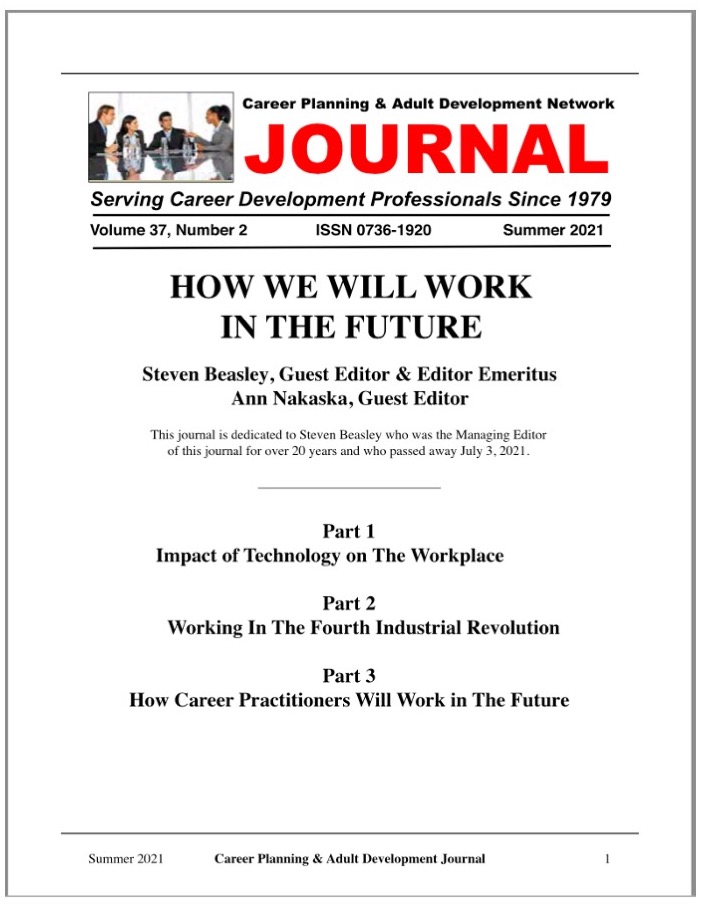
The theme of this special issue is: “How we will work in the future”. This is a robust issue, spanning 291 pages, and is divided into 3 parts:
- Part 1: The impact of technology on the workplace
- Part 2: Working in the fourth industrial revolution
- Part 3: How career practitioners will work in the future
My contribution to this robust publication is in included in Part 2. My piece is, “Career development, academic integrity and counterfeit credentials: Understanding the connections” (pp. 98 – 106).
Ann’s invitation challenged me to write for a different audience: career development professionals. This piece is for a professional practitioner audience, though it may also be of interest to others interested in the topic of fake degrees and fraudulent or faulty credentials.
Abstract
The purpose of this article is to highlight ethical aspects of career development through the lens of academic integrity. I begin with an overview of academic integrity and the fundamental values that underpin it. Then I discuss fake and faulty academic credentials, including degrees, diplomas, transcripts, and related documents. I explore the impact of fake credentials on society, highlighting a few significant examples that have been featured by mainstream media. Finally, I examine the role that career development professionals play in promoting academic integrity and professional ethics to their clients. I conclude with concrete recommendations for career development professionals to inform themselves and their clients, and in doing so, to become partners in integrity and advocates of ethical education.
The issue has just been released and Ann shared with all of the contributors that just before the issue was published, her co-guest editor, Steven Beasley, who had served as managing editor of the journal for 20 years passed away. My deepest condolences to Steven and all who knew him.
The entire issue can be accessed free of charge here: https://files.ctctusercontent.com/56f4bf3f301/4ffe3e3a-9252-46b4-b19c-c9913e1fec19.pdf?rdr=true
#AcademicIntegrity #FakeDegrees
Related posts
- Accreditation and Certification Fraud in IT
- IELTS Exam Fraud: Is large-scale cheating really a shock to anyone?
- Fake Degrees and Fraudulent Credentials in Higher Education: A Synopsis of the Book
- Scholarships Without Scruples: 3 Signs of Bogus Scholarships and Scams
- Why Universities and Colleges Need Clear Policies to Deal with Fake COVID-19 Vaccination Records and Test Results
- Degrees of Deceit: A Webinar
- Scholarships Without Scruples: 3 Signs of Bogus Scholarships and Scams
_____
Share or Tweet this: New article: “Career development, academic integrity and counterfeit credentials: Understanding the connections” https://drsaraheaton.wordpress.com/2021/07/26/new-article-career-development-academic-integrity-and-counterfeit-credentials-understanding-the-connections/
This blog has had over 3 million views thanks to readers like you. If you enjoyed this post, please “like” it or share it on social media. Thanks!
Sarah Elaine Eaton, PhD, is a faculty member in the Werklund School of Education, and the Educational Leader in Residence, Academic Integrity, University of Calgary, Canada. Opinions are my own and do not represent those of the University of Calgary or anyone else.

 Learning, Teaching and Leadership
[…] Last year, my friend and colleague, Ann Nakaska, invited me to contribute an article to a special issue of the Career Planning & Adult Development Journal for which she was serving as guest editor.Last year, my friend and colleague, Ann Nakaska, invited me to contribute an article to a special issue of the Career Planning & Adult Development Journal for which she was serving as guest editor.Read More […]