Since 2020 I’ve been working with a number of collaborators on projects related to fake degrees, diploma mills, and credential fraud. One of the people I have had the privilege of working with is FBI Special Agent (ret.), Allen Ezell, who is one of the world’s leading experts on fake degrees and accreditation fraud.
I’ve spent countless hours on the phone with Allen and have exchanged dozens, if not hundreds, of e-mails with him, over the years. Now in his 80s, Allen is one of the world’s finest experts on the topic. He contributed a fascinating chapter called “Yesterday, today, and tomorrow: A tour of Axact, the ‘World’s Largest Diploma Mill’” to our book, Fake Degrees and Fraudulent Credentials in Higher Education.
We also learned from other contributors to the book that the companies who sell fake credentials don’t stop there. They can also provide contact cheating services (often under the guise of ‘research services’), fake admission letters, fake transcripts, fraud in standardized testing (e.g., sending impersonators to write English language proficiency tests), and much more.
In the introduction for the book, we connect the dots to show how admissions fraud, contract cheating (e.g., term paper mills), scientific and scholarly paper mills, and fake degrees and fraudulent credentials are all connected. We synthesize the key ideas in this infographic:

It is difficult to get a handle on the exact size and scope of the industry, but based on what we know, we estimated that the industry is worth at least $21 Billion USD, and we figure that is a low estimate.
Throughout the past half-decade, we’ve developed a number of resources related to these topics. I’ve posted about them previously, but I figured it might be helpful if I gathered some of them into a single blog post. They are all freely available as open access resources.
Counterfeit Credentials: 13 Recommendations for Higher Education Professionals
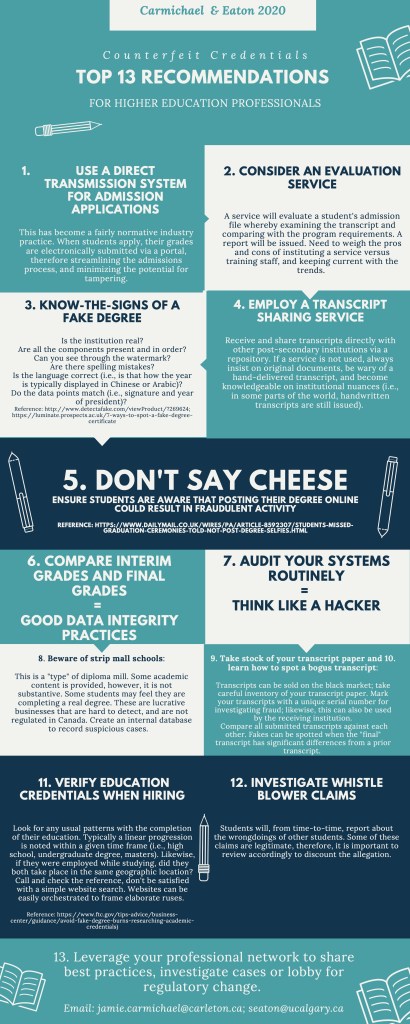
This infographic is intended mainly for registrars, admissions staff, admissions committees and others whose work involves assessing the credentials of applicants for university and college programs.
Scholarships Without Scruples
In this infographic, Jamie Carmichael and I share signs of scholarship scams, which is one from of educational fraud:

When it comes to education fraud, there are many angles to consider. There is certainly a need for more research, awareness, and advocacy on these topics, especially as GenAI can make these types of fraud easier.
Below are some related posts and further resources that I hope you find helpful.
Related posts
- Accreditation and Certification Fraud in IT
- IELTS Exam Fraud: Is large-scale cheating really a shock to anyone?
- Fake Degrees and Fraudulent Credentials in Higher Education: A Synopsis of the Book
- Scholarships Without Scruples: 3 Signs of Bogus Scholarships and Scams
- Why Universities and Colleges Need Clear Policies to Deal with Fake COVID-19 Vaccination Records and Test Results
- Degrees of Deceit: A Webinar
- Scholarships Without Scruples: 3 Signs of Bogus Scholarships and Scams
- Career development, academic integrity and counterfeit credentials: Understanding the connections
References and Resources
- Carmichael, J. (2023, June 7). Understanding Fake Degrees and Credential Fraud in Higher Ed. The Evollution: A Modern Campus Illumination. https://evolllution.com/programming/credentials/understanding-fake-degrees-and-credential-fraud-in-higher-ed/
- Carmichael, J. J. (2024). Reframing and Broadening Adversarial Stylometry for Academic Integrity. In S. E. Eaton (Ed.), Second Handbook of Academic Integrity (pp. 1467-1485). Springer Nature Switzerland. https://doi.org/10.1007/978-3-031-54144-5_148
- Carmichael, J., & Eaton, S. E. (2020). Counterfeit Credentials: Top 13 Recommendations for Higher Education Professionals (Infographic). University of Calgary. http://hdl.handle.net/1880/113042
- Clark, A. (2023). Examining the problem of fraudulent English test scores: What can Canadian higher education institutions learn? In S. E. Eaton, J. J. Carmichael, & H. Pethrick (Eds.), Fake Degrees and Fraudulent Credentials in Higher Education (pp. 187-207). Springer International Publishing. https://doi.org/10.1007/978-3-031-21796-8_9
- Çelik, Ö., & Razı, S. (2023). Avoiding favouritism in the recruitment practice of Turkish higher education institutions. In S. E. Eaton, J. J. Carmichael, & H. Pethrick (Eds.), Fake Degrees and Fraudulent Credentials in Higher Education (pp. 153-167). Springer International Publishing. https://doi.org/10.1007/978-3-031-21796-8_7
- DeCoster, B. (2023). There is no culture? A framework for addressing admissions fraud. In S. E. Eaton, J. J. Carmichael, & H. Pethrick (Eds.), Fake Degrees and Fraudulent Credentials in Higher Education (pp. 209-226). Springer International Publishing. https://doi.org/10.1007/978-3-031-21796-8_10
- Duklas, J. (2023). Bridging to tomorrow: A historical and technological review of credential exchange in higher education within Canada. In S. E. Eaton, J. J. Carmichael, & H. Pethrick (Eds.), Fake Degrees and Fraudulent Credentials in Higher Education (pp. 95-113). Springer International Publishing. https://doi.org/10.1007/978-3-031-21796-8_4
- Eaton, S. E., & Carmichael, J. (2020). Scholarships without scruples (Infographic). University of Calgary: http://hdl.handle.net/1880/113044
- Eaton, S. E., & Carmichael, J. (2022). The Ecosystem of Commercial Academic Fraud. University of Calgary. https://dx.doi.org/10.11575/PRISM/40330
- Eaton, S. E., Carmichael, J., & Pethrick, H. (Eds.). (2023). Fake degrees and credential fraud in higher education. Springer. https://doi.org/10.1007/978-3-031-21796-8
- Ezell, A. (2023). Yesterday, today, and tomorrow: A tour of Axact, the “World’s Largest Diploma Mill”. In S. E. Eaton, J. J. Carmichael, & H. Pethrick (Eds.), Fake Degrees and Fraudulent Credentials in Higher Education (pp. 49-94). Springer International Publishing. https://doi.org/10.1007/978-3-031-21796-8_3
- Hextrum, K. (2023). Fair play, fraud, or fixed? Athletic credentials in U.S. higher education. In S. E. Eaton, J. J. Carmichael, & H. Pethrick (Eds.), Fake Degrees and Fraudulent Credentials in Higher Education (pp. 115-132). Springer International Publishing. https://doi.org/10.1007/978-3-031-21796-8_5
- Orim, S.-M., & Glendinning, I. (2023). Corruption in admissions, recruitment, qualifications and credentials: From research into quality assurance. In S. E. Eaton, J. J. Carmichael, & H. Pethrick (Eds.), Fake Degrees and Fraudulent Credentials in Higher Education (pp. 133-151). Springer International Publishing. https://doi.org/10.1007/978-3-031-21796-8_6
- Sabbaghan, S., & Fazel, I. (2023). None of the above: Integrity concerns of standardized English proficiency tests. In S. E. Eaton, J. J. Carmichael, & H. Pethrick (Eds.), Fake Degrees and Fraudulent Credentials in Higher Education (pp. 169-185). Springer International Publishing. https://doi.org/10.1007/978-3-031-21796-8_8
–——–-
Share this post: Fake Degrees, Fraudulent Credentials and the Ecosystem of Commercial Academic Fraud – https://drsaraheaton.com/2025/04/10/fake-degrees-fraudulent-credentials-and-the-ecosystem-of-commercial-academic-fraud/
This blog has had over 3.7 million views thanks to readers like you. If you enjoyed this post, please ‘Like’ it using the button below or share it on social media. Thanks!
Sarah Elaine Eaton, PhD, is a Professor and Research Chair in the Werklund School of Education at the University of Calgary, Canada. Opinions are my own and do not represent those of my employer.

 Learning, Teaching and Leadership
You must be logged in to post a comment.