One of the great joys of being a journal editor is getting to share good news when a new article is published. I am going to make more of an effort to do this on my blog because the International Journal for Educational Integrity is a high quality (Q1) journal with lots to offer when it comes to academic integrity. We accept only about 10% of manuscripts submitted to the journal, so having an article published is a great achievment!
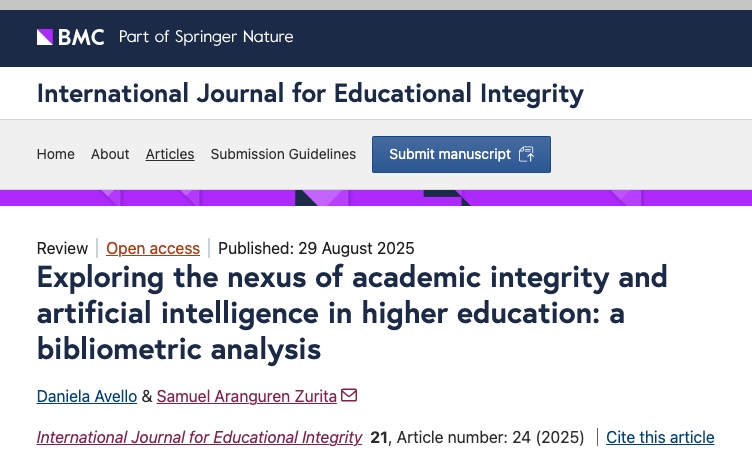
Check out the latest article, “Exploring the nexus of academic integrity and artificial intelligence in higher education: a bibliometric analysis” by Daniela Avello and Samuel Aranguren Zurita.
Abstract
Background
Artificial intelligence has created new opportunities in higher education, enhancing teaching and learning methods for both students and educators. However, it has also posed challenges to academic integrity.
Objective
To describe the evolution of scientific production on academic integrity and artificial intelligence in higher education.
Methodology
A bibliometric analysis was carried out using VOSviewer software and the Bibliometrix package in R. A total of 467 documents published between 2017 and 2025, retrieved from the Web of Science database, were analyzed.
Results
The analysis reveals a rapid expansion of the field, with an annual growth rate of 71.97%, concentrated in journals specializing in education, academic ethics, and technology. The field has evolved from a focus on the use of artificial intelligence in dishonest practices to the study of its integration in higher education. Four main lines of research were identified: the impact and adoption of artificial intelligence, implications for students, academic dishonesty, and associated psychological factors.
Conclusions
The field is at an early stage of development but is expanding rapidly, albeit with fragmented evolution, limited collaboration between research teams, and high editorial dispersion. The analysis shows a predominance of descriptive approaches, leaving room for the development of theoretical frameworks.
Originality or value
This study provides an overview and updated of the evolution of research on artificial intelligence and academic integrity, identifying trends, collaborations, and conceptual gaps. It highlights the need to promote theoretical reflection to guide future practice and research on the ethical use of artificial intelligence in higher education.
Check out the full article here.
________________________
Share this post: Latest IJEI article is out! “Exploring the nexus of academic integrity and artificial intelligence in higher education: a bibliometric analysis” – https://drsaraheaton.com/2025/08/29/latest-ijei-article-is-out-exploring-the-nexus-of-academic-integrity-and-artificial-intelligence-in-higher-education-a-bibliometric-analysis/
Sarah Elaine Eaton, PhD, is a Professor and Research Chair in the Werklund School of Education at the University of Calgary, Canada. Opinions are my own and do not represent those of my employer.

 Learning, Teaching and Leadership
You must be logged in to post a comment.