Free Spreadsheets to Help You Manage Your Language Program

February 14, 2011

Spreadsheets are an easy way to keep track of information. For smaller language schools and literacy programs that do not have access to the sophisticated information management systems or learning management systems (LMS), spreadsheets are a useful way to organize, update and archive all kinds of data, such as administrative, financial, class and student information.

Here’s a free, downloadable resource that I developed to help language school administrators develop their own spreadsheets. It’s a set of sample spreadsheets, that you can use as a template to develop your own spreadsheets.

There are four spreadsheets in this series:

  • Class and administrative information
  • Student progress spreadsheet
  • Class schedule
  • Cost breakdown and course costs

Language school spreadsheets

I prepared these spreadsheets on a Mac and so I’ve saved them in .pdf format so that anyone can have a look at them. If you’re a Mac user and you’d like the original Numbers file, send me an e-mail at sarahelaineeaton (at) gmail.com and I’ll forward the file. If you work in Excel or with Google Docs, you can create your own spreadsheets using these criteria or others that make sense for your program.

Related posts:

Free Webinar – How to Use Google Forms

Language School Application and Photo Release

___________________________

Share this post: Free Spreadsheets to Help You Manage Your Language Program http://wp.me/pNAh3-wf

Update – January 2018 – This blog has had over 1.8 million views thanks to readers like you. If you enjoyed this post, please “like” it or share it on social media. Thanks!

Sarah Elaine Eaton is a faculty member in the Werklund School of Education, University of Calgary, Canada.


Strategy for Learning Vocabulary: Building Confidence with Cognates

February 11, 2011

This week in my adult education Spanish class, we delved into vocabulary building, focusing on cognates. The students enjoyed themselves and “got lost in the learning”.

By the end of the class, they had created their own vocabulary lists and were energized to learn more words. Here’s an overview of the activity:

Define the word “cognate”

Cognates are words that look or sound the same in two or more languages and have the same, or a very similar, meaning.

Give examples of common cognates

For English and Spanish, there are loads of cognates. I chose examples in both masculine and feminine, as well as singular and plural:

el chocolate – the chocolate

la música – the music

los elefantes – the elephants

las naciones – the nations

Give them an authentic language example

Especially with adult learners, what they learn needs to be relevant and useful. Sometimes standard textbooks provide vocabulary that will be of little use to them in their everyday lives. (I mean really, do adults need to know how to say how many pieces of chalk there are in a classroom? Especially in today’s world? And yet, the textbooks we use still have vocabulary such as this in the introductory chapters. I think this is mostly because “that’s how it’s always been done”. From my experience, I can see my learners’ eyes glazing over with boredom when we have to learn vocabulary by rote that really has no relevance to them as working and professional adults who want to travel or do business abroad.

I keep to balance what we need to cover in our textbooks with real life examples of words they might encounter during their travels.

For this activity, I have a selection of magazines in a variety of topics including news, business, science, fashion, home and garden and even mechanics. There are enough magazines so that each student can chose one.

Have them seek and identify cognates

The students are challenged to find as many cognates as they can in their magazine in a given time period. I usually give them 5-10 minutes. I challenge them to find at least 10 new words – and hint that they can probably find 30 or 40, maybe more. Giving them a time limit keeps them on task and focussed.

Record the cognates

Students write down the words they can pick out and recognize. I tell them to add el, la, los, or las in front of the word to remind them of its number and gender. This turns the passive activity of identifying the cognates into an active activity of building their own vocabulary list. The act of writing it down engages them more and personalizes the learning as they build their list.

Share their cognates

Since each person has a different magazine, each will have identified and recorded different words. Once the time is up, students then work in pairs or groups of three to share their magazines and vocabulary lists. Each can add to their own list by learning from their peers.

Large group debrief

Once the students have shared in small groups, we debrief the entire activity reflecting on the process itself, as well as the new vocabulary lists they have built in a short period of time. Students inevitably report heightened feelings of confidence and interest as they find they can identify words from authentic materials. They become aware of the process involved in building their own vocabulary, recognizing that writing the words down will help them remember.

_____________

Share this post: Strategy for Learning Vocabulary: Building Confidence with Cognates  http://wp.me/pNAh3-vW

Update – January 2018 – This blog has had over 1.8 million views thanks to readers like you. If you enjoyed this post, please “like” it or share it on social media. Thanks!

Sarah Elaine Eaton is a faculty member in the Werklund School of Education, University of Calgary, Canada.


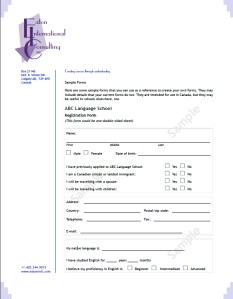
Sample Forms: Language School Application and Photo Release

February 9, 2011

I’m often asked by clients how to build a registration form for a new school or program. The two most requested forms are:

  • A sample registration form for a language school.
  • A photo release form for marketing materials.

I’ve developed sample forms that you can download for free.

I’ve designed them to give you an idea of what you’ll want to include on your own forms. Feel free to modify or customize them for your own language school or literacy program.

_________

Related posts:

Share this post: Sample Forms: Language School Application and Photo Release http://wp.me/pNAh3-vB

Update – January 2018 – This blog has had over 1.8 million views thanks to readers like you. If you enjoyed this post, please “like” it or share it on social media. Thanks!

Sarah Elaine Eaton is a faculty member in the Werklund School of Education, University of Calgary, Canada.


Listening Strategies for Beginning Language Students

February 4, 2011

In my adult Spanish first class of the semester, we listened to the recording of an introductory conversation. Students had the script of the conversation in their book. We followed these steps:

  1. Students read the conversation individually first, reading for meaning and context. They used pictures, their knowledge of cognates and the glossary to help them.
  2. We listened to the recorded conversation on the CD.
  3. Students practiced the conversation in pairs.

This is all pretty typical stuff. Then I challenged my students to practice active listening. I told them we were going to listen to the conversation again and their job wasn’t to listen for meaning. They already understood the conversation from the first few activities. This time I challenged them to:

Listen to the pronunciation of particular consonants and vowels. I modeled the consonants I wanted them to identify and listen to.

Pay attention to the native speakers’ intonation of both sentences and questions, as well as the tone they used. Some of them weren’t sure what intonation was, so I modeled it by raising my voice by saying “You like chocolate ice cream” as a sentence and then by turning it into the incredulous question, “You like chocolate ice cream?!” by changing the intonation and emphasizing the word “chocolate”. I pointed out that the words were the same, it was just my voice that was different. I asked them to listen to how the speakers used their voices in the conversation.

Focus on how the native speakers link words together. I pointed out that one thing that makes people sound fluent is the way they link words and phrases. Beginning language students often sound choppy and unsure of themselves. Learning how to link words together early on builds both skill and confidence.

We listened to the recorded conversation again. I asked them if listening actively made any difference. They nodded. We shared observations and then continued with our practice.

Tips for active listening activities

  1. Ensure they already understand the main idea of the material so they won’t focus on the content.
  2. Give specific instructions on what to listen for.
  3. Model the sounds or language yourself to be sure they understand what to listen for.
  4. Give a limited number of things (3 or 4 are enough) so they don’t get overwhelmed.
  5. Have them share their own observations.

We did this in our first class of the semester. My plan is to incorporate active listening into every class to help them build their communicative skills early on.

______________

Share this post: Listening Strategies for Beginning Language Students http://wp.me/pNAh3-tk

Update – January 2018 – This blog has had over 1.8 million views thanks to readers like you. If you enjoyed this post, please “like” it or share it on social media. Thanks!

Sarah Elaine Eaton is a faculty member in the Werklund School of Education, University of Calgary, Canada.


Free Resources Every Language Program Administrator Needs to Know About

January 30, 2011

Language program administration and management is not new in terms of the work we do, but it is starting to emerge as a “profession”. Training programs have popped up here and there that focus specifically on how to train language program directors to do their job better

Here are some free resources you’ll want to know about if you manage or direct a language program. Don’t worry if they are language-specific. There’s some good stuff in these manuals and papers that every LPA (language program administrator) can benefit from.

If you know of more free resources, let me know and I’ll add them to the list.

_________________________

Share this post: Free Resources Every Language Program Administrator Needs to Know About http://wp.me/pNAh3-sW

Update – January 2018 – This blog has had over 1.8 million views thanks to readers like you. If you enjoyed this post, please “like” it or share it on social media. Thanks!

Sarah Elaine Eaton is a faculty member in the Werklund School of Education, University of Calgary, Canada.