Foreign Language Programs in Crisis: Programs Closing, Faculty Losing Jobs

September 30, 2010

Lately people have been sending me all sorts of news articles about enrollments dropping in second and foreign language programs in high schools and universities. Here are a few examples:

“Community, Adult Education Programs Will be Missed”, Hometownlife.com, by Susan Steinmueller, Sept. 12, 2010

“Foreign language classes unresolved” – Isureveille, by Catherine Threlkeld, September 23, 2010

Cuts hurting language classes – The NewsStar by Carlos D. Fandal, September 26, 2010

Replacing Teachers with Technology – Fox News by Meredith Orban, September 28, 2010

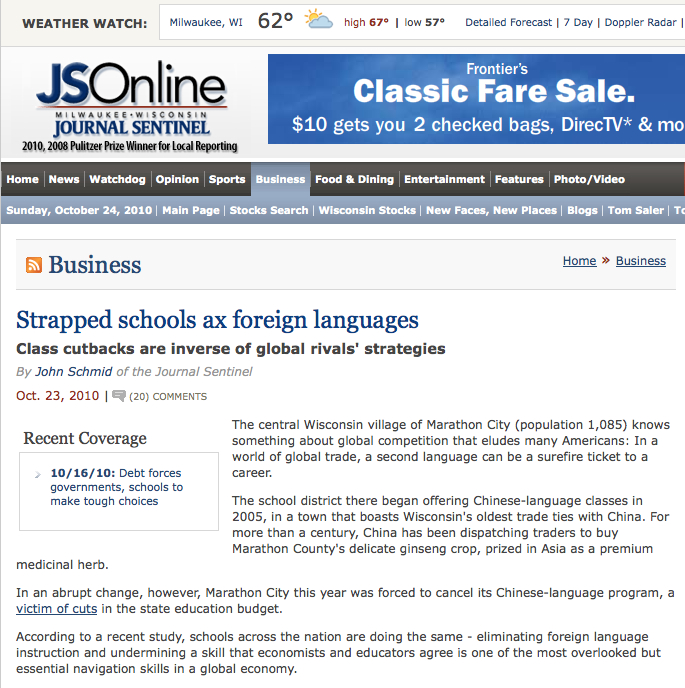
Strapped Schools Ax Foreign Language Programs – Milwaukee – Wisconsin Journal Sentinel, by John Schmid, October 23, 2010

It breaks my heart when I hear about programs that have decreasing enrollment or worse, under threat of closure due to low enrollment. From my experience of working with schools and programs over the past decade as a marketing consultant, I can honestly say that there is no “magic bullet” in a situation like this.

If you’ve been given notice that your program is about to close, managers and teachers essentially face a crisis situation. Not only is their passion about to be killed, and they know their students’ futures will be shaped in a very different way, but their livelihood may be gone, too.

What are language teachers, administrators and foreign language advocates to do?

The only answer it seems is find a way to revitalize not only our programs, but also interest in them. Parents and community stake holders need to see the value of second and foreign language learning and the benefits that students derive by studying them. There is no quick fix to this one, I’m afraid. If you manage or teach in a foreign language program, the best thing to do right now is to keep it vibrant and alive. If your program is under the threat of closure, there may still be time to implement a revitalization, public relations or marketing strategy to rebuild your program’s health so it doesn’t get shut down, or replaced by a computer program.

___________

Share or Tweet this article: Foreign Language Programs in Crisis: Programs Closing, Faculty Losing Jobs http://wp.me/pNAh3-hy

Update – January 2018 – This blog has had over 1.8 million views thanks to readers like you. If you enjoyed this post, please “like” it or share it on social media. Thanks!

Sarah Elaine Eaton is a faculty member in the Werklund School of Education, University of Calgary, Canada.


Reading strategies: Differences between summarizing and synthesizing

September 29, 2010

This semester I am teaching a course on Becoming an Effective Learner at the University of Calgary. I have asked my students to do a reading synthesis assignment on the different readings we have each week.  In today’s post I’m sharing some of the information I gave them about the differences between summarizing and synthesizing information in terms of reading strategies and research.

If you teach reading and you’d like to share it with your own students, you can download a copy here: difference-between-summarizing-and-synthesizing

Summarizing and synthesizing are both strategies used in reading and research. They are important skills, as they help learners make sense of what they reading.

Though they are both used as reading comprehension and research strategies, it is important to recognize that summarizing and synthesizing are different activities. Each has a different purpose, process and end result.

These are the main differences between them:

Summary

  • A basic reading technique.
  • Pulls together information in order to highlight the important points.
  • Re-iterates the information.
  • Shows what the original authors wrote.
  • Addresses one set of information (e.g. article, chapter, document) at a time. Each source remains distinct.
  • Presents a cursory overview.
  • Demonstrates an understanding of the overall meaning.

Synthesis

  • An advanced reading technique.
  • Pulls together information not only to highlight the important points, but also to draw your own conclusions.
  • Combines and contrasts information from different sources.
  • Not only reflects your knowledge about what the original authors wrote, but also creates something new out of two or more pieces of writing.
  • Combines parts and elements from a variety of sources into one unified entity.
  • Focuses on both main ideas and details.
  • Achieves new insight.

As you are reading information, be aware of whether you are simply re-iterating what someone else has said, or whether you are assimilating all the information in order to create one cohesive document that demonstrates your understanding of the concepts.

For both activities, it may be helpful to write out the main points, using diagrams or charts to help you.

Here are some helpful resources:

Comprehension Strategy – Synthesis / Summarization / Concluding
http://www.readinglady.com/mosaic/tools/Synthesis%20handout%20by%20Deb%20Smith.pdf

How to Synthesize Multiple Sources
http://home.cerrocoso.edu/swiridoff/Resources/Composition/how_to_synthesize_multiple_sourc.htm

What is a Synthesis Question?
http://www.passged.com/student_blogs/maria/2008/10/07/ged-reading-what-is-a-synthesis-question/

What it means to comprehend
http://www.suite101.com/content/what-it-means-to-comprehend-a72619

Reading Strategies

http://www.mindtools.com/rdstratg.html

_____________

Here’s a link for sharing: Reading strategies: Differences between summarizing and synthesizing http://wp.me/pNAh3-kW

Update – January 2018 – This blog has had over 1.8 million views thanks to readers like you. If you enjoyed this post, please “like” it or share it on social media. Thanks!

Sarah Elaine Eaton is a faculty member in the Werklund School of Education, University of Calgary, Canada.


Are your students plagiarizing? Here’s how you find out

September 26, 2010

Plagiarism is a hot topic among educators today. The Internet has revolutionized how students research, find and relate to information. Plagiarism used to consist of copying word for word from books. Nowadays a few simple key strokes will cut and paste information from any website into a student’s papers.

There are a number of ways teachers can figure out if their students are plagiarizing. There are a number of websites and programs that will help you do just that. You type in a portion of your student’s paper and run it through a plagiarism checker to see if those words appear elsewhere on the Internet. If they do, your student may have plagiarized. Check out these free online resources:

Related posts:

_______________

Share this post: Are your students plagiarizing? Here’s how you find out http://wp.me/pNAh3-l3

Update – January 2018 – This blog has had over 1.8 million views thanks to readers like you. If you enjoyed this post, please “like” it or share it on social media. Thanks!

Sarah Elaine Eaton is a faculty member in the Werklund School of Education, University of Calgary, Canada.


6 Reasons I love Glee – a language teacher’s point of view

September 23, 2010

This week, the new season of the TV show Glee aired. When I first heard about the show, I wasn’t interested. At first glance it looked fluffy, silly, and not particularly engaging. I don’t watch much television so when I do pick a show to watch it needs to engage my mind, as well as entertain me. For some reason last year, an episode of Glee got recorded and I, grumbling and growling, finally agreed to watch an episode of it. I was hooked.

As a language teacher I can’t help but notice that this hot new TV show offers a veritable cornucopia of material to use in class. Here are a few examples:

  1. The characters, young high school students speak eloquently. Verbal prowess is the norm among the characters.
  2. In speaking eloquently, the characters become role models for clear, concise and articulate communication.
  3. There’s much less slang than on other comedy shows.
  4. Characters express a wide array of emotions with no vulgar language. Nothing needs to be “bleeped out”. They find appropriate words to express their feelings.
  5. Characters don’t use phrases such as “So, like…. ya know,” leaving the listener to fill in the blanks.
  6. Characters will correct each other’s language mistakes. In this season’s premiere, this exchange happened between lead characters Rachel and Finn:

Finn: Rachel is what you’d call a controlist.

Rachel: I’m controlling. ‘Controlist’ isn’t a word.

Where else on television do you get teenage characters who show their vulnerabilities as they try to find their way in the world in a lighthearted, yet serious show where being articulate, and using the English language properly are highlighted?

__________________

Share this post: 6 Reasons I love Glee – a language teacher’s point of view http://wp.me/pNAh3-kJ

Update – January 2018 – This blog has had over 1.8 million views thanks to readers like you. If you enjoyed this post, please “like” it or share it on social media. Thanks!

Sarah Elaine Eaton is a faculty member in the Werklund School of Education, University of Calgary, Canada.


Finding an ESL agent – A open discussion

September 22, 2010

This event has passed.

Check out the webinar recording or view the slide presentation.

___________________________

I’ve been working with language schools for a decade now. One question keeps popping up time and time again: “How do we find agents?”

The traditional way to find an educational agent is to attend an agent workshop or fair. For small or aspiring language schools however, the fees to attend such fairs are out of the question.

I’ve organized a free, webinar-style discussion on the topic and I’m inviting you to join me. This will be a frank and open discussion. It will be online, open to anyone who wants to join in:

Here are the event details:
Title: “Working with ESL and Educational Agents: Tips from the Pros – a webinar”
Format: Online, real-time, live discussion
Date: Thursday, October 14, 2010
Time: 08:00 – 09:00 Mountain Standard Time (Origin point: Calgary, Canada) – Please convert to your time zone.

Guiding questions for the session:

  • How do ESL schools and programs find reputable agents?
  • What are the alternatives for small schools without a sufficient budget to attend the large agent fairs and workshops?
  • What are some pitfalls for language schools to avoid when working with agents?
  • How can schools develop long-term relationships with agents
  • Recommendations from the pros

Participants are invited to join at no cost. The point of this session is to provide information, education and an interactive discussion between language school directors and marketers and those working in the ESL / Educational agents field.

Registration link: http://workingwitheslagents.eventbrite.com/
Deadline to register: Tuesday, October 12 – Note: there are a limited number of seats available in the virtual classroom, so participants are encouraged to register early.

Please invite your associates and members to join us for this open discussion between ESL schools and educational agents.

This event is sponsored by:

  • Elluminate – Providers of the webinar technology.
  • Eventbrite – Providers of the registration system for the event.

Update: September 24 – So far, participants from the U.S.A, the UK, Italy and Korea have registered.

Related posts:

Tips for finding ESL educational agents

Tips for success at educational trade fairs

How to find a good ESL agent: Tips from the trenches

__________

Share or Tweet this: Finding an ESL agent – A open discussion http://wp.me/pNAh3-kD

Update – January 2018 – This blog has had over 1.8 million views thanks to readers like you. If you enjoyed this post, please “like” it or share it on social media. Thanks!

Sarah Elaine Eaton is a faculty member in the Werklund School of Education, University of Calgary, Canada.