Global Trends in Language Learning in the 21st Century: Webinar Follow Up

July 27, 2010

With participants, from Canada, the U.S, Romania, Germany, Guatemala, this was an amazingly international, multicultural and interactive session! Thanks for everyone who joined in today.

If you couldn’t make today’s webinar on Global Trends in Language Learning in the 21st Century, generously sponsored by Elluminate, don’t fret. I’ve archived everything for you.

Webinar recording
Check out the webinar recording. Note that this link may ask to download Java onto your computer. If you click “yes”, you’ll be able to access the recording, slides and all the chat that happened during the session.

Handouts

Click here for a copy of the handouts from the webinar.

Research report

This webinar was based on a research report that’s been archived in 3 countries now. Click here for a post with links to the full article.

Original webinar info

Want the information about the webinar? See this post.

Slides
I’ve archived the slides on Slideshare, here:

Testimonials

“This was the first time I attended a webinar, apart from all the conference calls organised at my place of work. I found it interesting, first because it shared information from my area of expertise, and also because it addressed a stringent matter of all teachers nowadays- how to take the leap into the 21st century without getting severely bruised.” – Anca Costea, Little London Nursery School, Bucharest, Romania.

“Sarah Eaton set out the results of here research in a very well structured and informative talk that provided many useful ideas for engaging language learners – especially younger learners – more effectively.” – Carl Dowse, Germany.

“My work in family literacy is backed up by emerging trends of the 21st century according to Dr. Eaton’s meta-research. In all fields of learning, we need to keep current on why people are formally or informally motivated to learn and how they would like to be equipped to do so. This webinar advances us towards a clear plan of taking action towards a literacy that allows all learners to communicate through thoughts and actions and respectively be able to reflect upon them.” – Tracy Howk, Literacy for Life Foundation

_______

Like this post? Share or Tweet it: Global Trends in Language Learning in the 21st Century: Webinar Follow Up http://wp.me/pNAh3-dE

Update – January 2018 – This blog has had over 1.8 million views thanks to readers like you. If you enjoyed this post, please “like” it or share it on social media. Thanks!

Sarah Elaine Eaton is a faculty member in the Werklund School of Education, University of Calgary, Canada.


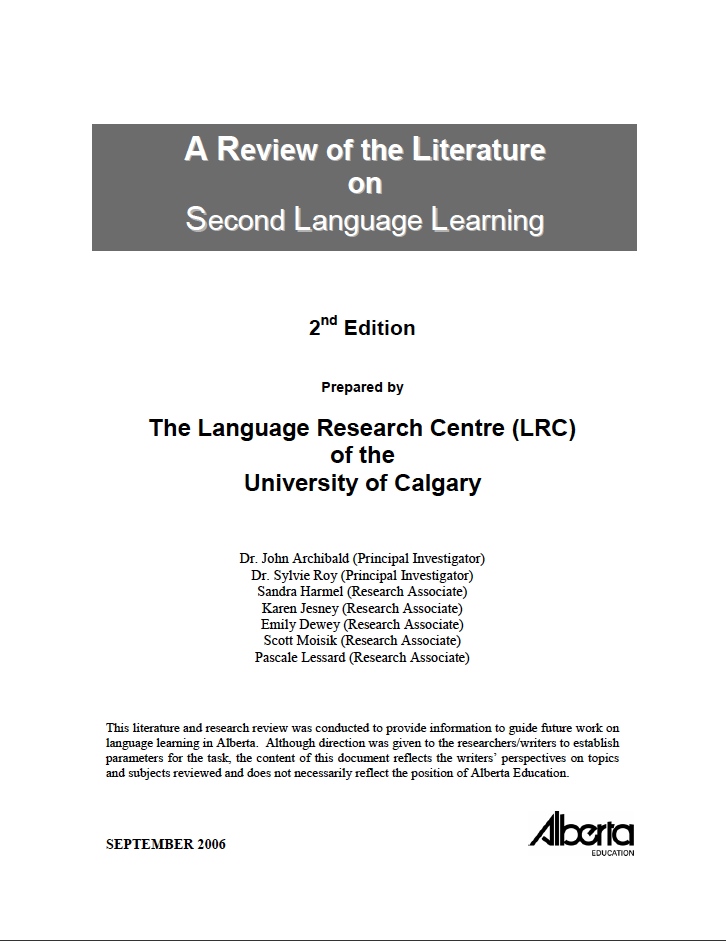
A Review of the Literature on Second Language Learning

July 19, 2010

Written Dr. John Archibald,  Dr. Sylvie Roy and other researchers at from the Language Research Centre (LRC), of the University of Calgary, A Review of the Literature on Second Language Learning, 2nd ed. Published in 2006, this study examines 4 key areas:

  1. Effects of a second language on a person’s first language
  2. The role of content instruction in offering a second language
  3. Effects of second language learning on students with special needs
  4. Effects of learning and third language on students for whom English is a second language.

Some key findings of this research are:

  • Exposure to a second language can enhance non-linguistic skills such as divergent thinking, attitudes towards others and math skills.
  • Acquiring knowledge in a second language does not impede first language development.
  • Significant time investment is required to acquire full fluency.
  • Content-based language teaching (e.g. teaching math or science in a second language) can increase students’ ability to make connections between second language study and the outside world.
  • Students with special needs can learn second languages.
  • Acquiring a third language is a common occurrence around the world.
  • It helps to learn a third language if you have a strong proficiency in a first language.

________

Share this post: A Review of the Literature on Second Language Learning https://wp.me/pNAh3-bO

Update – January 2018 – This blog has had over 1.8 million views thanks to readers like you. If you enjoyed this post, please “like” it or share it on social media. Thanks!

Sarah Elaine Eaton is a faculty member in the Werklund School of Education, University of Calgary, Canada.


Let’s stop forcing students to “puke out their brains”

July 14, 2010

Individualized, customizable, learner-centred approaches are becoming the new norm. Traditionally, education has been about developing a curriculum and teaching to students in a prescriptive manner. That made education easy for teachers because they could essentially teach the same thing, year in and year out.

That was not only boring for students, it’s ineffective.

It is said that one month after final examinations, students have lost 90% of the “knowledge” they had on the day of their final. That’s not learning. It’s stuffing information into a brain for it to be regurgitated on a test. And once it’s been puked out onto a test paper, it’s gone forever, it seems. Not exactly ideal, is it?

The good news is: learning is becoming more individualized and focused on the students and their needs.

Teachers of tomorrow will need to shift their thinking, stop thinking about how to get students to learn the curriculum and instead, make the curriculum work for the students.

Scratch that.

We don’t have time to wait for a new generation of teachers to understand that learning is about the students, not the textbooks, not the curriculum and most definitely not about standardized testing. Teachers of today need to learn that.

________________

Like this post? Share or Tweet it: Let’s stop forcing students to “puke out their brains” http://wp.me/pNAh3-bH

Update – January 2018 – This blog has had over 1.8 million views thanks to readers like you. If you enjoyed this post, please “like” it or share it on social media. Thanks!

Sarah Elaine Eaton is a faculty member in the Werklund School of Education, University of Calgary, Canada.


Global Trends in Language Learning in the 21st Century

July 13, 2010

If you liked the post I did a while back called Trends in Language Learning: What’s hot, what’s not , you’ll like this even better. At the urging of a few trusted colleagues and readers, I conducted more in-depth research into current and emerging trends in language education. The result is this full-fledged report, with three-pages of references.

Here’s an overview:

Global Trends in Language Learning the Twenty-First Century
Author: Eaton, Sarah Elaine
Date: June 2010
ISBN: 978-0-9733594-6-6
Publication Type: monograph
Total number of pages: 21

Abstract

Today’s language classroom is vastly different from that of the mid- to late 20th century. The study is a meta-analysis of recent research which provided the means to identify current and emerging trends in the field. Informed by this research, some identified trends that are shaping the 21st century language classroom are:

What’s out:
1. Vague, hollow promises that can’t be proven.
2. Saying that learning languages is easy.
3. Authoritative teacher attitudes.
4. Complaining about cutbacks and lack of funding.
5. Language labs.

What’s in:
1. Clear, provable demonstrations of learning.
2. Frameworks, benchmarks and other asset-based approaches to assessment.
3. Individualized, customizable, learner-centred approaches.
4. Proving the value of language learning through stories and speech.
5. Using technology for language learning.
6. Linking language learning to leadership skills.
7. Showing funders the impact their investment has on students and communities.

In short, the focus in language education in the twenty-first century is no longer on grammar, memorization and learning from rote, but rather using language and cultural knowledge as a means to communicate and connect to others around the globe. Geographical and physical boundaries are being transcended by technology as students learn to reach out to the world around them, using their language and cultural skills to facilitate the connections they are eager to make.

The full report is available free of charge. It has been archived by:

Education Resources Information Center (ERIC) (Accession number ED510276)

European Association of Education for Adults (EAEA)

Library and Archives Canada’s Electronic Collection

I will also be hosting a free webinar on this new research on July 27 at 10:00 Mountain time. For more information on the webinar click here.

Like this post? Share or Tweet it: Global Trends in Language Learning in the 21st Century http://wp.me/pNAh3-8I

Update – January 2018 – This blog has had over 1.8 million views thanks to readers like you. If you enjoyed this post, please “like” it or share it on social media. Thanks!

Sarah Elaine Eaton is a faculty member in the Werklund School of Education, University of Calgary, Canada.


Tips for finding ESL educational agents

July 10, 2010

An ESL agent, also known as an educational agent, or an international education agent, is someone who brokers a relationship between prospective students and an institution, be it a university, college or privately run school.

Good agents will act as a trusted advisor for both parties, working with prospective students to find them an excellent school abroad, helping them with any necessary paper work and  coaching them on what to expect.

Good agents work with excellent, accredited schools, ensuring that the experience they are providing is the best it can be for the students.

Bad agents don’t give a rat’s behind. They take money from students, making promises that will never come true. Ever heard of an agent who promised students they’d be driven to school every day in a limousine driven by a chauffeur? I have. And I can tell you that in Canada, I’ve never seen an international student arrive at school in a limo. Ever.
Bad agents don’t care that they’re telling lies or cheating students. And really, there’s nothing you can do to make them care.

What you can do, is spend your time finding a good agent.

But how? There are a number of ways.

Though you may find agents on line, it is more likely that you’ll find organizations that work with accredited agents. You may want to check out:

My suggestion would be to target which areas of the world you’d like more students from, then approach the professional organizations in those countries that work with reputable agents.

There are probably more organizations out there than I have listed here. And of course, I have to say that I’m providing these links as information only, not endorsements. 😉 There are no guarantees that working with an accredited organization will find you a stellar agent, but it does increase your chances. The bottom line is that finding excellent agents to work with takes time. Do your homework.

Related posts:

How to find a good ESL agent: Tips from the trenches

Tips for success at educational trade fairs

______________

Like this post? Share or Tweet it: Tips for finding ESL educational agents http://wp.me/pNAh3-be

Update – January 2018 – This blog has had over 1.8 million views thanks to readers like you. If you enjoyed this post, please “like” it or share it on social media. Thanks!

Sarah Elaine Eaton is a faculty member in the Werklund School of Education, University of Calgary, Canada.