A Review of the Literature on Second Language Learning

July 19, 2010

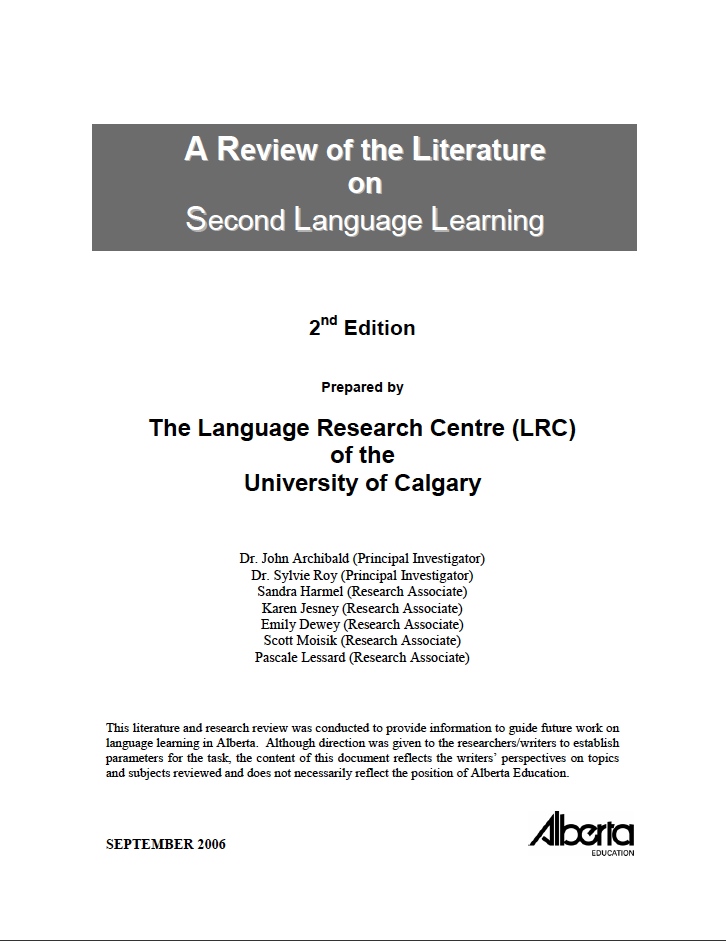
Written Dr. John Archibald,  Dr. Sylvie Roy and other researchers at from the Language Research Centre (LRC), of the University of Calgary, A Review of the Literature on Second Language Learning, 2nd ed. Published in 2006, this study examines 4 key areas:

  1. Effects of a second language on a person’s first language
  2. The role of content instruction in offering a second language
  3. Effects of second language learning on students with special needs
  4. Effects of learning and third language on students for whom English is a second language.

Some key findings of this research are:

  • Exposure to a second language can enhance non-linguistic skills such as divergent thinking, attitudes towards others and math skills.
  • Acquiring knowledge in a second language does not impede first language development.
  • Significant time investment is required to acquire full fluency.
  • Content-based language teaching (e.g. teaching math or science in a second language) can increase students’ ability to make connections between second language study and the outside world.
  • Students with special needs can learn second languages.
  • Acquiring a third language is a common occurrence around the world.
  • It helps to learn a third language if you have a strong proficiency in a first language.

________

Share this post: A Review of the Literature on Second Language Learning https://wp.me/pNAh3-bO

Update – January 2018 – This blog has had over 1.8 million views thanks to readers like you. If you enjoyed this post, please “like” it or share it on social media. Thanks!

Sarah Elaine Eaton is a faculty member in the Werklund School of Education, University of Calgary, Canada.

Global Trends in Language Learning in the 21st Century

July 13, 2010

If you liked the post I did a while back called Trends in Language Learning: What’s hot, what’s not , you’ll like this even better. At the urging of a few trusted colleagues and readers, I conducted more in-depth research into current and emerging trends in language education. The result is this full-fledged report, with three-pages of references.

Here’s an overview:

Global Trends in Language Learning the Twenty-First Century
Author: Eaton, Sarah Elaine
Date: June 2010
ISBN: 978-0-9733594-6-6
Publication Type: monograph
Total number of pages: 21

Abstract

Today’s language classroom is vastly different from that of the mid- to late 20th century. The study is a meta-analysis of recent research which provided the means to identify current and emerging trends in the field. Informed by this research, some identified trends that are shaping the 21st century language classroom are:

What’s out:
1. Vague, hollow promises that can’t be proven.
2. Saying that learning languages is easy.
3. Authoritative teacher attitudes.
4. Complaining about cutbacks and lack of funding.
5. Language labs.

What’s in:
1. Clear, provable demonstrations of learning.
2. Frameworks, benchmarks and other asset-based approaches to assessment.
3. Individualized, customizable, learner-centred approaches.
4. Proving the value of language learning through stories and speech.
5. Using technology for language learning.
6. Linking language learning to leadership skills.
7. Showing funders the impact their investment has on students and communities.

In short, the focus in language education in the twenty-first century is no longer on grammar, memorization and learning from rote, but rather using language and cultural knowledge as a means to communicate and connect to others around the globe. Geographical and physical boundaries are being transcended by technology as students learn to reach out to the world around them, using their language and cultural skills to facilitate the connections they are eager to make.

The full report is available free of charge. It has been archived by:

Education Resources Information Center (ERIC) (Accession number ED510276)

European Association of Education for Adults (EAEA)

Library and Archives Canada’s Electronic Collection

I will also be hosting a free webinar on this new research on July 27 at 10:00 Mountain time. For more information on the webinar click here.

Like this post? Share or Tweet it: Global Trends in Language Learning in the 21st Century http://wp.me/pNAh3-8I

Update – January 2018 – This blog has had over 1.8 million views thanks to readers like you. If you enjoyed this post, please “like” it or share it on social media. Thanks!

Sarah Elaine Eaton is a faculty member in the Werklund School of Education, University of Calgary, Canada.


Tips for finding ESL educational agents

July 10, 2010

An ESL agent, also known as an educational agent, or an international education agent, is someone who brokers a relationship between prospective students and an institution, be it a university, college or privately run school.

Good agents will act as a trusted advisor for both parties, working with prospective students to find them an excellent school abroad, helping them with any necessary paper work and  coaching them on what to expect.

Good agents work with excellent, accredited schools, ensuring that the experience they are providing is the best it can be for the students.

Bad agents don’t give a rat’s behind. They take money from students, making promises that will never come true. Ever heard of an agent who promised students they’d be driven to school every day in a limousine driven by a chauffeur? I have. And I can tell you that in Canada, I’ve never seen an international student arrive at school in a limo. Ever.
Bad agents don’t care that they’re telling lies or cheating students. And really, there’s nothing you can do to make them care.

What you can do, is spend your time finding a good agent.

But how? There are a number of ways.

Though you may find agents on line, it is more likely that you’ll find organizations that work with accredited agents. You may want to check out:

My suggestion would be to target which areas of the world you’d like more students from, then approach the professional organizations in those countries that work with reputable agents.

There are probably more organizations out there than I have listed here. And of course, I have to say that I’m providing these links as information only, not endorsements. 😉 There are no guarantees that working with an accredited organization will find you a stellar agent, but it does increase your chances. The bottom line is that finding excellent agents to work with takes time. Do your homework.

Related posts:

How to find a good ESL agent: Tips from the trenches

Tips for success at educational trade fairs

______________

Like this post? Share or Tweet it: Tips for finding ESL educational agents http://wp.me/pNAh3-be

Update – January 2018 – This blog has had over 1.8 million views thanks to readers like you. If you enjoyed this post, please “like” it or share it on social media. Thanks!

Sarah Elaine Eaton is a faculty member in the Werklund School of Education, University of Calgary, Canada.


Interview with Martha Urquhart: Leading by Example Series

July 5, 2010

Monday Inspiration Series: Literacy and Language Professionals who Lead by Example

This new series is dedicated to highlighting the impact made by exemplary literacy and language professionals who lead by example. The series features interviews with each of our leaders, sharing their inspirations, stories and tips. This week I’m delighted to showcase a literacy and language leader in Alberta who impacts the lives of many people in amazing ways through her work.

What is your name, affiliation, and connection to language learning?

Martha Urquhart
ESL Consultant with Rural Routes Initiative, NorQuest College
Literacy Specialist with the Community Reading Program, Slave Lake Adult Education Committee

As an ESL Consultant with Rural Routes, I train and mentor ESL Instructors and Tutors across Northern Alberta.  I consult with the ESL providers in small, rural communities, who are often the literacy coordinators or the adult education coordinators for the local community learning councils, regarding the training needs of their instructors and volunteer tutors, resources to use in their programs, ESL support available for their community, and any other topics on which the ESL providers require input.

As a Literacy Specialist with the Community Reading Program, a local volunteer tutor adult literacy service operating under the umbrella of the Slave Lake Adult Education Committee, I assess ESL learners, train the volunteer tutors, and provide resources and support for the tutors as they help their learners acquire the English language.

What are your thoughts about leadership and language learning?

To me, a leader is someone who helps others to rise up to their fullest potentials. All of the volunteer tutors who work one-on-one with their learners and ESL instructors who teach ESL classes are leaders in the field of language learning.  Even the volunteer tutors who work one-on-one with literacy learners are leaders as they are helping someone develop their literacy skills, part of language learning even if that language is their own.

These are perhaps the greatest leaders of all because they do so quietly, most often without rewards of any kind, other than pats on the back and yearly appreciation dinners.  They attend training without any compensation, donating their own time to improve their own skills in order to help others rise up to their fullest potentials.

Truly, the greatest leaders of all time are the ones at the grass-roots level.

In your opinion, what’s the most important aspect of a language teacher’s job?

It’s critical for language teachers to connect the classroom to the outside world.  Learners have to be able to use the language outside of the classroom. The purpose of language is not to be able to communicate within the halls of an institution, but to take that learning out into the world and apply it to one’s own life.

This requires the teaching of skills that allow learners to complete activities that require interacting with their communities (such as interviewing business owners), providing a safe place for the learners to develop the required skills, and creating opportunities to build bridges between the classrooms and the communities.

I believe this is important regardless of whether you are working with children or with adults.  It is especially important when working with adults, as adult learners have to see the relevance in what they are learning and how that applies to their own lives.

What are some of the projects you’ve been involved with that you would like to share?

I seem to always be involved in some project.  I believe in lifelong learning and being a part of a variety of projects allows me to live that belief.

My most recent project involved working with the iCCAN project and utilizing video conferencing equipment to increase training opportunities for small ESL and literacy community based programs.

Most of the 13 communities involved in this project had little to no video conferencing experience.  Eight sessions were offered (two of three different topics; one topic having two parts) with a total of 160 tutors, instructors, facilitators, coordinators, and board members participating.

I facilitated the first topic from a desk top videoconferencing unit while the next two topics were conducted from a classroom unit. These experimental sessions showed grassroots in action as some community programs are now partnering with other rural programs in utilizing video conferencing to increase the professional development opportunities for their tutors and instructors.

What do you see as three new directions in language learning?

I think that ESL programming in small rural communities will become more systematic.  Although it will be a challenge to ensure that community based programs remain personally relevant for their particular learners, I believe this will increase the quality of ESL programming.

This, in turn, will increase the professionalism within the field.  As more communities become comfortable with using video conferencing, and more training opportunities become available (via video conferencing or traditional formats), small rural community based programs will be able to increase the professionalism within their ESL programming.

And I believe computers will become an “additional language” that everyone, regardless of their roles within their communities, will need to add to their database of knowledge.  Already, literacy programs are seeing an increase in requests for what is being termed “computer literacy”.  I think incorporating the use of computers within the ESL programming will also be important, both as a tool for language learning itself and as a required skill for future opportunities.

_______________

Like this post? Share or Tweet it: Interview with Martha Urquhart http://wp.me/pNAh3-aV


Grass roots marketing for ESL: Success story

June 29, 2010

People often ask me if brochures are an effective way to market a language or literacy program. My answer is always the same: It depends.

I am a huge fan of technology. I love social media. I teach marketing workshops that show clients how to make a Facebook page and how to use Skype for learning and marketing.

But sometimes, brochures still have a place. Here’s a success story about a client who used a very low-cost, grass-roots marketing approach that included brochures – and built their very first e-mail list.

My client, an ESL program in a small town in a farming community in Canada wanted to increase their enrollments. Before we got started I asked them all the usual questions:

What are you doing now to market your program?

Answer: Brochures, an outdated website, flyers.

Are you able to track the return on the investment you’re making for your marketing dollars?

Answer: Blank stare. The idea of tracking this had never occurred to them. They didn’t even think it was possible.

How many students do you have now?

Answer: A handful. Certainly not enough to make ends meet.

What’s your target market?

Answer: The world.

Sigh. The last question often gets answered this way. It’s one of my pet peeves, to be honest. I dug deeper. I found out that most of their students were local immigrants. Some would qualify for government funding and others wouldn’t. The conversation revealed that some farmers in the local community employed seasonal foreign workers, mostly from Mexico. Not all of those farmers wanted their workers to be fluent in English, but some did.

Bingo.

“You’ve got brochures?”, I asked.

“Yes. They’re not pretty and we can’t afford new ones.” They cautioned.

No problem.

“What’s your budget?”, I asked.

Nervous chuckle. “Um… Free?”

“OK,” I said. “We can’t do free, but do you have $1500 to spend?”

“Well, not really, but I know you’ve got to invest something to get something.”

“Exactly,” I said. “Now here’s what I want you to do…”

My suggestion for this particular program was for them to rent a table for 4 weeks at the local farmers’ market. Have two staff members or teachers from the school work the table. Tell all the staff and students to come to the market this weekend “drop by and say hello”. Many staff went to the market on the weekends anyway, so that was easy.

By saying “drop by and say hello”, kept the feel of it casual and low-pressure. After all, just about everyone who meets a friend or colleague at the market stops to say hello, so we weren’t asking them to go out of their way.

I told them to make a big sign and hang it behind the table to people walking by would see it. “It’s important to hang it at eye level,” I told them. “Don’t make the mistake of hanging it off the table so people’s legs brush it as they walk by.” Putting signs at eye level is always important in a busy setting.

I told them to put this on their sign: “Win a free ESL course from ABC English School”.

Why a free class? It doesn’t cost a school hard dollars to give away one course. And it would generate interest.

Next, I said, make or buy a ballot box and have some pens and paper handy for people to write down their name and e-mail address.

And bring those brochures.

I told the staff their main job that day was to talk to people. Not to “sell” the program. Most definitely not to be pushy. Talk about the fact that the school was giving away one free course for the next session. Talk about the courses. Talk about the students, giving specific examples of students who have benefited from their program. Talk about what a great place it is to be.

I told my client that the e-mail addresses they collected would make up their first e-mail list. I’d coach them through that up after the farmers’ market campaign.

They went forward with the idea.

The result?

Teachers came by the booth with their families, stopping to say hello. This meant the table was not “empty”, with staff standing around looking bored. As conversations went on, others stopped by. They asked questions. Conversations happened.

Other vendors stopped by, a few of them welcoming the school to the market. It was a novelty to have an educational institution at the market. In some ways, they appeared not to fit in.

And yet they did. They were part of the community. In fact, their prospective clients were not only the students themselves, but also the farmers who might want to have their workers better educated. The school was reaching out to their prospective market by meeting them on their own turf.

Anyone who stopped by was invited to put their name into the draw. They were told that they could give the course away to anyone they chose, such as a seasonal staff member or a neighbor.

The ballot box slowly filled up with names.

People were interested. They took away brochures.

The result? After 4 weeks, enrollment for the semester was up by 47%, resulting in their highest number of registrations ever. A 47% increase in monthly registrations, achieved over a 4 week period is a significant increase.

The costs:

Table at the farmers market for 4 weeks: $80
Bristol board and big “fat markers” to make the sign: $10
Paper and pens for ballots: $7
Staff salaries: 2 people x 8 hours x $20 per hour x 4 weeks: $1280

Cost per week: $344.25

Total cost for 4 weeks: $1377

And most of that was spent on staff wages for those working at the market. Rather than putting most of the money into advertising that wasn’t generating much return, the school was actually helping out their own staff and teachers by giving them some extra hours.

Were they able to track the return on the investment they’d made? Absolutely!

What else did they get? They got new students and new relationships with others in the community who were interested in their programs.

Were the brochures helpful? In this case, yes. Anyone who was interested popped one into their bag and pulled it out later at a convenient time. This was, literally, not the market for high tech gadgets. A brochure was appropriate in this context.

With a few adaptations this same approach could also work for literacy programs who want to build an awareness campaign.

My point in sharing this story is that depending on your market, grass roots approaches may work very well. Reaching out to your market in a way that makes sense to them, and includes a personal connection is likely to be much more successful than doing something just because it’s fashionable.

So said the social media-butterfly / marketing expert who just got her first Blackberry.

___________________

Like this post? Share or Tweet it: Grass roots marketing for ESL: Success story http://wp.me/pNAh3-ap

Update – January 2018 – This blog has had over 1.8 million views thanks to readers like you. If you enjoyed this post, please “like” it or share it on social media. Thanks!

Sarah Elaine Eaton is a faculty member in the Werklund School of Education, University of Calgary, Canada.