Recently a colleague (someone whom I respect very much) told me that as far as social media goes, she has a “Just say no” policy. She claims it would take up too much of her time if she “did Facebook”. I felt like jumping across the table at the restaurant where we were enjoying lunch and strangling her.
Anyone who knows me knows that I am a big fan of social media. But me being a fan of it means nothing and that’s not why anyone should explore it. There is a one good simple reason why language programs should have an online presence, including a Facebook page. It is this: If you’re marketing something, you need to “be” where your prospective students are.
I have a client who runs an adventure language learning school in Europe. I’ve suggested to him that he focus his marketing efforts on finding students who are already into the adventure lifestyle. He’ll probably get more traction at outdoor expos than he will at a traditional language fair. He wants to “be” where his students are. He’s also looking at online marketing, and rightly so.
Why? Because his learners are young people, aged 18-25. And where are those folks? They’re on line. This age group rules the Internet. In particular, they’re on Facebook.
My adventure language learning school owner has it right, folks. If you’re marketing to 18-25 year olds, you don’t just want a website. You want an entire online presence that includes a Facebook page.
This means a Facebook page, at the very least. Don’t know how to get one? It’s easy and it’s free. I’ll give you an example. Here’s my company page: http://www.facebook.com/EatonInternationalConsulting
I’m not offering that up as shameless self-promotion, but rather to make it easy for you. On the bottom left hand side of the page there’s a link that says, “Create a page for my business”. Click on it. Make a page for your school.
See? Wasn’t that simple? 10 minutes of your time increases your online presence.
When you’re done that, send a note out to all your current and past students, asking them to become fans of your page. Yes, ask. It’s not cheesy. It’s how it’s done. Being a “fan” of someone’s FB page is code for “I think these folks are all right and I’m happy to be part of their community and support them”. (By the way, since I believe in practicing what I preach, why don’t you become a fan of my FB page while you’re there?)
Hopefully you already have a Facebook account for yourself and your students are your friends. If not, get yourself an account. Keep it professional. Search for a few student names and start adding friends. The term “friend” on Facebook can be your actual real, live friends and they can also be customers, business contacts and others. I keep my Facebook page fairly neutral and don’t mind if colleagues and former students are friends. It’s a good way to stay in touch.
If you go onto Facebook and do a search for groups using the term “language schools”, the results may surprise you. There are businesses listed who have hundreds of fans. Who are all these fans? Their current and former students, of course! The students use the school’s page as a place to post photos and exchange messages. It creates a hive of online activity, led in a large part by the students themselves. This is pretty much the perfect low-cost, high-impact marketing and promotion I am a big fan of.
When you’ve got your FB page, send me a note or drop me a comment on the blog and I’ll become a fan of your page. Why? Because I am way more of a “Just do it” kind of girl than my colleague in the restaurant. That is to say, when “just do it” is good for you, of course. When it comes to marketing it is definitely good to “do Facebook”.
__________________________________________________________
Share this post: Language schools and Facebook: Just do it http://wp.me/pNAh3-1q
Update – January 2018 – This blog has had over 1.8 million views thanks to readers like you. If you enjoyed this post, please “like” it or share it on social media. Thanks!
Sarah Elaine Eaton is a faculty member in the Werklund School of Education, University of Calgary, Canada.
 My friend, Felix Wöhler, Director of English Encounters recently shared his school’s 2010 video yearbook with me. It’s an amazing example of:


 Posted by Sarah Elaine Eaton, Ph.D.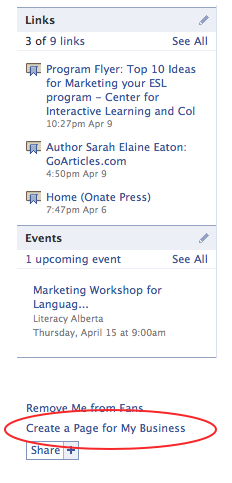

 Learning, Teaching and Leadership
You must be logged in to post a comment.