Nigeria launches national literacy awareness campaign

March 22, 2010

Nigeria has invested big dollars in a nation-wide literacy awareness campaign. Just last week it was announced that the National Commission for Mass Literacy, Adult and Non-Formal Education in Nigeria is launching a massive, national literacy awareness campaign across that country’s 36 states and the Federal Capital Territory.

Their plan (and a good one, I think) is to launch a radio awareness campaign. Literacy awareness campaigns differ from traditional marketing because they need to focus less on printed brochures, advertisements and other word-based forms of promotion. A radio campaign is a brilliant idea.

The country has invested 96.5 Million Nigerian nairas to fund this campaign. If I’ve done my math right, this translates into approximately $650,000 Canadian dollars, which is about $643,000 USD. Critics are saying this isn’t enough of an investment. Others are applauding the initiative.

I count myself among the second group. This is a tremendous initiative. A national campaign such as this requires a tremendous amount of planning, organization and coordination. I will be watching with interest as this unfolds.

Read more in this recent news article.

_______________________________

Share this post: Nigeria launches national literacy awareness campaign https://wp.me/pNAh3-1l

Update – January 2018 – This blog has had over 1.8 million views thanks to readers like you. If you enjoyed this post, please “like” it or share it on social media. Thanks!

Sarah Elaine Eaton is a faculty member in the Werklund School of Education, University of Calgary, Canada.


Language and Literacy Teachers as Leaders

March 18, 2010

Language and literacy teachers and tutors are instructional leaders. Every day they act as role models for the students that they teach. They are a source of inspiration, motivation and encouragement. For the most part, they also lead by example. When a literacy tutor teaches a learner to read, write and learn the alphabet, it is because they have also learned it themselves and they are sharing what they themselves have learned. Many foreign language teachers have lived and taught abroad. They understand the difficulties in grasping a foreign grammar and new vocabulary, as well as culture shock and learning how to “be” in a new place.

Here are 5 tips for celebrating your role as a Language Leader:

1. Share stories with your learners.

Humans connect through stories and shared experiences. Tell your students about your own experience as a learner, or a story about someone you know. Think of a student you have who is struggling. Then go back into your memory banks and find an anecdotal story about you or someone else that may help your learner in some way – to provide relief, inspiration or hope. I advise changing the names of characters in your stories, to protect the innocent, of course. But it OK to share stories about former students who have overcome similar difficulties and succeeded. Connecting through stories is a powerful way to lead.

2. Share your own tips for success.

Students sometimes struggle to find strategies that will help them succeed. One way they figure out what will work for them is to get tips from those who have already done the same. As a teacher, you act as a leader when you share your tips that will help others succeed. For example, I had trouble learning to roll my “rr” when I was learning Spanish. I had previously studied French and my “r”s were too far back in my throat for Spanish. I struggled with the new sound of the trilled Spanish “rr”. My teacher gave me the tip of practicing it in the shower. (Seriously!) I practiced every day in the shower until I could do it.

As a teacher I passed that same tip on to my own students, telling that that practicing every day for just a few minutes is important. The method of doing it while doing something else that is pretty routine and does not require much “deep thinking”, also helps to decrease anxiety. It worked for me and my students tell me that it works for them too. They appreciated the tip! Every teacher has good learning tips. What are some of your personal success tips that you can share with your learners?

3. Show your humanity.

Adults have this thing about failure. Children are less self-conscious about it until they learn that it’s bad to make mistakes. Adult learners may have feelings of shame or stigma about what they don’t know. As a Language Leader you want to show your learners that it is not only OK to make mistakes and not know things, it is inevitable! What we don’t know creates a space for us to learn in. No one knows everything and we all have the capacity to learn. When you’re working with your learners find ways to take yourself down off whatever pedestal your learners may want to put you on and show them that you are just as human as you are.

4. Laugh with your learners.

Along with showing your humanity comes laughter. I tell my students about the time when I was giving a presentation as a young college-age student who was studying Spanish. I concluded my presentation, which was an anecdote about my experience studying abroad in Madrid with the line, “Y al final me quedé bien embarazada.” A few people in the class broke out into laugher and my teacher stifled her laughter. What I said was “I finished up good and pregnant”. What I meant to say was, “At the end of it all, I was really embarrassed.” Oops! Needless to say, there was no pregnancy involved, but there was embarrassment – both during the initial incident and during my class presentation. And I learned to say it properly in Spanish – “Me dio mucha vergüenza.”

I share that story with my students so they can see my humanity. We have a good laugh over it and hopefully, they learn from my mistake!

5. Encourage learners with a “can do” attitude.

Every now and again we all become discouraged. When this happens, it’s easy to say, “I can’t do it”. As a Language Leader, your job is to say, “Oh yes you can!” I tell my students that I am actually a very slow learner, which is true. I tell them about times I wanted to give up and didn’t. I tell them that by tapping into their own personal determination and perseverance, they will learn to read and write the way they want to. They will learn their verb conjugations. More importantly, they will empower themselves to gain new skills and experience the world in new ways – that their effort will be worth it.

_____________________________________

Share this post: Language and Literacy Teachers as Leaders https://wp.me/pNAh3-1h

Update – January 2018 – This blog has had over 1.8 million views thanks to readers like you. If you enjoyed this post, please “like” it or share it on social media. Thanks!

Sarah Elaine Eaton is a faculty member in the Werklund School of Education, University of Calgary, Canada.


CCL’s Interactive Prose Literacy Map for Canada

March 8, 2010

The Canadian Council on Learning (CCL) hosts this Interactive Prose Literacy Map

CCL’s Prose Literacy Map

that shows levels of prose literacy in communities across the country.

Using data from the 2006 Census and the 2003 International Adult Literacy and Life Skills Survey (IALLSS), this map shows which areas of the country have higher and lower prose literacy rates. According to IALLSS, literacy is may be ranked on a scale of 1 to 5. Level 1 literacy indicates very poor skills, while 5 indicates very high skills.

CCL states that the map is “is an innovative look at the prose literacy landscape across Canada’s cities, towns, communities and neighbourhoods. In the map prose literacy is represented in two ways; 1) by average adult prose literacy scores (on a scale of 0 – 500), or 2) by regions of lower literacy. The latter depicts the proportion of the population that scored at the OECD’s prose-literacy Level 2 or below.”

This is my pick for the “cool tool” of the week for literacy in Canada. Go check it out.

__________________

Share this post: CCL’s Interactive Prose Literacy Map for Canada http://wp.me/pNAh3-17

Update – January 2018 – This blog has had over 1.8 million views thanks to readers like you. If you enjoyed this post, please “like” it or share it on social media. Thanks!

Sarah Elaine Eaton is a faculty member in the Werklund School of Education, University of Calgary, Canada.


How to brand your language or literacy program

February 25, 2010

Branding is one activity that falls under the larger umbrella of marketing. It’s important to have an overall marketing strategy. Branding is a hot topic though and lots of people ask me about it. So today I wanted to focus briefly just on branding for language schools and literacy programs. Here are a few tips to get you started:

Be clear about what programs you’re offering. If you focus on programs for adults, then be purposeful and decisive about it. Do not try to be all things to all people. Focus all your efforts on programs that fit within your niche. Find trusted colleagues who offer complementary programs so you can refer prospects to them who don’t fit in your niche. So if your specialty is a program for those 18-50 and you get an inquiry from someone looking for a youth program, have somewhere to refer them. That’s just good professional courtesy. Then, send them on their way and stay focussed on your niche. Being clear about who you are and what you do is the first step to marketing yourself successfully. From there, you can focus more on other activities, including branding.

Use your logo widely – If you have a logo, use it on all your marketing materials – not just the website or the brochures. Make sure it is on your business cards, your letterhead and any promotional materials you produce. People associate the logo with your activities , your style and your philosophy. Your logo is a visual, often pictorial image that represents who your organization is and what you do. This idea is very powerful for language and literacy programs where words may be a barrier to your clients! You don’t words on your logo. You can have them, but you don’t need them. Your logo becomes an imprint on the memory of those who see it. Use it widely and people will get to know your program better.

Be clear and consistent -You want to deliver the same message to your prospects with all of your marketing materials. It is important to keep the logo consistent over time and also to use it consistently.  In my experience, programs that have one logo that they use on every piece of paper that leaves their office and every web page are usually very successful. This is because they are sending a message that they are reliable, trustworthy and that they’re here to stay.

Here are a few of my favorite online articles for branding. They’re directed towards business people and entrepreneurs, and what they have to say is also good for educational leaders who are responsible for promoting their programs within their communities or to the world.

Fundamentals of branding
http://www.brandchannel.com/features_effect.asp?pf_id=183

Approaches to branding
http://www.knowthis.com/principles-of-marketing-tutorials/managing-products/approaches-to-branding/

How to position a company, product, service or brand
http://www.adcracker.com/position/

and a good articles on the failure of some marketing campaigns (and the resulting failure of the associated products and services):

Product and brand failures: a marketing perspective
http://articles.mplans.com/product-and-brand-failures-a-marketing-perspective/

_______________

Share this post: How to brand your language or literacy program http://wp.me/pNAh3-J

Update – January 2018 – This blog has had over 1.8 million views thanks to readers like you. If you enjoyed this post, please “like” it or share it on social media. Thanks!

Sarah Elaine Eaton is a faculty member in the Werklund School of Education, University of Calgary, Canada.


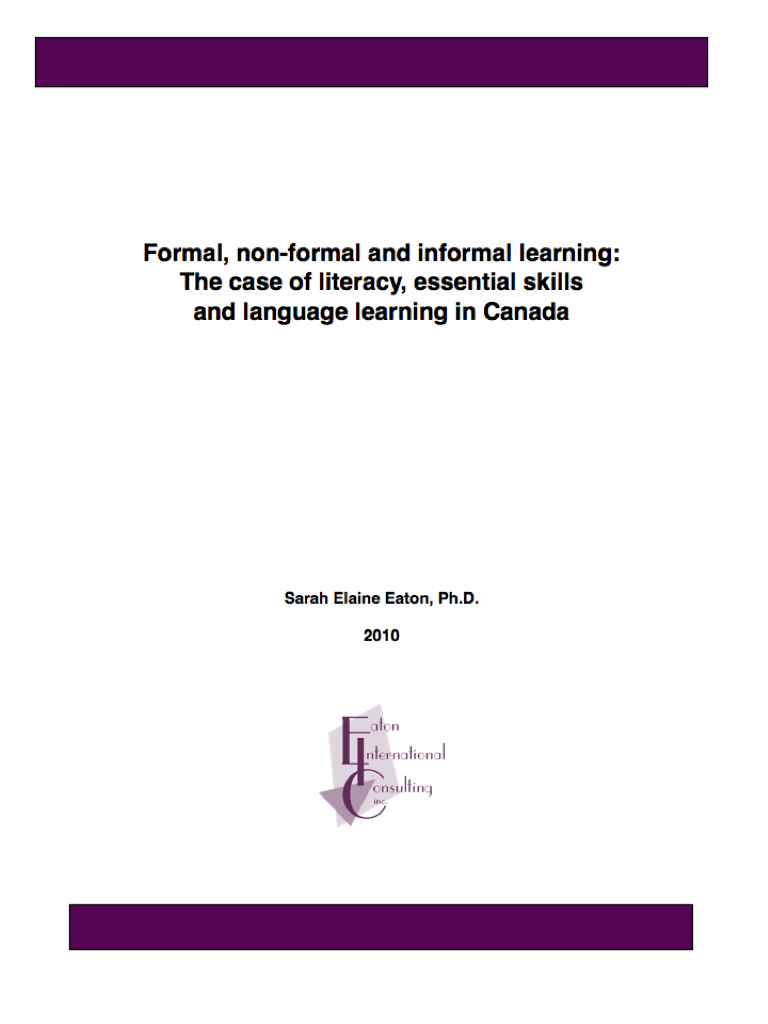
Formal, non-formal and informal learning: The case of literacy and language learning in Canada

February 16, 2010

This new research report is freely available in e-format (.pdf).

Executive Summary

This research report investigates the links between formal, non-formal and informal learning and the differences between them. In particular, the report aims to link these notions of learning to literacy and essential skills, as well as the learning of second and other languages in Canada.

Philosophical underpinnings of this research are:

  • There is value in learning of all kinds.
  • Learning is a lifelong endeavour.
  • An interdisciplinary approach is valuable.

Notions of formal, non-formal and informal learning may be briefly outlined as:

Formal learning – This type of learning is intentional, organized and structured. Formal learning opportunities are usually arranged by institutions. Often this type of learning is guided by a curriculum or other type of formal program.
Non-formal learning – This type of learning may or may not be intentional or arranged by an institution, but is usually organized in some way, even if it is loosely organized. There are no formal credits granted in non-formal learning situations.
Informal learning – This type of learning is never organized. Rather than being guided by a rigid curriculum, it is often thought of experiential and spontaneous.

– (Organisation for Economic Co-operation and Development / Organisation de Coopération et de Développement Economiques (OECD), n.d.; Werquin, 2007)

Examples are given for literacy and essential skills, as well as second and other languages for each of the categories mentioned above.

Finally, the examples of systems developed value different types of learning using asset-based approaches are given. The tools developed by Human Resources and Skills Development Canada are explored for the case of literacy. The Common European Framework of Reference for Languages developed by the Council of Europe is considered for second and other languages.

Copies of the report may be accessed through:

National Adult Literacy Database (Canada)

http://library.nald.ca/research/item/8549

or

European Association of Education for Adults (Helsinki, Finland)

http://www.eaea.org/news.php?aid=17397&k=2088&%20d=2010-02

or

National Library of Canada – Online Archives Collection (Canada)

http://epe.lac-bac.gc.ca/003/008/099/003008-disclaimer.html?orig=/100/200/300/eaton_intl_consulting/formal_non/Literacy_languages_and_types_of_learning.pdf

or

The Encyclopedia of Informal Education

http://www.infed.org/archives/e-texts/eaton_formal_nonformal_informal_learning.htm

or

Global Literacy Foundation

http://globalliteracy.org/Eaton

or

Centre for Adult English Language Acquisition (CAELA) (United States)

http://www.cal.org/CALWebDB/ESLResourceDB/ (Resource #0274)

New! August, 2010 – Check out the companion report: Formal, Non-Formal and Informal Learning in the Sciences.

Related posts:

Formal, non-formal and informal education: What Are the Differences?

Formal, Non-formal and Informal Learning (Infographic) https://wp.me/pNAh3-266

Formal, Non-formal and Informal Learning: A podcast

Breathtaking Impact of Volunteers’ Contribution to Non-formal and Informal Literacy Education in Alberta

Formal, Non-formal and Informal Learning in the Sciences

The many faces of non-formal learning

____________

If you found this post helpful, please click “Like” below and share it with others.

Here’s a link for sharing:

Formal, non-formal and informal learning: The case of literacy and language learning in Canada http://wp.me/pNAh3-C

Update – January 2018 – This blog has had over 1.8 million views thanks to readers like you. If you enjoyed this post, please “like” it or share it on social media. Thanks!

Sarah Elaine Eaton is a faculty member in the Werklund School of Education, University of Calgary, Canada.