7 signs your marketing is outdated

July 28, 2010

Marketing and promotion has changed tremendously in the past decade. Here are some indicators that your marketing is “sooooo 20th Century!”

  1. Buying print ads. Unless your ad is very targeted to an audience that reads the print material, and offers a direct benefit, print ads have lost their impact.
  2. Direct mail. The campaigns have a very low return on investment.
  3. Cold calling. People resist telemarketers like the plague.
  4. E-mail spam. Do you hate spam? So does everyone else. If you do mass e-mail, you’re not only outdated, you’re likely losing customers because you’ve ticked off the person on the other end.
  5. Spending money with no deliverables. Spend your marketing dollars on things that will get you a trackable return on your investment.
  6. A “Buy me! Buy me!” approach. There’s no faster turn off in today’s world.
  7. Focusing on your products. If the writing in your marketing materials start with “This service…”, “This course…”, “This program…”, or “This product…”, your writing style is outdated and likely to make others tune out.

If you’re still doing these things, your marketing may not be effective because it’s not current. If it’s not current, it won’t have an impact in today’s world.

Next time I’ll share some simple, easy ways to make sure your marketing and promotions are optimized for the 21st century.

________________

Like this post? Share or Tweet it: 7 Signs Your Marketing is Outdated http://wp.me/pNAh3-e8

Update – January 2018 – This blog has had over 1.8 million views thanks to readers like you. If you enjoyed this post, please “like” it or share it on social media. Thanks!

Sarah Elaine Eaton is a faculty member in the Werklund School of Education, University of Calgary, Canada.


Photo tips and ideas for language and literacy programs

July 23, 2010

Your marketing materials need photos. Period.

I’m a big fan of using professional quality photos in your marketing and promotional material. They really are worth it. If you really can’t afford to use pro quality photos, get out your digital camera and start clicking. Here are some tips.

Tips on taking and using marketing photos

  • Take high resolution photos. You can always shrink them later.
  • Keep your photos updated. – Every 2-3 years.
  • Make sure your photos are appropriate for your audience (culture, age, context)
  • Get permission from your photo subjects to use their photos.

Ideas of things to take photos of for language or literacy program marketing materials:

  • your students relaxing on school property
  • your students in class
  • your students on excursions or participating in activities
  • the school’s facilities
  • the graduation ceremony or year-end party
  • your school staff, faculty and administration
  • a typical homestay family and their home

________________________________________

Share this post: Photo tips and ideas for language and literacy programs http://wp.me/pNAh3-cZ

Update – January 2018 – This blog has had over 1.8 million views thanks to readers like you. If you enjoyed this post, please “like” it or share it on social media. Thanks!

Sarah Elaine Eaton is a faculty member in the Werklund School of Education, University of Calgary, Canada.


Use the KISS principle in all your marketing materials

July 21, 2010

The KISS (Keep it Short and Simple) principle can – and should – be used in your marketing and promotional materials. When it comes to writing, the KISS principle may also be called a plain language approach. And it makes your marketing more powerful and effective.

Regardless of what you call it, a simple, short approach is the most effective for marketing. This applies to both the amount of content and its presentation in your marketing materials. The first step is to eliminate unnecessary words. Next, review your document to ensure that the words are short, simple and easy to understand.

Some word processing programs tell you the reading level of the documents you write. For example, in my version of MS Word, I can do this by accessing

Tools >

Spelling and Grammar >

Options >

Show readability statistics.

This shows me the grade level of the text. For most marketing documents, a grade six or seven reading level is recommended. That’s for native speakers! Remember that you are marketing to people whose first language is not the same as yours. If the reading level comes out higher than grade 7, your sentences may be too complex to sell effectively.

Avoid colloquialisms in your international marketing material. If you were an ESL student, what would you think if you read, “…homestay families will look out for students…” in a brochure? Does that mean “keep vigil over them” or simply “protect them as their own parents would”? The phrase as it is could be difficult for a non-native speaker to understand.

You could re-word the above phrase to read: “Our homestay families care for you as part of their own family.”

Review your marketing materials to ensure they follow the KISS principle. You will find that students are more interested in your program because they understand what it is about.

___________________________

This post is an excerpt from 101 Ways to Market Your Language Program It is “Idea # 10: Use the KISS principle in all your marketing materials”

___________________________

Like this post? Share or Tweet it: Use the KISS principle in all your marketing materials http://wp.me/pNAh3-75

Update – January 2018 – This blog has had over 1.8 million views thanks to readers like you. If you enjoyed this post, please “like” it or share it on social media. Thanks!

Sarah Elaine Eaton is a faculty member in the Werklund School of Education, University of Calgary, Canada.


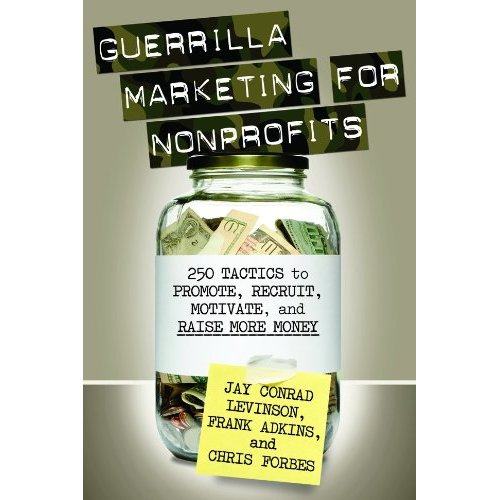
Guerrilla Marketing for Nonprofits – Join me for an interview with the co-author

July 15, 2010

Jay Conrad Levinson. Seth Godin. These are big names in marketing and specifically in Guerrilla Marketing.

There’s a new name to add to that list: Chris Forbes. He’s just co-authored Guerrilla Marketing for Nonprofits with Jay Conrad Levinson and Frank Adkins. This book is hot off the press, having been released on July 2.

On August 5 at 10:00 a.m. Calgary time I’m going to interview Chris about his new book via webinar. This is a public webinar sponsored by Elluminate. Chris is generously donating his time and expertise with us for this special event.

There’s no cost to attend. Nothing. Just come and enjoy Chris talk about his new book and share some of his 250 tactics to promote, recruit, motivate and raise more money for nonprofit organizations.

Please join us! Click here to register. There’s a registration link in the upper right hand corner. Just click on that to reserve your seat.

Feel free to pass this invitation along to others, too.

________________

Like this post? Share or Tweet it: Guerrilla Marketing for Nonprofits Webinar http://wp.me/pNAh3-c3

Update – January 2018 – This blog has had over 1.8 million views thanks to readers like you. If you enjoyed this post, please “like” it or share it on social media. Thanks!

Sarah Elaine Eaton is a faculty member in the Werklund School of Education, University of Calgary, Canada.


Tips for finding ESL educational agents

July 10, 2010

An ESL agent, also known as an educational agent, or an international education agent, is someone who brokers a relationship between prospective students and an institution, be it a university, college or privately run school.

Good agents will act as a trusted advisor for both parties, working with prospective students to find them an excellent school abroad, helping them with any necessary paper work and  coaching them on what to expect.

Good agents work with excellent, accredited schools, ensuring that the experience they are providing is the best it can be for the students.

Bad agents don’t give a rat’s behind. They take money from students, making promises that will never come true. Ever heard of an agent who promised students they’d be driven to school every day in a limousine driven by a chauffeur? I have. And I can tell you that in Canada, I’ve never seen an international student arrive at school in a limo. Ever.
Bad agents don’t care that they’re telling lies or cheating students. And really, there’s nothing you can do to make them care.

What you can do, is spend your time finding a good agent.

But how? There are a number of ways.

Though you may find agents on line, it is more likely that you’ll find organizations that work with accredited agents. You may want to check out:

My suggestion would be to target which areas of the world you’d like more students from, then approach the professional organizations in those countries that work with reputable agents.

There are probably more organizations out there than I have listed here. And of course, I have to say that I’m providing these links as information only, not endorsements. 😉 There are no guarantees that working with an accredited organization will find you a stellar agent, but it does increase your chances. The bottom line is that finding excellent agents to work with takes time. Do your homework.

Related posts:

How to find a good ESL agent: Tips from the trenches

Tips for success at educational trade fairs

______________

Like this post? Share or Tweet it: Tips for finding ESL educational agents http://wp.me/pNAh3-be

Update – January 2018 – This blog has had over 1.8 million views thanks to readers like you. If you enjoyed this post, please “like” it or share it on social media. Thanks!

Sarah Elaine Eaton is a faculty member in the Werklund School of Education, University of Calgary, Canada.