Research: ESL programs boost Calgary’s economy by $26M+ per year

September 2, 2010

How much money do ESL students bring into our city every year? That’s a question I asked myself a few years ago. I undertook an informal study to answer the question. I presented the results at an educational research forum at the University of Calgary. Then I dove right back into my PhD studies and examination preparations, leaving the study to gather dust.

I found the paper a little while ago and wanted to share it with you. I’ll be honest and say that the study was very informal, conducted out of a burning desire to have the research question answered, nothing more. I’d love to develop the work more fully at some point. If you know of others researching the economic impact of second and foreign language programs – particularly English as a Second Language, please leave a comment!

You can download the full paper from ERIC here:

Business with words: Language programs that generate revenue and impact communities

URL: http://www.eric.ed.gov/ERICWebPortal/contentdelivery/servlet/ERICServlet?accno=ED511632

Sarah Elaine Eaton, Ph.D. candidate
Presentation given at the Educational Research Forum
Faculty of Education, University of Calgary
July 18, 2006

Abstract
This paper examines the examines the  “business” of language programs. In particular, it focuses on the economic impact of English as a Second language programs physically located in Calgary, Alberta, Canada which draw and serve foreign students.  The impact such programs have on the wider community will also be explored. The results show that foreign students who study ESL in Calgary contribute a grand total of $26,250,000 to the city’s economy each year.

Read the whole paper (9 pages) on Scribd:

Business With Words

View this document on Scribd

Related posts:

__________________

Share this post: Research: ESL programs boost Calgary’s economy by $26M+ per year http://wp.me/pNAh3-iv

Update – January 2018 – This blog has had over 1.8 million views thanks to readers like you. If you enjoyed this post, please “like” it or share it on social media. Thanks!

Sarah Elaine Eaton is a faculty member in the Werklund School of Education, University of Calgary, Canada.


Formal, Non-formal and Informal Learning in the Sciences

August 18, 2010

A few months ago I shared a research report called Formal, non-formal and informal learning: The case of literacy and language learning in Canada. Following that report, I began working with a geophysicist, Heather L. Ainsworth, who also had interest in learning contexts. We collaborated and together we researched, wrote and published a companion report that took the same concepts of formal, non-formal and informal learning and applied them to science and engineering. The result was this companion report, which we co-authored.

View this document on Scribd

Formal, Non-formal and Informal Learning in the Sciences (July, 2010)

ISBN: 978-0-9733594-5-9

Formal abstract: This research report investigates the links between formal, non-formal and informal learning and the differences between them. In particular, the report aims to link these notions of learning to the field of sciences and engineering in Canada and the United States, including professional development of adults working in these fields. It offers practical, concrete examples as well as a conceptual framework for understanding formal, non-formal and informal learning. It offers examples of how all three types of learning are valued in the fields of science and engineering in both educational and professional contexts. It also discusses science literacy, what it is and how popular media is elevating science literacy in general. This is a companion report to “Formal, Non-formal and Informal Learning: The Case of Language Learning and Literacy in Canada” (February, 2010).

Full-text copies of this report may be downloaded from:

National Library of Canada Online Archives (Note: This link works in Explorer and Firefox.)

Related posts:

Formal, Non-formal and Informal Learning (Infographic) https://wp.me/pNAh3-266

Formal, non-formal and informal learning: The case of literacy and language learning in Canada

Formal, non-formal and informal education: What Are the Differences?

Formal, Non-formal and Informal Learning: A podcast

Breathtaking Impact of Volunteers’ Contribution to Non-formal and Informal Literacy Education in Alberta

________________

Tweet or Share this article: Formal, Non-formal and Informal Learning in the Sciences http://wp.me/pNAh3-gX

Update – January 2018 – This blog has had over 1.8 million views thanks to readers like you. If you enjoyed this post, please “like” it or share it on social media. Thanks!

Sarah Elaine Eaton is a faculty member in the Werklund School of Education, University of Calgary, Canada.


Global Trends in Language Learning in the 21st Century: Webinar Follow Up

July 27, 2010

With participants, from Canada, the U.S, Romania, Germany, Guatemala, this was an amazingly international, multicultural and interactive session! Thanks for everyone who joined in today.
If you couldn’t make today’s webinar on Global Trends in Language Learning in the 21st Century, generously sponsored by Elluminate, don’t fret. I’ve archived everything for you.

Webinar recording
Check out the webinar recording. Note that this link may ask to download Java onto your computer. If you click “yes”, you’ll be able to access the recording, slides and all the chat that happened during the session.

Handouts

Click here for a copy of the handouts from the webinar.

Research report

This webinar was based on a research report that’s been archived in 3 countries now. Click here for a post with links to the full article.

Original webinar info

Want the information about the webinar? See this post.

Slides
I’ve archived the slides on Slideshare, here:

Testimonials

“This was the first time I attended a webinar, apart from all the conference calls organised at my place of work. I found it interesting, first because it shared information from my area of expertise, and also because it addressed a stringent matter of all teachers nowadays- how to take the leap into the 21st century without getting severely bruised.” – Anca Costea, Little London Nursery School, Bucharest, Romania.

“Sarah Eaton set out the results of here research in a very well structured and informative talk that provided many useful ideas for engaging language learners – especially younger learners – more effectively.” – Carl Dowse, Germany.

“My work in family literacy is backed up by emerging trends of the 21st century according to Dr. Eaton’s meta-research. In all fields of learning, we need to keep current on why people are formally or informally motivated to learn and how they would like to be equipped to do so. This webinar advances us towards a clear plan of taking action towards a literacy that allows all learners to communicate through thoughts and actions and respectively be able to reflect upon them.” – Tracy Howk, Literacy for Life Foundation

_______

Like this post? Share or Tweet it: Global Trends in Language Learning in the 21st Century: Webinar Follow Up http://wp.me/pNAh3-dE

Update – January 2018 – This blog has had over 1.8 million views thanks to readers like you. If you enjoyed this post, please “like” it or share it on social media. Thanks!

Sarah Elaine Eaton is a faculty member in the Werklund School of Education, University of Calgary, Canada.


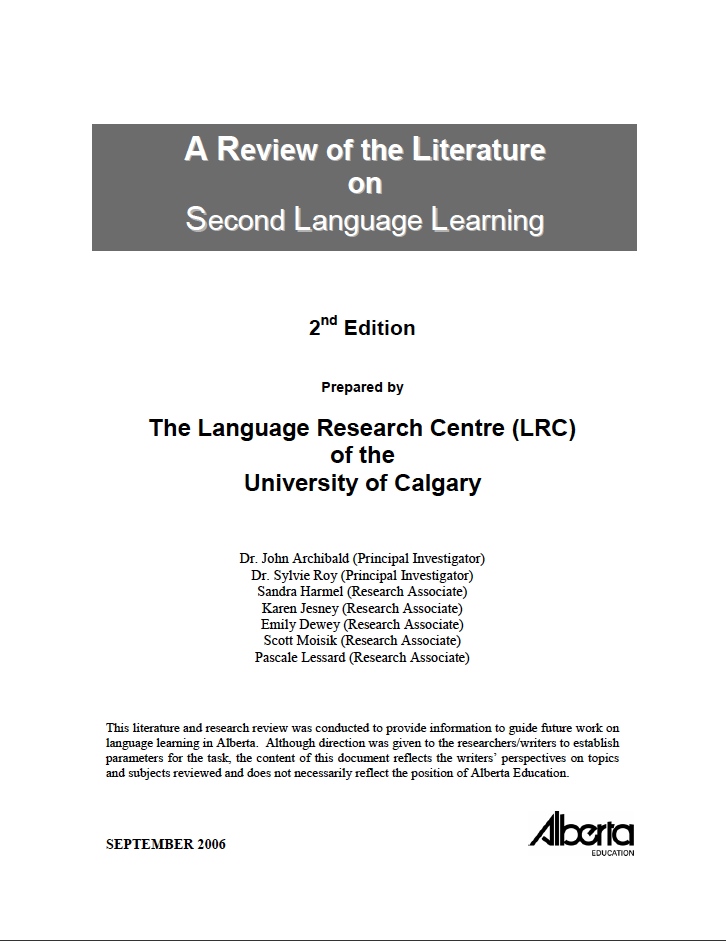
A Review of the Literature on Second Language Learning

July 19, 2010

Written Dr. John Archibald,  Dr. Sylvie Roy and other researchers at from the Language Research Centre (LRC), of the University of Calgary, A Review of the Literature on Second Language Learning, 2nd ed. Published in 2006, this study examines 4 key areas:

  1. Effects of a second language on a person’s first language
  2. The role of content instruction in offering a second language
  3. Effects of second language learning on students with special needs
  4. Effects of learning and third language on students for whom English is a second language.

Some key findings of this research are:

  • Exposure to a second language can enhance non-linguistic skills such as divergent thinking, attitudes towards others and math skills.
  • Acquiring knowledge in a second language does not impede first language development.
  • Significant time investment is required to acquire full fluency.
  • Content-based language teaching (e.g. teaching math or science in a second language) can increase students’ ability to make connections between second language study and the outside world.
  • Students with special needs can learn second languages.
  • Acquiring a third language is a common occurrence around the world.
  • It helps to learn a third language if you have a strong proficiency in a first language.

________

Share this post: A Review of the Literature on Second Language Learning https://wp.me/pNAh3-bO

Update – January 2018 – This blog has had over 1.8 million views thanks to readers like you. If you enjoyed this post, please “like” it or share it on social media. Thanks!

Sarah Elaine Eaton is a faculty member in the Werklund School of Education, University of Calgary, Canada.


Global Trends in Language Learning in the 21st Century: Webinar

July 14, 2010

Did you miss this webinar? Check out the follow-up post for links to the slides, handouts and recording.

Global Trends in Language Learning in the 21st Century: Webinar
http://www.learncentral.org/node/86167
Tuesday, July 27, 2010
Login start: 09:45 Mountain Time
Webinar: 10:00 – 11:00 Mountain Time

In this webinar we’ll talk about the findings of my new study that reveals what’s hot and what’s not in language learning in the 21st century.

The study, “Global Trends in Language Learning in the Twenty-First Century”, found, among other things, that public speaking and presentation skills, even for second language students, are enjoying new levels of prestige in the Obama era. “For the first time in decades, there is a U.S. President who is wooing young people with his power to communicate verbally. This is having an impact not only in the United States, but across the globe. Second language speech contests, debates, poetry readings, and story telling are particularly trendy,” the report reveals.

This is just one of a number of new trends in language learning you’ll want to hear about.  Join me as I share the highlights of this new research. The webinar will include a 20 minute presentation and 35 minutes for discussion.

How to join the webinar:

1) Mark the date and time of the event in your calendar

2) at 09:45 Mountain Time (adjust for your time zone!) on July 27, click on this URL:
 https://sas.elluminate.com/site/external/launch/dropin.jnlp?sid=lcevents&password=Webinar_Guest

3) Have a pen and some paper handy to take notes.

With thanks to our sponsor, Elluminate (www.elluminate.com), for providing the technology to make this webinar available to you free of charge.

Remember to convert the time of this webinar to your own time zone. You can do this at http://www.timeanddate.com/worldclock/converter.html. In the top of the box where it asks you to “Select time and place to convert from” choose “Canada – Alberta – Canada”. In the box under that, select your country and closest city.

_______________

Like this post? Share or Tweet it: Global Trends in Language Learning in the 21st Century: Webinar http://wp.me/pNAh3-bC

Update – January 2018 – This blog has had over 1.8 million views thanks to readers like you. If you enjoyed this post, please “like” it or share it on social media. Thanks!

Sarah Elaine Eaton is a faculty member in the Werklund School of Education, University of Calgary, Canada.