How to Market Your Language or Literacy Program – Idea #2 Create an image for your program

March 3, 2010

Creating an image for your program is an important part of marketing and promoting it. Think about what you want your prospective students to imagine when they see your marketing materials.

Is your program based on strict academics, intense cultural immersion, workplace learning or a fun holiday program? Once you have determined what image you want for your program, you can proceed to create that image through the photos, fonts and layouts that you choose for your marketing materials. For example, a fun holiday program does not need a coat of arms on its letterhead, but a program based on serious academic study may benefit from a more
traditional image. What is the image you want to create?

The creation of a program or school image is one that you may want to develop through a committee. The input from various committee members can help you clarify what message you want to send out to the world and what you want to avoid. Your committee can include a variety of perspectives such as administration, teaching staff, even students and alumni. Having someone with some training in branding or marketing may be helpful, too.

Remember that it is easier to create an image from the beginning, than it is to change an image that has already been established. Your aim is to create a strong image for your program so that when prospects and competitors see your marketing material they quickly associate it with your program.

This post is an excerpt from Sarah’s book, 101 Ways to Market Your Language Program

__________

Share this post: How to Market Your Language or Literacy Program – Idea #2 Create an image for your program  http://wp.me/pNAh3-T

Update – January 2018 – This blog has had over 1.8 million views thanks to readers like you. If you enjoyed this post, please “like” it or share it on social media. Thanks!

Sarah Elaine Eaton is a faculty member in the Werklund School of Education, University of Calgary, Canada.


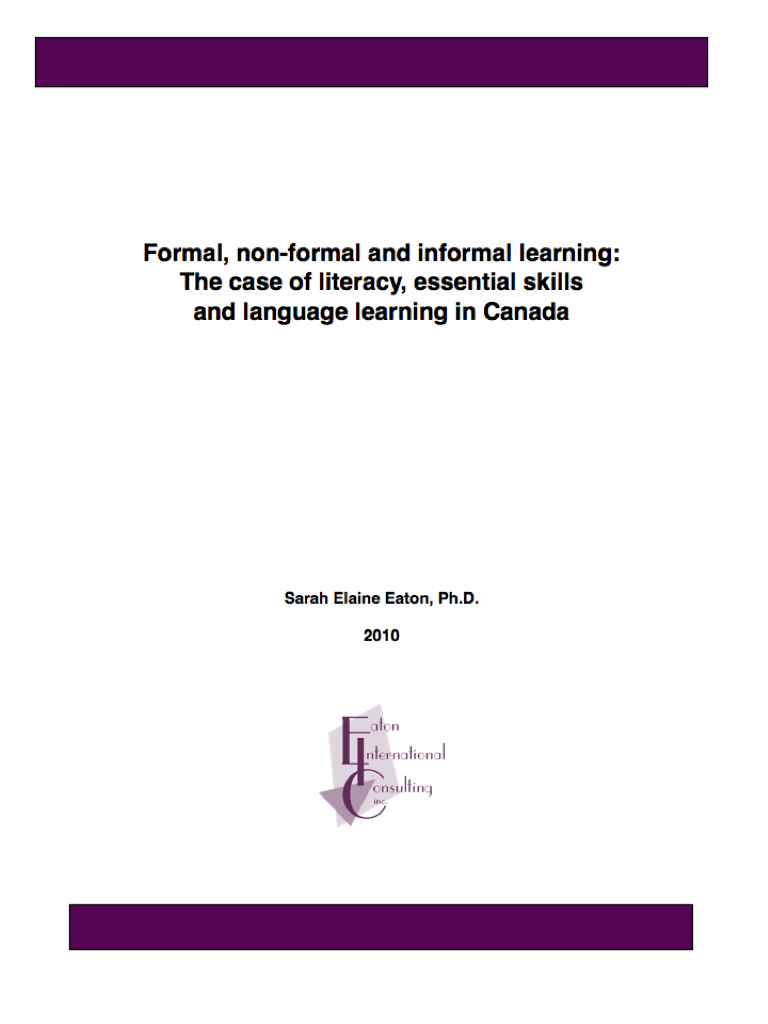
Formal, non-formal and informal learning: The case of literacy and language learning in Canada

February 16, 2010

This new research report is freely available in e-format (.pdf).

Executive Summary

This research report investigates the links between formal, non-formal and informal learning and the differences between them. In particular, the report aims to link these notions of learning to literacy and essential skills, as well as the learning of second and other languages in Canada.

Philosophical underpinnings of this research are:

  • There is value in learning of all kinds.
  • Learning is a lifelong endeavour.
  • An interdisciplinary approach is valuable.

Notions of formal, non-formal and informal learning may be briefly outlined as:

Formal learning – This type of learning is intentional, organized and structured. Formal learning opportunities are usually arranged by institutions. Often this type of learning is guided by a curriculum or other type of formal program.
Non-formal learning – This type of learning may or may not be intentional or arranged by an institution, but is usually organized in some way, even if it is loosely organized. There are no formal credits granted in non-formal learning situations.
Informal learning – This type of learning is never organized. Rather than being guided by a rigid curriculum, it is often thought of experiential and spontaneous.

– (Organisation for Economic Co-operation and Development / Organisation de Coopération et de Développement Economiques (OECD), n.d.; Werquin, 2007)

Examples are given for literacy and essential skills, as well as second and other languages for each of the categories mentioned above.

Finally, the examples of systems developed value different types of learning using asset-based approaches are given. The tools developed by Human Resources and Skills Development Canada are explored for the case of literacy. The Common European Framework of Reference for Languages developed by the Council of Europe is considered for second and other languages.

Copies of the report may be accessed through:

National Adult Literacy Database (Canada)

http://library.nald.ca/research/item/8549

or

European Association of Education for Adults (Helsinki, Finland)

http://www.eaea.org/news.php?aid=17397&k=2088&%20d=2010-02

or

National Library of Canada – Online Archives Collection (Canada)

http://epe.lac-bac.gc.ca/003/008/099/003008-disclaimer.html?orig=/100/200/300/eaton_intl_consulting/formal_non/Literacy_languages_and_types_of_learning.pdf

or

The Encyclopedia of Informal Education

http://www.infed.org/archives/e-texts/eaton_formal_nonformal_informal_learning.htm

or

Global Literacy Foundation

http://globalliteracy.org/Eaton

or

Centre for Adult English Language Acquisition (CAELA) (United States)

http://www.cal.org/CALWebDB/ESLResourceDB/ (Resource #0274)

New! August, 2010 – Check out the companion report: Formal, Non-Formal and Informal Learning in the Sciences.

Related posts:

Formal, non-formal and informal education: What Are the Differences?

Formal, Non-formal and Informal Learning (Infographic) https://wp.me/pNAh3-266

Formal, Non-formal and Informal Learning: A podcast

Breathtaking Impact of Volunteers’ Contribution to Non-formal and Informal Literacy Education in Alberta

Formal, Non-formal and Informal Learning in the Sciences

The many faces of non-formal learning

____________

If you found this post helpful, please click “Like” below and share it with others.

Here’s a link for sharing:

Formal, non-formal and informal learning: The case of literacy and language learning in Canada http://wp.me/pNAh3-C

Update – January 2018 – This blog has had over 1.8 million views thanks to readers like you. If you enjoyed this post, please “like” it or share it on social media. Thanks!

Sarah Elaine Eaton is a faculty member in the Werklund School of Education, University of Calgary, Canada.