Honoured to be an Adjunct

October 3, 2011

University of Calgary

I received the official letter today from the Provost and Vice-President (Academic) at the University of Calgary, appointing me as an Adjunct Assistant Professor in the Faculty of Arts’ Department of Germanic, Slavic and East Asian Studies. I owe so many people thanks for making this happen. At the top of the list are:

Dr. Mary O’Brien, Director, Language Research Centre

Dr. Rahat Naqvi, Associate Director, Language Research Centre

Dr. Florentine Strzelczyk, Head,  Germanic, Slavic and East Asian Studies

Dr. Olga Mladenova, Professor of Russian, Germanic, Slavic and East Asian Studies

I also owe a debt of gratitude to other colleagues at the Language Research Centre, as well as the administrative staff in both GSEA, the Dean of Arts office and others who helped to make this a reality. This has been in the works for months and involved so many people collaborating and supporting. I am honoured and thrilled and I promise to do my best to contribute in a positive way to the University community.

________________________________

Update – January 2018 – This blog has had over 1.8 million views thanks to readers like you. If you enjoyed this post, please “like” it or share it on social media. Thanks!

Sarah Elaine Eaton is a faculty member in the Werklund School of Education, University of Calgary, Canada.


Global Issues in Language Teaching and Learning

June 23, 2011

University of Calgary A few colleagues and I at the University of Calgary are collaborating to team teach a block week course this fall:

LANG 599 / 699: Global Issues in Language Teaching and Learning
Block Week Fall 2011: September 6-10, 2011

Course description:

In today’s multilingual society, each of us is both a language learner and a language teacher. In this interdisciplinary course we will discuss current research and its practical implications as they relate to language teaching and learning. Students will engage with real-world data and will have the opportunity to publish course papers.

Instructors: Dr. Mary O’Brien, Dr. Sarah Eaton, Roswita Dressler and Katherine Mueller.

Course location: This course is taught live (face-to-face) at the University of Calgary.

Prerequisites: Senior or graduate student standing.

____________________________

Update – January 2018 – This blog has had over 1.8 million views thanks to readers like you. If you enjoyed this post, please “like” it or share it on social media. Thanks!

Sarah Elaine Eaton is a faculty member in the Werklund School of Education, University of Calgary, Canada.


Lifelong Language Learning: Benefits for 21st Century Global Citizens

April 1, 2011

University of CalgaryApril 2 – 9, 2001 is International Adult Learners’ Week. The Language Research Centre, in conjunction with Alberta Advanced Education and Technology and UNESCO, is hosting a panel discussion on the importance of lifelong language learning, mutilingualism and multiculturalism.

This panel brings together thought leaders from a variety of organizations in Calgary who are experts on language learning, multilingualism and multiculturalism. They will share their views on the importance of language learning in the 21st century and its relevance to us as Calgarians, Canadians and global citizens.

Expert panelists include:

  • Mr. Wayne Cao, MLA Calgary Fort (to be confirmed)
  • Dr. Mary O’Brien, Director, Language Research Centre
  • Dr. Rahat Naqvi, Associate Director, Language Research Centre
  • Dr. Jürgen Meisel, Distinguished Fellow, Language Research Centre
  • Mr. Michael Gretton, Southern Alberta Heritages Language Association (SAHLA)
  • Ms. Shaheen Murji, Mount Royal University, International Education and Past President, Alberta Teachers of English as a Second Language

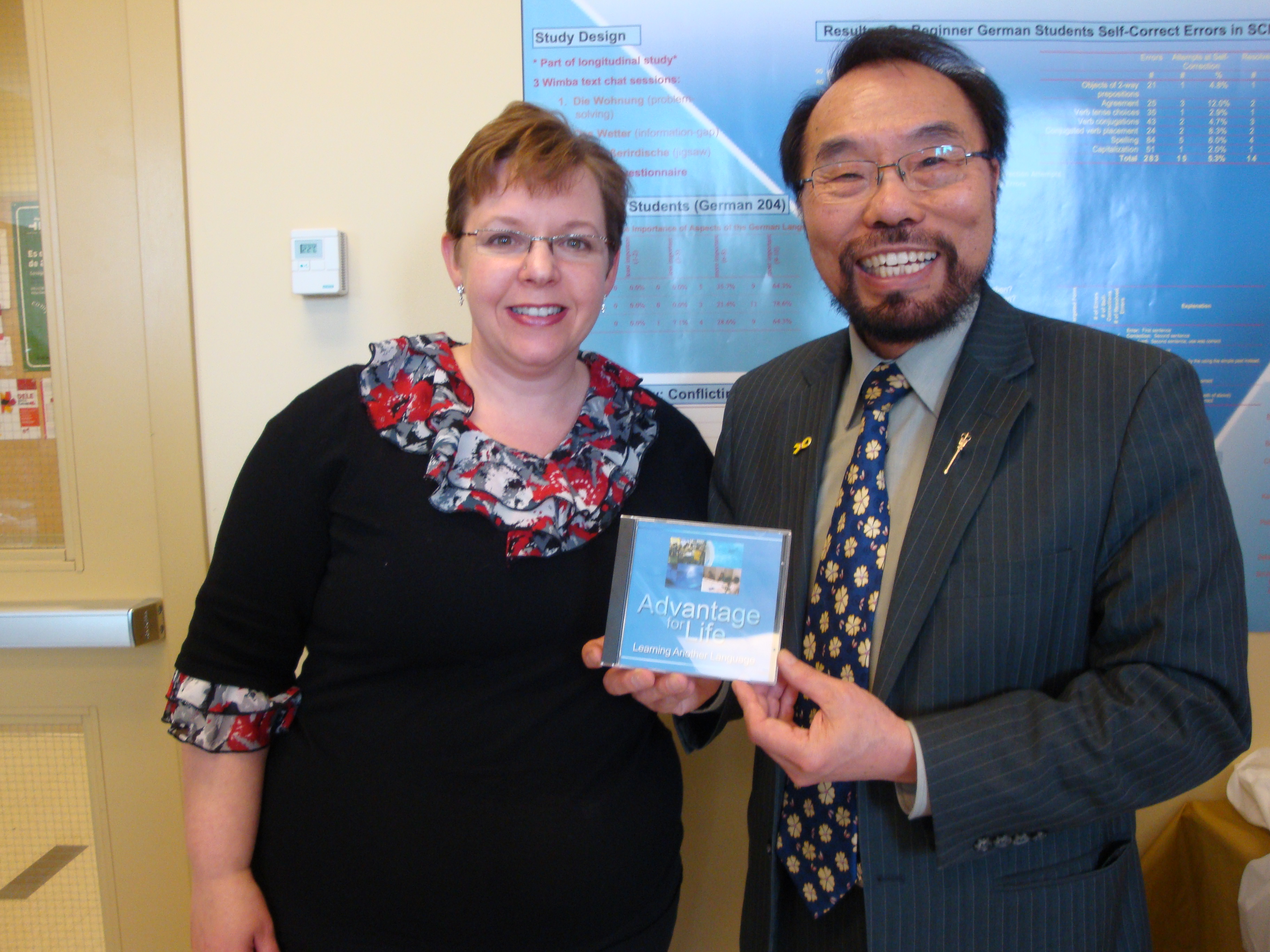
    Wayne Cao, MLA, Calgary Fort and Dr. Sarah Eaton

    Mr. Wayne Cao, MLA, Calgary Fort with me, holding the “Advantage for Life” CD produced by the Language Research Centre. This photo was taken at the IALW event.

Student Discussant: Ms. Jacqueline Warrell, PhD Candidate, Graduate Division of Educational Research

Event host: Dr. Sarah Eaton, Research Associate, Language Research Centre

The Institute for Innovation in Second Language Education (IISLE) will join us via videoconference from Edmonton.

For more information, visit these websites:

Alberta Advanced Education and Technology (AAET)
Language Research Centre

View this document on Scribd

_________________

Share this post: Lifelong Language Learning: Benefits for 21st Century Global Citizens http://wp.me/pNAh3-Bv

Update – January 2018 – This blog has had over 1.8 million views thanks to readers like you. If you enjoyed this post, please “like” it or share it on social media. Thanks!

Sarah Elaine Eaton is a faculty member in the Werklund School of Education, University of Calgary, Canada.


Leadership through Language Learning and Teaching: The Case of Gandhi

May 11, 2010

In February I presented a paper called “Leading through Language Learning and Teaching: The Case of Gandhi” at the “Interdisciplinary Language Research: Relevance and Application Series” at the Language Research Centre at the University of Calgary.

I talked about a study I conducted of Gandhi’s autobiography, An autobiography or the story of my experiments with truth.
My purpose was to uncover and analyze Gandhi’s experiences as a second language learner. Here’s what I found:

1) Gandhi learned 11 languages throughout his life, including his native Gujarati.

2) He used his knowledge of other languages to connect with others on a deeper level, helping them fight for human and civil rights.

3) He believed that all children should learn more than one language.

He says, ““It is now my opinion that in all Indian curricula of higher education there should be a place for Hindi, Samskrit, Persian, Arabic and English, besides of course the vernacular.” (Gandhi, 1948, p. 9)

For Gandhi, language learning and leadership were intertwined. He saw language learning as a way to communicate with others in his own country, to connect with others on a deeper level, understanding their human condition from a compassionate point of view.

While not everyone who learns another language may go on to have a profound effect on the world to the degree that Gandhi did, any person who learns a new language grows as a human being because they can communicate with others in new ways. This helps to develop a more profound curiosity about the world around us, which leads us to learn more about that world. Learning more about the world and those who live in it leads to deeper understandings of other cultures, other values and other ways of understanding life, love, politics, spirituality and all that is important to humans. Learning other languages opens up new possibilities for personal and professional growth, new opportunities to do meaningful work and ultimately, to value others more deeply because we can communicate with them better and understand them.

The presentation included a practical classroom activity for students.

The full-text paper is publicly available on the ERIC data base.

http://www.eric.ed.gov/ERICWebPortal/contentdelivery/servlet/ERICServlet?accno=ED508664

___________

Related posts:

______________________

Share this post: Leadership through Language Learning and Teaching: The Case of Gandhi http://wp.me/pNAh3-4L

Update – January 2018 – This blog has had over 1.8 million views thanks to readers like you. If you enjoyed this post, please “like” it or share it on social media. Thanks!

Sarah Elaine Eaton is a faculty member in the Werklund School of Education, University of Calgary, Canada.