10 Tips for Success as an Online Learner

April 15, 2011

Some of the same principles that apply to face-to-face learning also apply online, but the activities are different:

1. Arrive early

In the same way that you would budget time to find a parking space, walk to your classroom and get settled for a face-to-face training session, you need to arrive early for an online learning session. Your “arrive early” activities include:

  • Logging on
  • Testing your audio and mic
  • Saying hello to fellow participants and the facilitator

Plan to arrive 10 to 15 minutes ahead of your scheduled start time. That way, when the session starts, you’re ready to go.

2. Just say “No” to distractions

In a face-to-face learning environment, you can’t do laundry, answer the door, cook lunch, deal with staff questions, answer inquiries, staff the front desk or do any number of other activities that would detract from your learning. Create a “learning sanctum” that is free of distractions and allows you to be fully present during your e-learning session.

  • Turn off your telephone(s).
  • Put a sign on your door that says “Do Not Disturb”.
  • Go to the bathroom before the session starts.

3. Be An Active Learner

What are the qualities of an active learner in a bricks-and-mortar classroom? Someone who pays attention, doesn’t distract other learners, doesn’t allow themselves to be distracted and seems genuinely interested. The same thing applies on line:

  • Listen actively
  • Ask questions
  • Take notes (See the next point…)

4. Take notes – in a way that makes sense for you

Whether you use  a traditional notebook and a pen or a word processing program, taking notes is an important part of learning. It helps you capture the main ideas and embed them in your brain. Notes also give you something to refer back to later on.

Not everyone is comfortable taking notes on a mobile device or hearing a keyboard click as they’re listening. Other people may get hand cramps if they hold a pen too long. Don’t get too caught up in the idea of using technology for everything. How you choose to take notes is incidental. The important thing is to do it. Write down key points to help you remember them later.

5. Engage with other participants

You wouldn’t sit in a classroom and not speak to anyone else would you? Make a point of engaging with other participants. Ask questions, make comments, give kudos where they’re due. Remember that, just like you, those are human beings who are sitting in front of their respective screens. More than anything, humans crave connection. Try to connect personally with at least one other person in your session, if you can.

6. Go Green

E-learning provides a tremendous opportunity to be environmentally responsible. Experiment with reading on line. Test different font sizes and document sizes to find what works for you. Try not to print out every single handout, or .pdf file.

Digital materials are often meant to be interactive. If you print them, you lose the interactivity and web links may not show up in your print out.

7. Organize Your Stuff

In the same way that it’s frustrating to have a messy bookbag or a binder with papers falling out, it can be just as frustrating to have your digital materials scattered all over the place.

Set up folders and sub-folders on your computer to organize and store your files, course materials and handouts. Not only will this help you find it more easily later, it will also help to “make it yours”. Synch between devices to keep everything current.

8. Share and be social

Share online links to other resources. Explore online bookmarking sites (e.g. Diigo or StumbleUpon) to store and share interesting resources you find. If you’d like more resources or information, ask others to share with you. Be sure to thanks others who share interesting and helpful resources with you.

9. Be patient and kind

As in a traditional classroom, there are likely to be learners who are less capable than you… and others who are more capable. In an online environment, this applies as much ability with technology, as it does to the content. Think of comfort and ability with technology as a continuum. People will be scattered all along the continuum. Be patient with those who aren’t as far along as you.

10. Find reasons to celebrate and have fun!

Remember when you were a kid in school and you got a gold star from the teacher? Humans respond well to positive reinforcement, regardless if it is face-to-face or online. Successful online learners look for opportunities to compliment and notice others’ progress. They are also self-aware and self-realized learners who acknowledge their own progress. Cheer on others when you see them making leaps and bounds and give yourself a pat on the back when you do a good job. Remember, learning is supposed to be fun!

___________

Share this post: 10 Tips for Success as an Online Learner http://wp.me/pNAh3-Cs

Update – January 2018 – This blog has had over 1.8 million views thanks to readers like you. If you enjoyed this post, please “like” it or share it on social media. Thanks!

Sarah Elaine Eaton is a faculty member in the Werklund School of Education, University of Calgary, Canada.


Petition Saves Second Language Programs at University of Saskatchewan

April 14, 2011

A recent news release from the Academia Group gave highlights from this article in the Star Phoenix by Sean Tremblath: “U of S language program cuts re-examined after petition“. The article starts with this punchy first line:

“A University of Saskatchewan language program is being overhauled after speculation of major cutbacks sparked a student petition with almost 2,000 names.”

The article goes on to talk about scheduled cuts to language programs at the University of Saskatchewan, and in particular to the German program. The result was a petition to save the program that received 2000 signatures – in 3 days. The article quotes David Parkinson, Vice Dean of Humanities and Fine Arts, a man I’ve met in my professional travels and have a great deal of respect for. He can see “the big picture” and can balance students’ needs with high level administrative pressures. I’ve admired his work for a long time… and don’t envy him one bit right now.

Language programs are being cut or having their funding reduced at alarming rates in North American schools and universities. Really, it’s shameful.

Here’s my response, in the form of a Letter to the Editor of the Star Phoenix:

I’m writing in response to Sean Tremblath’s article “U of S language program cuts re-examined after petition”, published on April 13, 2011.

Three cheers for the students at U Sask, who evidently know the value of learning languages in the 21st century and were willing to petition to keep language courses alive and well.

Cutbacks to second and modern language programs in North American universities is very troubling – particularly when all of Europe, as well as countries on other continents are encouraging – even mandating – the study of additional languages.

I’ve met David Parkinson, Vice Dean of Humanities and Fine Arts, who is quoted in the article and I have a great deal of respect for him. He’s a man who can see “the big picture” and can balance students’ needs with high level administrative pressures.

I’ve admired his work for a long time… and don’t envy him one bit right now. He now faces a situation that language program administrators across North America face: Advocating for the viability of modern language programs in a system that has changed its criteria for what it will support based on bottom-line numbers and a philosophy that says “bums in seats = program success”.

Across Canada and the US, we seem preoccupied with cutting programs that have lower enrolments or those for which there is less financial justification. As a specialist in the integration of business practices and philosophies into higher education management, and in particular, the marketing and management of language programs in Canadian universities, I am saddened when I see this. My own research in this field has shown me that the bottom line is not the only indicator of success in education. In fact, it’s probably one of the least powerful indicators of success of an educational program. Better questions to ask are: What skills are needed by 21st century professionals and leaders? How do we, as educational institutions, ensure that we are building the capacity of our students to set them up for success as global citizens in a digital age?

Language learning programs don’t need to be cut from educational institutions. They need to be updated. Get away from literature-based programs that revolve around faculty interests and focus on the students. It’s time to incorporate real-world language skills that students can carry with them into their future professional and personal lives. Focus on global citizenship, technology, mobile language learning (MALL), and other aspects of learning that actually make sense and are relevant for language learners of today.

If we updated the programs with a focus on making them truly learner centred, rather than focussing on the traditional literature-based programs that reflect the specializations of current or soon-to-retire faculty, then we might be better at engaging our students and increasing our enrolments.

Kudos to the students and all those who signed the petition at U Sask for having the vision to see the benefits of language learning in the 21st century. The challenge goes back to the institution to create relevant programs that keep learners engaged, provide them with real world skills and develop courses that fill the seats because they’re so darned interesting and relevant that students will beat down the doors to get into them.

I encourage you to read the original article and send your own Letter to the Editor to support the continuation and growth of second language programs at Canadian universities!

____________

Share this post: Petition Saves Second Language Programs at University of Saskatchewanhttp://wp.me/pNAh3-Ck

Update – January 2018 – This blog has had over 1.8 million views thanks to readers like you. If you enjoyed this post, please “like” it or share it on social media. Thanks!

Sarah Elaine Eaton is a faculty member in the Werklund School of Education, University of Calgary, Canada.


The 3 C’s of 21st Century Learning and Leading: Creativity, Collaboration and Capacity-Building

April 13, 2011

What are the skills needed for 21st century leaders? I’d argue that they’re the same skills needed for 21st century students and learners. Why? Because the students and learners of today are not only the leaders of tomorrow, but also the leaders of today. Notions of leadership are changing. The component of leadership that involves wisdom gained through life experience will always rest with those who have more of that experience. But young people are pushing the boundaries of technology and social change. Here are the three skills leaders of today – and tomorrow – need.

Sarah Eaton - blog - iStock photo

Creativity

Leadership today need to be creative problem solvers. The issues that are arising challenge all that we know about the world and how to make it right. Authoritarian or cookie-cutter approaches to problem solving simply won’t work in the 21st century. Even the ability to “think outside the box” won’t be enough. Instead, learners and leaders will need to be able to say, “‘Box? There is no box.”

If you’ve seen the movie, The Matrix, you may remember a scene with the small boy who bends a spoon with nothing more than his mind. When Keanu Reeves’ character, Neo, asks him how he bent the spoon, the boy replies, “There is no spoon”. A similar idea of thinking beyond what we currently know to be possible will be a common characteristic of 21st century leaders. A creative and open mind will drive that ability.

Sarah Eaton - blog - group of children

Collaboration

Young learners and senior leaders alike need to know how to play well with others. We accomplish more when we work together. There needs to be trust, appreciation and a willingness to join forces and collaborate. Phrases such as, “Trust me… just do it my way.” or “Because I’m the boss and I say so!” just won’t cut it in this century.

In this century, everyone has the ability and capacity to be both a follower and a leader. Those who try to exert authority over others without their consent will not only be questioned, they’re likely to be shunned. Learning to appreciate others’ strengths won’t be enough… Learning how to leverage each other’s strengths will be a key to working together, creating new work, solving problems and achieving new goals.

Geographical boundaries have been almost completely transcended in the first decade of this century. In a few more decades, people won’t think twice about working with someone at a distance on a collaborative project. Those who don’t partner and collaborate effectively will be left behind. In a century driven by technology, people skills are – and will continue to be – more important than ever.

Capacity-Building

Twenty-first century leaders will have the ability to look at those around them and help them build their capacity in order to help them grown personally. That growth will add to the organizational growth. In addition to leveraging one’s current strengths, there will be a drive to explore and learn by doing.

This century, more than any other period in history is passionate about – even addicted to – creating new knowledge using technology, to inventing new and visionary projects and making things happen on a large – even global – scale. To do so, a dedication to lifelong learning not only for ourselves, but also for our colleagues, partners and team members will become the norm. Learning in a traditional classroom has already been extended to the Web, to podcasts, to television… Learning, professional development and continuous self-creation will happen almost any place, any time.

Each of us is both a learner and a leader in the 21st century. I, for one, believe in our collective potential and look forward to what we can create together.

____________________

Share this post: The 3 C’s of 21st Century Learning and Leading: Creativity, Collaboration and Capacity-Building http://wp.me/pNAh3-BT

Update – January 2018 – This blog has had over 1.8 million views thanks to readers like you. If you enjoyed this post, please “like” it or share it on social media. Thanks!

Sarah Elaine Eaton is a faculty member in the Werklund School of Education, University of Calgary, Canada.


“Let Them Build It and It Will Be Amazing”

April 8, 2011

In over 20 years in the education sector, I’ve managed and collaborated with others to develop courses and programs in a variety of ways. Each has their merits. Using the wrong approach can be disastrous.

I was recently hired by a major organization to undertake the development of a new program for them. I thought about how to go about doing this and, because I don’t know them very well, I said, “Look, there are 3 ways we can do this. Here are the options:”

Traditional Approach

Tried and true. Teacher-centered. Deliver as much solid content as possible, to as many people as possible, in the shortest amount of time. Mostly one-way (trainer-to-participant) communication.

This approach is the easiest and in some ways, the most fun (at least for the developer). I develop my goals, objectives and outcomes, build content and deliver it. If I’ve done my job right, someone else can step right in and deliver the content. In the professional training and speaking world, this is called “canned content”. You literally open up the package of materials and feed it to the participants. Or to use another analogy, the program developer is the architect, construction company and interior designer. Once you have finished the job, you invite people in.

I can churn out a job like this on a fairly tight timeline. Because of my own tendency towards perfectionism, no one gets invited to see my work before I’m happy with it. And I’ve been doing this a long time, so I know how to produce quality and do it quickly.

Interactive Approach

This approach allows for increased learner interactivity. Feed them content, and keep them engaged. Allows time at regular intervals for discussion and interaction, rather than “saving all the questions until the end”.

The Interactive Approach, although sometimes cloaked as “learner-centered”, it is really still a “teacher-centered” approach, but does allow participants to ask more questions and permits some lively discussion. The teacher or trainer is very much in control of what happens, how it happens and when it happens. And it’s expected that he or she will maintain control throughout the process.

The teacher needs to know how to keep the discussion on track, cut off those who aren’t moving in the appropriate direction or who take up too much time and generally be an authority figure who guides the process, while building in some flexibility. The program developer is the architect, construction company and may invite others to give input on the final touches, but really, what they say doesn’t change much.

Designing a course like this is much like building a traditional course, except that you build in allowances for interactivity. Over the past 10 years, most of the projects I’ve been involved with have involved this type of project. It allows the client to pay lip service to the notion of learner involvement, without any fundamental changes to how they’ve always done things.

Participatory Capacity-Building Approach

Innovative. Edgy. Highly collaborative and creative. Teacher is replaced by a facilitator who is OK relinquishing some control to participants as they drive the learning process forward.

The Participatory Capacity-Building Approach is likely to be somewhat uncomfortable for participants, since they will be challenged to try new ways of doing things (e.g. using new technologies that they’re not entirely comfortable with). Participants are challenged to be co-creators of new knowledge, as they engage in peer-to-peer-teaching-and-learning. Saying it is an “active learning process” is an understatement.

Essentially, you construct a solid frame. Then you give the learners the tools to build around it, adding to the design, rolling up their sleeves and getting in on the design and doing some of the labour. They then add the final touches. The final product is their work (likely with a few mistakes here and there). In the end, they own it… and they know it. It ends up being a place to call home because they’ve made it themselves.

From a course developer’s point of view, it is highly challenging. The frame you build needs to be rock solid. It needs to make sense to the participants. They must agree to participate, or nothing is built. You have know what tools to give them and show them how to use them (safely) in a short period of time. You must give them guidance on how to protect themselves from distractions and overcome obstacles (such as fear, anxiety and perfectionism). You have to let them know that perfection is not the goal – creation is. You have to let them fail (just a little) and allow them to get up and try again. It requires a facilitator who is comfortable being uncomfortable, who inspires creativity and doesn’t cling to control.

I’ve used this approach with my own classes and internal project staff, but less so with external clients. It’s an uncomfortable place for many organizations. I once thought this approach would be great for a certain client, but when I designed a participatory course for them, they freaked. They said, “We don’t want to build capacity! We just want the frickin’ content!”

I learned my lesson. Since then, I’ve always presented the options. Most clients don’t go for the third option… Too radical… Too uncomfortable.  That is, until recently. A new, highly forward-thinking client, has just said, “Our people do good work. Give us the tools and show us how to build it. I don’t know what we’ll create, but I know it’ll be amazing.”

A leader who believes so deeply in the potential of their people is inspiring and exhilarating to work with.

Let them collaborate (Latin for “work together”).

Let them create something new.

Provide opportunities for them to build their capacity.

Watch them build something amazing.

___________

Share this post: “Let Them Build It and It Will Be Amazing” http://wp.me/pNAh3-BM

Update – January 2018 – This blog has had over 1.8 million views thanks to readers like you. If you enjoyed this post, please “like” it or share it on social media. Thanks!

Sarah Elaine Eaton is a faculty member in the Werklund School of Education, University of Calgary, Canada.


Lifelong Language Learning: Benefits for 21st Century Global Citizens

April 1, 2011

University of CalgaryApril 2 – 9, 2001 is International Adult Learners’ Week. The Language Research Centre, in conjunction with Alberta Advanced Education and Technology and UNESCO, is hosting a panel discussion on the importance of lifelong language learning, mutilingualism and multiculturalism.

This panel brings together thought leaders from a variety of organizations in Calgary who are experts on language learning, multilingualism and multiculturalism. They will share their views on the importance of language learning in the 21st century and its relevance to us as Calgarians, Canadians and global citizens.

Expert panelists include:

  • Mr. Wayne Cao, MLA Calgary Fort (to be confirmed)
  • Dr. Mary O’Brien, Director, Language Research Centre
  • Dr. Rahat Naqvi, Associate Director, Language Research Centre
  • Dr. Jürgen Meisel, Distinguished Fellow, Language Research Centre
  • Mr. Michael Gretton, Southern Alberta Heritages Language Association (SAHLA)
  • Ms. Shaheen Murji, Mount Royal University, International Education and Past President, Alberta Teachers of English as a Second Language

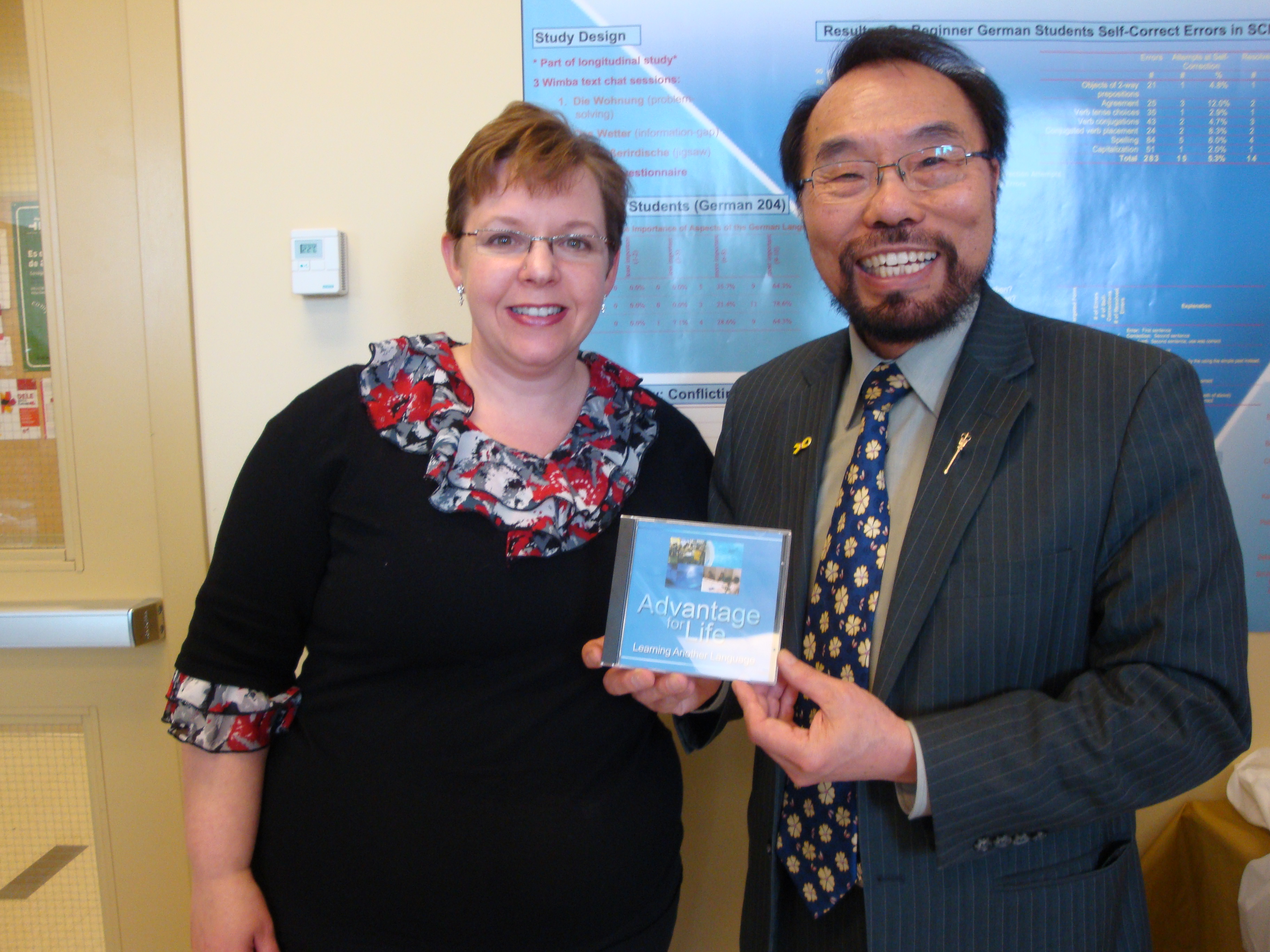
    Wayne Cao, MLA, Calgary Fort and Dr. Sarah Eaton

    Mr. Wayne Cao, MLA, Calgary Fort with me, holding the “Advantage for Life” CD produced by the Language Research Centre. This photo was taken at the IALW event.

Student Discussant: Ms. Jacqueline Warrell, PhD Candidate, Graduate Division of Educational Research

Event host: Dr. Sarah Eaton, Research Associate, Language Research Centre

The Institute for Innovation in Second Language Education (IISLE) will join us via videoconference from Edmonton.

For more information, visit these websites:

Alberta Advanced Education and Technology (AAET)
Language Research Centre

View this document on Scribd

_________________

Share this post: Lifelong Language Learning: Benefits for 21st Century Global Citizens http://wp.me/pNAh3-Bv

Update – January 2018 – This blog has had over 1.8 million views thanks to readers like you. If you enjoyed this post, please “like” it or share it on social media. Thanks!

Sarah Elaine Eaton is a faculty member in the Werklund School of Education, University of Calgary, Canada.