Workshop for Educators: Academic Integrity – Opening Up the Conversation Around Plagiarism

March 15, 2017

Today my research assistants, Jenny and Ian, collaborated with me to facilitate a workshop to faculty members and grad students in the Werklund School of Education, University of Calgary, on plagiarism. This workshop is part of the knowledge sharing and mobilization for a research project on plagiarism in our school of education.

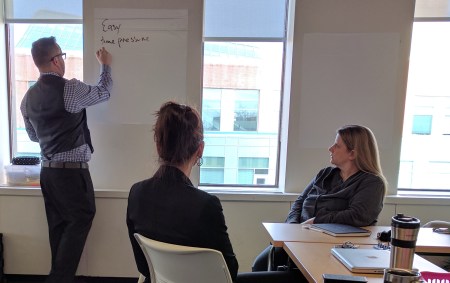
Here’s a photo of the group discussing their experiences with plagiarism in their professional practice in higher education contexts.

2017-03-15 - Worshop photo 1

We brainstormed ideas about why students plagiarize:

2017-03-15 - Workshop photo 2

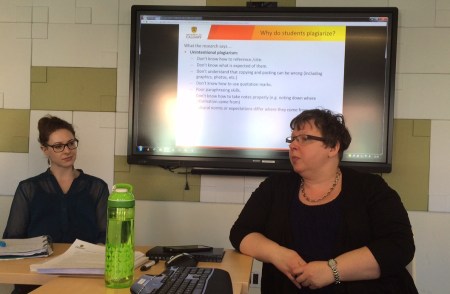
Then, we talked about the reasons why students plagiarize, as informed by the research literature, and compared participants’ responses to what is evident in the literature. There were numerous parallels between participants’ experiences and what we found in the literature.

2017-03-15 - Workshop photo 3

Finally, we shared strategies about how to prevent plagiarism and also how to address it if you encounter it in a student’s work.

You can find a copy of our slides from the workshop here:

You can download a copy of the supplementary materials guide that we gave out to participants here: http://hdl.handle.net/1880/51859

Funding for this study was provided by  the University of Calgary Werklund School of Education Scholarship of Teaching and Learning Grant.

Here are some other posts related to this research project:

____________________________________________________

Share this post: Plagiarism workshop for faculty http://wp.me/pNAh3-1NS

This blog has had over 1.8 million views thanks to readers like you. If you enjoyed this post, please “like” it or share it on social media. Thanks!

Sarah Elaine Eaton is a faculty member in the Werklund School of Education, University of Calgary, Canada.


Plagiarism Workshop for Hokkaido University of Education Exchange Students

March 13, 2017

Today I co-presented a workshop on plagiarism for exchange students from Hokkaido University of Education who are at the University of Calgary for a one-month stay to improve their English language skills.

My co-presenter was Benedict “Kojo” Otoo, a graduate research assistant working with me on the academic integrity research project.

You can find a copy of our slides online here: https://youtu.be/zBnqdGM36P0

Related posts:

Here are some other posts related to this research project:

____________________________________________________

Share this post: Plagiarism Workshop for Hokkaido University of Education Exchange Students http://wp.me/pNAh3-1Nn

This blog has had over 1.8 million views thanks to readers like you. If you enjoyed this post, please “like” it or share it on social media. Thanks!

Sarah Elaine Eaton is a faculty member in the Werklund School of Education, University of Calgary, Canada.


Article: Comparative Analysis of Institutional Policy Definitions of Plagiarism: A Pan-Canadian University Study

January 18, 2017

interchange I’m pleased to share the news with you about my latest article, published in Interchange. The title is: “Comparative Analysis of Institutional Policy Definitions of Plagiarism: A Pan-Canadian University Study”.

Here is a link to the online version of the article: http://rdcu.be/oCx2

Funding for this study was provided by  the University of Calgary Werklund School of Education Scholarship of Teaching and Learning Grant.

Here are some other posts related to this research project:

____________________________________________________

Share this post: Comparative Analysis of Institutional Policy Definitions of Plagiarism: A Pan-Canadian University Study https://wp.me/pNAh3-1LD

This blog has had over 1.8 million views thanks to readers like you. If you enjoyed this post, please “like” it or share it on social media. Thanks!

Sarah Elaine Eaton is a faculty member in the Werklund School of Education, University of Calgary, Canada.


New project: Investigating Academic Integrity in the School of Education

January 9, 2017

I’m excited to tell you about a new research project I am working on.

This project investigates how instructors, teaching assistants (TA’s) and administrators perceive and act upon cases of plagiarism or in the Werklund School of Education (WSE) at the University of Calgary. Academic dishonesty continues to present a major problem in higher education.

Research team for

Research team for “Investigating Academic Integrity”

The WSE “Process for Reporting and Responding to Plagiarism” will be used as a tool to engage participants in focus groups and interviews to facilitate dialogue on the topic of academic integrity.

I have the privilege of working with four fabulous research assistants on this project. To the right is a photo of our research team.

Recommendations will be provided as part of the final report.

Here’s a research brief I wrote on the project:

Eaton, S. E. (2016). Investigating academic integrity in the Werklund School of Education: Process, policy and perceptions: Research Project Brief. Calgary: University of Calgary. Retrieved from http://hdl.handle.net/1880/51764

Funding for this study was provided by  the University of Calgary Werklund School of Education Scholarship of Teaching and Learning Grant.

Related posts:

____________________________________________________

Share this post: New project: Investigating Academic Integrity in the School of Education http://wp.me/pNAh3-1Ll

This blog has had over 1.8 million views thanks to readers like you. If you enjoyed this post, please “like” it or share it on social media. Thanks!

Sarah Elaine Eaton is a faculty member in the Werklund School of Education, University of Calgary, Canada.


Outsourcing is the new plagiarism: What teachers need to know

September 28, 2010

In a recent post, I gave some resources for teachers to find out if their students are plagiarizing. I’ll be blunt though. Plagiarizing is soooo 20th century! (Yawn.)

Some students make a game of staying one step ahead of “the system”. In the 21st century, the really clever cheaters aren’t plagiarizing, they’re outsourcing their assignments. It’s kind of like getting your Mom, Dad or best friend to do your homework for you, only more sophisticated. Any student with a credit card  can do it.

And if you think you’re safe because your students are too young to have credit cards of your own, think again. The pre-paid credit card Aunt Mabel gave to little Johnny last Christmas will work just fine, thanks very much.

So, how do they do it?

There are Internet services out there who sole purpose is to match those who provide freelance or outsourced services with those who need them. (I won’t list them here, as that might be considered unethical for someone who is employed as a part-time university faculty member.) Legitimate small business owners will use such services to find virtual assistants, transcribers, typists, graphic designers, web designer and other providers of easily outsourced work. Such sites post all kinds of disclaimers about what type of work is or isn’t allowed to be offered or solicited. That doesn’t stop people from plainly saying what services they want or will provide.

For someone who lives in a developed country, outsourcing your work to India, the Philippines or other countries where workers get paid much less has become the norm in some businesses. Leaving the ethics and politics of globalization aside, the key message here is that it’s not just companies who are outsourcing work any more. Students are, too.

I recently saw an ad that looked something like this:

“Assignment: Write a 10-page history paper for a 300-level university course on the military strategies employed during the American Civil War. The paper must be ten double-spaced pages, written in Times New Roman, 12-point font with one-inch margins. At least 15 references are needed and citations are required in APA format. Must be written in perfect English, spell-checked and grammar-checked. Due: three weeks from the posting date of this ad.”

Suppliers bid on the project. At the time I saw the ad, bids had come in from a variety of countries and hovered around $30 USD. India seemed to be a popular country for outsourced academic papers, it seems. But suppliers from a variety of other countries were evident, too. Some bidders stated that they had PhDs themselves and would guarantee a well-written paper. It is safe to say that those who bid on such projects are  likely highly educated, fluent in academic English and think that $30 USD is worth the effort.

This is all done, of course, using anonymous e-mail addresses that can’t be traced back to the student. The work is all done on line. It’s not plagiarized. Rather, it is custom-written by an outsourced ghost writer thousands of miles away.

The paper is e-mailed to the student by the supplier, making all the plagiarism detectors that I mentioned in the previous post completely irrelevant. Those papers can never be found on the Internet. They haven’t been purchased by a service who has a bank of papers on numerous topics, ready to be shipped out to buyers. Instead, outsourced papers are specifically written according to the exact criteria given by the student (who re-iterates what his or her instructor has told him).

Let’s do the math:

A student works at a local pizza take-out and makes $15 per hour. If we take taxes and other payroll deductions into account, that students would have to work for about three hours – or maximum, four hours – to earn about $30 to pay the outsourced paper writer.

How long would it take him to write his own paper? At least 10 hours, but more likely 12 or 15, if he writes an excellent paper that merits an A grade.

Simple economics shows that the student benefits financially from outsourcing his paper. The supplier to whom the paper is outsourced benefits, as he is making a decent wage in comparison to whatever he or she might earn in a comparable time period in their local currency. Who loses? Well, the student loses out on the opportunity to learn research techniques and skills involved in writing a paper, of course. But mostly, it’s the current academic system and those who work in it who lose. The ideals that they hold regarding ethics, integrity and academic honour are thrown out the window.

Once the student has established a relationship with his outsourced ghost writer, he can contract the same academic-on-demand to write all his papers for the same course, thus ensuring that there is consistency in the tone, writing style and research skills of all his assignments.

My guess is that academic papers will become a thing of the past. Only those who sincerely enjoy research and the process of learning will be encouraged — or perhaps even allowed — to undertake academic research. Rather than demanding that students produce papers for marks, we may reserve the right to teach advanced research skills to those who are willing to commit to and engage in the entire process.

The question isn’t “How do we stop our students from plagiarizing or outsourcing?” but rather, “How do we teach students the value, joy and benefit of learning for themselves?”

Related posts:

_____________

Share or Tweet this: Outsourcing is the new plagiarism: What teachers need to know http://wp.me/pNAh3-lc

Update – January 2018 – This blog has had over 1.8 million views thanks to readers like you. If you enjoyed this post, please “like” it or share it on social media. Thanks!

Sarah Elaine Eaton is a faculty member in the Werklund School of Education, University of Calgary, Canada.