Dignity, Grief, and the Case of Jason Arday

August 16, 2026

I have been quiet about the case of Dr. Jason Arday, who previously worked at Cambridge University and left his job following allegations of plagiarism and questions about other claims in his life story. The reason is not lack of interest in the case, but rather because my family recently lost my brother and we have been mourning.

Aaron Edward Eaton: A Brief Background on Recent Events

First, a personal statement. A couple of weeks ago the Royal Canadian Mounted Police (RCMP) (Canada’s national police) issued a missing person alert for my brother. Once the RCMP released the alert on social media, the matter immediately became public. We received messages of support from around the world.

On August 3, my brother was found deceased and this was also publicly announced on social media and via a newspaper article. I won’t go into the details, but suffice to say that the phrase, ‘found deceased’ is often a euphemism for ‘died by suicide’. Society hides behind vague and passive language rather than being direct about what really happened. I’ve never been fond of circumlocutions, but society has its rules.

Although we have deeply appreciated the support, having a private family matter become public changes the experience. Emotional energy is directed into reading, replying, and also taking a step away from technology to process quietly.

In any case, my lack of response about the Arday case was not due to indifference, but rather because I was focused on family matters.

Jason Arday: ‘Found Deceased’

I did not know Jason Arday. I have no basis on which to conclude whether misconduct occurred in his academic work, and that question is not the subject of this post. News of his passing hit me in a visceral and raw way. My deepest condolences to his family and friends. As is so often the case when someone is ‘found dead’, those left behind have many questions, deep grief, and sometimes, a feeling that it didn’t have to end the way it did. I can only imagine that Dr. Arday’s family and friends are experiencing with the level of public spectacle we have seen.

So, I will not be weighing in on questions relating to misconduct allegations. What concerns me are different questions: What do we, as a society, owe a person who is being investigated for misconduct during — and after — an investigative process? A related question also hovers: How can we ensure that a person’s dignity is preserved in the process of a misconduct investigation?

A Resignation Is Not a Verdict

Dr. Arday resigned his professorship at the University of Cambridge on August 5, 2026, after weeks of public scrutiny over plagiarism allegations and questions about other claims in his life story [McArthur, 2026]. He was found dead at his home in south London nine days later. Prime Minister Andy Burnham called the death “a tragedy on so many levels”. Arday’s family said that “the campaign of misinformation was too much for Jason”.

Iryna Pavlova, writing for our Postplagiarism blog, makes a valuable observation: reading the resignation as proof of guilt and reading it as proof of persecution involve the same error, which is treating an outcome as though it settles a question not yet answered by a thorough and fair investigation. I would add a further question to Iryna’s: Why should we let public persecution stand in for fair process? (Short answer: We shouldn’t.)

What a Process Without Dignity Looks Like

Article 11 of the Universal Declaration of Human Rights establishes a presumption of innocence until proven guilty. Article 12 protects a person against arbitrary attacks on their honour and reputation.

The Universal Declaration of Human Rights applies to all persons, everywhere. Full stop.

An individual alleged to have engaged in misconduct should be investigated by professionals with the skills and training to undertake the matter in a fair and just way. Being judged in the public sphere, with dozens if not hundreds or even thousands of people chiming in as armchair judges, turns due process into a public spectacle. A misconduct investigation, carried out in a professional and dignified manner, and a public trial by social media are not the same venue. Treating them as equivalent lets institutions (and quite frankly, members of society) off the hook for their own conduct.

Comment sections do not offer due process. Let me be clear: this is not an argument for shielding scholars from scrutiny. It is an argument for insisting that scrutiny happens in a manner that does not deprive individuals of their human rights.

Call to Action

A human‑rights‑by‑design approach to misconduct policy does not soften findings of wrongdoing; it separates the question of what happened from the question of how a person is treated while questions remain open (Eaton, 2024). I have yet to find a university or college anywhere that has explicitly adopted a human-rights centred approach to misconduct policy or process. I am not talking here about due process or procedural fairness. I am talking about misconduct policies and procedures that intentionally and explicitly commit to upholding human rights as a foundation for due process. (If you know such an institution, drop me a note.)

Institutions can commit to clear and private procedures rather than adjudication by the media. When we allow public persecution to prevail, we discard dignity and human rights.

Institutional leaders can communicate with the accused promptly. No one should wait in uncertainty for weeks. Institutional leaders should provide mental health and wellbeing support throughout the process, at no extra cost to the individual. Counsellors should be available alongside the investigation, not after it. We, as members of higher education institutions and as members of society, can also exercise restraint. We can wait for a review to conclude before we comment publicly, rather than posturing and pontificating. In Arday’s case, many people did not show that restraint.

Whatever the historical record eventually shows about Arday’s scholarship, the record already shows how his case was handled while questions remained open, which has been deplorable. The way in which the matter has been handled deserves as much scrutiny as the plagiarism allegations themselves.

May Dr. Jason Arday rest in peace. May his family, friends, and those who cared about him find solace and healing.

References

Ahmed, A. (2026, August 15). Tributes paid to Jason Arday after former Cambridge professor’s death. The Guardian. https://www.theguardian.com/uk-news/2026/aug/15/jason-arday-tributes-paid-to-former-cambridge-professor

Eaton, S. E. (2024). Future-proofing integrity in the age of artificial intelligence and neurotechnology: prioritizing human rights, dignity, and equity. International Journal for Educational Integrity, 20(1), 21. https://doi.org/10.1007/s40979-024-00175-2

Hui, S. (2026, August 15). UK’s leader calls for reflection after the death of former Cambridge professor accused of plagiarism. Associated Press. https://apnews.com/article/britain-jason-arday-cambridge-death-burnham-b9e2463ca6b474ac90cc6196ed668238

McArthur, T. (2026, August 14). Jason Arday, ex-Cambridge professor at centre of plagiarism row, found dead. BBC News. https://www.bbc.com/news/articles/c1j1ye6n30no

Pavlova, I. (2026, August 12). Beyond “Did He Plagiarize?”: What the Jason Arday Case Reveals About Academic Integrity in a Postplagiarism Era. Postplagiarism Blog. https://postplagiarism.com/2026/08/12/beyond-did-he-plagiarize-what-the-jason-arday-case-reveals-about-academic-integrity-in-a-postplagiarism-era

Red Deer Advocate Staff. (August 4, 2026). Missing Red Deer man found deceased. Red Deer Advocate. https://reddeeradvocate.com/2026/08/04/missing-red-deer-man-found-deceased/

United Nations. (2021). Universal Declaration of Human Rights. https://www.un.org/en/about-us/universal-declaration-of-human-rights

___________

Share this post – Dignity, Grief, and the Case of Jason Arday – https://drsaraheaton.com/2026/08/16/dignity-grief-and-the-case-of-jason-arday/

Sarah Elaine Eaton, PhD, is a Professor and Research Chair in the Werklund School of Education at the University of Calgary, Canada. Opinions are my own and do not represent those of my employer.


Consequences of Teacher Cheating: A Canadian Case Study

July 3, 2026

A British Columbia arbitrator recently confirmed what the Vernon School District 22 board decided in 2024: Tasha Whitney, a continuing contract teacher at W. L. Seaton Secondary School, will not return to the classroom (Assman, 2026b). The arbitrator dismissed the union’s grievance and upheld her termination for cause. The ruling offers a case study in how academic integrity violations by educators differ from those committed by students, and why the consequences differ, too.

The facts, as reported by Assman (2026a, 2026b), are straightforward. Whitney invigilated a mandatory Grade 12 literacy assessment in June 2024. When one student, identified as CD, joked about having someone else write his exam, Whitney suggested other students who might do it. On the day of the exam, another student, AB, used CD’s login credentials to complete both his own assessment and CD’s, running out the clock on one screen with a video game while completing the other exam on a second screen. Whitney signed documents certifying that both students had written their own assessments. When a colleague noticed the irregularity, Whitney fabricated an explanation. She continued to minimize her role throughout the district investigation and the arbitration hearing that followed.

The arbitrator’s reasoning matters as much as the outcome. Had Whitney told the truth from the outset, the arbitrator indicated that termination would have been excessive; the district could have treated the incident as a serious error made under personal strain, with progressive discipline restoring her employment (Assman, 2026b). The union presented medical evidence that Whitney had experienced post-traumatic stress disorder and anxiety following a violent workplace incident in October 2023, and a psychiatric assessment acknowledged that this anxiety likely affected her decision-making. The assessment found no causal link between the diagnosis and the fraudulent conduct itself. Dishonesty, sustained over months and through a formal investigation, severed the trust her employment required.

This distinction between error and deceit connects to an argument I make with my co-author Zeenath Reza Khan in our own work on ethics in teacher training. Zeenath and I contend that teacher training programs must include explicit instruction in ethical decision-making, not compliance training alone, because teachers model integrity for the students in their care (Eaton & Khan, 2022). The arbitrator’s finding in the Whitney case reflects this same principle, holding that facilitating cheating violated Whitney’s fiduciary duty to model ethical behaviour for the youth in her charge (Assman, 2026b).

A student who cheats on an exam violates a rule. A teacher who helps a student cheat, then invigilates the fraud, signs false certification documents, and misleads colleagues and investigators, violates the basis on which the school entrusts her with that role. I have written, with Zeenath Reza Khan, that academic integrity education for pre-service teachers remains inconsistent internationally, with many programs offering little beyond a brochure or a single workshop (Eaton & Khan, 2022). The Whitney case suggests what happens when that gap is left unaddressed at the level of professional judgement, particularly when a person under stress reaches for concealment rather than disclosure.

The arbitrator’s finding leaves a narrow but clear lesson for the profession: honesty in the aftermath of a mistake changes what an institution can offer in response. Whitney’s initial decision to encourage a workaround may have originated in a lapse of judgement. Her subsequent choice to lie repeatedly, to a colleague, to school administrators, and to an independent investigator, closed the door that honesty could have left open.

References

Assman, B. (2026a, February 10). Vernon teacher fired for helping student cheat on an exam. Castanet. https://www.castanet.net/news/Vernon/598708/Vernon-teacher-fired-for-helping-student-cheat-on-an-exam

Assman, B. (2026b, June 23). Vernon teacher’s firing upheld, after facilitating exam cheating and lying to cover it up. Castanet. https://www.castanet.net/news/Vernon/621104/Vernon-teacher-s-firing-upheld-after-facilitating-exam-cheating-and-lying-to-cover-it-up

Eaton, S. E., & Khan, Z. R. (2022). Ethics in teacher training: An overview. In S. E. Eaton & Z. R. Khan (Eds.), Ethics and integrity in teacher education (pp. 1–11). Springer. https://doi.org/10.1007/978-3-031-16922-9_1

___________

Share this post – Consequences of Teacher Cheating: A Canadian Case Study https://drsaraheaton.com/2026/07/03/consequences-of-teacher-cheating-a-canadian-case-study/

Sarah Elaine Eaton, PhD, is a Professor and Research Chair in the Werklund School of Education at the University of Calgary, Canada. Opinions are my own and do not represent those of my employer.


AI, Postplagiarism and K-12 Education in New Brunswick, Canada

April 25, 2026

This week, I had the opportunity to take part in two leadership events led by the New Brunswick Department of Education and Early Childhood Development focused on artificial intelligence and education. 

On April 22 I gave a workshop on academic integrity and assessment with generative AI to educational leaders, academics, and professional staff at the AI Leadership Summit. The next day, I delivered a keynote address on postplagiarism, education and artificial intelligence at a province-wide summit on AI and education attended by almost 250 people from across the province.

I had an opportunity to meet and speak with the Hon. Claire Johnson, Minister of Education and Early Childhood Development, Deputy Minister Ryan Donaghy, and Assistant Deputy Minister Tiffany Bastin, all of whom commented on how postplagiarism aligns with their provincial strategy and policy vision. 

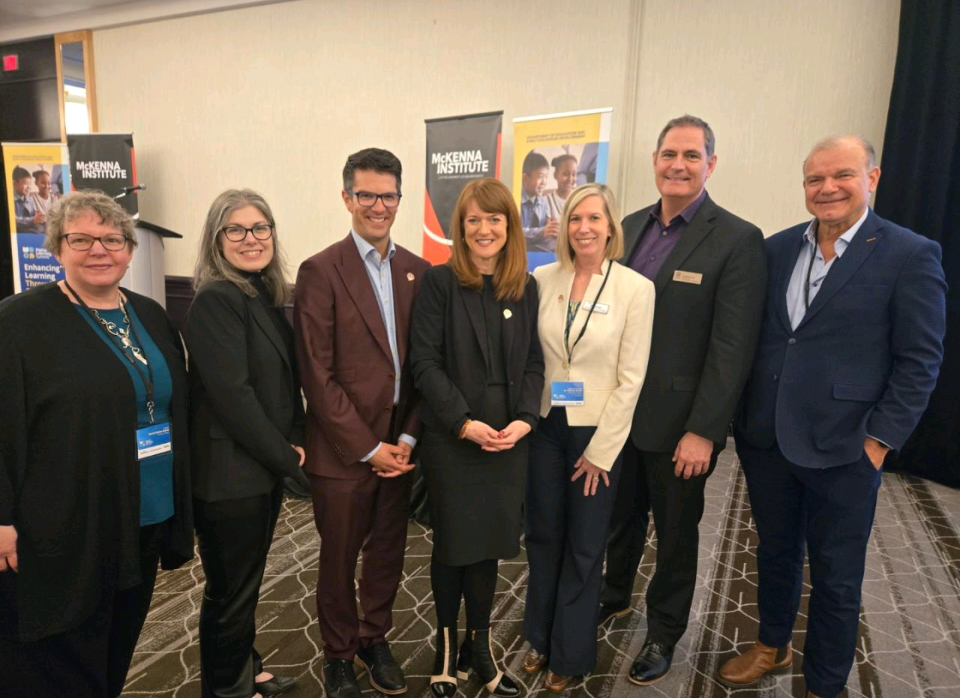
A group of people standing together.
(Left to right: Sarah Elaine Eaton, Sarah Rankin, Ryan Donaghy, Hon. Claire Johnson, Tiffany Bastin, Geoff Edwards, Robert Martellaci – April 2026, New Brunswick AI and Education Summit)

It was announced during the event that preparations are underway to integrate artificial intelligence into the provincial digital literacy strategy and educational curricula across all levels and subjects, with a plan to have AI fully integrated in time for the beginning of the next school year, starting in September, 2026. Staff at the Department of Education and Early Childhood Development are in the midst of updating curricula as we speak. 

To my knowledge, New Brunswick is the first province or territory in Canada to integrate AI across the K-12 curriculum. They are investing in professional learning for leaders, education specialists and developers, and educators, to improve and increase AI literacy levels throughout the education sector. Throughout the two days, I spoke with leaders and educators from across the province who repeated the same message to me, that postplagiarism was a refreshing and forward-thinking way to think about academic integrity, ethics, and student success in an AI-enabled world.

It was exciting and energizing to be brought into education conversations that connected policy, pedagogy, and postplagiarism. The real world applications of postplagiarism are taking shape and I am inspired to see how others are are findings ways to implement the framework as a future-focused roadmap for ethical learning and teaching with advanced technologies.

About the author: Sarah Elaine Eaton, PhD, is a Professor and the Director of the Postplagiarism Research Lab in the Werklund School of Education, University of Calgary.

______________

Reposted from original: AI, Postplagiarism and K-12 Education in New Brunswick, Canada – https://postplagiarism.com/2026/04/25/ai-postplagiarism-and-k-12-education-in-new-brunswick-canada/


Interfacing with the Future: Reflections on the National Day of Learning 2026

April 1, 2026

On March 28, 2026, I had the pleasure of joining educators from across Canada for the National Day of Learning, hosted by Let’s Talk Science. This one-day, nation-wide professional learning event brought together K–12 teachers, post-secondary educators, and policy leaders to explore some of the most pressing issues shaping education today, with artificial intelligence high on the agenda.

I was invited to deliver a session titled “Interfacing with the Future: Wearable AI and Academic Integrity for K–12 and Higher Ed.” What follows are a few reflections and key ideas from that conversation, hosted by Dr. Alec Couros.

Moving into the Postplagiarism Era

One of the central ideas framing my talk is postplagiarism. In this reality, artificial intelligence is no longer an external tool that students occasionally use, but rather, it is embedded into everyday life and learning.

Students are already engaging with AI in ways that challenge traditional notions of authorship, originality, and academic work. The question is no longer if students will use AI, but how.

This shift requires a corresponding change in how we think about academic integrity. Detection and surveillance, long relied upon as primary strategies, are no longer sufficient. Instead, we must rethink how we design learning environments that foster integrity from the ground up.

From Tools to Wearables: How AI is Advancing

A key focus of my presentation was the rapid evolution from AI tools to AI wearables — particularly smart glasses and other forms of cosmetically invisible interfaces. The talk was based, in part, on our recent article in Canadian Perspectives on Academic Integrity

Wearable technologies integrate AI directly into our physical experience of the world. Rather than pulling out a device, users can access real-time information, transcription, and prompts seamlessly through their field of vision.

This shift introduces both opportunities and tensions:

  • Cognitive offloading: Learners can reduce mental load by accessing information instantly. (Phill Dawson has done some great work on cognitive offloading that I recommend reading.)
  • Enhanced presence: Wearables allow users to maintain eye contact and engagement without device distraction.
  • Efficiency gains: Tasks such as note-taking or translation can be automated in real time.

At the same time, these benefits come with real challenges including information overload, privacy concerns, and technical limitations. More importantly for educators, they fundamentally disrupt assumptions about what it means to “know” something independently.

New Technology ≠ Cheating

One of the most important messages I emphasized is this: new technology does not automatically equal academic misconduct.

If a tool is permitted, then its use is not cheating. The real issue lies in unauthorized use or misuse in ways that create unfair advantage. 

We must also remain attentive to equity and accessibility. Some wearable technologies may be used as accommodations, making it essential that our integrity policies are inclusive and nuanced rather than rigid and punitive.

Designing for Integrity (Not Surveillance)

Rather than doubling down on detection, I encourage educators to shift their focus toward designing for integrity.

This means:

  • Prioritizing assessment validity: If an AI system can complete a task without genuine understanding, then the task itself needs to be rethought.
  • Moving beyond “gotcha” approaches: Surveillance-based strategies erode trust and are increasingly ineffective.
  • Supporting diverse learners: Students bring different technological access, needs, and experiences. Our designs must reflect that.
  • Building a culture of integrity: Integrity is not enforced; it is cultivated through meaningful learning experiences.

Bridging K–12 and Post-Secondary Education

Another key theme was the gap between K–12 and post-secondary expectations.

In K–12 environments, students are often encouraged to explore technology as part of their learning. In contrast, post-secondary institutions frequently operate under the assumption that students already understand complex academic integrity rules.

As AI continues to evolve, this gap becomes more pronounced. We need stronger alignment across educational sectors to ensure that students are supported, rather than being set up for failure, as they transition between systems. (Myke Healy has a great paper on the topic of GenAI in the K-12 context that is worth reading.) 

Looking Ahead

If there is one takeaway from this experience, it is this: wearable AI is not a future scenario. It is already here.

As educators, we are being called to respond not with fear, but with thoughtful, research-informed approaches. The challenge is not simply to manage technology, but to reimagine teaching, learning, and assessment in ways that remain meaningful in an AI-integrated world.

Events like the National Day of Learning remind me of the power of community. Bringing educators together to share ideas, ask difficult questions, and explore new possibilities is essential as we navigate this rapidly changing landscape.

Thank you to Let’s Talk Science and to Dr. Alec Couros for the opportunity to be part of this important conversation, and to all the educators who continue to lead with curiosity, courage, and care.

______________

Share this post: Interfacing with the Future: Reflections on the National Day of Learning 2026 –  https://drsaraheaton.com/2026/04/01/interfacing-with-the-future-reflections-on-the-national-day-of-learning-2026/

Sarah Elaine Eaton, PhD, is a Professor and Research Chair in the Werklund School of Education at the University of Calgary, Canada. Opinions are my own and do not represent those of my employer.


Breaking Barriers: Academic Integrity and Neurodiversity

November 20, 2025

When we talk about academic integrity in universities, we often focus on preventing plagiarism and cheating. But what if our very approach to enforcing these standards is unintentionally creating barriers for some of our most vulnerable students?

My recent research explores how current academic integrity policies and practices can negatively affect neurodivergent students—those with conditions like ADHD, dyslexia, Autism, and other learning differences. Our existing systems, structures, and policies can further marginalize students with cognitive differences.

The Problem with One-Size-Fits-All

Neurodivergent students face unique challenges that can be misunderstood or ignored. A dyslexic student who struggles with citation formatting isn’t necessarily being dishonest. They may be dealing with cognitive processing differences that make these tasks genuinely difficult. A student with ADHD who has trouble managing deadlines and tracking sources is not necessarily lazy or unethical. They may be navigating executive function challenges that affect time management and organization. Yet our policies frequently treat these struggles as potential misconduct rather than as differences that deserve support.

Yet our policies frequently treat these struggles as potential misconduct rather than as differences that deserve support.

The Technology Paradox for Neurodivergent Students

Technology presents a particularly thorny paradox. On one hand, AI tools such as ChatGPT and text-to-speech software can be academic lifelines for neurodivergent students, helping them organize thoughts, overcome writer’s block, and express ideas more clearly. These tools can genuinely level the playing field.

On the other hand, the same technologies designed to catch cheating—especially AI detection software—appear to disproportionately flag neurodivergent students’ work. Autistic students or those with ADHD may be at higher risk of false positives from these detection tools, potentially facing misconduct accusations even when they have done their own work. This creates an impossible situation: the tools that help are the same ones that might get students in trouble.

Moving Toward Epistemic Plurality

So what’s the solution? Epistemic plurality, or recognizing that there are multiple valid ways of knowing and expressing knowledge. Rather than demanding everyone demonstrate learning in the exact same way, we should design assessments that allow for different cognitive styles and approaches.

This means:

  • Rethinking assessment design to offer multiple ways for students to demonstrate knowledge
  • Moving away from surveillance technologies like remote proctoring that create anxiety and accessibility barriers
  • Building trust rather than suspicion into our academic cultures
  • Recognizing accommodations as equity, not as “sanctioned cheating”
  • Designing universally, so accessibility is built in from the start rather than added as an afterthought

What This Means for the Future

In the postplagiarism era, where AI and technology are seamlessly integrated into education, we move beyond viewing academic integrity purely as rule-compliance. Instead, we focus on authentic and meaningful learning and ethical engagement with knowledge.

This does not mean abandoning standards. It means recognizing that diverse minds may meet those standards through different pathways. A student who uses AI to help structure an essay outline isn’t necessarily cheating. They may be using assistive technology in much the same way another student might use spell-check or a calculator.

Call to Action

My review of existing research showed something troubling: we have remarkably little data about how neurodivergent students experience academic integrity policies. The studies that exist are small, limited to English-speaking countries, and often overlook the voices of neurodivergent individuals themselves.

We need larger-scale research, global perspectives, and most importantly, we need neurodivergent students to be co-researchers and co-authors in work about them. “Nothing about us without us” is not just a slogan, but a call to action for creating inclusive academic environments.

Key Messages

Academic integrity should support learning, not create additional barriers for students who already face challenges. By reimagining our approaches through a lens of neurodiversity and inclusion, we can create educational environments where all students can thrive while maintaining academic standards.

Academic integrity includes and extends beyond student conduct; it means that everyone in the learning system acts with integrity to support student learning. Ultimately, there can be no integrity without equity.

Read the whole article here:
Eaton, S. E. (2025). Neurodiversity and academic integrity: Toward epistemic plurality in a postplagiarism era. Teaching in Higher Educationhttps://doi.org/10.1080/13562517.2025.2583456

______________

Share this post: Breaking Barriers: Academic Integrity and Neurodiversity – https://drsaraheaton.com/2025/11/20/breaking-barriers-academic-integrity-and-neurodiversity/

Sarah Elaine Eaton, PhD, is a Professor and Research Chair in the Werklund School of Education at the University of Calgary, Canada. Opinions are my own and do not represent those of my employer.