Dignity, Grief, and the Case of Jason Arday

August 16, 2026

I have been quiet about the case of Dr. Jason Arday, who previously worked at Cambridge University and left his job following allegations of plagiarism and questions about other claims in his life story. The reason is not lack of interest in the case, but rather because my family recently lost my brother and we have been mourning.

Aaron Edward Eaton: A Brief Background on Recent Events

First, a personal statement. A couple of weeks ago the Royal Canadian Mounted Police (RCMP) (Canada’s national police) issued a missing person alert for my brother. Once the RCMP released the alert on social media, the matter immediately became public. We received messages of support from around the world.

On August 3, my brother was found deceased and this was also publicly announced on social media and via a newspaper article. I won’t go into the details, but suffice to say that the phrase, ‘found deceased’ is often a euphemism for ‘died by suicide’. Society hides behind vague and passive language rather than being direct about what really happened. I’ve never been fond of circumlocutions, but society has its rules.

Although we have deeply appreciated the support, having a private family matter become public changes the experience. Emotional energy is directed into reading, replying, and also taking a step away from technology to process quietly.

In any case, my lack of response about the Arday case was not due to indifference, but rather because I was focused on family matters.

Jason Arday: ‘Found Deceased’

I did not know Jason Arday. I have no basis on which to conclude whether misconduct occurred in his academic work, and that question is not the subject of this post. News of his passing hit me in a visceral and raw way. My deepest condolences to his family and friends. As is so often the case when someone is ‘found dead’, those left behind have many questions, deep grief, and sometimes, a feeling that it didn’t have to end the way it did. I can only imagine that Dr. Arday’s family and friends are experiencing with the level of public spectacle we have seen.

So, I will not be weighing in on questions relating to misconduct allegations. What concerns me are different questions: What do we, as a society, owe a person who is being investigated for misconduct during — and after — an investigative process? A related question also hovers: How can we ensure that a person’s dignity is preserved in the process of a misconduct investigation?

A Resignation Is Not a Verdict

Dr. Arday resigned his professorship at the University of Cambridge on August 5, 2026, after weeks of public scrutiny over plagiarism allegations and questions about other claims in his life story [McArthur, 2026]. He was found dead at his home in south London nine days later. Prime Minister Andy Burnham called the death “a tragedy on so many levels”. Arday’s family said that “the campaign of misinformation was too much for Jason”.

Iryna Pavlova, writing for our Postplagiarism blog, makes a valuable observation: reading the resignation as proof of guilt and reading it as proof of persecution involve the same error, which is treating an outcome as though it settles a question not yet answered by a thorough and fair investigation. I would add a further question to Iryna’s: Why should we let public persecution stand in for fair process? (Short answer: We shouldn’t.)

What a Process Without Dignity Looks Like

Article 11 of the Universal Declaration of Human Rights establishes a presumption of innocence until proven guilty. Article 12 protects a person against arbitrary attacks on their honour and reputation.

The Universal Declaration of Human Rights applies to all persons, everywhere. Full stop.

An individual alleged to have engaged in misconduct should be investigated by professionals with the skills and training to undertake the matter in a fair and just way. Being judged in the public sphere, with dozens if not hundreds or even thousands of people chiming in as armchair judges, turns due process into a public spectacle. A misconduct investigation, carried out in a professional and dignified manner, and a public trial by social media are not the same venue. Treating them as equivalent lets institutions (and quite frankly, members of society) off the hook for their own conduct.

Comment sections do not offer due process. Let me be clear: this is not an argument for shielding scholars from scrutiny. It is an argument for insisting that scrutiny happens in a manner that does not deprive individuals of their human rights.

Call to Action

A human‑rights‑by‑design approach to misconduct policy does not soften findings of wrongdoing; it separates the question of what happened from the question of how a person is treated while questions remain open (Eaton, 2024). I have yet to find a university or college anywhere that has explicitly adopted a human-rights centred approach to misconduct policy or process. I am not talking here about due process or procedural fairness. I am talking about misconduct policies and procedures that intentionally and explicitly commit to upholding human rights as a foundation for due process. (If you know such an institution, drop me a note.)

Institutions can commit to clear and private procedures rather than adjudication by the media. When we allow public persecution to prevail, we discard dignity and human rights.

Institutional leaders can communicate with the accused promptly. No one should wait in uncertainty for weeks. Institutional leaders should provide mental health and wellbeing support throughout the process, at no extra cost to the individual. Counsellors should be available alongside the investigation, not after it. We, as members of higher education institutions and as members of society, can also exercise restraint. We can wait for a review to conclude before we comment publicly, rather than posturing and pontificating. In Arday’s case, many people did not show that restraint.

Whatever the historical record eventually shows about Arday’s scholarship, the record already shows how his case was handled while questions remained open, which has been deplorable. The way in which the matter has been handled deserves as much scrutiny as the plagiarism allegations themselves.

May Dr. Jason Arday rest in peace. May his family, friends, and those who cared about him find solace and healing.

References

Ahmed, A. (2026, August 15). Tributes paid to Jason Arday after former Cambridge professor’s death. The Guardian. https://www.theguardian.com/uk-news/2026/aug/15/jason-arday-tributes-paid-to-former-cambridge-professor

Eaton, S. E. (2024). Future-proofing integrity in the age of artificial intelligence and neurotechnology: prioritizing human rights, dignity, and equity. International Journal for Educational Integrity, 20(1), 21. https://doi.org/10.1007/s40979-024-00175-2

Hui, S. (2026, August 15). UK’s leader calls for reflection after the death of former Cambridge professor accused of plagiarism. Associated Press. https://apnews.com/article/britain-jason-arday-cambridge-death-burnham-b9e2463ca6b474ac90cc6196ed668238

McArthur, T. (2026, August 14). Jason Arday, ex-Cambridge professor at centre of plagiarism row, found dead. BBC News. https://www.bbc.com/news/articles/c1j1ye6n30no

Pavlova, I. (2026, August 12). Beyond “Did He Plagiarize?”: What the Jason Arday Case Reveals About Academic Integrity in a Postplagiarism Era. Postplagiarism Blog. https://postplagiarism.com/2026/08/12/beyond-did-he-plagiarize-what-the-jason-arday-case-reveals-about-academic-integrity-in-a-postplagiarism-era

Red Deer Advocate Staff. (August 4, 2026). Missing Red Deer man found deceased. Red Deer Advocate. https://reddeeradvocate.com/2026/08/04/missing-red-deer-man-found-deceased/

United Nations. (2021). Universal Declaration of Human Rights. https://www.un.org/en/about-us/universal-declaration-of-human-rights

___________

Share this post – Dignity, Grief, and the Case of Jason Arday – https://drsaraheaton.com/2026/08/16/dignity-grief-and-the-case-of-jason-arday/

Sarah Elaine Eaton, PhD, is a Professor and Research Chair in the Werklund School of Education at the University of Calgary, Canada. Opinions are my own and do not represent those of my employer.


Bibliography of Equity, Diversity, Inclusion, and Accessibility Resources for Academic Integrity

September 12, 2025

This week I did an invited presentation for the European Network for Academic Integrity (ENAI) Integrity for All Working Group.

As part of my presentation, I shared this bibliography of resources that I’ve worked on over the past several years on academic integrity as it relates to equity, diversity, inclusion, accessibility, and decolonization. These topics have become increasingly important to me over the past half decade and it is more important now than it ever has been to elevate the importance of these topics, along with human rights and social justice, when addressing matters of student conduct.

This bibliography contains a list of academic integrity articles, presentations, and resources that focus on these topics. 

I’ve done my best to prepare this list according to APA 7 conventions, but please forgive any errors.

I aim to make as much of my content open access. If there is anything on this list that you cannot access, please contact me directly and I’ll see what I can do.

______________

Share this post: Bibliography of Equity, Diversity, Inclusion, and Accessibility Resources for Academic Integrity – https://drsaraheaton.com/2025/09/12/bibliography-of-equity-diversity-inclusion-and-accessibility-resources-for-academic-integrity/

Sarah Elaine Eaton, PhD, is a Professor and Research Chair in the Werklund School of Education at the University of Calgary, Canada. Opinions are my own and do not represent those of my employer.


Dignity: A Foundation of Academic Integrity

April 8, 2025

In our pursuit of knowledge, we often focus on policies, consequences, and detection systems. Yet at the heart of academic integrity lies something fundamental: human dignity.

When we produce original work, we honor our intellectual journey and the dignity of those whose ideas we build upon. Attribution acknowledges that knowledge creation is a collaborative endeavor spanning generations.

Academic integrity shouldn’t be about avoiding punishment, but rather, about recognizing the worth in honest intellectual exchange. It’s understanding that shortcuts diminish our growth and the trust that sustains scholarly communities.

As educators and learners, we can frame integrity less as compliance and more as respect – for ourselves, peers, and institutions that facilitate collective wisdom. When we approach academic work with dignity as our compass, integrity follows.

–——–-

Share this post: Dignity: A Foundation of Academic Integrity – https://drsaraheaton.com/2025/04/08/dignity-a-foundation-of-academic-integrity/

This blog has had over 3.7 million views thanks to readers like you. If you enjoyed this post, please ‘Like’ it using the button below or share it on social media. Thanks!

Sarah Elaine Eaton, PhD, is a Professor and Research Chair in the Werklund School of Education at the University of Calgary, Canada. Opinions are my own and do not represent those of my employer. 


Three tips for future-proofing academic and research integrity this year

January 2, 2025

In my 2024 annual editorial for the International Journal for Educational Integrity, was entitled, ’Future-proofing integrity in the age of artificial intelligence and neurotechnology: prioritizing human rights, dignity, and equity

Here are three things you can do to prioritize human rights and dignity when it comes to policies and procedures to address allegations of academic or research misconduct:

Use a human-rights-by-design approach to developing, revising, and implementing policies by conducting a comprehensive review of existing academic integrity policies. Update policies to explicitly incorporate human rights principles, ensuring they address fair process, privacy, equitable treatment, and respect for human dignity. It is essential to involve individuals from representative groups in this process.

Provide ongoing training, education, and support to faculty, staff, and students about human rights principles and how they apply to misconduct investigations and case management. Create orientation programs that explain expectations for ethical conduct while respecting diverse cultural perspectives. Offer workshops and resources, peer mentoring programs, and support services.

Focus on continuous improvement and quality assurance of ethics and integrity practices by gathering feedback from students, faculty, staff and relevant stakeholders. Regularly review misconduct case management processes and data to ensure equitable treatment across different demographics.

Implementing human rights principles into misconduct investigations and case management helps to create more effective and sustainable learning environments. This approach prioritizes people over punishment, dignity over draconianism, and compassion over callousness.

Read the full article here: https://edintegrity.biomedcentral.com/articles/10.1007/s40979-024-00175-2 

Related post:

Future-proofing integrity in the age of artificial intelligence and neurotechnology: Prioritizing human rights, dignity, and equity

________________________

Share this post: Three tips for future-proofing academic and research integrity this year – https://drsaraheaton.com/2025/01/02/three-tips-for-future-proofing-academic-and-research-integrity-this-year/

This blog has had over 3 million views thanks to readers like you. If you enjoyed this post, please “like” it or share it on social media. Thanks!

Sarah Elaine Eaton, PhD, is a Professor and Research Chair in the Werklund School of Education at the University of Calgary, Canada. Opinions are my own and do not represent those of my employer. 


Future-proofing integrity in the age of artificial intelligence and neurotechnology: Prioritizing human rights, dignity, and equity

November 13, 2024

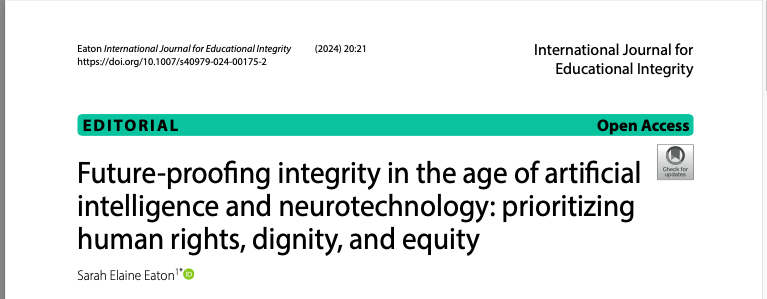
Once a year I write an editorial for the International Journal for Educational Integrity. I take a big idea, ground it in literature written by some of the best in the world and then call for ways to improve our field even more. In 2023 I wrote about Postplagiarism and in 2022, I focused on equity, diversity, inclusion, accessibility and decolonization as new priorities for academic integrity. Here is this year’s editorial:

Future-proofing integrity in the age of artificial intelligence and neurotechnology: prioritizing human rights, dignity, and equity

A screenshot of an article title page. There is black text on a white background with a green banner at the top.
Here is a link to the original: https://edintegrity.biomedcentral.com/articles/10.1007/s40979-024-00175-2

Abstract

In this article I argue for the prioritisation of human rights when developing and implementing misconduct policies. Existing approaches may be perpetuate inequities, particularly for individuals from marginalised groups. A human-rights-by-design approach, which centres human rights in policy development, revision, and implementation, ensuring that every individual is treated with dignity and respect.

Recommendations for implementing a human-rights approach to misconduct investigations and case management are offered, covering areas such as procedural fairness, privacy, equity, and the right to education. Additional topics covered are the need to limit surveillance technologies, and the need to recognize that not all use of artificial intelligence tools automatically constitutes misconduct. I disentangle

the differences between equity and equality and explain how both are important when considering ethics and integrity. A central argument of this paper is that a human-rights-by-design approach to integrity does not diminish standards but rather strengthens educational systems by cultivating ethical awareness and respect for personhood. I conclude with a call to action with a seven-point plan for institutions to adopt a human-rights-based approach to ethics and integrity. In the age of artificial intelligence and neurotechnology, insisting on human rights and dignity when we investigate and address misconduct allegations is an ethical imperative that has never been more important.

Keywords Academic misconduct, Academic dishonesty, Plagiarism, Policy, Human rights, Restorative justice, Artificial intelligence, Neurotechnology, Higher education, Education

Commentary

As I reflect on the current state of academic and research integrity, I am struck by a glaring omission in our discussions: the connection between misconduct and human rights. We often treat these as separate entities, failing to recognize the profound impact that misconduct investigations and policies can have on the fundamental rights of individuals. This oversight is particularly concerning in the age of artificial intelligence (AI) and neurotechnology, where the potential for harm is magnified.

Take, for example, the case of a professor in Canada who physically assaulted international students accused of plagiarism. This horrifying example demonstrates how the pursuit of academic integrity can be twisted into a justification for degrading and inhumane treatment, violating the very principles of dignity and respect that should guide our actions. While this is an extreme case, it highlights the need for a fundamental shift in our approach.

In this editorial, I offer a call to action to move beyond simply adhering to legal requirements and embrace a ‘human-rights-by-design’ approach that embeds human rights principles into our policies and practices. This means ensuring procedural fairness throughout investigations, safeguarding the privacy of individuals, and recognizing the right to be presumed innocent until there is proof to the contrary. It also requires us to acknowledge the diverse backgrounds and circumstances of our students and staff, striving for equitable treatment that addresses systemic inequalities and provides the support needed for everyone to succeed.

In the face of rapidly evolving technologies like AI, we must be especially vigilant in upholding human rights. The temptation to rely on unproven AI detection tools or to rush to judgement based on suspicion rather than evidence is strong, but it is a path that leads us away from justice and fairness. We cannot allow fear or expediency to erode our commitment to human dignity.

By centring human rights in our approach to integrity, we can create educational and research environments that are not only ethically sound but also truly just and equitable. This is not about lowering standards; it is about building a culture of integrity that upholds the inherent worth of every individual.

________________________

Share this post: Future-proofing integrity in the age of artificial intelligence and neurotechnology: Prioritizing human rights, dignity, and equity – https://drsaraheaton.com/2024/11/13/future-proofing-integrity-in-the-age-of-artificial-intelligence-and-neurotechnology-prioritizing-human-rights-dignity-and-equity/
This blog has had over 3 million views thanks to readers like you. If you enjoyed this post, please “like” it or share it on social media. Thanks!

Sarah Elaine Eaton, PhD, is a Professor and Research Chair in the Werklund School of Education at the University of Calgary, Canada. Opinions are my own and do not represent those of my employer.