Interfacing with the Future: Reflections on the National Day of Learning 2026

April 1, 2026

On March 28, 2026, I had the pleasure of joining educators from across Canada for the National Day of Learning, hosted by Let’s Talk Science. This one-day, nation-wide professional learning event brought together K–12 teachers, post-secondary educators, and policy leaders to explore some of the most pressing issues shaping education today, with artificial intelligence high on the agenda.

I was invited to deliver a session titled “Interfacing with the Future: Wearable AI and Academic Integrity for K–12 and Higher Ed.” What follows are a few reflections and key ideas from that conversation, hosted by Dr. Alec Couros.

Moving into the Postplagiarism Era

One of the central ideas framing my talk is postplagiarism. In this reality, artificial intelligence is no longer an external tool that students occasionally use, but rather, it is embedded into everyday life and learning.

Students are already engaging with AI in ways that challenge traditional notions of authorship, originality, and academic work. The question is no longer if students will use AI, but how.

This shift requires a corresponding change in how we think about academic integrity. Detection and surveillance, long relied upon as primary strategies, are no longer sufficient. Instead, we must rethink how we design learning environments that foster integrity from the ground up.

From Tools to Wearables: How AI is Advancing

A key focus of my presentation was the rapid evolution from AI tools to AI wearables — particularly smart glasses and other forms of cosmetically invisible interfaces. The talk was based, in part, on our recent article in Canadian Perspectives on Academic Integrity

Wearable technologies integrate AI directly into our physical experience of the world. Rather than pulling out a device, users can access real-time information, transcription, and prompts seamlessly through their field of vision.

This shift introduces both opportunities and tensions:

  • Cognitive offloading: Learners can reduce mental load by accessing information instantly. (Phill Dawson has done some great work on cognitive offloading that I recommend reading.)
  • Enhanced presence: Wearables allow users to maintain eye contact and engagement without device distraction.
  • Efficiency gains: Tasks such as note-taking or translation can be automated in real time.

At the same time, these benefits come with real challenges including information overload, privacy concerns, and technical limitations. More importantly for educators, they fundamentally disrupt assumptions about what it means to “know” something independently.

New Technology ≠ Cheating

One of the most important messages I emphasized is this: new technology does not automatically equal academic misconduct.

If a tool is permitted, then its use is not cheating. The real issue lies in unauthorized use or misuse in ways that create unfair advantage. 

We must also remain attentive to equity and accessibility. Some wearable technologies may be used as accommodations, making it essential that our integrity policies are inclusive and nuanced rather than rigid and punitive.

Designing for Integrity (Not Surveillance)

Rather than doubling down on detection, I encourage educators to shift their focus toward designing for integrity.

This means:

  • Prioritizing assessment validity: If an AI system can complete a task without genuine understanding, then the task itself needs to be rethought.
  • Moving beyond “gotcha” approaches: Surveillance-based strategies erode trust and are increasingly ineffective.
  • Supporting diverse learners: Students bring different technological access, needs, and experiences. Our designs must reflect that.
  • Building a culture of integrity: Integrity is not enforced; it is cultivated through meaningful learning experiences.

Bridging K–12 and Post-Secondary Education

Another key theme was the gap between K–12 and post-secondary expectations.

In K–12 environments, students are often encouraged to explore technology as part of their learning. In contrast, post-secondary institutions frequently operate under the assumption that students already understand complex academic integrity rules.

As AI continues to evolve, this gap becomes more pronounced. We need stronger alignment across educational sectors to ensure that students are supported, rather than being set up for failure, as they transition between systems. (Myke Healy has a great paper on the topic of GenAI in the K-12 context that is worth reading.) 

Looking Ahead

If there is one takeaway from this experience, it is this: wearable AI is not a future scenario. It is already here.

As educators, we are being called to respond not with fear, but with thoughtful, research-informed approaches. The challenge is not simply to manage technology, but to reimagine teaching, learning, and assessment in ways that remain meaningful in an AI-integrated world.

Events like the National Day of Learning remind me of the power of community. Bringing educators together to share ideas, ask difficult questions, and explore new possibilities is essential as we navigate this rapidly changing landscape.

Thank you to Let’s Talk Science and to Dr. Alec Couros for the opportunity to be part of this important conversation, and to all the educators who continue to lead with curiosity, courage, and care.

______________

Share this post: Interfacing with the Future: Reflections on the National Day of Learning 2026 –  https://drsaraheaton.com/2026/04/01/interfacing-with-the-future-reflections-on-the-national-day-of-learning-2026/

Sarah Elaine Eaton, PhD, is a Professor and Research Chair in the Werklund School of Education at the University of Calgary, Canada. Opinions are my own and do not represent those of my employer.


ChatGPT is in classrooms. What now?

February 2, 2026

“What should we be assessing exactly?” This was a question one of our research participants asked when we interviewed them as part of our project on artificial intelligence and academic integrity, sponsored by a University of Calgary Teaching Grant.

In an article published in The Conversation, we provide highlights of the results from our interviews with 28 educators across Canada, as well as our analysis of 15 years of research that looked at how AI affects education. (Spoiler alert: AI is a double-edged sword for educators and there are no easy answers.)

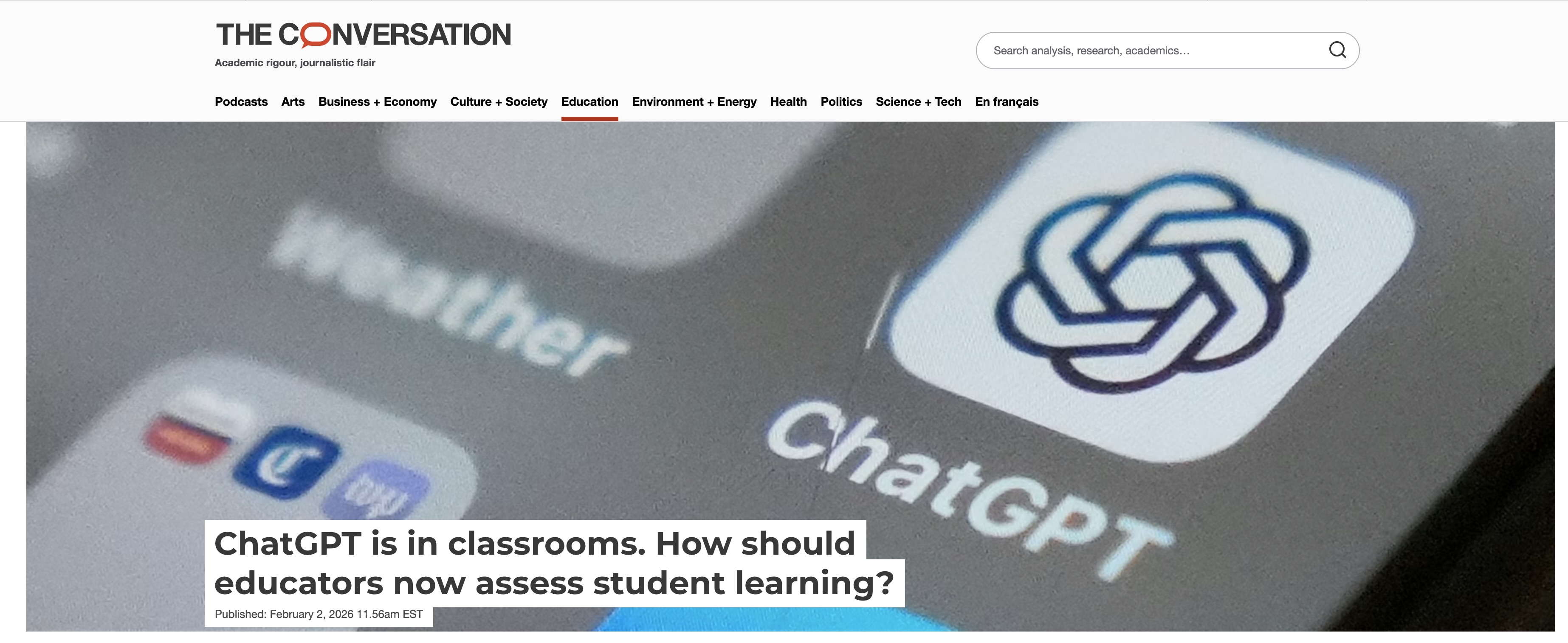
Alt text: Screenshot of The Conversation website showing a blurred smartphone screen with the ChatGPT app icon. Overlaid headline reads, “ChatGPT is in classrooms. How should educators now assess student learning?”
Screenshot from The Conversation.

We emphasize that, “in a post-plagiarism context, we consider that humans and AI co-writing and co-creating does not automatically equate to plagiarism.” Check out the full article in The Conversation.

You can check out the scholarly paper that we published in Assessment and Evaluation in Higher Education that goes into more detail about the methods and findings of our interviews.

I’d like to give a shoutout to all the project team members who worked with us on various aspects of this research: Robert (Bob) Brennan (Schulich School of Engineering, University of Calgary), Jason Weins (Faculty of Arts, University of Calgary), Brenda McDermott (Student Accessibility Services, University of Calgary), Rahul Kumar (Faculty of Education, Brock University), Beatriz Moya (Instituto de Éticas Aplicadas, Pontificia Universidad Católica de Chile) and the student research assistants who helped along the way (who have now all successfully graduated and moved on to the next phase of their careers): Jonathan Lesage, Helen Pethrick, and Mawuli Tay.

Related posts:

What Should We Be Assessing in a World with AI? Insights from Higher Education Educators – https://drsaraheaton.com/2025/11/25/what-should-we-be-assessing-in-a-world-with-ai-insights-from-higher-education-educators/

______________

Share this post: ChatGPT is in classrooms. What now? https://drsaraheaton.com/2026/02/02/chatgpt-is-in-classrooms-what-now/

Sarah Elaine Eaton, PhD, is a Professor and Research Chair in the Werklund School of Education at the University of Calgary, Canada. Opinions are my own and do not represent those of my employer.


Bibliography of Equity, Diversity, Inclusion, and Accessibility Resources for Academic Integrity

September 12, 2025

This week I did an invited presentation for the European Network for Academic Integrity (ENAI) Integrity for All Working Group.

As part of my presentation, I shared this bibliography of resources that I’ve worked on over the past several years on academic integrity as it relates to equity, diversity, inclusion, accessibility, and decolonization. These topics have become increasingly important to me over the past half decade and it is more important now than it ever has been to elevate the importance of these topics, along with human rights and social justice, when addressing matters of student conduct.

This bibliography contains a list of academic integrity articles, presentations, and resources that focus on these topics. 

I’ve done my best to prepare this list according to APA 7 conventions, but please forgive any errors.

I aim to make as much of my content open access. If there is anything on this list that you cannot access, please contact me directly and I’ll see what I can do.

______________

Share this post: Bibliography of Equity, Diversity, Inclusion, and Accessibility Resources for Academic Integrity – https://drsaraheaton.com/2025/09/12/bibliography-of-equity-diversity-inclusion-and-accessibility-resources-for-academic-integrity/

Sarah Elaine Eaton, PhD, is a Professor and Research Chair in the Werklund School of Education at the University of Calgary, Canada. Opinions are my own and do not represent those of my employer.


Embedding Social Justice, Equity, Inclusion, Diversity, and Accessibility in Academic Integrity

August 25, 2025

As a new academic year begins here in the northern hemisphere, I’m worried. I am worried that equity-deserving students, including racialized and linguistic-minority students, disabled and neurodivergent students, and others from equity-deserving groups will fall through the cracks again this year.

Conversations about academic integrity often centre around detection and discipline. 

How many students will be accused of — and investigated for — academic cheating this year when what they actually needed was learning support? Or language support? Or just a clearer understanding of what academic integrity is and how to uphold it?

It doesn’t have to be this way.

Academic integrity is also about creating a learning environment grounded in fairness and opportunity for every student. Social justice, equity, inclusion, diversity, and accessibility shape how students experience integrity in real ways:

  • Equity reminds us that students enter the classroom with different levels of preparation and support.
  • Inclusion ensures every student can participate in learning and assessment.
  • Accessibility removes barriers that make it harder for some students to meet expectations.
Infographic entitled 'Embedding Social Justice, Equity, Inclusion, Diversity, and Accessibility in Academic Integrity.' It features four bullet points: Equity acknowledges varied student preparation and support; Inclusion promotes participation in learning and assessment; Accessibility removes barriers to meeting expectations; and a Social Justice lens reveals patterns in integrity breaches. An illustration of a balanced scale appears below the text. The poster is credited to Sarah Elaine Eaton, PhD, August 2025.

A social justice lens helps us see patterns in who is reported or penalized for breaches of integrity and why.

  • Here are some actions educators can take in the first month of classes to support student success:
  • Review course materials to ensure instructions and policies about integrity are written in plain, accessible language.
  • Dedicate class time to talking with students about what integrity looks like in your course and why it matters.
  • Share examples of proper citation and collaboration that are relevant to your discipline.
  • Make time for questions about assessments so students understand what is expected and where to find help.
  • Connect students early to campus supports such as writing centres, student services, and accessibility services.

This is just a start.

My point is this: Do not assume that students should just know what academic integrity means. Take the time to explain your expectations and policies. In order for students to follow the rules, they need to know what the rules are.

Academic integrity is not only about avoiding plagiarism or cheating. It is also about fostering trust and fairness so that all students have a fair chance to learn and succeed. The choices we make in the first few weeks of the term set the tone for the entire year.

What steps are you taking at the start of this new school year to build a more inclusive and equitable approach to academic integrity?

________________________

Share this post: Embedding Social Justice, Equity, Inclusion, Diversity, and Accessibility in Academic Integrity – https://drsaraheaton.com/2025/08/25/embedding-social-justice-equity-inclusion-diversity-and-accessibility-in-academic-integrity/

Sarah Elaine Eaton, PhD, is a Professor and Research Chair in the Werklund School of Education at the University of Calgary, Canada. Opinions are my own and do not represent those of my employer.


Fake Degrees, Fraudulent Credentials and the Ecosystem of Commercial Academic Fraud

April 10, 2025

Since 2020 I’ve been working with a number of collaborators on projects related to fake degrees, diploma mills, and credential fraud. One of the people I have had the privilege of working with is FBI Special Agent (ret.), Allen Ezell, who is one of the world’s leading experts on  fake degrees and accreditation fraud. 

I’ve spent countless hours on the phone with Allen and have exchanged dozens, if not hundreds, of e-mails with him, over the years. Now in his 80s, Allen is one of the world’s finest experts on the topic. He contributed a fascinating chapter called “Yesterday, today, and tomorrow: A tour of Axact, the ‘World’s Largest Diploma Mill’” to our book, Fake Degrees and Fraudulent Credentials in Higher Education

We also learned from other contributors to the book that the companies who sell fake credentials don’t stop there. They can also provide contact cheating services (often under the guise of ‘research services’), fake admission letters, fake transcripts, fraud in standardized testing (e.g., sending impersonators to write English language proficiency tests), and much more. 

In the introduction for the book, we connect the dots to show how admissions fraud, contract cheating (e.g., term paper mills), scientific and scholarly paper mills, and fake degrees and fraudulent credentials are all connected. We synthesize the key ideas in this infographic:

Diagram titled "The Ecosystem of Commercial Academic Fraud" by Eaton & Carmichael (2022), showing four overlapping colored circles, each representing a type of academic fraud, with "Fraud" in the center where all circles overlap. The categories are: Degree Mills (red): Fake and fraudulent diplomas, transcripts, reference letters, and other academic and professional documents. Contract Cheating (orange): Outsourced student academic work including term paper mills, assignment completion services, thesis writing services, and student proxy services. Admissions Fraud (green): Impersonation and fraud services for standardized admissions testing (e.g., SATs), language proficiency testing, and unethical educational agents. Paper Mills (blue): Manufactured scholarly and scientific publications, authorship for sale. Each category overlaps in the center to show they are part of a broader ecosystem of fraud. The image includes a citation and Creative Commons license at the bottom.

It is difficult to get a handle on the exact size and scope of the industry, but based on what we know, we estimated that the industry is worth at least $21 Billion USD, and we figure that is a low estimate.

Throughout the past half-decade, we’ve developed a number of resources related to these topics. I’ve posted about them previously, but I figured it might be helpful if I gathered some of them into a single blog post. They are all freely available as open access resources.

Counterfeit Credentials: 13 Recommendations for Higher Education Professionals

Infographic titled "Counterfeit Credentials: Top 13 Recommendations for Higher Education Professionals" by Carmichael & Eaton (2020). It offers guidance to help institutions detect and prevent the use of fake degrees and fraudulent documents in admissions and hiring. The recommendations are:
1.	Use a direct transmission system for admission applications – Electronic grade submissions reduce tampering.
2.	Consider an evaluation service – Evaluate transcripts against program requirements.
3.	Know the signs of a fake degree – Check for authenticity, spelling, watermarks, correct language, matching data points.
4.	Employ a transcript sharing service – Use secure repositories or verify hand-delivered transcripts.
5.	Don't say cheese – Warn students not to post degrees online due to risk of fraud.
6.	Compare interim and final grades – Ensures data integrity.
7.	Audit your systems routinely – Think like a hacker to uncover weaknesses.
8.	Beware of strip mall schools – Diploma mills that mimic real institutions; create internal databases for tracking.
9.	Take stock of your transcript paper – Use serial numbers and compare for inconsistencies.
10.	Learn how to spot a bogus transcript – Identify fakes by comparing submitted transcripts.
11.	Verify education credentials when hiring – Check for linear academic progression and verify references beyond website searches.
12.	Investigate whistleblower claims – Some student reports may be legitimate and need proper review.
13.	Leverage your professional network – Share practices, investigate cases, or lobby for change.
References and contact emails (jamie.carmichael@carleton.ca; seaton@ucalgary.ca) are included for further information.

This infographic is intended mainly for registrars, admissions staff, admissions committees and others whose work involves assessing the credentials of applicants for university and college programs. 

Scholarships Without Scruples

In this infographic, Jamie Carmichael and I share signs of scholarship scams, which is one from of educational fraud:

Infographic titled “Scholarships Without Scruples – 3 Signs of Scholarship Scams.” Credit Card Required: Don’t give out your credit card number. Legitimate scholarship applications never ask for this information. Discount in Disguise: You should not have to buy anything to receive a scholarship. Legit scholarships never require payment for goods or services. Tax Trickery: Legit scholarships are taxed differently than earned income. If proper tax documentation isn’t provided, it may not be a real scholarship. At the bottom: “Find out more” – Contact information for Sarah Elaine Eaton (University of Calgary, seaton@ucalgary.ca) and Jamie Carmichael (Carleton University, Jamie.Carmichael@Carleton.ca). Footer text: “Scholarship scams are real. Learn how to protect yourself!”

When it comes to education fraud, there are many angles to consider. There is certainly a need for more research, awareness, and advocacy on these topics, especially as GenAI can make these types of fraud easier.

Below are some related posts and further resources that I hope you find helpful.

Related posts

References and Resources

  • Carmichael, J. (2023, June 7). Understanding Fake Degrees and Credential Fraud in Higher Ed. The Evollution: A Modern Campus Illumination. https://evolllution.com/programming/credentials/understanding-fake-degrees-and-credential-fraud-in-higher-ed/
  • Carmichael, J. J. (2024). Reframing and Broadening Adversarial Stylometry for Academic Integrity. In S. E. Eaton (Ed.), Second Handbook of Academic Integrity (pp. 1467-1485). Springer Nature Switzerland. https://doi.org/10.1007/978-3-031-54144-5_148 
  • Carmichael, J., & Eaton, S. E. (2020). Counterfeit Credentials: Top 13 Recommendations for Higher Education Professionals (Infographic). University of Calgary. http://hdl.handle.net/1880/113042 
  • Clark, A. (2023). Examining the problem of fraudulent English test scores: What can Canadian higher education institutions learn? In S. E. Eaton, J. J. Carmichael, & H. Pethrick (Eds.), Fake Degrees and Fraudulent Credentials in Higher Education (pp. 187-207). Springer International Publishing. https://doi.org/10.1007/978-3-031-21796-8_9 
  • Çelik, Ö., & Razı, S. (2023). Avoiding favouritism in the recruitment practice of Turkish higher education institutions. In S. E. Eaton, J. J. Carmichael, & H. Pethrick (Eds.), Fake Degrees and Fraudulent Credentials in Higher Education (pp. 153-167). Springer International Publishing. https://doi.org/10.1007/978-3-031-21796-8_7 
  • DeCoster, B. (2023). There is no culture? A framework for addressing admissions fraud. In S. E. Eaton, J. J. Carmichael, & H. Pethrick (Eds.), Fake Degrees and Fraudulent Credentials in Higher Education (pp. 209-226). Springer International Publishing. https://doi.org/10.1007/978-3-031-21796-8_10 
  • Duklas, J. (2023). Bridging to tomorrow: A historical and technological review of credential exchange in higher education within Canada. In S. E. Eaton, J. J. Carmichael, & H. Pethrick (Eds.), Fake Degrees and Fraudulent Credentials in Higher Education (pp. 95-113). Springer International Publishing. https://doi.org/10.1007/978-3-031-21796-8_4
  • Eaton, S. E., & Carmichael, J. (2020). Scholarships without scruples (Infographic). University of Calgary: http://hdl.handle.net/1880/113044
  • Eaton, S. E., & Carmichael, J. (2022). The Ecosystem of Commercial Academic Fraud. University of Calgary. https://dx.doi.org/10.11575/PRISM/40330
  • Eaton, S. E., Carmichael, J., & Pethrick, H. (Eds.). (2023). Fake degrees and credential fraud in higher education. Springer. https://doi.org/10.1007/978-3-031-21796-8
  • Ezell, A. (2023). Yesterday, today, and tomorrow: A tour of Axact, the “World’s Largest Diploma Mill”. In S. E. Eaton, J. J. Carmichael, & H. Pethrick (Eds.), Fake Degrees and Fraudulent Credentials in Higher Education (pp. 49-94). Springer International Publishing. https://doi.org/10.1007/978-3-031-21796-8_3 
  • Hextrum, K. (2023). Fair play, fraud, or fixed? Athletic credentials in U.S. higher education. In S. E. Eaton, J. J. Carmichael, & H. Pethrick (Eds.), Fake Degrees and Fraudulent Credentials in Higher Education (pp. 115-132). Springer International Publishing. https://doi.org/10.1007/978-3-031-21796-8_5
  • Orim, S.-M., & Glendinning, I. (2023). Corruption in admissions, recruitment, qualifications and credentials: From research into quality assurance. In S. E. Eaton, J. J. Carmichael, & H. Pethrick (Eds.), Fake Degrees and Fraudulent Credentials in Higher Education (pp. 133-151). Springer International Publishing. https://doi.org/10.1007/978-3-031-21796-8_6
  • Sabbaghan, S., & Fazel, I. (2023). None of the above: Integrity concerns of standardized English proficiency tests. In S. E. Eaton, J. J. Carmichael, & H. Pethrick (Eds.), Fake Degrees and Fraudulent Credentials in Higher Education (pp. 169-185). Springer International Publishing. https://doi.org/10.1007/978-3-031-21796-8_8

–——–-

Share this post: Fake Degrees, Fraudulent Credentials and the Ecosystem of Commercial Academic Fraud – https://drsaraheaton.com/2025/04/10/fake-degrees-fraudulent-credentials-and-the-ecosystem-of-commercial-academic-fraud/

This blog has had over 3.7 million views thanks to readers like you. If you enjoyed this post, please ‘Like’ it using the button below or share it on social media. Thanks!

Sarah Elaine Eaton, PhD, is a Professor and Research Chair in the Werklund School of Education at the University of Calgary, Canada. Opinions are my own and do not represent those of my employer.