Redesigning Assessment for the Age of Agentic AI: A Real-World Reflection

September 23, 2026

This past summer (July and August here in Calgary), I taught EDER 619.26, Leadership for Learning: Policy, Governance, and Community, a fully online course in the University of Calgary’s Master of Education (MEd) program. Most of my students were K-12 teachers in Alberta pursuing advanced training while working full time. This was my first time teaching the course, and I used it as an opportunity to redesign my assessment approach in response to a concern I have followed closely in recent months: the threat that agentic AI poses to academic integrity in online courses.

I want to share what I did, why I did it, and how another instructor could try the same approach.

The Problem I Set Out to Solve

In online courses we have relied on the same assessment tools for decades: discussion board posts and a final paper submitted at the end of the term. These formats work well when the greatest risk to academic integrity is a student copying a classmate’s work. They work less well when a student can hand an assignment to an AI agent and receive a finished product in return. I wanted an assessment structure that valued process over product and made real-time, verifiable engagement central to how students earned their grades.

Photo by Canva Studio on Pexels.com

My Approach

I built the course as a hybrid model with mandatory video conference (i.e., Zoom) sessions, scheduled well in advance so students knew what to expect. I selected a small number of required readings and asked students to locate supplementary readings on their own through the library databases, connected to the weekly themes and the in-class tasks. I adopted a flipped classroom structure: students completed the readings before each session and arrived prepared to apply them.

Seventy-five percent of the course grade came from three real-time learning tasks tied to the Zoom sessions. For two of the three sessions, I brought a current Canadian policy or governance news story to the group, chosen because the course readings focused on the Canadian context. For the third, I built a synthetic educational case with the assistance of Claude, and I told my students I had done so. In each session, students worked in self-selected groups for a set period, initially ten minutes and later shortened to five, to apply the readings to the case or news story and produce a shared artifact documenting their thinking. They then uploaded that artifact to a course Dropbox.

I informed students from the outset that I was trying this format for the first time and that I expected to adjust it as I learned what worked. I asked for their feedback throughout the term and changed the process in response, including the shortened submission window after students reported that some groups kept working past the agreed time.

I also changed how I graded. I was not looking for a polished, consensus-driven product. I wanted evidence of student thinking, including open questions and points of disagreement that a group had not resolved. I told students that AI tool use was permitted under the University of Calgary Faculty of Graduate Studies Artificial Intelligence Guidelines and would not affect their grade either way. Most reported that they spent the bulk of their time in conversation with their groupmates rather than using AI tools, largely because the time constraint left little room for anything else.

The remaining twenty-five percent of the grade was a synthesis paper. Students combined the required and supplementary readings, the bibliographic sources they had shared with classmates during the sessions, and the two news stories and the synthetic case addressed in class into a single integrated paper.

Steps to Try This Assessment Approach

  1. Schedule your synchronous sessions early. Set the dates and times for all mandatory sessions at the start of the term and communicate the expectation of real-time participation.
  2. Curate a limited reading list. Choose a small set of required readings and ask students to locate supplementary sources through the library databases, tied to the weekly themes.
  3. Flip the classroom. Assign readings for completion before each session and communicate this expectation in writing.
  4. Prepare a case or current news story for each session. Select material relevant to your discipline and your students’ context, or construct a synthetic case with AI assistance. If you use AI assistance, disclose it to your students.
  5. Set a group task with a firm time limit. Give students 5 to 10 minutes to work in self-selected groups, apply the readings to the case, and produce a shared artifact documenting their discussion and reasoning.
  6. Collect the artifact through a shared drop point. I used the D2L / Brightspace Dropbox, but you could also use a shared document, or similar tool works well. Set the submission window based on your own testing; shorten it if students report that groups continue working past the agreed time.
  7. Grade for process, not polish. Communicate to students that you are evaluating evidence of learning and engagement with the readings, not a finished, consensus-driven product. Tell them unresolved questions and disagreements are acceptable and worth documenting.
  8. State your AI expectations explicitly. Clarify whether AI tool use is permitted for the in-class task and confirm that it will not affect grading either way, consistent with your institution’s guidelines (if they have them).
  9. Build a synthesis assignment. Ask students to integrate the required readings, their self-sourced supplementary readings, and the material from each session into a single paper at the end of the term.
  10. Offer an alternate path for students who miss a session. Schedule a makeup session or provide an equivalent assessment based on the same weekly reading and format.

What I Would Change Next Time

Students told me they would have benefited from more time to discuss each case or news story during the sessions. I plan to extend the collaboration window in future offerings of the course.

Reflection

Most of my students had not encountered agentic AI before this course and some did not know the term. That gap became a useful discussion point, even though artificial intelligence and academic integrity were not the stated focus of the course. Students reported that the sessions felt more purposeful than a standard discussion board, in part because they knew each session would produce a graded outcome. I plan to repeat this assessment structure. This updated assessment approach replaced a format that has gone unchanged in online learning for decades and shifted the emphasis toward collaboration, real-time problem solving, and process over product.

This was by no means a perfect experiment, but in the end, the effort was worth it… And I’ll close by saying that the students were — and are — brilliant, thoughtful, and inspiring.

___________

Share this post – Redesigning Assessment for the Age of Agentic AI: A Real-World Reflection – https://drsaraheaton.com/2026/09/23/redesigning-assessment-for-the-age-of-agentic-ai-a-real-world-reflection/

Sarah Elaine Eaton, PhD, is a Professor and Research Chair in the Werklund School of Education at the University of Calgary, Canada. Opinions are my own and do not represent those of my employer.


Call for Proposals: Special issue on Postplagiarism and Generativism: Human-AI Hybrid Approaches to Ethical Teaching, Learning, and Assessment

March 17, 2026

Special Issue Call for Papers

Postplagiarism and Generativism: Human-AI Hybrid Approaches to Ethical Teaching, Learning, and Assessment

For publication in the Journal of University Teaching and Learning Practice

Guest editors

Background

Every new technology brings with it societal and moral panic (Orben, 2020). When the Internet first became popular, concerns about plagiarism increased. Even though there is scant empirical evidence that the Internet was actually responsible for increases in rates of plagiarism, the perception that new technology resulted in more academic cheating persisted (Panning Davies & Howard, 2016).

Some plagiarism scholars have been emphatic that the majority of student plagiarism cases are not an intent to deceive, but rather a lack of academic literacy and poor academic practice, and have even advocated for disposing of plagiarism in academic misconduct policies in favour of increased student support (Howard, 1992; Jamieson & Howard, 2021). The idea that plagiarism could be decoupled from academic misconduct seems somewhat unlikely, but by the 2020s it was obvious to some that generative artificial intelligence (GenAI) would have an impact on writing, and by extension, on plagiarism (Mindzak & Eaton, 2021).

In response to these technological shifts, various frameworks have emerged to conceptualize academic integrity in the GenAI era. The postplagiarism framework, first introduced by Eaton (2021, 2023) and since discussed by scholars worldwide (Bali, 2023; Bagenal, 2024; Kenny, 2024), offers one approach. Other perspectives, such as Generativism (Pratschke, 2023), AI Literacy frameworks (Ng et al., 2021; Pretorius & Cahusac de Caux, 2024), and UNESCO’s Guidance for Generative AI in Education (2023), provide complementary or alternative viewpoints on similar phenomena.

Postplagiarism is based on six tenets (Eaton, 2023): (1) human-AI hybrid writing will become the norm; (2) creativity can be enhanced by AI; (3) AI can help to overcome language barriers; (4) we can outsource control of our writing to AI, but we do not outsource responsibility for what is written; (5) attribution remains important; and (6) historical definitions of plagiarism may require rethinking.

Empirical testing of these and related frameworks has shown differing levels of acceptance and application across educational contexts (Kumar, 2025).

Equity, Diversity, Inclusion, and Accessibility in a Postplagiarism Age

As higher education institutions aim to promote social justice through equity, diversity, and inclusion (EDI), GenAI holds the potential to either break down or reinforce barriers related to linguistic, cultural, socioeconomic, and ability differences requires critical examination.

Assessment practices should be designed proactively to enable all students to demonstrate their learning without being unfairly disadvantaged by their personal characteristics or circumstances (Tai et al., 2022). Similarly, McDermott (2024) highlights the importance of considering accessibility, equity, and inclusion in assessment and academic integrity.

GenAI offers opportunities to enhance equity by providing personalized support, overcoming language barriers, and assisting learners with diverse needs. However, without careful implementation, it may exacerbate existing inequities through unequal access to technology, algorithmic biases, or assessment designs that privilege certain ways of knowing and communicating.

In this special edition, we propose to examine the broader question: “How are pedagogies, learning, and teaching approaches evolving in response to GenAI, and what frameworks best support ethical academic practice in a postplagiarism landscape?”

We invite researchers and practitioners to submit their original research papers exploring the transformation of teaching, learning, and assessment in a GenAI age. We welcome both theoretical and empirical contributions, including positions that may present contrasting viewpoints. Potential topics of interest include, but are not limited to:

  • New developments in postplagiarism, generativism, and other emerging frameworks for understanding academic integrity in the GenAI era
  • Empirical studies testing these frameworks in different contexts and disciplines
  • The use of these frameworks to design or reform academic misconduct policies and procedures
  • The relationship between GenAI, academic literacies, and related competencies (e.g., digital literacy, information literacy)
  • Pedagogical approaches that embrace GenAI while maintaining academic integrity
  • Case studies of successful integration of GenAI into teaching, learning, and assessment
  • Critical perspectives on the limitations or challenges of current approaches to GenAI in education
  • Position papers presenting new or alternative frameworks for understanding GenAI in teaching and learning

We particularly encourage submissions that engage in dialogue with existing frameworks, offering either supportive evidence or critical alternatives. Our goal is to foster a robust debate about the future of teaching and learning in a GenAI (and even a post-GenAI) world.

We welcome submissions from both established researchers and early-career scholars from diverse academic and cultural backgrounds. All submissions will be peer-reviewed by an international panel of experts. Accepted papers will be published in a special issue of the Journal of University Teaching and Learning Practice.

Types of publications accepted into this Special Issue

The types of publications that are eligible for acceptance into this Special Issue include:

  • Research papers
  • Review articles (e.g., systematic review or meta-analysis)
  • Case studies and evidence-based good practice examples

Developing a high-quality proposal

We recommend the creation of a single document in Word (.doc or .docx) format that contains the following:

  • Proposed article title
  • Proposed authors names, affiliations, and ORCid
  • A clear evidence-based rationale for the line of inquiry proposed
  • Research question(s)
  • Proposed method (for both theoretical and empirical manuscripts)
  • Practice-based implications of the proposed research

The word limit for the proposal is 250 words (not including references) and is designed to give the Editorial Team a sense of the rigour of the manuscript proposed and the possible implications of such research. The Editorial Team may return with an invitation to combine similar manuscripts. Acceptance of proposals does not guarantee acceptance of final manuscripts.

Timeline

  • Proposals due – April 30, 2026
  • Proposal acceptance notifications: May 14, 2026
  • Full articles due: August 31, 2026

Submit your abstract via this online form: https://forms.gle/6sKjc2jkKGWCtGgw7

For further information contact Professor Sarah Elaine Eaton, University of Calgary.

References

Bali, M. (2023, March 3). Are We Approaching a Postplagiarism Era? https://blog.mahabali.me/educational-technology-2/are-we-approaching-a-postplagiarism-era/

Bagenal, J. (2024). Generative artificial intelligence and scientific publishing: Urgent questions, difficult answers. The Lancet, 403(10432), 1118–1120. https://doi.org/10.1016/S0140-6736(24)00416-1

Eaton, S. E. (2021). Plagiarism in Higher Education: Tackling Tough Topics in Academic Integrity. Bloomsbury.

Eaton, S. E. (2023). Postplagiarism: Transdisciplinary ethics and integrity in the age of artificial intelligence and neurotechnology. International Journal for Educational Integrity, 19(1), 1–10. https://doi.org/10.1007/s40979-023-00144-1

Orben, A. (2020). The Sisyphean cycle of technology panics. Perspectives on Psychological Science, 15(5), 1143–1157. https://doi.org/10.1177/1745691620919372

Howard, R. M. (1992). A plagiarism pentimento. Journal of Teaching Writing, 11(2), 233–245.


ChatGPT is in classrooms. What now?

February 2, 2026

“What should we be assessing exactly?” This was a question one of our research participants asked when we interviewed them as part of our project on artificial intelligence and academic integrity, sponsored by a University of Calgary Teaching Grant.

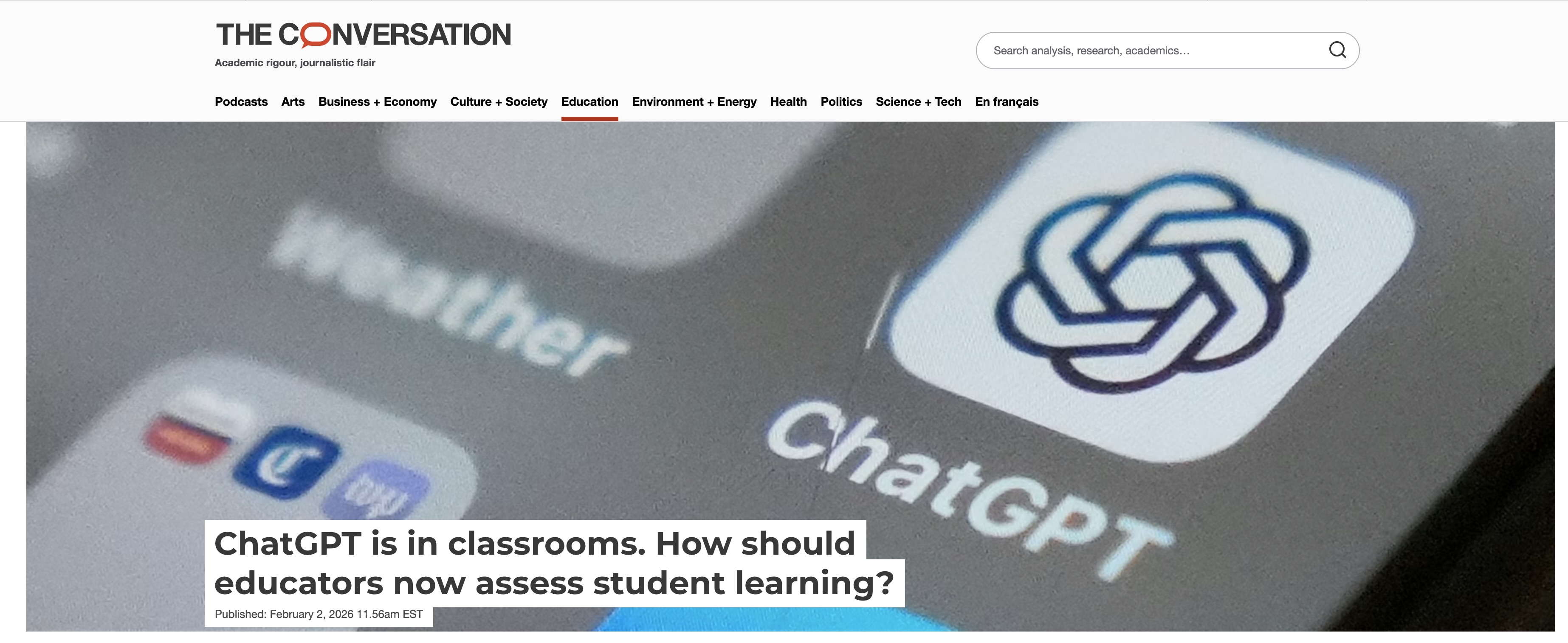
In an article published in The Conversation, we provide highlights of the results from our interviews with 28 educators across Canada, as well as our analysis of 15 years of research that looked at how AI affects education. (Spoiler alert: AI is a double-edged sword for educators and there are no easy answers.)

Alt text: Screenshot of The Conversation website showing a blurred smartphone screen with the ChatGPT app icon. Overlaid headline reads, “ChatGPT is in classrooms. How should educators now assess student learning?”
Screenshot from The Conversation.

We emphasize that, “in a post-plagiarism context, we consider that humans and AI co-writing and co-creating does not automatically equate to plagiarism.” Check out the full article in The Conversation.

You can check out the scholarly paper that we published in Assessment and Evaluation in Higher Education that goes into more detail about the methods and findings of our interviews.

I’d like to give a shoutout to all the project team members who worked with us on various aspects of this research: Robert (Bob) Brennan (Schulich School of Engineering, University of Calgary), Jason Weins (Faculty of Arts, University of Calgary), Brenda McDermott (Student Accessibility Services, University of Calgary), Rahul Kumar (Faculty of Education, Brock University), Beatriz Moya (Instituto de Éticas Aplicadas, Pontificia Universidad Católica de Chile) and the student research assistants who helped along the way (who have now all successfully graduated and moved on to the next phase of their careers): Jonathan Lesage, Helen Pethrick, and Mawuli Tay.

Related posts:

What Should We Be Assessing in a World with AI? Insights from Higher Education Educators – https://drsaraheaton.com/2025/11/25/what-should-we-be-assessing-in-a-world-with-ai-insights-from-higher-education-educators/

______________

Share this post: ChatGPT is in classrooms. What now? https://drsaraheaton.com/2026/02/02/chatgpt-is-in-classrooms-what-now/

Sarah Elaine Eaton, PhD, is a Professor and Research Chair in the Werklund School of Education at the University of Calgary, Canada. Opinions are my own and do not represent those of my employer.


Embedding Social Justice, Equity, Inclusion, Diversity, and Accessibility in Academic Integrity

August 25, 2025

As a new academic year begins here in the northern hemisphere, I’m worried. I am worried that equity-deserving students, including racialized and linguistic-minority students, disabled and neurodivergent students, and others from equity-deserving groups will fall through the cracks again this year.

Conversations about academic integrity often centre around detection and discipline. 

How many students will be accused of — and investigated for — academic cheating this year when what they actually needed was learning support? Or language support? Or just a clearer understanding of what academic integrity is and how to uphold it?

It doesn’t have to be this way.

Academic integrity is also about creating a learning environment grounded in fairness and opportunity for every student. Social justice, equity, inclusion, diversity, and accessibility shape how students experience integrity in real ways:

  • Equity reminds us that students enter the classroom with different levels of preparation and support.
  • Inclusion ensures every student can participate in learning and assessment.
  • Accessibility removes barriers that make it harder for some students to meet expectations.
Infographic entitled 'Embedding Social Justice, Equity, Inclusion, Diversity, and Accessibility in Academic Integrity.' It features four bullet points: Equity acknowledges varied student preparation and support; Inclusion promotes participation in learning and assessment; Accessibility removes barriers to meeting expectations; and a Social Justice lens reveals patterns in integrity breaches. An illustration of a balanced scale appears below the text. The poster is credited to Sarah Elaine Eaton, PhD, August 2025.

A social justice lens helps us see patterns in who is reported or penalized for breaches of integrity and why.

  • Here are some actions educators can take in the first month of classes to support student success:
  • Review course materials to ensure instructions and policies about integrity are written in plain, accessible language.
  • Dedicate class time to talking with students about what integrity looks like in your course and why it matters.
  • Share examples of proper citation and collaboration that are relevant to your discipline.
  • Make time for questions about assessments so students understand what is expected and where to find help.
  • Connect students early to campus supports such as writing centres, student services, and accessibility services.

This is just a start.

My point is this: Do not assume that students should just know what academic integrity means. Take the time to explain your expectations and policies. In order for students to follow the rules, they need to know what the rules are.

Academic integrity is not only about avoiding plagiarism or cheating. It is also about fostering trust and fairness so that all students have a fair chance to learn and succeed. The choices we make in the first few weeks of the term set the tone for the entire year.

What steps are you taking at the start of this new school year to build a more inclusive and equitable approach to academic integrity?

________________________

Share this post: Embedding Social Justice, Equity, Inclusion, Diversity, and Accessibility in Academic Integrity – https://drsaraheaton.com/2025/08/25/embedding-social-justice-equity-inclusion-diversity-and-accessibility-in-academic-integrity/

Sarah Elaine Eaton, PhD, is a Professor and Research Chair in the Werklund School of Education at the University of Calgary, Canada. Opinions are my own and do not represent those of my employer.


Embracing AI as a Teaching Tool: Practical Approaches for the Post-plagiarism Classroom

March 23, 2025

Artificial intelligence (AI) has moved from a futuristic concept to an everyday reality. Rather than viewing AI tools like ChatGPT as threats to academic integrity, forward-thinking educators are discovering their potential as powerful teaching instruments. Here’s how you can meaningfully incorporate AI into your classroom while promoting critical thinking and ethical technology use.

Making AI Visible in the Learning Process

One of the most effective approaches to teaching with AI is to bring it into the open. When we demystify these tools, students develop a more nuanced understanding of the tools’ capabilities and limitations.

Start by dedicating class time to explore AI tools together. You might begin with a demonstration of how ChatGPT or similar tools respond to different types of prompts. Ask students to compare the quality of responses when the tool is asked to:

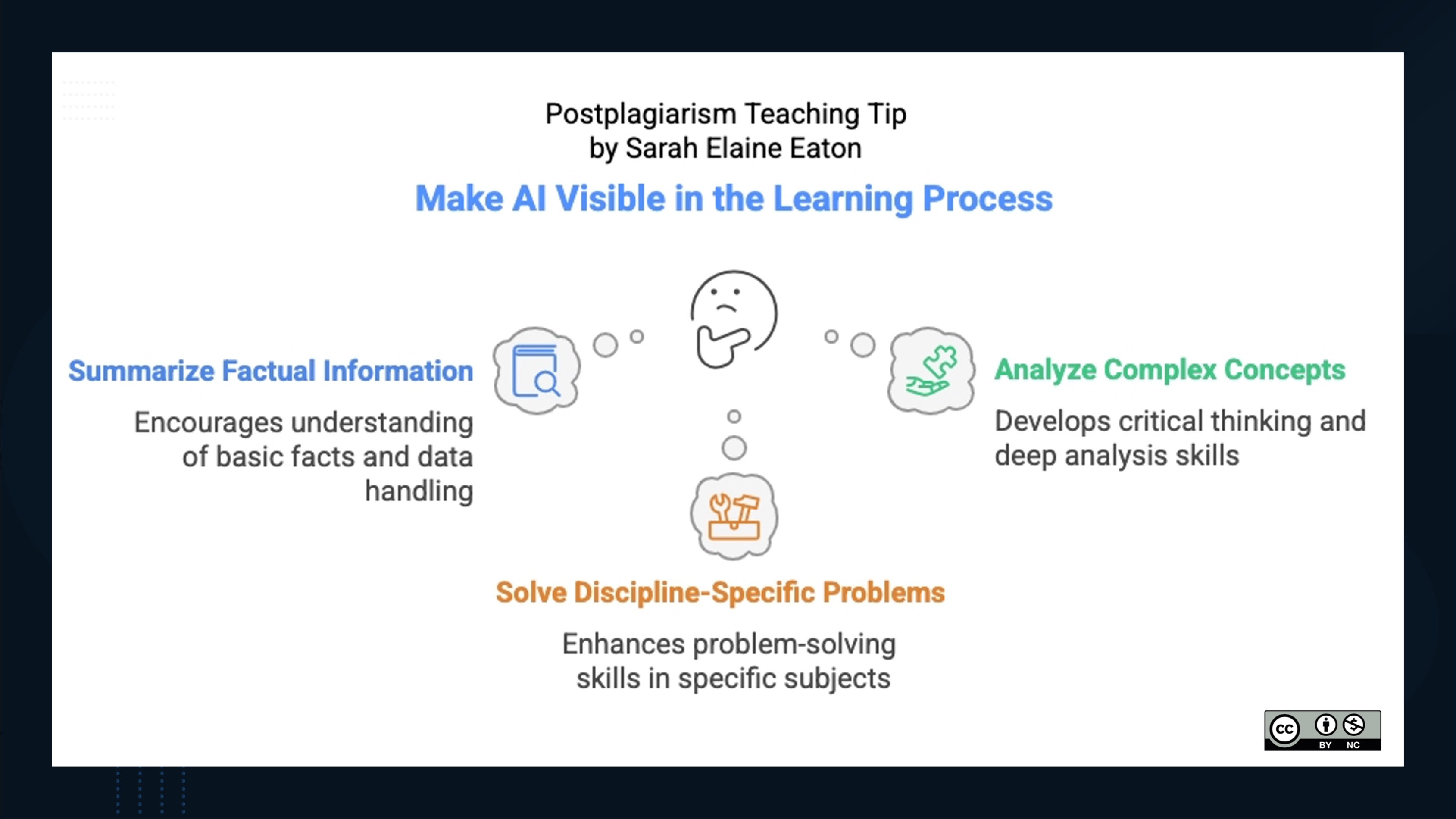
  • Summarize factual information
  • Analyze a complex concept
  • Solve a problem in your discipline
A teaching tip infographic titled "Postplagiarism Teaching Tip by Sarah Elaine Eaton: Make AI Visible in the Learning Process." The infographic features a central image of a thinking face emoji, with three connected bubbles highlighting different aspects of AI integration in learning:

Summarize Factual Information (blue): Encourages understanding of basic facts and data handling, represented by an icon of a document with a magnifying glass.

Analyze Complex Concepts (green): Develops critical thinking and deep analysis skills, represented by an icon of a puzzle piece.

Solve Discipline-Specific Problems (orange): Enhances problem-solving skills in specific subjects, represented by an icon of tools (wrench and screwdriver).
In the bottom right corner, there’s a Creative Commons license (CC BY-NC) icon.

Have students identify where the AI excels and where it falls short. Hands-on experience that is supervised by an educator helps students understand that while AI can be impressive and  capable, it has clear boundaries and weaknesses.

From AI Drafts to Critical Analysis

AI tools can quickly generate content that serves as a starting point for deeper learning. Here is a step-by-step approach for using AI-generated drafts as teaching material:

  1. Assignment Preparation: Choose a topic relevant to your course and generate a draft response using an AI tool such as ChatGPT.
  2. Collaborative Analysis: Share the AI-generated draft with students and facilitate a discussion about its strengths and weaknesses. Prompt students with questions such as:
    • What perspectives are missing from this response?
    • How could the structure be improved?
    • What claims require additional evidence?
    • How might we make this content more engaging or relevant?

The idea is to bring students into conversations about AI, to build their critical thinking and also have them puzzle through the strengths and weaknesses of current AI tools.

  • Revision Workshop: Have students work individually or in groups to revised an AI draft into a more nuanced, complete response. This process teaches students that the value lies not in generating initial content (which AI can do) but in refining, expanding, and critically evaluating information (which requires human judgment).
  • Reflection: Ask students to document what they learned through the revision process. What gaps did they identify in the AI’s understanding? How did their human perspective enhance the work? Building in meta-cognitive awareness is one of the skills that assessment experts such as Bearman and Luckin (2020) emphasize in their work.

This approach shifts the educational focus from content creation to content evaluation and refinement—skills that will remain valuable regardless of technological advancement.

Teaching Fact-Checking Through Deliberate Errors

AI systems often present information confidently, even when that information is incorrect or fabricated. This characteristic makes AI-generated content perfect for teaching fact-checking skills.

Try this classroom activity:

  1. Generate Content with Errors: Use an AI tool to create content in your subject area, either by requesting information you know contains errors or by asking about obscure topics where the AI might fabricate details.
  2. Fact-Finding Mission: Provide this content to students with the explicit instruction to identify potential errors and verify information. You might structure this as:
    • Individual verification of specific claims
    • Small group investigation with different sections assigned to each group
    • A whole-class collaborative fact-checking document
  3. Source Evaluation: Have students document not just whether information is correct, but how they determined its accuracy. This reinforces the importance of consulting authoritative sources and cross-referencing information.
  4. Meta-Discussion: Use this opportunity to discuss why AI systems make these kinds of errors. Topics might include:
  • How large language models are trained
  • The concept of ‘hallucination’ in AI
  • The difference between pattern recognition and understanding
  • Why AI might present incorrect information with high confidence

These activities teach students not just to be skeptical of AI outputs but to develop systematic approaches to information verification—an essential skill in our information-saturated world.

Case Studies in AI Ethics

Ethical considerations around AI use should be explicit rather than implicit in education. Develop case studies that prompt students to engage with real ethical dilemmas:

  1. Attribution Discussions: Present scenarios where students must decide how to properly attribute AI contributions to their work. For example, if an AI helps to brainstorm ideas or provides an outline that a student substantially revises, how could this be acknowledged?
  2. Equity Considerations: Explore cases highlighting AI’s accessibility implications. Who benefits from these tools? Who might be disadvantaged? How might different cultural perspectives be underrepresented in AI outputs?
  3. Professional Standards: Discuss how different fields are developing guidelines for AI use. Medical students might examine how AI diagnostic tools should be used alongside human expertise, while creative writing students could debate the role of AI in authorship.
  4. Decision-Making Frameworks: Help students develop personal guidelines for when and how to use AI tools. What types of tasks might benefit from AI assistance? Where is independent human work essential?

These discussions help students develop thoughtful approaches to technology use that will serve them well beyond the classroom.

Implementation Tips for Educators

As you incorporate these approaches into your teaching, consider these practical suggestions:

  • Start small with one AI-focused activity before expanding to broader integration
  • Be transparent with students about your own learning curve with these technologies
  • Update your syllabus to clearly outline expectations for appropriate AI use
  • Document successes and challenges to refine your approach over time
  • Share experiences with colleagues to build institutional knowledge

Moving Beyond the AI Panic

The concept of postplagiarism does not mean abandoning academic integrity—rather, it calls for reimagining how we teach integrity in a technologically integrated world. By bringing AI tools directly into our teaching practices, we help students develop the critical thinking, evaluation skills, and ethical awareness needed to use these technologies responsibly.

When we shift our focus from preventing AI use to teaching with and about AI, we prepare students not just for academic success, but for thoughtful engagement with technology throughout their lives and careers.

References

Bearman, M., & Luckin, R. (2020). Preparing university assessment for a world with AI: Tasks for human intelligence. In M. Bearman, P. Dawson, R. Ajjawi, J. Tai, & D. Boud (Eds.), Re-imagining University Assessment in a Digital World (pp. 49-63). Springer International Publishing. https://doi.org/10.1007/978-3-030-41956-1_5 

Eaton, S. E. (2023). Postplagiarism: Transdisciplinary ethics and integrity in the age of artificial intelligence and neurotechnology. International Journal for Educational Integrity, 19(1), 1-10. https://doi.org/10.1007/s40979-023-00144-1

Edwards, B. (2023, April 6). Why ChatGPT and Bing Chat are so good at making things up. Arts Technica. https://arstechnica.com/information-technology/2023/04/why-ai-chatbots-are-the-ultimate-bs-machines-and-how-people-hope-to-fix-them/ 

________________________

Share this post: Embracing AI as a Teaching Tool: Practical Approaches for the Postplagiarism Classroom – https://drsaraheaton.com/2025/03/23/embracing-ai-as-a-teaching-tool-practical-approaches-for-the-post-plagiarism-classroom/

This blog has had over 3.7 million views thanks to readers like you. If you enjoyed this post, please ‘Like’ it using the button below or share it on social media. Thanks!

Sarah Elaine Eaton, PhD, is a Professor and Research Chair in the Werklund School of Education at the University of Calgary, Canada. Opinions are my own and do not represent those of my employer.