How Phishing Scams Exploit Academic Integrity Fears

September 3, 2026

An Instagram post caught my attention this week. A University of Alberta student described being phished through a fake accusation of academic misconduct.

https://www.instagram.com/reels/Dcl1uJnubqD

The scam did not rely on advanced technology. It did not require artificial intelligence or an elaborate hacking scheme. The scammer needed one thing: a strong feeling, delivered before the target had time to think.

That should concern anyone who works with students.

The Emotional Attack

Cybersecurity training focuses on information, such as: 

  • Do not click unfamiliar links.
  • Check the sender’s address. 
  • Watch for unexpected attachments. 

These are important tips that everyone should follow.

There’s a second part, that is just as important to pay attention to: how a person feels in the moment they read a message. As Guy Curtis and Amanda White point out in their recent research article, an allegation of academic misconduct can cause students distress and anxiety.

Fear produces urgency. Sympathy produces a desire to help. Excitement makes a person overlook details they would otherwise catch. Embarrassment stops a person from asking a friend or colleague whether something looks right.

None of this requires a scammer to outsmart the target’s technical knowledge. The scammer only needs to get past the target’s pause button, and feelings do that work quickly.

Once a person thinks, ‘I need to do this right now,’ the scammer has already won half the exchange.

Why This Matters for Students

Consider the situations a university student faces in a given semester. Tuition deadlines. Financial aid. Scholarships. Housing applications. Job offers. Academic standing. A friend who needs help fast. None of these topics is suspicious on its own. Students encounter them constantly, which is exactly why a scammer can use any one of them as a disguise.

A student who reads a message claiming that something important is at risk rarely stops to ask, ‘Is this a phishing attempt?’ The more immediate question is, ‘How do I fix this?’ That question is the trap. The scammer counts on the student staying inside it.

Urgency as a Weapon

Fraudsters have relied on manufactured urgency for a long time. Consider these common tactics: You have only a few minutes. Your account will close. Pay immediately. A friend needs help right now.

Urgency changes the question a person asks. Instead of ‘Is this legitimate?’, the target asks ‘How fast can I resolve this?’ The scammer controls that shift, and once it happens, careful judgment tends to disappear.

Students cannot reasonably treat every email or text with suspicion. That approach is not realistic, and it is not sustainable. What do to instead: when a message produces a strong emotional reaction, pause. The stronger the reaction, the more the pause matters.

Where Colleges and Universities Fit In

This is not only a student problem. Universities invest in cybersecurity training. Students learn about phishing, password hygiene, and multifactor authentication. That training is necessary, but it does not address scams built specifically to manipulate emotion.

When we teach cybersecuirty, we must include an emotional literacy component. Students should learn to notice when a message is working to make them afraid, guilty, excited, embarrassed, or suddenly responsible for solving an urgent problem. Orientation sessions, residence programming, and digital literacy initiatives are reasonable places to build this in.

The guidance itself is simple. If a message makes a person feel they must act immediately, they should stop. Then they should verify the request through a channel they already know is legitimate, not the phone number or link the message provides. The university website, the student portal, the bank, the employer: these sources exist independently of the suspicious message, and they are the ones worth contacting.

One extra minute, spent verifying, separates a student who avoids a scam from a student who becomes its next case study.

Rethinking Phishing Awareness

Fraud prevention cannot stop at spotting suspicious technology. The scammers doing the most damage right now often look ordinary. Scams arrive through platforms students already trust and tell a believable story. They contain no typos, no broken links, nothing that trips a spam filter.

The strength of the scam comes from something else entirely: an accurate read of how people behave under emotional pressure.

When considering cybersecurity we must account for psychology, as well as technology. Students do not need a degree in information security to protect themselves. They need the instinct to notice the feeling first and pay attention to it before acting. Panic, urgency, fear, excitement, guilt, an overwhelming pull to help someone right away. Any of these is reason enough to stop.

Step back. Verify independently. Then decide.

The scam rarely starts the moment someone clicks a link. It starts the moment a message succeeds in making a person react before they think.

Closing Remarks

An allegation of academic misconduct can cause students to panic and feel all kinds of emotions, including anxiety and terror. Those of us who work in education need to attend as much to our students’ well being, dignity and humanity as much as holding them accountable for their behaviour. 

___________

Share this post – How Phishing Scams Exploit Academic Integrity Fears – https://drsaraheaton.com/2026/09/03/how-phishing-scams-exploit-academic-integrity-fears/

Sarah Elaine Eaton, PhD, is a Professor and Research Chair in the Werklund School of Education at the University of Calgary, Canada. Opinions are my own and do not represent those of my employer.


Dignity, Grief, and the Case of Jason Arday

August 16, 2026

I have been quiet about the case of Dr. Jason Arday, who previously worked at Cambridge University and left his job following allegations of plagiarism and questions about other claims in his life story. The reason is not lack of interest in the case, but rather because my family recently lost my brother and we have been mourning.

Aaron Edward Eaton: A Brief Background on Recent Events

First, a personal statement. A couple of weeks ago the Royal Canadian Mounted Police (RCMP) (Canada’s national police) issued a missing person alert for my brother. Once the RCMP released the alert on social media, the matter immediately became public. We received messages of support from around the world.

On August 3, my brother was found deceased and this was also publicly announced on social media and via a newspaper article. I won’t go into the details, but suffice to say that the phrase, ‘found deceased’ is often a euphemism for ‘died by suicide’. Society hides behind vague and passive language rather than being direct about what really happened. I’ve never been fond of circumlocutions, but society has its rules.

Although we have deeply appreciated the support, having a private family matter become public changes the experience. Emotional energy is directed into reading, replying, and also taking a step away from technology to process quietly.

In any case, my lack of response about the Arday case was not due to indifference, but rather because I was focused on family matters.

Jason Arday: ‘Found Deceased’

I did not know Jason Arday. I have no basis on which to conclude whether misconduct occurred in his academic work, and that question is not the subject of this post. News of his passing hit me in a visceral and raw way. My deepest condolences to his family and friends. As is so often the case when someone is ‘found dead’, those left behind have many questions, deep grief, and sometimes, a feeling that it didn’t have to end the way it did. I can only imagine that Dr. Arday’s family and friends are experiencing with the level of public spectacle we have seen.

So, I will not be weighing in on questions relating to misconduct allegations. What concerns me are different questions: What do we, as a society, owe a person who is being investigated for misconduct during — and after — an investigative process? A related question also hovers: How can we ensure that a person’s dignity is preserved in the process of a misconduct investigation?

A Resignation Is Not a Verdict

Dr. Arday resigned his professorship at the University of Cambridge on August 5, 2026, after weeks of public scrutiny over plagiarism allegations and questions about other claims in his life story [McArthur, 2026]. He was found dead at his home in south London nine days later. Prime Minister Andy Burnham called the death “a tragedy on so many levels”. Arday’s family said that “the campaign of misinformation was too much for Jason”.

Iryna Pavlova, writing for our Postplagiarism blog, makes a valuable observation: reading the resignation as proof of guilt and reading it as proof of persecution involve the same error, which is treating an outcome as though it settles a question not yet answered by a thorough and fair investigation. I would add a further question to Iryna’s: Why should we let public persecution stand in for fair process? (Short answer: We shouldn’t.)

What a Process Without Dignity Looks Like

Article 11 of the Universal Declaration of Human Rights establishes a presumption of innocence until proven guilty. Article 12 protects a person against arbitrary attacks on their honour and reputation.

The Universal Declaration of Human Rights applies to all persons, everywhere. Full stop.

An individual alleged to have engaged in misconduct should be investigated by professionals with the skills and training to undertake the matter in a fair and just way. Being judged in the public sphere, with dozens if not hundreds or even thousands of people chiming in as armchair judges, turns due process into a public spectacle. A misconduct investigation, carried out in a professional and dignified manner, and a public trial by social media are not the same venue. Treating them as equivalent lets institutions (and quite frankly, members of society) off the hook for their own conduct.

Comment sections do not offer due process. Let me be clear: this is not an argument for shielding scholars from scrutiny. It is an argument for insisting that scrutiny happens in a manner that does not deprive individuals of their human rights.

Call to Action

A human‑rights‑by‑design approach to misconduct policy does not soften findings of wrongdoing; it separates the question of what happened from the question of how a person is treated while questions remain open (Eaton, 2024). I have yet to find a university or college anywhere that has explicitly adopted a human-rights centred approach to misconduct policy or process. I am not talking here about due process or procedural fairness. I am talking about misconduct policies and procedures that intentionally and explicitly commit to upholding human rights as a foundation for due process. (If you know such an institution, drop me a note.)

Institutions can commit to clear and private procedures rather than adjudication by the media. When we allow public persecution to prevail, we discard dignity and human rights.

Institutional leaders can communicate with the accused promptly. No one should wait in uncertainty for weeks. Institutional leaders should provide mental health and wellbeing support throughout the process, at no extra cost to the individual. Counsellors should be available alongside the investigation, not after it. We, as members of higher education institutions and as members of society, can also exercise restraint. We can wait for a review to conclude before we comment publicly, rather than posturing and pontificating. In Arday’s case, many people did not show that restraint.

Whatever the historical record eventually shows about Arday’s scholarship, the record already shows how his case was handled while questions remained open, which has been deplorable. The way in which the matter has been handled deserves as much scrutiny as the plagiarism allegations themselves.

May Dr. Jason Arday rest in peace. May his family, friends, and those who cared about him find solace and healing.

References

Ahmed, A. (2026, August 15). Tributes paid to Jason Arday after former Cambridge professor’s death. The Guardian. https://www.theguardian.com/uk-news/2026/aug/15/jason-arday-tributes-paid-to-former-cambridge-professor

Eaton, S. E. (2024). Future-proofing integrity in the age of artificial intelligence and neurotechnology: prioritizing human rights, dignity, and equity. International Journal for Educational Integrity, 20(1), 21. https://doi.org/10.1007/s40979-024-00175-2

Hui, S. (2026, August 15). UK’s leader calls for reflection after the death of former Cambridge professor accused of plagiarism. Associated Press. https://apnews.com/article/britain-jason-arday-cambridge-death-burnham-b9e2463ca6b474ac90cc6196ed668238

McArthur, T. (2026, August 14). Jason Arday, ex-Cambridge professor at centre of plagiarism row, found dead. BBC News. https://www.bbc.com/news/articles/c1j1ye6n30no

Pavlova, I. (2026, August 12). Beyond “Did He Plagiarize?”: What the Jason Arday Case Reveals About Academic Integrity in a Postplagiarism Era. Postplagiarism Blog. https://postplagiarism.com/2026/08/12/beyond-did-he-plagiarize-what-the-jason-arday-case-reveals-about-academic-integrity-in-a-postplagiarism-era

Red Deer Advocate Staff. (August 4, 2026). Missing Red Deer man found deceased. Red Deer Advocate. https://reddeeradvocate.com/2026/08/04/missing-red-deer-man-found-deceased/

United Nations. (2021). Universal Declaration of Human Rights. https://www.un.org/en/about-us/universal-declaration-of-human-rights

___________

Share this post – Dignity, Grief, and the Case of Jason Arday – https://drsaraheaton.com/2026/08/16/dignity-grief-and-the-case-of-jason-arday/

Sarah Elaine Eaton, PhD, is a Professor and Research Chair in the Werklund School of Education at the University of Calgary, Canada. Opinions are my own and do not represent those of my employer.


Stop wasting my time! AI Agents Infiltrate Scholarly Publishing

February 6, 2026

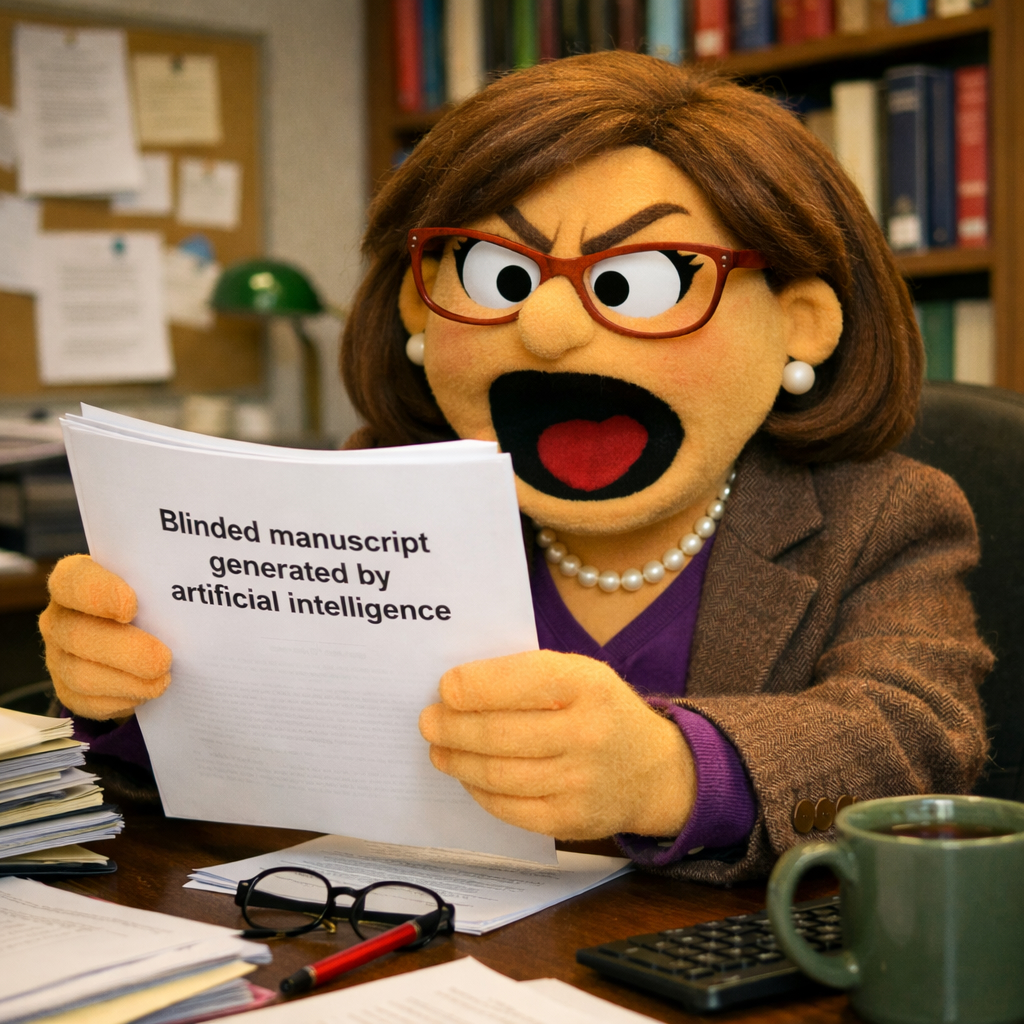
As the Editor-in-Chief of the International Journal for Educational Integrity, I have witnessed (and become super frustrated with) threats to academic publishing and research integrity from Gen AI. Don’t get me wrong, I am not opposed to AI, but I have been clear in my research and writing that technology can be used in good and helpful ways or ways that are unethical and inappropriate. Recently, our editorial office received a manuscript with the file name ‘Blinded manuscript generated by artificial intelligence.’

My reaction was, “Are you kidding me?! Well, that’s bold!” Although the honesty of the title may be rarity, the submission itself is symptomatic of a burgeoning crisis in academic publishing: the rise of ‘AI slop.’ Since the proliferation of large language models (LLMs), we have seen a dramatic increase in submissions. Now, I’m pretty sure that a portion of the manuscripts we are receiving are written entirely by AI agents or bots, sending submissions on behalf of authors.

ChatGPT generated image. A puppet seated at a desk in an office, holding a printed document titled “Blinded manuscript generated by artificial intelligence.” The desk is covered with papers, a pair of glasses, a pen, and a coffee mug, with bookshelves and a bulletin board visible in the background.

As a journal editor, let me be clear: The volume of manuscripts you send out does not equate to the value to the readership. It is not that I oppose the use of AI carte blanche, but I do object to manuscripts prepared and sent by bots, with no human interaction in the process. If a manuscript does not bring value to our readers, it gets an immediate desk rejections, and for good reason.

The Problem with AI Slop in Research

Academic journals exist to advance the frontiers of human knowledge. A manuscript is expected to contribute new and original findings to scholarship and science. AI-generated papers, by their very nature, struggle to meet this requirement.

  • Lack of Empirical Depth: AI excels at synthesizing existing information but cannot conduct original fieldwork, clinical trials, or archival research. It mimics the structure of a study without performing the substance of it.
  • Axiological Misalignment: There is a gap between the automated generation of text and the values-driven process of human inquiry. Research requires a commitment to truth, ethics, and accountability, qualities a machine cannot possess.
  • The Echo Chamber Effect: These submissions often present fabricated or corrupted  citations or circular logic that offers little to no utility to the reader. They clutter the ecosystem without moving the needle on critical conversations.

Upholding the Integrity of the Record

Our editorial board remains committed to a rigorous peer-review process, but let’s be clear: the ‘publish or perish’ culture, now supercharged by Gen AI, is threatening to overwhelm the very systems meant to ensure quality.

If an academic paper submitted for publication does not offer an original contribution or if it lacks the human oversight necessary to guarantee its validity, it has no place in a scholarly journal. We in a postplagiarism era where the focus must shift from merely detecting copied text to evaluating the originality of thought and the integrity of the research process. Postplagiarism does not mean that we throw out academic and research integrity or that ‘anything goes’. We recognize that co-creation with GenAI may be normal for some writers today. But having an AI agent write and submit manuscripts on your behalf wastes everyone’s time.

To our contributors: scholarship is a human endeavor. We value your insights, your unique perspectives, and your rigorous labour. In the meantime, we will continue with our commitment to quality, and I expect that the journal’s rejection rate will continue to be high as we focus on papers that bring value to our readership.

______________

Share this post: Stop wasting my time! AI Agents Infiltrate Scholarly Publishing – https://drsaraheaton.com/2026/02/06/stop-wasting-my-time-ai-agents-infiltrate-scholarly-publishing/

Sarah Elaine Eaton, PhD, is a Professor and Research Chair in the Werklund School of Education at the University of Calgary, Canada. Opinions are my own and do not represent those of my employer.


A Brief History of Postplagiarism: Or, Why Fabrication is Not the New Flattery

October 13, 2025
Infographic titled "Postplagiarism: A Brief History" by Sarah Elaine Eaton, PhD, showing a timeline from 2021 to 2025 that highlights key milestones in the development of the concept of postplagiarism.
2021: Eaton introduces postplagiarism in her book Plagiarism in Higher Education, building on Rebecca Moore Howard’s work.
2023: Eaton explicitly defines postplagiarism in an article published in the International Journal for Educational Integrity.
2024: Eaton and Kumar launch www.postplagiarism.com, offering multilingual translations and open-access content.
2025: Rahul Kumar publishes the first empirical study on postplagiarism in the same journal, analyzing student reactions.

I am always excited to hear about new work that showcases postplagiarism. Imagine my dismay when I read a new article, published in an (allegedly) peer-reviewed journal, that foregrounded the tenets of postplagiarism, but was rife with fabricated sources, including references to work attributed to me, but that I never wrote.

I have opted not to ‘name and shame’ the authors. Anyone who is curious enough need only do an Internet search to find the offending article and those who wrote it.

Instead, I prefer to take a more productive approach. Here I provide a brief timeline of the development of postplagiarism as both a framework and a theory:

2021: Plagiarism in Higher Education: Tackling Tough Topics in Academic Integrity

The book begins with a history of plagiarism. Then, I discuss plagiarism in modern times. In the concluding chapter I contemplate the future of plagiarism. Building on the scholarship of Rebecca Moore Howard, I proposed that  the age of generative artificial intelligence (Gen AI) could launch us into a post-plagiarism era in which human-AI hybrid writing becomes the norm.

2023: Expanding on the ideas first presented in the final chapter of my book, I wrote my first article dedicated to the topic: “Postplagiarism: Transdisciplinary ethics and integrity in the age of artificial intelligence and neurotechnology”, published in the International Journal for Educational Integrity.

2024: Dr. Rahul Kumar (Brock University, Canada) and I launch our website, http://www.postplagiarism.com. We provide open access resources free of charge. Thanks to the generosity of colleagues and friends who speak multipole language, we offer translations of the postplagiarism infographic in multiple languages.

Also, in this year, Rahul Kumar begins a study to test the tenets of postplagiarism.

2025: Rahul Kumar publishes the results of the first empirical article on the tenets of postplagiarism. His article, “Understanding PSE students’ reactions to the postplagiarism concept: a quantitative analysis” is published in the International Journal for Educational Integrity.

If you see references to our work on postplagiairsm as we have conceptualized it that pre-date our work, dig deeper to see if the work is real. There are now fabricated sources published on the Internet that do not — and never did — exist.

Imitation is flattery, as the saying goes. This quip has been used as a way to dismiss plagiarism concerns, as students learn to imitate great writers by quoting them without attribution. The saying digs deep into cultural and historical understandings that are beyond the scope of a blog post. What I can say is that in the postplagiarism era, fabrication is not the new flattery.

One of the tenets of postplagiarism is that humans can relinquish control over what they write to an AI, but we do not relinquish responsibility. The irony of seeing fabricated references about postplagiarism in fabricated is as absurd as it is puzzling. There is no need to fabricate references to post plagiarism, especially since we provide numerous free and open access to resources and research on the topic.

______________

Share this post: A Brief History of Postplagiarism: Or, Why Fabrication is Not the New Flattery – https://drsaraheaton.com/2025/10/13/a-brief-history-of-postplagiarism-or-why-fabrication-is-not-the-new-flattery/

Sarah Elaine Eaton, PhD, is a Professor and Research Chair in the Werklund School of Education at the University of Calgary, Canada. Opinions are my own and do not represent those of my employer.


Latest IJEI article is out! “Exploring the nexus of academic integrity and artificial intelligence in higher education: a bibliometric analysis” 

August 29, 2025

One of the great joys of being a journal editor is getting to share good news when a new article is published. I am going to make more of an effort to do this on my blog because the International Journal for Educational Integrity is a high quality (Q1) journal with lots to offer when it comes to academic integrity. We accept only about 10% of manuscripts submitted to the journal, so having an article published is a great achievment!

Check out the latest article, “Exploring the nexus of academic integrity and artificial intelligence in higher education: a bibliometric analysis” by Daniela Avello and Samuel Aranguren Zurita.

The image shows a webpage from the International Journal for Educational Integrity, part of Springer Nature. The header includes navigation links for Home, About, Articles, and Submission Guidelines, along with a "Submit manuscript" button. The featured article is titled "Exploring the nexus of academic integrity and artificial intelligence in higher education: a bibliometric analysis" by Daniela Avello and Samuel Aranguren Zurita. It is marked as open access, published on 29 August 2025, and appears in volume 21, article number 24. Citation options are available at the bottom.

Abstract

Background

Artificial intelligence has created new opportunities in higher education, enhancing teaching and learning methods for both students and educators. However, it has also posed challenges to academic integrity.

Objective

To describe the evolution of scientific production on academic integrity and artificial intelligence in higher education.

Methodology

A bibliometric analysis was carried out using VOSviewer software and the Bibliometrix package in R. A total of 467 documents published between 2017 and 2025, retrieved from the Web of Science database, were analyzed.

Results

The analysis reveals a rapid expansion of the field, with an annual growth rate of 71.97%, concentrated in journals specializing in education, academic ethics, and technology. The field has evolved from a focus on the use of artificial intelligence in dishonest practices to the study of its integration in higher education. Four main lines of research were identified: the impact and adoption of artificial intelligence, implications for students, academic dishonesty, and associated psychological factors.

Conclusions

The field is at an early stage of development but is expanding rapidly, albeit with fragmented evolution, limited collaboration between research teams, and high editorial dispersion. The analysis shows a predominance of descriptive approaches, leaving room for the development of theoretical frameworks.

Originality or value

This study provides an overview and updated of the evolution of research on artificial intelligence and academic integrity, identifying trends, collaborations, and conceptual gaps. It highlights the need to promote theoretical reflection to guide future practice and research on the ethical use of artificial intelligence in higher education.

Check out the full article here.

________________________

Share this post: Latest IJEI article is out! “Exploring the nexus of academic integrity and artificial intelligence in higher education: a bibliometric analysis” – https://drsaraheaton.com/2025/08/29/latest-ijei-article-is-out-exploring-the-nexus-of-academic-integrity-and-artificial-intelligence-in-higher-education-a-bibliometric-analysis/

Sarah Elaine Eaton, PhD, is a Professor and Research Chair in the Werklund School of Education at the University of Calgary, Canada. Opinions are my own and do not represent those of my employer.