Dignity, Grief, and the Case of Jason Arday

August 16, 2026

I have been quiet about the case of Dr. Jason Arday, who previously worked at Cambridge University and left his job following allegations of plagiarism and questions about other claims in his life story. The reason is not lack of interest in the case, but rather because my family recently lost my brother and we have been mourning.

Aaron Edward Eaton: A Brief Background on Recent Events

First, a personal statement. A couple of weeks ago the Royal Canadian Mounted Police (RCMP) (Canada’s national police) issued a missing person alert for my brother. Once the RCMP released the alert on social media, the matter immediately became public. We received messages of support from around the world.

On August 3, my brother was found deceased and this was also publicly announced on social media and via a newspaper article. I won’t go into the details, but suffice to say that the phrase, ‘found deceased’ is often a euphemism for ‘died by suicide’. Society hides behind vague and passive language rather than being direct about what really happened. I’ve never been fond of circumlocutions, but society has its rules.

Although we have deeply appreciated the support, having a private family matter become public changes the experience. Emotional energy is directed into reading, replying, and also taking a step away from technology to process quietly.

In any case, my lack of response about the Arday case was not due to indifference, but rather because I was focused on family matters.

Jason Arday: ‘Found Deceased’

I did not know Jason Arday. I have no basis on which to conclude whether misconduct occurred in his academic work, and that question is not the subject of this post. News of his passing hit me in a visceral and raw way. My deepest condolences to his family and friends. As is so often the case when someone is ‘found dead’, those left behind have many questions, deep grief, and sometimes, a feeling that it didn’t have to end the way it did. I can only imagine that Dr. Arday’s family and friends are experiencing with the level of public spectacle we have seen.

So, I will not be weighing in on questions relating to misconduct allegations. What concerns me are different questions: What do we, as a society, owe a person who is being investigated for misconduct during — and after — an investigative process? A related question also hovers: How can we ensure that a person’s dignity is preserved in the process of a misconduct investigation?

A Resignation Is Not a Verdict

Dr. Arday resigned his professorship at the University of Cambridge on August 5, 2026, after weeks of public scrutiny over plagiarism allegations and questions about other claims in his life story [McArthur, 2026]. He was found dead at his home in south London nine days later. Prime Minister Andy Burnham called the death “a tragedy on so many levels”. Arday’s family said that “the campaign of misinformation was too much for Jason”.

Iryna Pavlova, writing for our Postplagiarism blog, makes a valuable observation: reading the resignation as proof of guilt and reading it as proof of persecution involve the same error, which is treating an outcome as though it settles a question not yet answered by a thorough and fair investigation. I would add a further question to Iryna’s: Why should we let public persecution stand in for fair process? (Short answer: We shouldn’t.)

What a Process Without Dignity Looks Like

Article 11 of the Universal Declaration of Human Rights establishes a presumption of innocence until proven guilty. Article 12 protects a person against arbitrary attacks on their honour and reputation.

The Universal Declaration of Human Rights applies to all persons, everywhere. Full stop.

An individual alleged to have engaged in misconduct should be investigated by professionals with the skills and training to undertake the matter in a fair and just way. Being judged in the public sphere, with dozens if not hundreds or even thousands of people chiming in as armchair judges, turns due process into a public spectacle. A misconduct investigation, carried out in a professional and dignified manner, and a public trial by social media are not the same venue. Treating them as equivalent lets institutions (and quite frankly, members of society) off the hook for their own conduct.

Comment sections do not offer due process. Let me be clear: this is not an argument for shielding scholars from scrutiny. It is an argument for insisting that scrutiny happens in a manner that does not deprive individuals of their human rights.

Call to Action

A human‑rights‑by‑design approach to misconduct policy does not soften findings of wrongdoing; it separates the question of what happened from the question of how a person is treated while questions remain open (Eaton, 2024). I have yet to find a university or college anywhere that has explicitly adopted a human-rights centred approach to misconduct policy or process. I am not talking here about due process or procedural fairness. I am talking about misconduct policies and procedures that intentionally and explicitly commit to upholding human rights as a foundation for due process. (If you know such an institution, drop me a note.)

Institutions can commit to clear and private procedures rather than adjudication by the media. When we allow public persecution to prevail, we discard dignity and human rights.

Institutional leaders can communicate with the accused promptly. No one should wait in uncertainty for weeks. Institutional leaders should provide mental health and wellbeing support throughout the process, at no extra cost to the individual. Counsellors should be available alongside the investigation, not after it. We, as members of higher education institutions and as members of society, can also exercise restraint. We can wait for a review to conclude before we comment publicly, rather than posturing and pontificating. In Arday’s case, many people did not show that restraint.

Whatever the historical record eventually shows about Arday’s scholarship, the record already shows how his case was handled while questions remained open, which has been deplorable. The way in which the matter has been handled deserves as much scrutiny as the plagiarism allegations themselves.

May Dr. Jason Arday rest in peace. May his family, friends, and those who cared about him find solace and healing.

References

Ahmed, A. (2026, August 15). Tributes paid to Jason Arday after former Cambridge professor’s death. The Guardian. https://www.theguardian.com/uk-news/2026/aug/15/jason-arday-tributes-paid-to-former-cambridge-professor

Eaton, S. E. (2024). Future-proofing integrity in the age of artificial intelligence and neurotechnology: prioritizing human rights, dignity, and equity. International Journal for Educational Integrity, 20(1), 21. https://doi.org/10.1007/s40979-024-00175-2

Hui, S. (2026, August 15). UK’s leader calls for reflection after the death of former Cambridge professor accused of plagiarism. Associated Press. https://apnews.com/article/britain-jason-arday-cambridge-death-burnham-b9e2463ca6b474ac90cc6196ed668238

McArthur, T. (2026, August 14). Jason Arday, ex-Cambridge professor at centre of plagiarism row, found dead. BBC News. https://www.bbc.com/news/articles/c1j1ye6n30no

Pavlova, I. (2026, August 12). Beyond “Did He Plagiarize?”: What the Jason Arday Case Reveals About Academic Integrity in a Postplagiarism Era. Postplagiarism Blog. https://postplagiarism.com/2026/08/12/beyond-did-he-plagiarize-what-the-jason-arday-case-reveals-about-academic-integrity-in-a-postplagiarism-era

Red Deer Advocate Staff. (August 4, 2026). Missing Red Deer man found deceased. Red Deer Advocate. https://reddeeradvocate.com/2026/08/04/missing-red-deer-man-found-deceased/

United Nations. (2021). Universal Declaration of Human Rights. https://www.un.org/en/about-us/universal-declaration-of-human-rights

___________

Share this post – Dignity, Grief, and the Case of Jason Arday – https://drsaraheaton.com/2026/08/16/dignity-grief-and-the-case-of-jason-arday/

Sarah Elaine Eaton, PhD, is a Professor and Research Chair in the Werklund School of Education at the University of Calgary, Canada. Opinions are my own and do not represent those of my employer.


The Impact of Workplace Incivility on Higher Education

August 23, 2025

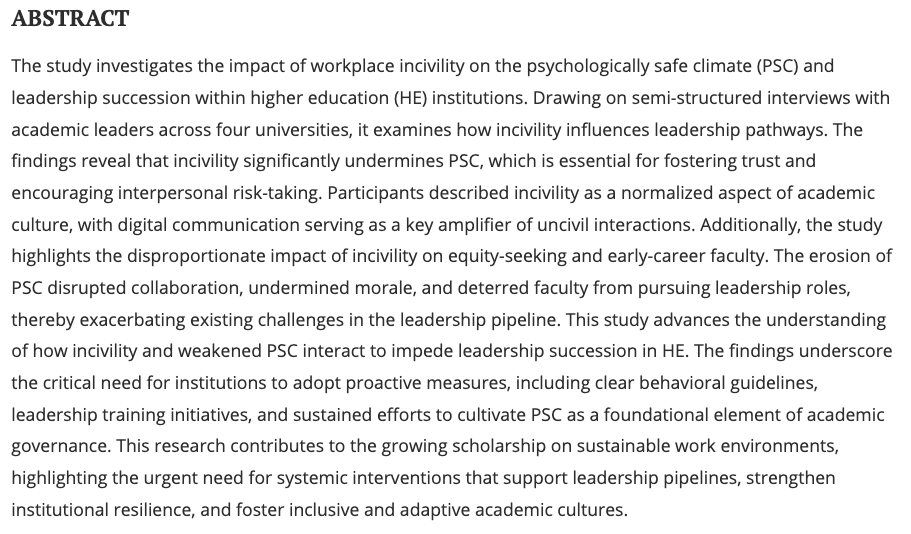
I am pleased to have collaborated with Dr. Leda Stawnychko and Ms. Rafi Mehnaz on this new article, “Exploring the impact of workplace incivility on psychological safety and leadership succession in higher education” in the International Journal for Leadership in Education.

I first met Leda Stawnychko when she was an EdD student at the University of Calgary. I had the pleasure of serving on her supervisory committee to support her doctor of education research project on Leadership Development Experiences of Department Chairs at a Canadian University.

When Leda invited me to join her later for a project on psychological safety and leadership succession in higher education, I accepted right away. This topic is important one and it rarely gets discussed in the literature on academic integrity, but as we know, professional and collegial ethics are part of a comprehensive approach to academic integrity.

As we point out in the abstract and in the main body of the article, there is a disproportionate impact of incivility on equity-seeking and early-career faculty. In other words, those who are already marginalized and experience barriers and discrimination are more likely to be on the receiving end of workplace incivility and hostility.

I’ve said it before and I’ll say it again: There can be no integrity without equity. We need to think more about the way that higher education as a system allows for the perpetuation of discrimination and harm, not only for students, but also for faculty and staff. If the workplace is not a psychologically safe environment, then employees cannot thrive.

I invite you to check out the article, which is open access and free to read and download.

________________________

Share this post: The Impact of Workplace Incivility on Higher Education – https://drsaraheaton.com/2025/08/23/the-impact-of-workplace-incivility-on-higher-education/

Sarah Elaine Eaton, PhD, is a Professor and Research Chair in the Werklund School of Education at the University of Calgary, Canada. Opinions are my own and do not represent those of my employer.


Nelson Mandela’s first language being cut from South African schools

January 24, 2012

Nelson Mandela is a man with a deep commitment to defending human rights. He also speaks English as a Second Language. His first language is Xhosa.

A recent article from the Times Alive in South Africa reports that language classes for both Xhosa and Zulu are being cut in South African state schools. The main language of instruction in South African schools is English. Prega Govender reports that until this school year, students were required to take classes in two additional languages, but this year, that requirement has been changed. Now students are only required to take one additional language.

Most schools in the area are opting for Afrikaans as the additional language of choice for students in that region. The article reports that in one case, the Xhosa language teacher has been re-deployed to teach Afrikaans this year. The decision seems to be driven by numbers:

“Last year, 68455 matrics countrywide wrote Afrikaans as their first additional language, whereas only 10943 wrote Zulu and a mere 1547 wrote Xhosa.”

Regular readers of this blog will know that I am strongly opposed to the removal of language programs from a curriculum.  There are a number of reasons for this:

Benefits of learning additional languages for cognitive ability

Research shows that the benefits of learning additional languages extend beyond language and cultural skills. Learning additional languages also has a positive effect on a person’s general cognitive ability (Kimbrough Oller, D and Eilers R.E., 2002). Specific research has also found that students who study other languages also score better on math tests (Bournot-Trites, M. and K. Reeder, 2001; de Courcy, M. and M. Burston, 2000; Turnbull, M., S. Lapkin and D. Hart, 2001 and Turnbull, M., D. Hart and S. Lapkin, 2003). The benefits of learning additional languages are clear and have been documented time and time again through research. We know that the more languages a young person is exposed to, the more capacity he or she will have to develop lifelong multilingual skills.

When languages are removed from a curriculum, it sends a message that the language is unimportant

It could be argued that students in South Africa will still enjoy these cognitive and linguistic benefits, since they will be studying Afrikaans as an additional language. That may be true, but making the decision to remove Xhosa and Zulu from the curriculum sends a strong message that these languages do not matter in formal education in that region.

While I do not profess to understand the complexity of minority languages or the politics of South Africa, I have studied the concepts of formal and informal education extensively.

Young students who speak Xhosa and Zulu as first languages at home have now lost the opportunity to learn their native language in an organized, formal environment, as a shared experience with peers. Though they may continue to learn the language in the informal context of the home, we know that informal learning is considered the least legitimate and is less respected than formal learning.

By removing these languages from the curriculum, those who have the responsibility and authority to set policies and make decisions send a strong message that these languages lack sufficient legitimacy to be included in the standard curriculum of formal education in the region.

Language abilities are linked to leadership skills

In previous research I have discussed how some significant world leaders, such as Ghandi, leveraged multiple languages to extend their leadership reach. Nelson Mandela’s first language is Xhosa. While not a perfect human being, he has arguably been one of the world’s most influential leaders over the past several decades. What message does it send to teachers, parents, students and indeed, everyone living in the region, that this leader’s first language, which was formerly offered as part of the standard state school curriculum, has now been cut for students in the younger grades?

While the article reports that students may still take the language in later grades, cutting it from the curriculum for children in grades one to three sends a strong message that it is not as important as math, science or even Afrikaans. Those subjects are considered part of the critical foundation of the young learner’s formal education experience. But Zulu and Xhosa… these are superfluous options that can be added later.

I worry when languages are cut from curricula. I worry when students and parents get the message that language learning is not important. I worry even more when they get the message that their first language is not important, as is the case for Xhosa and Zulu for many young people in South Africa. Formally recognizing the importance and significance of learning first languages in a plurilingual society such as South Africa is critical.

As educators worldwide we must do everything in our power to prepare the young people of today to lead the world tomorrow. Learning additional languages will help them do that.

References

Bournot-Trites, M. and K. Reeder. (2001). “Interdependence Revisited: Mathematics Achievement in an Intensified French Immersion Program.”

de Courcy, M. and M. Burston. (2000). “Learning Mathematics Through French in Australia.”

Eaton, S. E. (2010). Leading though Language Learning and Teaching: The Case of Gandhi. Retrieved from ERIC: http://www.eric.ed.gov/PDFS/ED508664.pdf

Eaton, S. E. (2010). Formal, non-formal and informal education: The case of literacy, essential skills and language learning in Canada. Calgary.

Kimbrough Oller, D and Eilers R.E. (2002). “Balancing Interpretations Regarding Effects of Bilingualism: Empirical Outcomes and Theoretical Possibilities.”

Turnbull, M., S. Lapkin and D. Hart. (2001). “Grade Three Immersion Students’ Performance in Literacy and Mathematics: Province-wide Results from Ontario (1998–99).”

Turnbull, M., D. Hart and S. Lapkin. (2003). “Grade 6 French Immersion Students’ Performance on Large-scale Reading, Writing, and Mathematics Tests: Building Explanations.”

Related posts

Formal, Non-formal and Informal Learning: What Are the Differences?

Formal, non-formal and informal learning: The case of literacy and language learning in Canada

____________________________

Share this post: Nelson Mandela’s first language being cut from South African schools http://wp.me/pNAh3-1cA

Update – January 2018 – This blog has had over 1.8 million views thanks to readers like you. If you enjoyed this post, please “like” it or share it on social media. Thanks!

Sarah Elaine Eaton is a faculty member in the Werklund School of Education, University of Calgary, Canada.