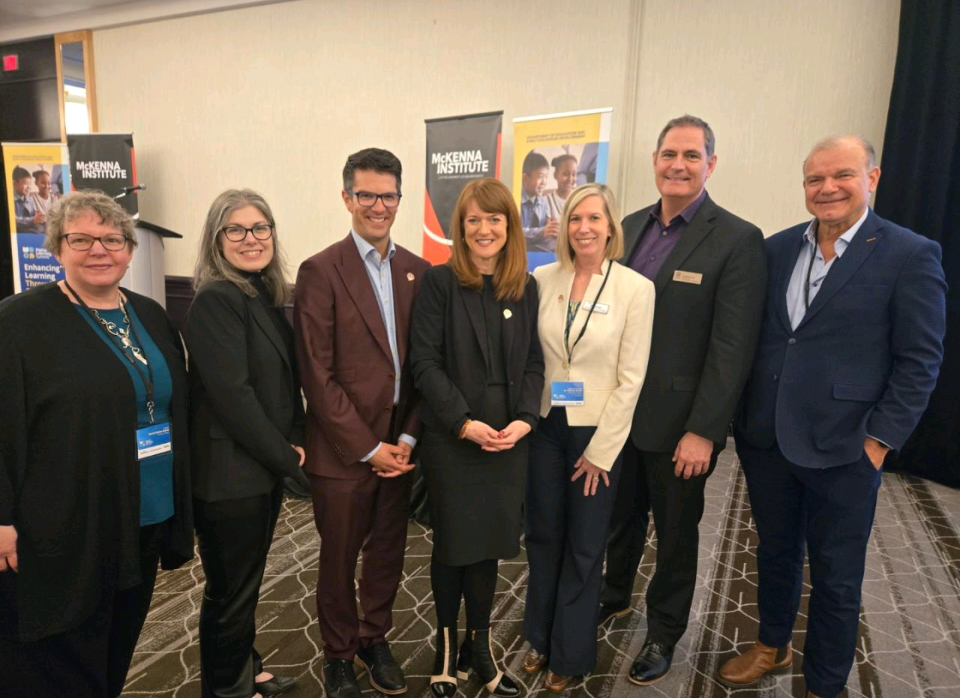
On April 22 I gave a workshop on academic integrity and assessment with generative AI to educational leaders, academics, and professional staff at the AI Leadership Summit. The next day, I delivered a keynote address on postplagiarism, education and artificial intelligence at a province-wide summit on AI and education attended by almost 250 people from across the province.
I had an opportunity to meet and speak with the Hon. Claire Johnson, Minister of Education and Early Childhood Development, Deputy Minister Ryan Donaghy, and Assistant Deputy Minister Tiffany Bastin, all of whom commented on how postplagiarism aligns with their provincial strategy and policy vision.
(Left to right: Sarah Elaine Eaton, Sarah Rankin, Ryan Donaghy, Hon. Claire Johnson, Tiffany Bastin, Geoff Edwards, Robert Martellaci – April 2026, New Brunswick AI and Education Summit)
It was announced during the event that preparations are underway to integrate artificial intelligence into the provincial digital literacy strategy and educational curricula across all levels and subjects, with a plan to have AI fully integrated in time for the beginning of the next school year, starting in September, 2026. Staff at the Department of Education and Early Childhood Development are in the midst of updating curricula as we speak.
To my knowledge, New Brunswick is the first province or territory in Canada to integrate AI across the K-12 curriculum. They are investing in professional learning for leaders, education specialists and developers, and educators, to improve and increase AI literacy levels throughout the education sector. Throughout the two days, I spoke with leaders and educators from across the province who repeated the same message to me, that postplagiarism was a refreshing and forward-thinking way to think about academic integrity, ethics, and student success in an AI-enabled world.
It was exciting and energizing to be brought into education conversations that connected policy, pedagogy, and postplagiarism. The real world applications of postplagiarism are taking shape and I am inspired to see how others are are findings ways to implement the framework as a future-focused roadmap for ethical learning and teaching with advanced technologies.
About the author: Sarah Elaine Eaton, PhD, is a Professor and the Director of the Postplagiarism Research Lab in the Werklund School of Education, University of Calgary.
When we talk about academic integrity in universities, we often focus on preventing plagiarism and cheating. But what if our very approach to enforcing these standards is unintentionally creating barriers for some of our most vulnerable students?
My recent research explores how current academic integrity policies and practices can negatively affect neurodivergent students—those with conditions like ADHD, dyslexia, Autism, and other learning differences. Our existing systems, structures, and policies can further marginalize students with cognitive differences.
The Problem with One-Size-Fits-All
Neurodivergent students face unique challenges that can be misunderstood or ignored. A dyslexic student who struggles with citation formatting isn’t necessarily being dishonest. They may be dealing with cognitive processing differences that make these tasks genuinely difficult. A student with ADHD who has trouble managing deadlines and tracking sources is not necessarily lazy or unethical. They may be navigating executive function challenges that affect time management and organization. Yet our policies frequently treat these struggles as potential misconduct rather than as differences that deserve support.
Yet our policies frequently treat these struggles as potential misconduct rather than as differences that deserve support.
The Technology Paradox for Neurodivergent Students
Technology presents a particularly thorny paradox. On one hand, AI tools such as ChatGPT and text-to-speech software can be academic lifelines for neurodivergent students, helping them organize thoughts, overcome writer’s block, and express ideas more clearly. These tools can genuinely level the playing field.
On the other hand, the same technologies designed to catch cheating—especially AI detection software—appear to disproportionately flag neurodivergent students’ work. Autistic students or those with ADHD may be at higher risk of false positives from these detection tools, potentially facing misconduct accusations even when they have done their own work. This creates an impossible situation: the tools that help are the same ones that might get students in trouble.
Moving Toward Epistemic Plurality
So what’s the solution? Epistemic plurality, or recognizing that there are multiple valid ways of knowing and expressing knowledge. Rather than demanding everyone demonstrate learning in the exact same way, we should design assessments that allow for different cognitive styles and approaches.
This means:
Rethinking assessment design to offer multiple ways for students to demonstrate knowledge
Moving away from surveillance technologies like remote proctoring that create anxiety and accessibility barriers
Building trust rather than suspicion into our academic cultures
Designing universally, so accessibility is built in from the start rather than added as an afterthought
What This Means for the Future
In the postplagiarism era, where AI and technology are seamlessly integrated into education, we move beyond viewing academic integrity purely as rule-compliance. Instead, we focus on authentic and meaningful learning and ethical engagement with knowledge.
This does not mean abandoning standards. It means recognizing that diverse minds may meet those standards through different pathways. A student who uses AI to help structure an essay outline isn’t necessarily cheating. They may be using assistive technology in much the same way another student might use spell-check or a calculator.
Call to Action
My review of existing research showed something troubling: we have remarkably little data about how neurodivergent students experience academic integrity policies. The studies that exist are small, limited to English-speaking countries, and often overlook the voices of neurodivergent individuals themselves.
We need larger-scale research, global perspectives, and most importantly, we need neurodivergent students to be co-researchers and co-authors in work about them. “Nothing about us without us” is not just a slogan, but a call to action for creating inclusive academic environments.
Key Messages
Academic integrity should support learning, not create additional barriers for students who already face challenges. By reimagining our approaches through a lens of neurodiversity and inclusion, we can create educational environments where all students can thrive while maintaining academic standards.
Academic integrity includes and extends beyond student conduct; it means that everyone in the learning system acts with integrity to support student learning. Ultimately, there can be no integrity without equity.
Read the whole article here: Eaton, S. E. (2025). Neurodiversity and academic integrity: Toward epistemic plurality in a postplagiarism era. Teaching in Higher Education. https://doi.org/10.1080/13562517.2025.2583456
Sarah Elaine Eaton, PhD, is a Professor and Research Chair in the Werklund School of Education at the University of Calgary, Canada. Opinions are my own and do not represent those of my employer.
In this case, the court dismissed the lawsuit, noting that the university’s academic integrity policy explicitly applied to students, but not faculty. Although the legal reasoning is sound, the ethical implications are profound.
Role Modeling: Faculty are the standard-bearers of scholarly conduct. When instructors fail to uphold integrity, it undermines the credibility of the entire educational process. This is an idea repeated over and over again in the Second Handbook of Academic Integrity and one that emerged in the Comprehensive Academic Integrity Framework: academic integrity includes, and extends beyond student conduct.
Trust and Fairness: Students trust that their learning environment is built on fairness. A double standard, where plagiarism policies apply only to students, erodes that trust. As I have written about elsewhere, trust has been a central theme of academic integrity for decades and is a foundation for education and it applies not only to students, but to faculty and administrators as well.
Institutional Reputation: Universities thrive on public confidence in their academic rigour. Ignoring faculty misconduct risks reputational damage far beyond the classroom.
What should change?
Institutions need comprehensive integrity policies that apply to everyone—students, faculty, and administrators. These policies should include clear definitions, reporting mechanisms, and consequences for violations. Academic integrity is a shared responsibility, and everyone in the learning community is accountable.
Recommendations for Higher Education Institutions
Expand and Unify Policy Scope: Ensure academic integrity policies explicitly apply to faculty, staff, and administrators, not just students.
Develop Reporting Mechanisms: Create confidential, transparent processes for reporting and investigating faculty misconduct.
Mandatory Training: Require regular integrity training for faculty, emphasizing ethical scholarship and teaching practices, as well as research ethics.
Institutional Culture: Promote integrity as a shared value through leadership messaging, recognition programs, and open dialogue.
Accountability Framework: Include consequences for faculty breaches in contracts and performance evaluations.
Call to Action
Academic integrity is a foundation of higher education. If we expect students to be honest in their work, then faculty must be held to the same (if not higher) standards. Universities and colleges should act now to close the policy gap, embed integrity in institutional culture, and hold everyone accountable. If we want students to take integrity seriously, faculty must lead by example. Anything less is hypocrisy.
References
Eaton, S. E. (2024). Comprehensive Academic Integrity (CAI): An Ethical Framework for Educational Contexts. In S. E. Eaton (Ed.), Second Handbook of Academic Integrity (pp. 1–14). Springer Nature Switzerland. https://doi.org/10.1007/978-3-031-54144-5_194
Eaton, S. E. (2025). Think Piece: Trust as a foundation for ethics and integrity in educational contexts. Critical Studies in Teaching and Learning (CriSTaL), 13(SI2), 4–7. https://doi.org/10.14426/cristal.v13iSI2.3057
Christensen Hughes, J., & Eaton, S. E. (2022). Academic misconduct in Canadian higher education: Beyond student cheating. In S. E. Eaton & J. Christensen Hughes (Eds.), Academic integrity in Canada: An enduring and essential challenge (pp. 81–102). Springer. https://doi.org/10.1007/978-3-030-83255-1
Sarah Elaine Eaton, PhD, is a Professor and Research Chair in the Werklund School of Education at the University of Calgary, Canada. Opinions are my own and do not represent those of my employer.
I am always excited to hear about new work that showcases postplagiarism. Imagine my dismay when I read a new article, published in an (allegedly) peer-reviewed journal, that foregrounded the tenets of postplagiarism, but was rife with fabricated sources, including references to work attributed to me, but that I never wrote.
I have opted not to ‘name and shame’ the authors. Anyone who is curious enough need only do an Internet search to find the offending article and those who wrote it.
Instead, I prefer to take a more productive approach. Here I provide a brief timeline of the development of postplagiarism as both a framework and a theory:
The book begins with a history of plagiarism. Then, I discuss plagiarism in modern times. In the concluding chapter I contemplate the future of plagiarism. Building on the scholarship of Rebecca Moore Howard, I proposed that the age of generative artificial intelligence (Gen AI) could launch us into a post-plagiarism era in which human-AI hybrid writing becomes the norm.
2024: Dr. Rahul Kumar (Brock University, Canada) and I launch our website, http://www.postplagiarism.com. We provide open access resources free of charge. Thanks to the generosity of colleagues and friends who speak multipole language, we offer translations of the postplagiarism infographic in multiple languages.
Also, in this year, Rahul Kumar begins a study to test the tenets of postplagiarism.
If you see references to our work on postplagiairsm as we have conceptualized it that pre-date our work, dig deeper to see if the work is real. There are now fabricated sources published on the Internet that do not — and never did — exist.
Imitation is flattery, as the saying goes. This quip has been used as a way to dismiss plagiarism concerns, as students learn to imitate great writers by quoting them without attribution. The saying digs deep into cultural and historical understandings that are beyond the scope of a blog post. What I can say is that in the postplagiarism era, fabrication is not the new flattery.
One of the tenets of postplagiarism is that humans can relinquish control over what they write to an AI, but we do not relinquish responsibility. The irony of seeing fabricated references about postplagiarism in fabricated is as absurd as it is puzzling. There is no need to fabricate references to post plagiarism, especially since we provide numerous free and open access to resources and research on the topic.
Sarah Elaine Eaton, PhD, is a Professor and Research Chair in the Werklund School of Education at the University of Calgary, Canada. Opinions are my own and do not represent those of my employer.
The first time I heard about decriminalizing the language and processes we use to address cases of plagiarism and other forms of academic misconduct; I was riveted. It was at an academic integrity conference in Richmond, Virginia and the lead presenter was Dr. James Earl Orr, who presented together with students on how a developmental and supportive approach to academic misconduct case management can help lead students towards academic success while still holding them responsible for their behaviour. James Earl Orr, writing together with Karita Orr, published an excellent article on using restorative practices to resolve academic integrity violations.
When I was writing the University of Calgary’s academic integrity Handbook for Academic Staff and Teaching Assistants, I took the opportunity to apply what I had learned from listening to Dr. Orr at conferences and reading his work by including a section on how to decriminalize the language we use to talk about academic misconduct.
Academic integrity violations are rarely criminal in nature and yet, much of the language we use when addressing plagiarism and academic cheating is legalistic, setting the stage for criminalizing student behaviour. One step towards taking a more learner-centred approach to misconduct is to decriminalize the language we use to talk about breaches of academic integrity.
Front cover of the Student Academic Integrity Faculty Handbook, published by the Taylor Institute for Teaching and Learning at the University of Calgary
“We know that words matter and the language we use is important. A full list of terms related to academic misconduct is available in our policy. It should be noted that the terms “academic integrity” and “academic misconduct” are not interchangeable.
Academic integrity is about acting ethically in teaching, learning and research contexts. We do not report, investigate or manage cases of academic integrity. We report, investigate and manage cases of academic misconduct.
Academic misconduct is what happens when individuals do not act with integrity. This is currently the language used in our policy and procedures. When speaking and writing about academic misconduct, we can use the terms “breaches of integrity or “violations of integrity” as synonyms for academic misconduct.
At the University of Calgary we take a proactive approach to academic integrity, including in the language we use and in keeping the focus on teaching, learning and fairness to students. In our conversations with students and others, it can be helpful to use the language of integrity that focuses on education and support” (Eaton, 2022, p. 13).
See the table below, which is also an expert from our handbook (with a few minor updates):
The language of academic integrity
Preferred language
Language to avoid
Explanation
Hold responsible
Guilt Guilty
The words “guilt” and “guilty” do not appear anywhere in our polices or procedures. We do not find students guilty of academic misconduct, but instead we hold them responsible for their behaviours.
Sanctions Consequence Outcome
Punish Punishment
When disciplinary actions are taken in response to academic misconduct, we do not use the terms “punish” or “punishment” in our institutional documents. We opt instead for “sanctions”, “discipline,” “consequences” or “outcome” which can include educational responses depending on the misconduct.
Hearing
Trial
The University of Calgary does not conduct trials related to academic misconduct. In other countries, various forms of academic misconduct can be considered an offense under the criminal code and students may be required to attend a criminal trial. That is not the case at the University of Calgary or anywhere in Canada. In the case of an appeal, a hearing might occur. In rare cases, an appeal case might escalate to an externally reviewed case in court, but these proceedings are not administered by the university itself.
When I talk about taking a postplagiarism approach to academic integrity I am talking about disrupting historically adversarial and antagonistic approaches to misconduct that pit students against their teachers. It is time to move past crime-and-punishment approaches to student misconduct where students are the villains and teachers are the heroes. When we talk about postplagiarism we talk about social justice and student success as being intertwined, and we focus on students as stewards of the future, who will be best equipped for an increasingly complex world when they understand the importance of ethical decision-making, both in theory and in practice.
Postplagiarism does not mean anything goes, and nor does it mean that we turn a blind eye to misconduct. Postplagiarism is about finding socially just ways to address misconduct include relationally, restoration, and the preservation of dignity and human rights. When we decriminalize language related to student misconduct, we are taking a step towards dignity and student success.
Our University of Calgary’s academic integrity Handbook for Academic Staff and Teaching Assistants is an open access handbook with a Creative Commons license. This means you can share and adapt the material, providing the original work is properly attributed.
If this is helpful to you, please share this with others.
Eaton, S. E. (2023). Postplagiarism: Transdisciplinary ethics and integrity in the age of artificial intelligence and neurotechnology. International Journal for Educational Integrity, 19(1), 1–10. https://doi.org/10.1007/s40979-023-00144-1
Eaton, S. E. (2025). Global Trends in Education: Artificial Intelligence, Postplagiarism, and Future-focused Learning for 2025 and Beyond – 2024–2025 Werklund Distinguished Research Lecture. International Journal for Educational Integrity, 21(1), 12. https://doi.org/10.1007/s40979-025-00187-6
Orr, J. E., & Hall, J. (2018). Student-led case adjudication: Promoting student learning through peer-to-peer engagement. 25th Annual International Center for Academic Integrity (ICAI) Conference, Richmond, VA.
Orr, J. E., & Orr, K. (2023). Restoring honor and integrity through integrating restorative practices in academic integrity with student leaders. Journal of Academic Ethics, 21, 55–70. https://doi.org/10.1007/s10805-021-09437-x
Orr, J. E., & Orren, S. (2018, March 4). The Development & Implementation of a Campus Academic Integrity Education Program. 25th Annual International Center for Academic Integrity (ICAI) Conference, Richmond, VA.
Sarah Elaine Eaton, PhD, is a Professor and Research Chair in the Werklund School of Education at the University of Calgary, Canada. Opinions are my own and do not represent those of my employer.
You must be logged in to post a comment.