This week, I had the opportunity to take part in two leadership events led by the New Brunswick Department of Education and Early Childhood Development focused on artificial intelligence and education.
On April 22 I gave a workshop on academic integrity and assessment with generative AI to educational leaders, academics, and professional staff at the AI Leadership Summit. The next day, I delivered a keynote address on postplagiarism, education and artificial intelligence at a province-wide summit on AI and education attended by almost 250 people from across the province.
I had an opportunity to meet and speak with the Hon. Claire Johnson, Minister of Education and Early Childhood Development, Deputy Minister Ryan Donaghy, and Assistant Deputy Minister Tiffany Bastin, all of whom commented on how postplagiarism aligns with their provincial strategy and policy vision.
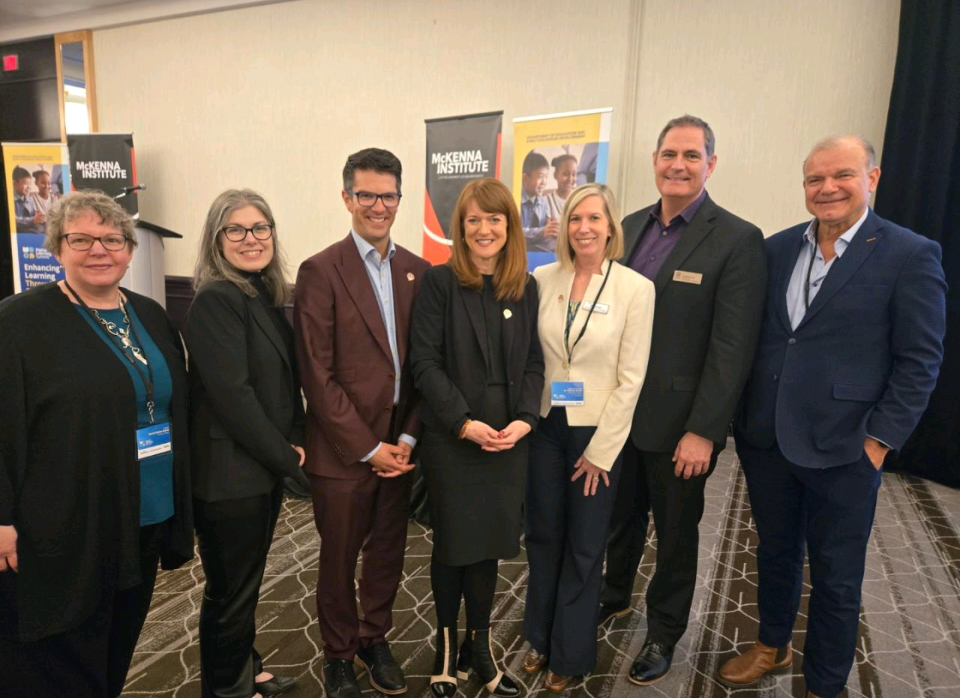
It was announced during the event that preparations are underway to integrate artificial intelligence into the provincial digital literacy strategy and educational curricula across all levels and subjects, with a plan to have AI fully integrated in time for the beginning of the next school year, starting in September, 2026. Staff at the Department of Education and Early Childhood Development are in the midst of updating curricula as we speak.
To my knowledge, New Brunswick is the first province or territory in Canada to integrate AI across the K-12 curriculum. They are investing in professional learning for leaders, education specialists and developers, and educators, to improve and increase AI literacy levels throughout the education sector. Throughout the two days, I spoke with leaders and educators from across the province who repeated the same message to me, that postplagiarism was a refreshing and forward-thinking way to think about academic integrity, ethics, and student success in an AI-enabled world.
It was exciting and energizing to be brought into education conversations that connected policy, pedagogy, and postplagiarism. The real world applications of postplagiarism are taking shape and I am inspired to see how others are are findings ways to implement the framework as a future-focused roadmap for ethical learning and teaching with advanced technologies.
About the author: Sarah Elaine Eaton, PhD, is a Professor and the Director of the Postplagiarism Research Lab in the Werklund School of Education, University of Calgary.
______________
Reposted from original: AI, Postplagiarism and K-12 Education in New Brunswick, Canada – https://postplagiarism.com/2026/04/25/ai-postplagiarism-and-k-12-education-in-new-brunswick-canada/


 Posted by Sarah Elaine Eaton, Ph.D.


You must be logged in to post a comment.