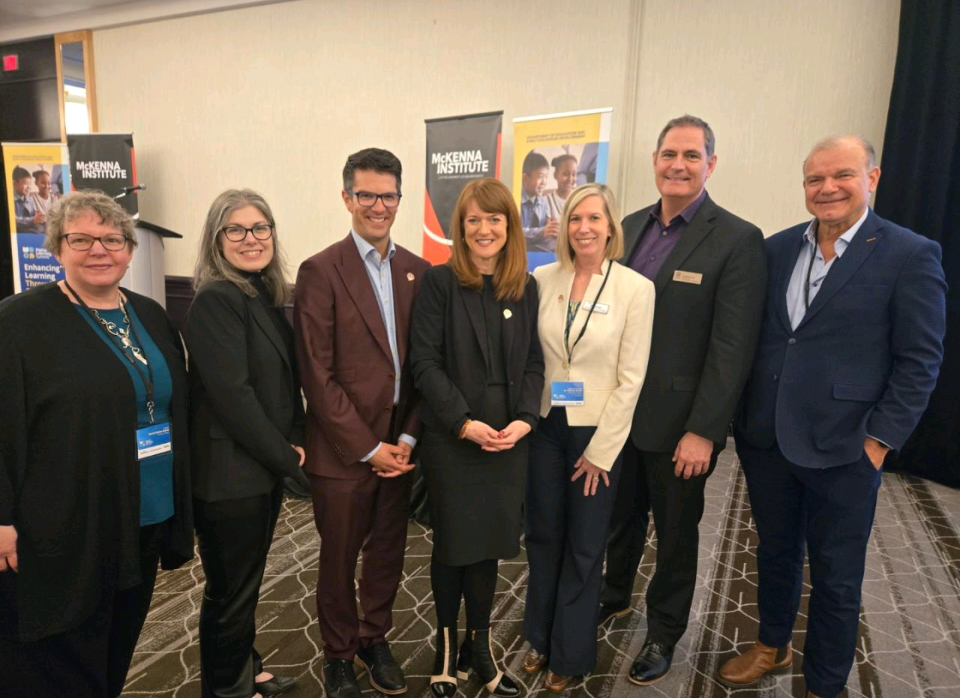
On April 22 I gave a workshop on academic integrity and assessment with generative AI to educational leaders, academics, and professional staff at the AI Leadership Summit. The next day, I delivered a keynote address on postplagiarism, education and artificial intelligence at a province-wide summit on AI and education attended by almost 250 people from across the province.
I had an opportunity to meet and speak with the Hon. Claire Johnson, Minister of Education and Early Childhood Development, Deputy Minister Ryan Donaghy, and Assistant Deputy Minister Tiffany Bastin, all of whom commented on how postplagiarism aligns with their provincial strategy and policy vision.
(Left to right: Sarah Elaine Eaton, Sarah Rankin, Ryan Donaghy, Hon. Claire Johnson, Tiffany Bastin, Geoff Edwards, Robert Martellaci – April 2026, New Brunswick AI and Education Summit)
It was announced during the event that preparations are underway to integrate artificial intelligence into the provincial digital literacy strategy and educational curricula across all levels and subjects, with a plan to have AI fully integrated in time for the beginning of the next school year, starting in September, 2026. Staff at the Department of Education and Early Childhood Development are in the midst of updating curricula as we speak.
To my knowledge, New Brunswick is the first province or territory in Canada to integrate AI across the K-12 curriculum. They are investing in professional learning for leaders, education specialists and developers, and educators, to improve and increase AI literacy levels throughout the education sector. Throughout the two days, I spoke with leaders and educators from across the province who repeated the same message to me, that postplagiarism was a refreshing and forward-thinking way to think about academic integrity, ethics, and student success in an AI-enabled world.
It was exciting and energizing to be brought into education conversations that connected policy, pedagogy, and postplagiarism. The real world applications of postplagiarism are taking shape and I am inspired to see how others are are findings ways to implement the framework as a future-focused roadmap for ethical learning and teaching with advanced technologies.
About the author: Sarah Elaine Eaton, PhD, is a Professor and the Director of the Postplagiarism Research Lab in the Werklund School of Education, University of Calgary.
On March 28, 2026, I had the pleasure of joining educators from across Canada for the National Day of Learning, hosted by Let’s Talk Science. This one-day, nation-wide professional learning event brought together K–12 teachers, post-secondary educators, and policy leaders to explore some of the most pressing issues shaping education today, with artificial intelligence high on the agenda.
I was invited to deliver a session titled “Interfacing with the Future: Wearable AI and Academic Integrity for K–12 and Higher Ed.” What follows are a few reflections and key ideas from that conversation, hosted by Dr. Alec Couros.
Moving into the Postplagiarism Era
One of the central ideas framing my talk is postplagiarism. In this reality, artificial intelligence is no longer an external tool that students occasionally use, but rather, it is embedded into everyday life and learning.
Students are already engaging with AI in ways that challenge traditional notions of authorship, originality, and academic work. The question is no longer if students will use AI, but how.
This shift requires a corresponding change in how we think about academic integrity. Detection and surveillance, long relied upon as primary strategies, are no longer sufficient. Instead, we must rethink how we design learning environments that foster integrity from the ground up.
From Tools to Wearables: How AI is Advancing
A key focus of my presentation was the rapid evolution from AI tools to AI wearables — particularly smart glasses and other forms of cosmetically invisible interfaces. The talk was based, in part, on our recent article in Canadian Perspectives on Academic Integrity.
Wearable technologies integrate AI directly into our physical experience of the world. Rather than pulling out a device, users can access real-time information, transcription, and prompts seamlessly through their field of vision.
This shift introduces both opportunities and tensions:
Enhanced presence: Wearables allow users to maintain eye contact and engagement without device distraction.
Efficiency gains: Tasks such as note-taking or translation can be automated in real time.
At the same time, these benefits come with real challenges including information overload, privacy concerns, and technical limitations. More importantly for educators, they fundamentally disrupt assumptions about what it means to “know” something independently.
New Technology ≠ Cheating
One of the most important messages I emphasized is this: new technology does not automatically equal academic misconduct.
If a tool is permitted, then its use is not cheating. The real issue lies in unauthorized use or misuse in ways that create unfair advantage.
We must also remain attentive to equity and accessibility. Some wearable technologies may be used as accommodations, making it essential that our integrity policies are inclusive and nuanced rather than rigid and punitive.
Designing for Integrity (Not Surveillance)
Rather than doubling down on detection, I encourage educators to shift their focus toward designing for integrity.
This means:
Prioritizing assessment validity: If an AI system can complete a task without genuine understanding, then the task itself needs to be rethought.
Moving beyond “gotcha” approaches: Surveillance-based strategies erode trust and are increasingly ineffective.
Building a culture of integrity: Integrity is not enforced; it is cultivated through meaningful learning experiences.
Bridging K–12 and Post-Secondary Education
Another key theme was the gap between K–12 and post-secondary expectations.
In K–12 environments, students are often encouraged to explore technology as part of their learning. In contrast, post-secondary institutions frequently operate under the assumption that students already understand complex academic integrity rules.
As AI continues to evolve, this gap becomes more pronounced. We need stronger alignment across educational sectors to ensure that students are supported, rather than being set up for failure, as they transition between systems. (Myke Healy has a great paper on the topic of GenAI in the K-12 context that is worth reading.)
Looking Ahead
If there is one takeaway from this experience, it is this: wearable AI is not a future scenario. It is already here.
As educators, we are being called to respond not with fear, but with thoughtful, research-informed approaches. The challenge is not simply to manage technology, but to reimagine teaching, learning, and assessment in ways that remain meaningful in an AI-integrated world.
Events like the National Day of Learning remind me of the power of community. Bringing educators together to share ideas, ask difficult questions, and explore new possibilities is essential as we navigate this rapidly changing landscape.
Thank you to Let’s Talk Science and to Dr. Alec Couros for the opportunity to be part of this important conversation, and to all the educators who continue to lead with curiosity, courage, and care.
Sarah Elaine Eaton, PhD, is a Professor and Research Chair in the Werklund School of Education at the University of Calgary, Canada. Opinions are my own and do not represent those of my employer.
When Leda invited me to join her later for a project on psychological safety and leadership succession in higher education, I accepted right away. This topic is important one and it rarely gets discussed in the literature on academic integrity, but as we know, professional and collegial ethics are part of a comprehensive approach to academic integrity.
As we point out in the abstract and in the main body of the article, there is a disproportionate impact of incivility on equity-seeking and early-career faculty. In other words, those who are already marginalized and experience barriers and discrimination are more likely to be on the receiving end of workplace incivility and hostility.
I’ve said it before and I’ll say it again: There can be no integrity without equity. We need to think more about the way that higher education as a system allows for the perpetuation of discrimination and harm, not only for students, but also for faculty and staff. If the workplace is not a psychologically safe environment, then employees cannot thrive.
I invite you to check out the article, which is open access and free to read and download.
Sarah Elaine Eaton, PhD, is a Professor and Research Chair in the Werklund School of Education at the University of Calgary, Canada. Opinions are my own and do not represent those of my employer.
Academic misconduct cases can leave professors feeling frustrated, especially when outcomes don’t align with their expectations. These emotions are understandable and how faculty respond to disappointing rulings can impact their professional standing; relationships with colleagues and students; and future effectiveness in addressing misconduct.
Here are five common mistakes professors make when they disagree with academic misconduct decisions—and better approaches to consider.
1. Venting to Students About the Decision
The Mistake: Discussing the case details or expressing frustration about the ruling with other students, either in class or informal settings.
Why It Backfires: This behavior undermines institutional authority, creates an uncomfortable environment for students, and may violate confidentiality requirements. Students lose confidence in the system and may question whether they’ll receive fair treatment.
Better Approach: Process your concerns through appropriate channels. If you need to discuss the case, speak with department chairs, ombudspersons, or trusted colleagues who understand confidentiality requirements.
2. Making Public Complaints on Social Media or Forums
The Mistake: Posting about the case on social media, academic forums, or other public platforms, even when avoiding specific names.
Why It Backfires: Public complaints damage professional relationships and institutional reputation. Even anonymous posts can often be traced back to their authors. This approach also models poor conflict resolution for students and colleagues.
Better Approach: Use internal grievance procedures or professional development opportunities to address systemic concerns. Focus energy on improving processes rather than criticizing past decisions.
3. Refusing to Participate in Future Misconduct Proceedings
The Mistake: Declining to serve on academic integrity committees or refusing to report suspected misconduct because of disagreement with previous outcomes.
Why It Backfires: Withdrawal from the process eliminates your voice from future decisions and reduces the system’s effectiveness. This stance also shifts additional burden to colleagues who continue participating.
Better Approach: Stay engaged while working to improve the system. Use your experience to advocate for clearer guidelines, better training, or procedural improvements that address your concerns.
4. Treating the Student Differently in Future Interactions
The Mistake: Allowing disappointment about the ruling to affect how you interact with the student in subsequent courses, recommendations, or professional settings.
Why It Backfires: This behavior constitutes unprofessional conduct and potential retaliation. It undermines the educational mission and creates legal risks for both you and the institution.
Better Approach: Maintain professional boundaries and treat all students equitably. If you find it difficult to interact objectively with the student, consider recusing yourself from situations where bias might affect your judgment.
5. Bypassing Established Processes
The Mistake: Going directly to senior administrators, board members, or external parties without following institutional procedures for investigations, appeals, or grievances.
Why It Backfires: Skipping proper channels damages relationships with immediate supervisors and colleagues. It also reduces the likelihood that your concerns will receive serious consideration, as decision-makers prefer to see that established processes were followed.
Better Approach: Work through designated channels first. Document your concerns clearly and present them through official appeal mechanisms. If these prove insufficient, seek guidance from faculty governance bodies or professional organizations.
Moving Forward Constructively
Disagreement with academic misconduct decisions stems from genuine concern for educational standards and fairness. Channel this concern into productive action by focusing on prevention, process improvement, and professional development rather than relitigating past cases.
Consider these constructive alternatives: participate in policy review committees, mentor colleagues on documentation practices, advocate for faculty training on academic integrity, or contribute to scholarship on effective misconduct prevention.
The goal is not to eliminate disagreement with misconduct decisions—different perspectives strengthen academic integrity systems. The goal is to express disagreement in ways that improve outcomes for everyone involved while maintaining the professional standards that serve our educational mission.
Sarah Elaine Eaton, PhD, is a Professor and Research Chair in the Werklund School of Education at the University of Calgary, Canada. Opinions are my own and do not represent those of my employer.
I have been doing a lot of travelling lately, giving talks on postplagiarsm and academic integrity in the age of generative artificial intelligence. Recently I was at the Calgary airport and ask I was going through the security screening process, I took out my laptop and placed it in the bin to be screened. A staff member pointed to my laptop and asked, “Are you a professor at the University of Calgary?!”
She recognized the laptop sticker. It says #UHaveIntegrity, which is the slogan for our academic integrity campaign at the University of Calgary.
I replied, “Yes! Yes, I am! Are you a student?” She replied yes, that she was a majoring in political science.
It was most inspiring moment I have ever had going through airport security!
Shifting the Conversation
Traditional academic integrity messaging often starts from a deficit model, emphasizing what students should not do and the consequences of misconduct. This approach inadvertently positions students as potential cheaters rather than developing adults.
The #UHaveIntegrity campaign reframes this conversation. We acknowledge and celebrate students as whole human beings with existing ethical foundations. Our role as educators shifts from policing to supporting their continued development.
From Classroom to Career
Academic integrity transcends assignment submissions and exam protocols. It forms the foundation for ethical decision-making that extends beyond graduation. The research literature demonstrates that students who develop strong ethical frameworks during their education carry these principles into their professional lives (e.g., Guerrero-Dib et al., 2020; Tammeleht et al., 2022).
When we recognize that students already have integrity, we create space for authentic dialogue about ethical challenges rather than simply enforcing rules. Students become active participants in their ethical development rather than passive recipients of policy statements.
Supporting Student Success
The #UHaveIntegrity campaign represents our commitment to supporting student learning and academic success. By starting from a position of trust, we establish educational environments where:
Students feel empowered to ask questions about citation and collaboration
Errors become learning opportunities rather than character judgments
Discussions about integrity focus on growth rather than compliance
Moving Toward Postplagiarism
The #UHaveIntegrity campaign exemplifies what we call postplagiarism pedagogy—an educational approach that moves beyond rule-based instruction to consider how learning, writing, and collaboration can happen ethically in the age of generative AI.
Postplagiarism does not mean ignoring source citation or academic honesty. Instead, it acknowledges that students develop as writers in a world where information flows differently than in previous generations. ChatGPT was released almost two and half years ago, in November 2022. Here we are in 2025 and our historical norms around citing and referencing are inadequate in the age of remix, mashup, and co-creation with GenAI.
By starting from the premise that students have integrity, educators can engage in richer conversations about:
How knowledge creation occurs in digital environments
Why proper attribution matters in different contexts
How collaboration and individual work intersect in contemporary scholarship
In a small-scale study led by my colleague, Dr. Soroush Sabbaghan, we interviewed ten graduate students about their use of GenAI. They told us that they want and need guidance and support to use GenAI ethically. They also wanted agency to use GenAI tools to help them do their research. They wanted GenAI tools to help them amplify their own voices and discover new perspectives. Although our study was small, the findings are worthy of consideration. You can check out the article here if you are interested.
Moving Forward Together
The sticker on my laptop serves as a daily reminder of our responsibility as educators. It’s up to us educators to create learning environments that nurture the integrity students already possess, providing them with the knowledge and skills to navigate increasingly complex ethical landscapes.
The next time you encounter academic integrity challenges in your classroom, remember: your students have integrity. The question is not about instilling values they lack, but supporting their application of existing values to new academic contexts.
#UHaveIntegrity is more than a hashtag. It is our University of Calgary commitment to educational partnerships built on integrity and mutual respect.
University of Calgary Academic Integrity Week 2025
This year at the University of Calgary, we’ll mark Academic Integrity Week from October 14-17. Our themes are artificial intelligence and engaging students as partners in academic integrity. We are excited to engage with students on these important topics!
References
Guerrero-Dib, J. G., Portales, L., & Heredia-Escorza, Y. (2020). Impact of academic integrity on workplace ethical behaviour. International Journal for Educational Integrity, 16(1), 2. https://doi.org/10.1007/s40979-020-0051-3
Sabbaghan, S., & Eaton, S. E. (2025). Navigating the ethical frontier: Graduate students’ experiences with generative AI-mediated scholarship. International Journal of Artificial Intelligence in Education. https://doi.org/10.1007/s40593-024-00454-6
Tammeleht, A., Löfström, E., & Rodríguez-Triana, j. M. J. (2022). Facilitating development of research ethics and integrity leadership competencies. International Journal for Educational Integrity, 18(1), 1–23. https://doi.org/10.1007/s40979-022-00102-3
Sarah Elaine Eaton, PhD, is a Professor and Research Chair in the Werklund School of Education at the University of Calgary, Canada. Opinions are my own and do not represent those of my employer.


 Posted by Sarah Elaine Eaton, Ph.D.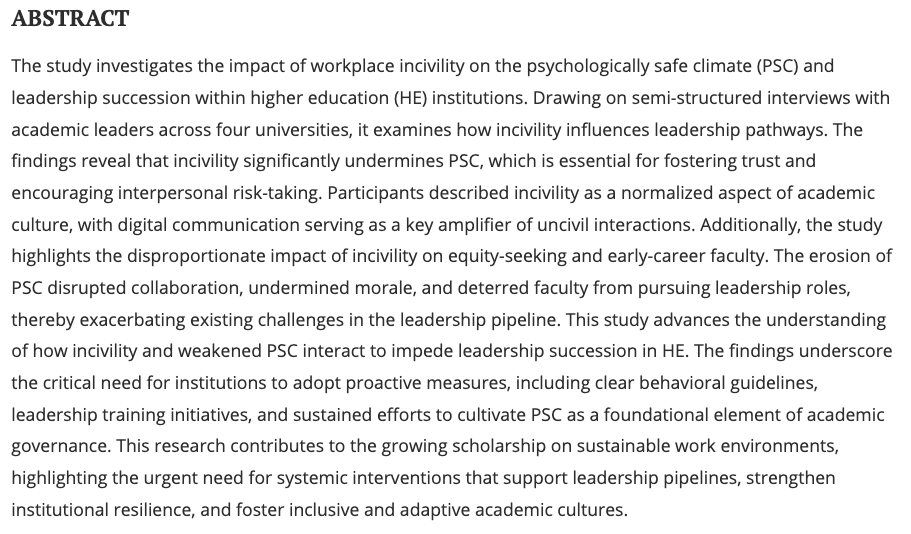



You must be logged in to post a comment.