Research Integrity Oversight in Canada: A Postplagiarism Perspective

April 11, 2026

The Canadian Panel on Responsible Conduct of Research (PRCR) is proposing substantive changes to Canada’s research integrity framework, and the public comment window closes April 17, 2026. If you care about research ethics in this country, you have days left to weigh in.

I want to flag a few things about these proposed changes and why they matter to those of us working in postplagiarism research.

The most consequential proposal is the removal of any statute of limitations on allegations of research misconduct. As attorney Minal Caron told Retraction Watch, the existing policy is silent on this question. The proposed language would require institutions to review allegations regardless of how much time has passed since the work was published, which would be a significant shift. It’s also a long-overdue one. Complainants often delay coming forward out of fear of retaliation, and a policy that turns away allegations on procedural grounds protects no one except those who benefit from institutional inaction.

The PRCR also proposes to require institutions to hold respondents accountable even after they have left, and to accept anonymous allegations and allegations already circulating in the public domain as grounds for review. These aren’t radical ideas. They’re basic conditions for a credible oversight system.

I’ve written and spoken at length about how postplagiarism requires us to rethink accountability in an age of AI. But accountability without enforcement infrastructure is a philosophical position, not a policy. These proposed changes represent a concrete attempt to build infrastructure. They will not resolve every tension in Canadian research oversight, and the critics quoted in the article are right to flag gaps, particularly around the vagueness of institutional RCR education requirements.

One of the scholars quoted in the Retraction Watch piece is Gengyan Tang, a PhD candidate and a member of our Postplagiarism Research Lab, who studies research integrity policy. His observation that the proposed language around RCR education is too ambiguous is precise and fair. Institutions can host an ‘Academic Integrity Week’ and check a compliance box without delivering anything substantive. Policies that do not specify how education is to be delivered or evaluated leave too much room for performative compliance.

The Pruitt case, cited in the article as a catalyst for some of this reform momentum, is worth naming directly. Jonathan Pruitt was found to have fabricated and falsified data. The case exposed how the 2011 framework’s absence of relevant procedures allowed institutions to deflect rather than investigate. Requiring institutions to act regardless of elapsed time or an individual’s current affiliation is a direct response to that failure.

Postplagiarism, as a framework, asks us to think past the categories we have inherited. The academic integrity arms race that I have discuss in my research applies just as much to research misconduct oversight as it does to student cheating. Detection tools, policies, and procedures are only as good as the institutional will to apply them rigorously. These proposed changes push toward compulsion rather than discretion, which warrants close attention.

The comment period is open until April 17, 2026. If you work in research integrity, this is your chance: read the proposed revisions and submit feedback.

__________

Reposted from: Research Integrity Oversight in Canada: A Postplagiarism Perspective – https://postplagiarism.com/2026/04/11/research-integrity-oversight-in-canada-a-postplagiarism-perspective/


Three tips for future-proofing academic and research integrity this year

January 2, 2025

In my 2024 annual editorial for the International Journal for Educational Integrity, was entitled, ’Future-proofing integrity in the age of artificial intelligence and neurotechnology: prioritizing human rights, dignity, and equity

Here are three things you can do to prioritize human rights and dignity when it comes to policies and procedures to address allegations of academic or research misconduct:

Use a human-rights-by-design approach to developing, revising, and implementing policies by conducting a comprehensive review of existing academic integrity policies. Update policies to explicitly incorporate human rights principles, ensuring they address fair process, privacy, equitable treatment, and respect for human dignity. It is essential to involve individuals from representative groups in this process.

Provide ongoing training, education, and support to faculty, staff, and students about human rights principles and how they apply to misconduct investigations and case management. Create orientation programs that explain expectations for ethical conduct while respecting diverse cultural perspectives. Offer workshops and resources, peer mentoring programs, and support services.

Focus on continuous improvement and quality assurance of ethics and integrity practices by gathering feedback from students, faculty, staff and relevant stakeholders. Regularly review misconduct case management processes and data to ensure equitable treatment across different demographics.

Implementing human rights principles into misconduct investigations and case management helps to create more effective and sustainable learning environments. This approach prioritizes people over punishment, dignity over draconianism, and compassion over callousness.

Read the full article here: https://edintegrity.biomedcentral.com/articles/10.1007/s40979-024-00175-2 

Related post:

Future-proofing integrity in the age of artificial intelligence and neurotechnology: Prioritizing human rights, dignity, and equity

________________________

Share this post: Three tips for future-proofing academic and research integrity this year – https://drsaraheaton.com/2025/01/02/three-tips-for-future-proofing-academic-and-research-integrity-this-year/

This blog has had over 3 million views thanks to readers like you. If you enjoyed this post, please “like” it or share it on social media. Thanks!

Sarah Elaine Eaton, PhD, is a Professor and Research Chair in the Werklund School of Education at the University of Calgary, Canada. Opinions are my own and do not represent those of my employer. 


Future-proofing integrity in the age of artificial intelligence and neurotechnology: Prioritizing human rights, dignity, and equity

November 13, 2024

Once a year I write an editorial for the International Journal for Educational Integrity. I take a big idea, ground it in literature written by some of the best in the world and then call for ways to improve our field even more. In 2023 I wrote about Postplagiarism and in 2022, I focused on equity, diversity, inclusion, accessibility and decolonization as new priorities for academic integrity. Here is this year’s editorial:

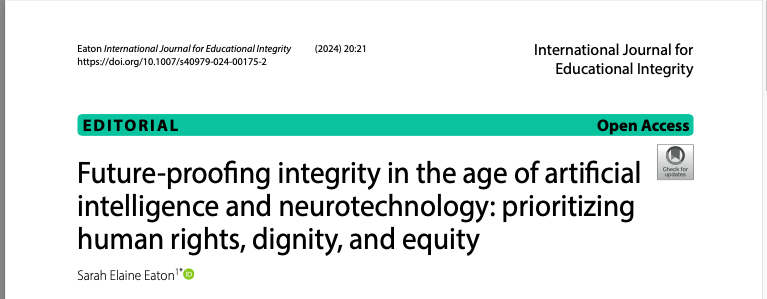
Future-proofing integrity in the age of artificial intelligence and neurotechnology: prioritizing human rights, dignity, and equity

A screenshot of an article title page. There is black text on a white background with a green banner at the top.
Here is a link to the original: https://edintegrity.biomedcentral.com/articles/10.1007/s40979-024-00175-2

Abstract

In this article I argue for the prioritisation of human rights when developing and implementing misconduct policies. Existing approaches may be perpetuate inequities, particularly for individuals from marginalised groups. A human-rights-by-design approach, which centres human rights in policy development, revision, and implementation, ensuring that every individual is treated with dignity and respect.

Recommendations for implementing a human-rights approach to misconduct investigations and case management are offered, covering areas such as procedural fairness, privacy, equity, and the right to education. Additional topics covered are the need to limit surveillance technologies, and the need to recognize that not all use of artificial intelligence tools automatically constitutes misconduct. I disentangle

the differences between equity and equality and explain how both are important when considering ethics and integrity. A central argument of this paper is that a human-rights-by-design approach to integrity does not diminish standards but rather strengthens educational systems by cultivating ethical awareness and respect for personhood. I conclude with a call to action with a seven-point plan for institutions to adopt a human-rights-based approach to ethics and integrity. In the age of artificial intelligence and neurotechnology, insisting on human rights and dignity when we investigate and address misconduct allegations is an ethical imperative that has never been more important.

Keywords Academic misconduct, Academic dishonesty, Plagiarism, Policy, Human rights, Restorative justice, Artificial intelligence, Neurotechnology, Higher education, Education

Commentary

As I reflect on the current state of academic and research integrity, I am struck by a glaring omission in our discussions: the connection between misconduct and human rights. We often treat these as separate entities, failing to recognize the profound impact that misconduct investigations and policies can have on the fundamental rights of individuals. This oversight is particularly concerning in the age of artificial intelligence (AI) and neurotechnology, where the potential for harm is magnified.

Take, for example, the case of a professor in Canada who physically assaulted international students accused of plagiarism. This horrifying example demonstrates how the pursuit of academic integrity can be twisted into a justification for degrading and inhumane treatment, violating the very principles of dignity and respect that should guide our actions. While this is an extreme case, it highlights the need for a fundamental shift in our approach.

In this editorial, I offer a call to action to move beyond simply adhering to legal requirements and embrace a ‘human-rights-by-design’ approach that embeds human rights principles into our policies and practices. This means ensuring procedural fairness throughout investigations, safeguarding the privacy of individuals, and recognizing the right to be presumed innocent until there is proof to the contrary. It also requires us to acknowledge the diverse backgrounds and circumstances of our students and staff, striving for equitable treatment that addresses systemic inequalities and provides the support needed for everyone to succeed.

In the face of rapidly evolving technologies like AI, we must be especially vigilant in upholding human rights. The temptation to rely on unproven AI detection tools or to rush to judgement based on suspicion rather than evidence is strong, but it is a path that leads us away from justice and fairness. We cannot allow fear or expediency to erode our commitment to human dignity.

By centring human rights in our approach to integrity, we can create educational and research environments that are not only ethically sound but also truly just and equitable. This is not about lowering standards; it is about building a culture of integrity that upholds the inherent worth of every individual.

________________________

Share this post: Future-proofing integrity in the age of artificial intelligence and neurotechnology: Prioritizing human rights, dignity, and equity – https://drsaraheaton.com/2024/11/13/future-proofing-integrity-in-the-age-of-artificial-intelligence-and-neurotechnology-prioritizing-human-rights-dignity-and-equity/
This blog has had over 3 million views thanks to readers like you. If you enjoyed this post, please “like” it or share it on social media. Thanks!

Sarah Elaine Eaton, PhD, is a Professor and Research Chair in the Werklund School of Education at the University of Calgary, Canada. Opinions are my own and do not represent those of my employer.


New Academic Integrity Research from Canada (October, 2021)

October 15, 2021

I think this might be a record for the number of academic integrity research outputs in Canada across different venues, all published in a single week: two articles, each published in a different journal, as well as two conference presentations. It’s one thing to have a series of research outputs from a single source, such as one issue of a journal or a set of conference proceedings, but what’s worth celebrating here is that these are from multiple, peer-reviewed sources.

Hu & Zhang (2021) and Liang et al. (2021) have papers in the proceedings from Teaching Culturally and Linguistically Diverse International Students in Open and/or Online Learning Environments: A Research Symposium hosted by the University of Windsor in June:

Hu, J., & Zhang, C. (2021). ESL student plagiarism prevention challenges and institutional interventions. Paper presented at the Teaching Culturally and Linguistically Diverse International Students in Open and/or Online Learning Environments: A Research Symposium (Online), University of Windsor, ON. https://scholar.uwindsor.ca/cgi/viewcontent.cgi?article=1048&context=itos21

Liang, A., Maddison, T., & England, S. (2021). Proactive not punitive: Strategies to prevent plagiarism and promote international student success. Paper presented at the Teaching Culturally and Linguistically Diverse International Students in Open and/or Online Learning Environments: A Research Symposium (Online), University of Windsor, ON. https://scholar.uwindsor.ca/cgi/viewcontent.cgi?article=1053&context=itos21

Josh Seeland and colleagues from Manitoba published this Classroom Note in the International Journal of Mathematical Education in Science and Technology (Taylor & Francis):

Seeland, J., Cliplef, L., Munn, C., & Dedrick, C. (2021). Mathematics and academic integrity: institutional support at a Canadian college. International Journal of Mathematical Education in Science and Technology, 1-8. https://doi.org/10.1080/0020739X.2021.1981472

And last but not least, the latest article from the Contract Cheating in Canada: National Policy Analysis project that I’m leading has been published in the Canadian Journal for Educational Administration and Policy. This paper reports on our policy analysis of Ontario Universities.

Miron, J. B., McKenzie, A., Eaton, S. E., Stoesz, B. M., Thacker, E., Devereaux, L., . . . Rowbotham, K. (2021). Academic integrity policy analysis of publicly-funded universities in Ontario, Canada: A focus on contract cheating. Canadian Journal of Educational Administration and Policy, 197, 62-75. https://journalhosting.ucalgary.ca/index.php/cjeap/article/view/72082

In 2018 when I co-published with Rachael Edino a literature review about existing research from Canada on academic integrity, we reported that we’d found 56 sources published over 25 years. I am so proud to see how far we have come as a Canadian community to build our research and practice expertise and mobilize that knowledge via high quality peer-reviewed journals and conferences.

In case you’re wondering if academic integrity is a field of research, it absolutely is, with high quality scholarly outputs coming out every month, from scholars across the world. Of course, I highlight outputs from my compatriots because I am happy for them and proud of their work, and we are part of a global community of scholars, educators, and professionals across the world doing this work. (Hey, colleagues in Australia and the UK, are you reading this? We are catching up to you!)

Check out these recent publications and see what we’ve been doing in Canada. It’s pretty awesome.

______________________

Share or Tweet this: New Academic Integrity Research from Canada (October 2021) https://drsaraheaton.wordpress.com/2021/10/15/new-academic-integrity-research-from-canada-october-2021/

This blog has had over 2 million views thanks to readers like you. If you enjoyed this post, please “like” it or share it on social media. Thanks!

Sarah Elaine Eaton, PhD, is a faculty member in the Werklund School of Education, and the Educational Leader in Residence, Academic Integrity, University of Calgary, Canada.

Opinions are my own and do not represent those of the University of Calgary or anyone else.


New article: Understanding the academic integrity policies of publicly funded universities in western Canada

December 23, 2020

Educational PolicyThe latest article in our project, Contract Cheating in Canada: National Policy Analysis has just been published!

Stoesz, B., & Eaton, S. E. (2020). Understanding the academic integrity policies of publicly funded universities in western Canada. Educational Policy. https://doi.org/10.1177/0895904820983032

Abstract

We examined 45 academic integrity policy documents from 24 publicly-funded universities in Canada’s four western provinces using a qualitative research design. We extracted data related to 5 core elements of exemplary academic integrity policy (i.e., access, detail, responsibility, approach, support). Most documents pointed to punitive approaches for academic misconduct and were based on the notion that academic misconduct results from a lack of morals. One university used the term “contract cheating,” although nearly all categorized the outsourcing of academic work as plagiarism. Details about educational resources and supports to increase student and staff understanding of academic integrity and prevention of academic misconduct were sparse. This study signals the continuing punitive nature of academic integrity policies in western Canadian universities, the reluctance to address contract cheating directly, and the need to revise policies with deeper consideration of educative approaches to academic integrity that support students and academic staff.

Keywords: academic integrity, Canada, contract cheating, educational supports, higher education, policy

This is an open access article and is free to read and download.

For more information about this article, or the national project, please contact me directly.

_____

Share or Tweet this: New article: Understanding the academic integrity policies of publicly funded universities in western Canada – https://drsaraheaton.wordpress.com/2020/12/23/new-article-understanding-the-academic-integrity-policies-of-publicly-funded-universities-in-western-canada/

This blog has had over 2 million views thanks to readers like you. If you enjoyed this post, please “like” it or share it on social media. Thanks!

Sarah Elaine Eaton, PhD, is a faculty member in the Werklund School of Education, and the Educational Leader in Residence, Academic Integrity, University of Calgary, Canada. Opinions are my own and do not represent those of the University of Calgary.