The University of Toronto Settlement Is a Turning Point for Academic Integrity in Canada

May 22, 2026

On April 1, 2026, Justice Meaghan M. Conroy of the Federal Court of Canada issued a consent judgment confirming that the Easy EDU tutoring companies infringed the copyright of the University of Toronto and three named professors: Robert Gazzale, Lisa Kramer, and Ai Taniguchi. Joe Friesen covered the story for The Globe and Mail (paywalled, but worth tracking down). The settlement requires Easy EDU to pay $1 million in damages, plus HST and interest. A counterclaim by Easy EDU against the university was dismissed without costs. The case had been before the courts since 2022.

Friesen reported that Easy EDU reproduced course outlines, slide presentations, lecture notes, and assignments without authorization. In some instances, the company provided tests written by faculty with answers included, placing students at direct risk of academic misconduct violations. One published adjudication described how 180 students received a study package containing 22 questions that corresponded directly to questions a professor had written for an assessment. The student named in that case received a grade of zero and a 28-month suspension.

This case matters beyond copyright law and anyone who works in academic integrity in Canada should be paying attention Why? Because the case could set a precedent for how Canadian institutions respond when students use file-sharing services, term paper mills, or engage so-called academic consultants.

What the Settlement Exposes

Let’s be clear: the Easy EDU case did not emerge in isolation. The case reflects a pattern I and others have documented extensively. In Academic Integrity in Canada: An Enduring and Essential Challenge, which Julia Christensen Hughes and I edited and published with Springer in 2022, our contributors wrote about contract cheating in Canada in a number of chapters. Collectively, we traced the commercialization of academic support services as part of a broader commodification of higher education. The volume includes chapters on contract cheating in Canada and on EdTech-enabled contract cheating, both of which point to the same structural condition that made Easy EDU possible: a market for services that operates in parallel to formal education, targeting students under pressure, with few regulatory constraints.

Canada has no legislation against contract cheating companies. The U of T settlement is a copyright remedy, not a criminal one. Easy EDU was not shut down because what it did was illegal under a contract cheating statute. It was held responsible for reproducing materials that belonged to the university and its faculty. This distinction is important here because copyright law filled a gap that academic integrity policy could not. 

The Platformization of Academic Misconduct 

A recent 2026 study published in the British Educational Research Journal adds another dimension to this picture. My PhD student Gengyan Tang led this study, with Wei Cai and me as co-authors. Tang, Cai, and I examined commercial academic misconduct appeal services operating in China’s digital marketplace and found that these agencies target Chinese international students through platforms such as Xiaohongshu (RED). These services operate in a regulatory and ethical grey zone, packaging appeal support as a marketable product and translating case outcomes into metrics like success rates.

Tang, Cai, and I conceptualize this process as self-platformization: commercial actors reorganizing educational assistance in alignment with platform economies. The same logic applies to tutoring services like Easy EDU. These are not tutoring companies in any traditional sense. They are platform-aware businesses that use algorithms, social media, and scale to insert themselves into students’ academic lives at precisely the moments when students are most vulnerable.

The students in the U of T case were not, for the most part, bad actors. Many were international students navigating unfamiliar institutional systems, in some cases at risk of losing their study permits. Easy EDU identified that vulnerability and built a business model around it. One student, identified only by initials in the published adjudication, faced a 28-month suspension, not because they set out to deceive, but because a commercial service supplied unauthorized materials and they used them.

In our study, Tang, Cai, and I argue that institutions have invested heavily in prevention and detection but have largely ignored the post-violation stage. That gap is where commercial services can operate with relative ease because there is nothing stopping them from doing so. Universities focus on catching misconduct. Academic consulting services (i.e., contract cheating companies) profit from what happens next, whether that means supplying unauthorized test answers before an assessment or, as we found in our research, or coaching students through misconduct hearings afterward.

So What’s Next?

The U of T injunction permanently restrains Easy EDU from making further use of the university’s course materials. The university has committed to directing settlement proceeds toward student academic supports. These are constructive outcomes, and also insufficient on their own.

In Academic Integrity in Canada: An Enduring and Essential Challenge, I, together with other contributors, called for legislation that would deter contract cheating firms from operating in Canada. That call has gone largely unanswered. The U of T case demonstrates that copyright enforcement can achieve results where academic integrity policy alone cannot, but copyright litigation is expensive, slow, and available only to institutions with the resources to pursue it. The case took four years to resolve, an in the financial climate we are in today, many institutions simply cannot absorb that kind of cost.

What the settlement does accomplish is normative because it establishes, through a federal court consent judgment, that reproducing course materials for commercial tutoring purposes constitutes copyright infringement. It names the professors whose intellectual property was taken and affirms, as U of T vice-provost Heather Boon stated, in Friesen’s article, that faculty own the copyright in their course materials and the university will support them in protecting it. That is a meaningful public statement. It signals that institutions are prepared to act, and that the legal tools to do so exist.

The Bigger Picture

Academic integrity is not simply a student conduct problem, but rather a structural problem shaped by institutional design, assessment practice, resource inequity, and the commercialization of educational support. The Easy EDU case sits at the intersection of all of these.

The students who attended those tutoring sessions needed academic support. Easy EDU positioned itself as that help, at a price, with materials it had no right to distribute. The university’s commitment to redirecting settlement funds to student supports is the right response. It will not be enough without sustained investment and clearer procedural guidance for students facing misconduct allegations. Institutions across our country happily received international student tuition fees, on the assumption that students are admitted have the academic skills and preparation they need to succeed. By and large, we still tend to blame the students if they lack academic skills or knowledge of how to navigate the higher education system. When the students turn to third parties whom they believe can help them fill their skills gap, historically, it is the students who are held responsible while companies operating in the background simply line their pockets with profits without any repercussions. This is the first time, to my knowledge, that a commercial supplier of academic services operating in Canada has faced a monetary penalty for facilitating academic misconduct.

Better institutional supports, clearer procedural guidance for students facing misconduct allegations, and platform-aware integrity education are not peripheral concerns. They are the conditions under which commercial exploitation becomes less attractive. In our study, Tang, Cai, and I call for a post-violation framework that attends to digital infrastructures and addresses students during crisis moments, not only before them. I continue to believe that work is overdue.

Kudos to the team at U of T for pursuing this case. You’ve now set a precedent that others can follow.

References

Eaton, S. E., & Christensen Hughes, J. (Eds.). (2022). Academic integrity in Canada: An enduring and essential challenge. Springer. https://doi.org/10.1007/978-3-030-83255-1

Friesen, J. (2026, May 22). University of Toronto reaches settlement for $1-million in damages from tutoring company. The Globe and Mail. https://www.theglobeandmail.com/canada/article-university-of-toronto-reaches-settlement-1-million-damages-tutoring  

Tang, G., Eaton, S. E., & Cai, W. (2026). Academic misconduct appeal services in China: Platform logics, self-platformization and implications for integrity education. British Educational Research Journal. https://doi.org/10.1002/berj.70130

______

Share this post: The University of Toronto Settlement Is a Turning Point for Academic Integrity in Canada – https://drsaraheaton.com/2026/05/22/the-university-of-toronto-settlement-is-a-turning-point-for-academic-integrity-in-canada/

Sarah Elaine Eaton, PhD, is a Professor and Research Chair in the Werklund School of Education at the University of Calgary, Canada. Opinions are my own and do not represent those of my employer.


IELTS Exam Fraud: Is large-scale cheating really a shock to anyone?

January 7, 2025
A screenshot from an online news story. There is a photo of students taking an exam. There is black text on a white background.

The headline reads, “IELTS exam fraud scandal ‘shocks’ Indonesia“, as reported by Vietnam.vn. The article goes on to offer details about large-scale cheating on English-language proficiency testing, saying that, “Faced with the increasing incidence of fraud, many prestigious universities around the world have adjusted their admission policies, especially regarding IELTS requirements.”

Contract cheating and exam proxies (i.e., impersonators) are at the heart of the scandal, with customers each paying about 47,000,000 Vietnamese Dong (which seems to convert to about $1851 USD or $2650 CAD, according to one online currency exchange website).

The article reports that these cheating incidents have caused schools in Singapore, Australia, and the US to raise the minimum test score for entrance to certain programs. (I am puzzled as to why schools think that raising the minimum score for admissions will prevent cheating on standardized texts used as an entrance requirement? My guess is that it might just drive up the price of fraud…)

Two chapters from our edited book, Fake Degrees and Fraudulent Credentials in Higher Education (Eaton, Carmichael, and Pethrick, 2023) are worth mentioning, as the authors of both chapters raised the alarm about the issue of large-scale global cheating on English language proficiency exams.

Soroush Sabbaghan (University of Calgary) and Ismaeil Fazel (University of British Columbia) in their chapter, ‘None of the above: Integrity concerns of standardized English proficiency tests’, “shed light on the complexities and the apparent disconnect between equity, integrity, fairness, and justice in standardized language proficiency tests and the integrity issues that can arise as a result.”

Angela Clark (York University), in her chapter, “Examining the Problem of Fraudulent English Test Scores: What Can Canadian Higher Education Institutions Learn?”, argues that “relying on a single language proficiency test score to determine an individual’s readiness is problematic, and also problematic is the lack of related academic research and data to help guide admissions decision-making”. She looks at media reports from the UK, US, and Canada, noting that, “Media reports and a lack of data serve to promote distrust of the language testing process and the test scores that institutions receive.”

Cheating on English language proficiency exams is nothing new and nor is it isolated to any one country.

Both of these chapters are thoroughly researched and well written. If you’re interested in the topic of fraud in English language exams, I recommend checking them out. In the meantime, large-scale cheating on standardized tests and the related problem of admissions fraud should shock exactly no one.

References

Clark, A. (2023). Examining the problem of fraudulent English test scores: What can Canadian higher education institutions learn? In S. E. Eaton, J. J. Carmichael, & H. Pethrick (Eds.), Fake Degrees and Fraudulent Credentials in Higher Education (pp. 187-207). Springer International Publishing. https://doi.org/10.1007/978-3-031-21796-8_9 

IELTS exam fraud scandal “shocks” Indonesia. (2024, December 28). Vietnam.vn. https://www.vietnam.vn/en/be-boi-thi-ho-ielts-rung-dong-indonesia/

Sabbaghan, S., & Fazel, I. (2023). None of the above: Integrity concerns of standardized English proficiency tests. In S. E. Eaton, J. J. Carmichael, & H. Pethrick (Eds.), Fake Degrees and Fraudulent Credentials in Higher Education (pp. 169-185). Springer International Publishing. https://doi.org/10.1007/978-3-031-21796-8_8 

Related posts:

________________________

Share this post: IELTS Exam Fraud: Is large-scale cheating really a shock to anyone? https://drsaraheaton.com/2025/01/07/ielts-exam-fraud-is-large-scale-cheating-really-a-shock-to-anyone/

This blog has had over 3.7 million views thanks to readers like you. If you enjoyed this post, please ‘Like’ it using the button below or share it on social media. Thanks!

Sarah Elaine Eaton, PhD, is a Professor and Research Chair in the Werklund School of Education at the University of Calgary, Canada. Opinions are my own and do not represent those of my employer. 


Accreditation and Certification Fraud in IT

December 27, 2024

Many people in the academic integrity world are already familiar with contract cheating websites, those that deal in the business of buying and selling exams, bespoke term papers, theses, and exam questions and answers.

But this business isn’t limited to the millions of K-12, high school and post-secondary students. The exam fraud business is alive and well for professional accreditation exams for folks who either want to bypass a formal university degree or to supplement existing credentials.

For example, in the IT industry credentials are often the golden key to new opportunities. Certifications and accreditations (allegedly) validate technical skills, offering (so-called) proof that a candidate has the expertise needed for a professional role. 

Taking into account supply and demand, with job candidates being in high supply and well-paying jobs being in high demand, certification and accreditation fraud is alive and well in the IT industry, as well as other industries. This is a trend employers cannot afford to ignore.

Exposing the Fraud: How Buying and Selling of Certification Exam Questions Works

Certification fraud occurs when individuals falsify credentials, purchase counterfeit certifications, or misuse legitimate certifications obtained by others. But there’s this sneaky grey area that exists when a person actually sits a professional exam themselves, but they’ve prepared by buying the exam questions and/or the answers from an online vendor.

I won’t name specific companies that do this in this post, because I’m not in the habit of advertising for these fraudsters, but I want to show you how they work, so here are some screenshots:

Screenshot #1: Home page

A website screenshot. Black background, with text in white and blue. Some of the text is quoted in the narrative that follows.

At the top of this website, the company claims that 94% of the exam questions that they sold were “almost the same” and that 97% of customers passed the exam using their materials. (Who knows what happened to the other 3%…?) Finally, 98% of customers found the “study guides” effective and helpful.

There’s that phrase that we commonly see on contract cheating websites, “study guide”. For the uninitiated, this is a euphemism for “exam questions”. 

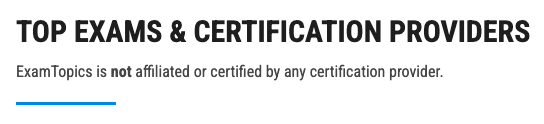
Screenshot #2: Saying it like it is: Not affiliated with any certification provider

A website screenshot. White background with black text.

In this screenshot the company states plainly that they are not affiliated or certified by any certification provider. Reading between the lines, the message is ‘caveat emptor’ or ‘buyer beware’. They are telling you upfront that they are in the business of selling exam questions and make no guarantees about their products.

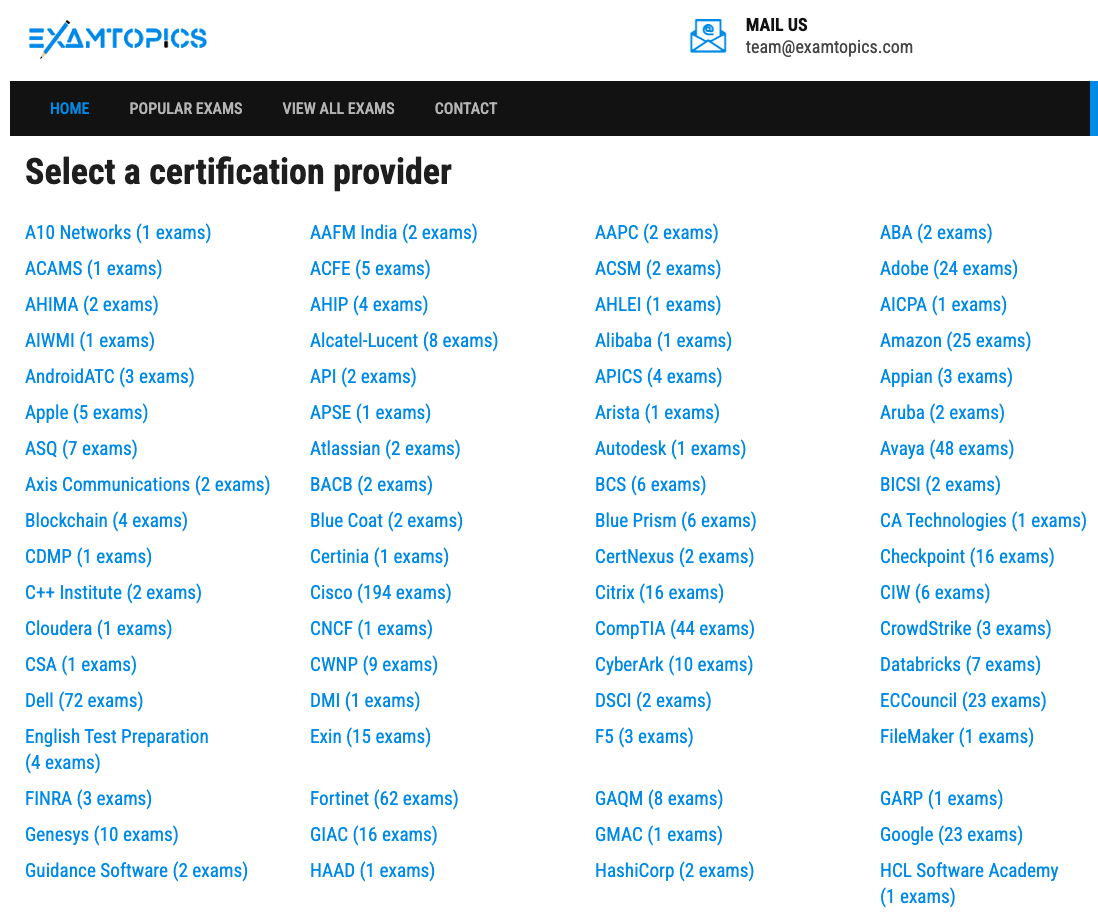
Screenshot #3: Samples of accreditation exam questions for sale

A website screenshot. White background. Black task bar with light grey text. There are lists of texts written in blue.

Look at all the options: You can buy exam questions for certifications offered by DELL, English language proficiency exams, Citrix, Adobe, and Amazon, and Google just to name a few. 

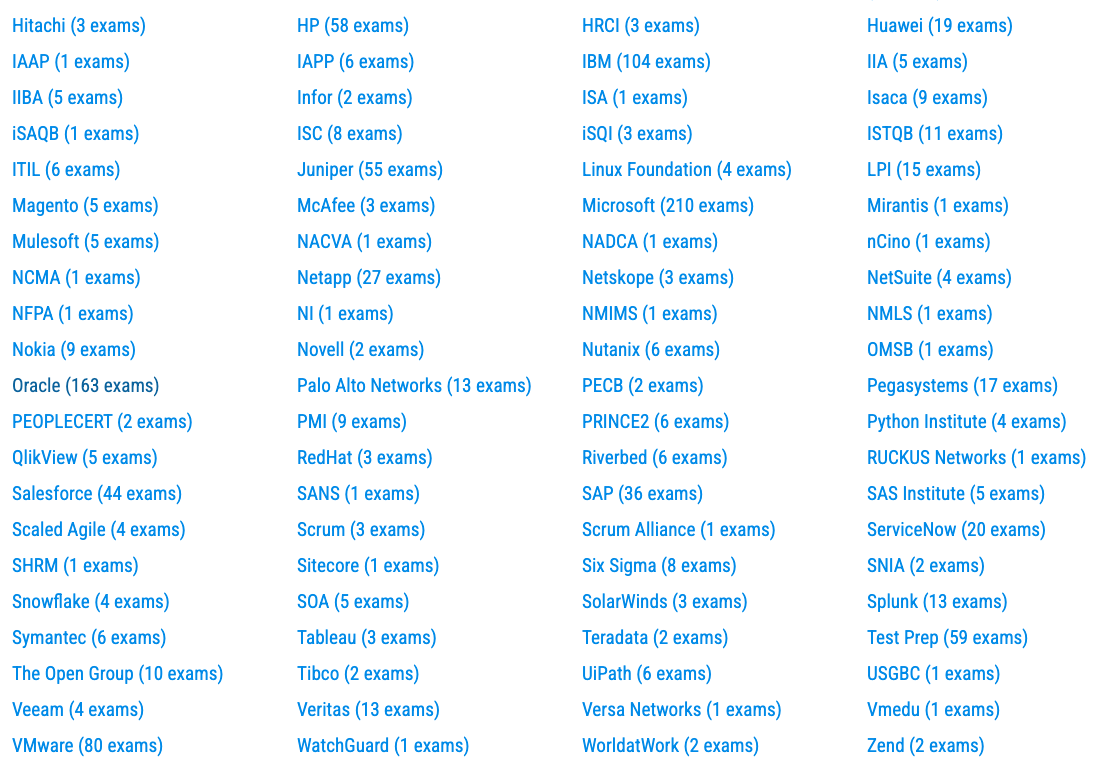
Screenshot #4: More samples of certification provider exam questions for sale.

A website screenshot. White background. Black task bar with light grey text. There are lists of texts written in blue.

But wait! There’s more! You can buy exam questions for certifications offers by Oracle, IBM, SAP, and others.

Assessment Security

Sites like compromise the assessment security of certification exams that are meant to qualify individuals to do a particular job. If this term is new to you, I recommend Professor Phill Dawson’s book, Defending Assessment Security in a Digital World. For a quick (and free) overview, of Phill’s work, this slide deck from one of his presentations is worth checking out.

Businesses that buy and sell exam certification questions engage in fraudulent practices undermine trust in the certification system and create significant risks for employers.

Consequences for Employers

Hiring someone with counterfeit credentials can have dire consequences. Unqualified employees may lack the technical skills to handle complex tasks, leading to project delays, costly errors, or even security breaches. Beyond the financial impact, fraudulent certifications can erode team morale, as employees with genuine qualifications may feel undervalued when working alongside those who faked their way in.

What Employers and Hiring Managers can Do

Employers, and especially hiring managers and those working in HR, must take proactive steps to safeguard their hiring processes. Some of you may be asking if this kind of practice is actually illegal. I’m not a lawyer, but what I can say is that although contact cheating for students is illegal in countries like Australia, the UK, and Ireland, if you’re not a student, then you might get to live a proverbial grey zone. To the best of my knowledge, it is not actually illegal to buy and sell questions for professional certification exams in most countries of the world.

So, what can employers do? First, trust but verify! Verifying certifications directly with issuing organizations is one step. Many certification bodies offer easy online verification tools to confirm a candidate’s credentials. Additionally, employers should stay informed about recognized accreditation standards and avoid unverified institutions. 

Having said this, verification of credentials and certification won’t help if someone has bought exam questions online and then taken the test themselves. Their results could be ‘verifiable’ in a sense, because there’s an assumption that a person who has passed an exam had the knowledge to do so. But when someone buys their exam questions before sitting the test, it means that they have prepared for an exam and may not necessarily have internalized the knowledge or skills that should match the certification they receive from passing an exam. An exam is one measure of knowledge, but it isn’t the only one. 

Having prospective employees demonstrate their skills and respond to technical questions that could only be answered if the person has the knowledge to back up their documentation can also help. One possibility is to give an interviewee a real-world scenario that could happen at your organization. Ask them how they would go about problem-solving it. If they struggle or stumble, it could be a sign that they lack the necessary skills for the job. (It could also be a sign that they’re just nervous or that interviewing isn’t their strength. So let me also make a plug here for having an inclusive and equitable interviewing process.)

Investing in robust, inclusive, and equitable hiring practices not only protects an organization from the pitfalls of fraud but also helps to create a culture of accountability and excellence. By placing a premium on authentic certifications combined with demonstrable knowledge and skills and inclusive hiring practices, employers signal their commitment to integrity and ensure they are building a team of qualified professionals.

Bottom line: If you’re hiring someone who says they have an IT certification based on taking exams, it’s worth it to find out if they actually have the knowledge and skills to do the job. 

And this is just one example of one site. Rest assured that it is not the only one out there. Exam cheating companies like this one don’t exist in isolation. They’re in the game to make money, and lots of it. 

In an industry where skills and knowledge drive success, vigilance against certification and accreditation fraud is not optional—it is a driver of success.

Future Outlook

Fraud and corruption are alive and well education and industry. There is a growing community of sleuths, scholars, and activists who are ready to sniff out fraud and expose it and naïveté about these matters is quickly going out of fashion. 

There may have been a time when it was acceptable—or even fashionable—to clutch your pearls, proclaim moral outrage, or just refuse to accept that educational and professional fraud are more commonplace than you might have previously thought. GenAI is here to stay, and so are companies whose business is educational, accreditation, scientific, and professional fraud. These companies are profitable because they have customers willing to pay for their goods and services.

Vigilance, sleuthing, and exposing fraud are very much on trend as we move ahead into the new year. And if you’re a hiring manager, taking steps to protect the integrity of your operations is definitely part of the job in 2025 and beyond.

References and Further Reading

Carmichael, J. (2023, June 7). Understanding Fake Degrees and Credential Fraud in Higher Ed. The Evollution: A Modern Campus Illumination. https://evolllution.com/programming/credentials/understanding-fake-degrees-and-credential-fraud-in-higher-ed/

Eaton, S. E., & Carmichael, J. (2022). The Ecosystem of Commercial Academic Fraud. In. Calgary, Canada: University of Calgary. https://dx.doi.org/10.11575/PRISM/40330

Eaton, S. E., Carmichael, J., & Pethrick, H. (Eds.). (2023). Fake degrees and credential fraud in higher education. Springer. https://doi.org/10.1007/978-3-031-21796-8

Related posts

________________________

Share this post: Accreditation and Certification Fraud in IT – https://drsaraheaton.com/2024/12/27/accreditation-and-certification-fraud-in-the-it-world/

This blog has had over 3 million views thanks to readers like you. If you enjoyed this post, please “like” it or share it on social media. Thanks!

Sarah Elaine Eaton, PhD, is a Professor and Research Chair in the Werklund School of Education at the University of Calgary, Canada. Opinions are my own and do not represent those of my employer. 


Unveiling the Handbook of Academic Integrity (2nd ed.) in Dubai

December 28, 2023
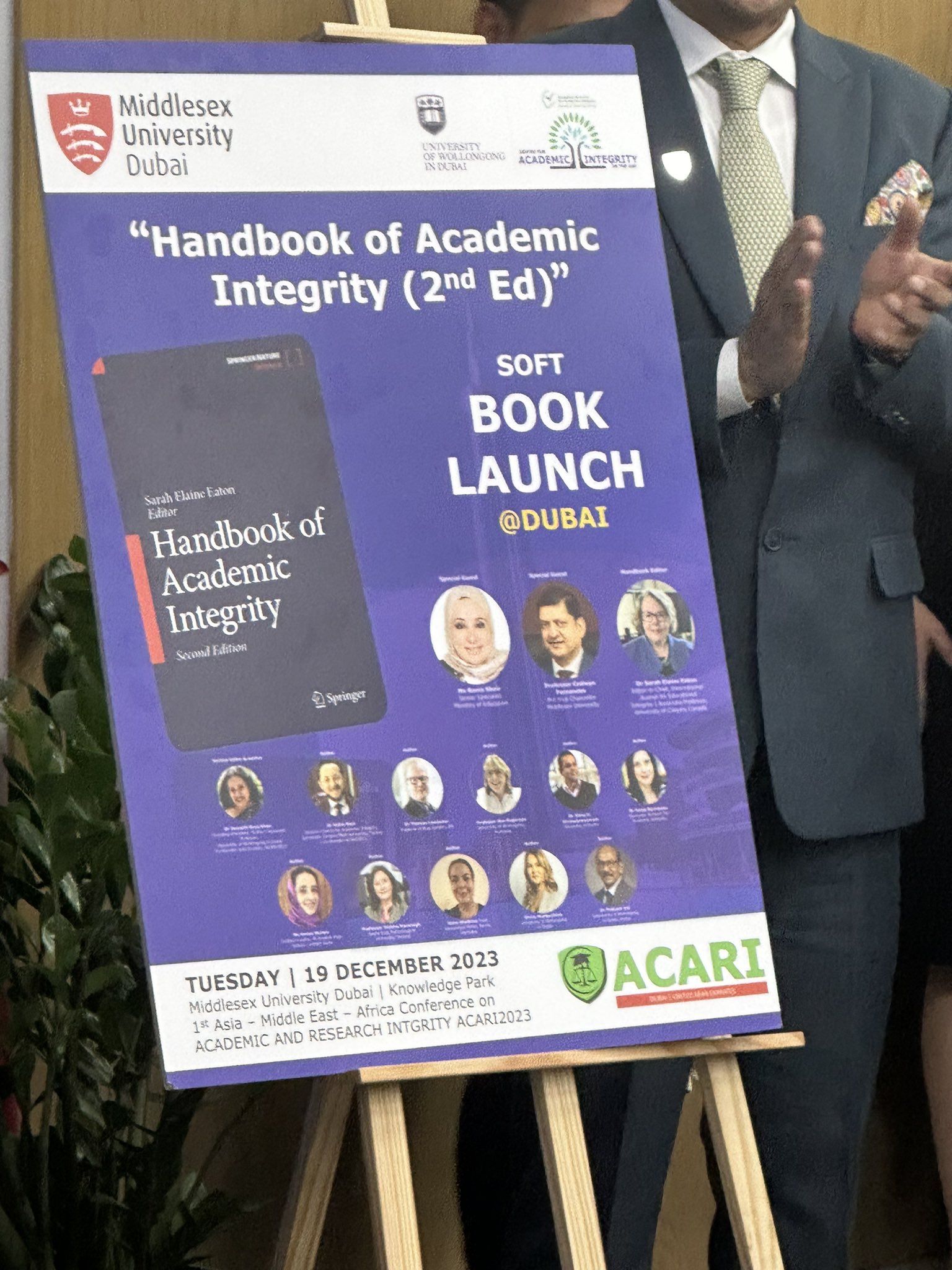
A poster with a blue background. There is a white banner at the top with university logos. The poster contains an image of a book cover and faces of individuals associated with the book.

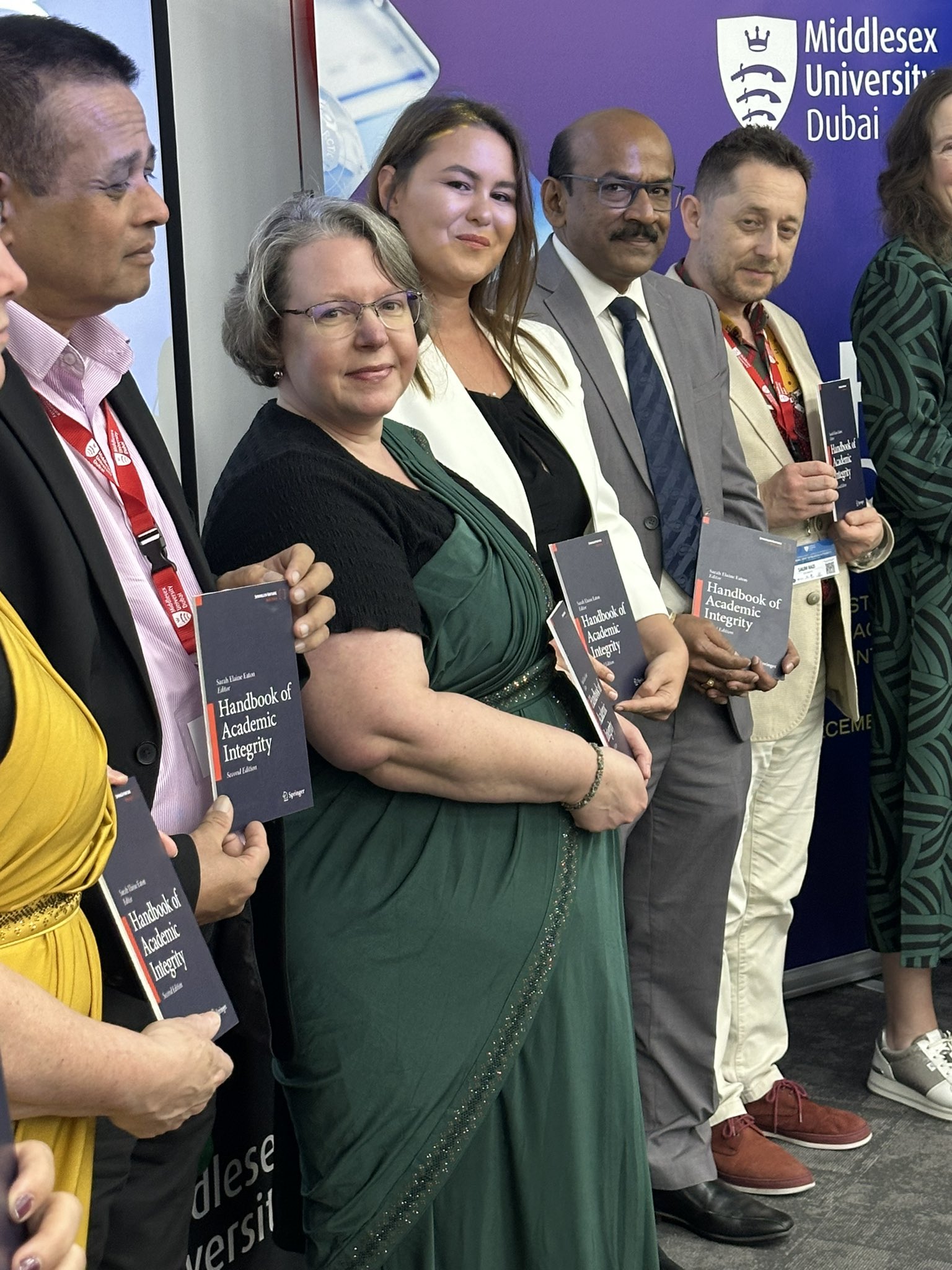
The 1st Asia -Middle East – Africa Conference on Academic and Research Integrity (ACARI) 2023, 17-19 December at Middlesex University Dubai. It was against this backdrop that the highly anticipated Handbook of Academic Integrity (2nd ed.), published by Springer, was unveiled at a dazzling soft launch, marking a milestone in the book’s journey and the evolution of academic integrity knowledge-sharing and community-building.

The handbook is now in its final stages of production, and the standalone second edition will be released in hard copy in January, 2024. To celebrate, Dr. Zeenath Reza Khan, who serves as one of the handbook’s section editors and contributors, and was a co-chair of the 1st Asia -Middle East – Africa Conference on Academic and Research Integrity (ACARI) 2023, 17-19 December led the organization of the soft launch for the handbook during the conference.

The launch was held during the closing ceremony of the conference on the final day in an auditorium at the prestigious Middlesex University Dubai, was both festive and scholarly, as it brought together educators, researchers, and advocates for academic integrity. In addition to conference delegates, a number of esteemed dignitaries attended including, His Excellency, Jamal Hossain, Consul General of Bangladesh to UAE; Dr. Mohammad Ali Reza Khan, Award-winning Expert Wildlife Specialist, Dubai Municipality, along with Professor Cedwyn Fernandes, Pro Vice Chancellor of Middlesex University and Director of Middlesex University Dubai. Special thanks to Ms. Rania Sheir, Senior Specialist, Entrepreneurship and Innovation, Ministry of Education, UAE, who not only attended the launch, but also posted about it on LinkedIn.

 A screenshot of a LinkedIn post.

The Handbook, meticulously curated by leading experts in the field, is a compendium of insights, strategies, and best practices aimed at upholding the ethical practices in academia and research. It covers a diverse range of topics, from plagiarism to artificial intelligence, to the promotion of ethical behaviour in academic research, and much more. The multidimensional approach of the Handbook of Academic Integrity  ensures that it caters to the needs of educators, administrators, and students alike.

A number of contributing authors were in attendance, including:

Dr. Zeenath generously gifted two colleagues and me with authentic saris that we wore during the closing ceremony and the launch. As you can see from the photo below, I was given one in dark green and I just love it! I had an opportunity to say a few words about the book and its importance in the field, and to thank the organizers and authors. Each contributor was gifted a symbolic souvenir cut-out of the front cover of the handbook and following the formalities, we signed the back of one another’s covers.

The book launch culminated in a celebratory atmosphere, with attendees leaving inspired. The Handbook of Academic Integrity (2nd ed.), now poised to be a cornerstone in the field, builds on the first edition and stands as a testament to the collective commitment to nurturing a culture of integrity throughout every level of education and research.

Photo gallery:

Unveiling of the Handbook of Academic Integrity (2nd ed.) Two people are removing a gold-coloured cover from a poster featuring the book cover. People are standing in the background. There are blue and white balloons on the left edge of the frame.
A group of people standing around a large easel. On the easel is a poster.
An easel showing a large poster.
A photo with a group of people. Each person is holding a cardboard cutout of a book cover.
A photo of a group of people. There is an easel with a poster in the centre.
A photo of a group of people. Each person is holding a cardboard cutout of a book cover.

____________________________

Share this post: Unveiling the Handbook of Academic Integrity (2nd ed.) in Dubai – https://drsaraheaton.wordpress.com/2023/12/28/unveiling-the-handbook-of-academic-integrity-2nd-ed-in-dubai/

This blog has had over 3 million views thanks to readers like you. If you enjoyed this post, please “like” it or share it on social media. Thanks!

Sarah Elaine Eaton, PhD, is a faculty member in the Werklund School of Education at the University of Calgary, Canada. Opinions are my own and do not represent those of my employer.


Contract Cheating and Freedom of Expression: How the Chicago Principles Can Help You Promote Academic Integrity on Your Campus

October 4, 2022
woman wearing brown shirt carrying black leather bag on front of library books
Photo by Abby Chung on Pexels.com

It’s that time of the year again, when contract cheating and unethical tutoring companies hand out flyers to students as they enter classrooms and leave them all over campus – littered in classrooms, strewn on benches, tacked to bulletin boards, and so on. Historically, it has been difficult for some schools to have these advertisements removed because the companies behind them have claimed censorship and threatened legal action against the institution. However, there is reason for hope, especially if your school as a Statement on Free Expression. Let me explain.

Although the original Chicago statement – and others that were modelled on it – were created to support freedom of expression, there is a small but important detail about the limitations of free speech on campus that is relevant to academic integrity. In the original version of the Chicago Principles of Freedom of Expression, it states:

“The freedom to debate and discuss the merits of competing ideas does not, of course, mean that individuals may say whatever they wish, wherever they wish. The University may restrict expression that violates the law, that falsely defames a specific individual, that constitutes a genuine threat or harassment, that unjustifiably invades substantial privacy or confidentiality interests, or that is otherwise directly incompatible with the functioning of the University.” (Chicago Principles of Freedom of Expression, p. 2, emphasis added.)

I am not a lawyer, but I am a policy scholar. (You can find out more about my academic work on higher education policy here, here, and here, for example.) When examining policy, the devil is in the details, as they say. In this case, there is an argument to be made that when contract cheating companies and unethical tutoring businesses advertise on our campuses, they are acting in a manner that is directly incompatible with the functioning of the university. As such, the institution has a right to remove advertisements from campus that promote academic misconduct.

Every school that has developed its own statement of free expression based on the Chicago principles may have this important detail included that gives it leverage to curtail the blatant advertising of contract cheating services the school, including those in Canada. For example, in 2019, the Alberta government mandated that all post-secondary institutions in the province develop a statement to affirm freedom of expression that aligned with the Chicago Principles on Free Speech. Like all higher education institutions in the province of Alberta, the University of Calgary followed the government mandate, making a formal public announcement on December 16, 2019 that it had published its Statement on Free Expression. Our institutional Statement on Free Expression is publicly available. For quick reference, here is the .pdf statement: https://www.ucalgary.ca/provost/sites/default/files/StatementonFreeExpression.pdf 

The University of Calgary statement includes this sentence: “Free expression is subject to limitations imposed by law and, on our campuses, by University policies and procedures related to the functioning of the University.”

I brought this detail to the attention of our Provost at the time, Dr. Dru Marshall, pointing out that this could give the university leverage to reasonably remove advertisements for contract cheating services.  The Provost agreed and informed me that she would instruct Caretaking to have the advertisements on campus removed on this basis. We currently have an Interim Provost, Dr. Penny Werthner and I recently brought this information to her attention and she responded that she too, would take action.

Any post-secondary institution that has a Statement on Free Expression based on the Chicago principles, may be in a position to mandate the removal of advertisements that promote academic misconduct. Of course, this would need the agreement of the Provost or equivalent. I am sure that some lawyers could debate the nuances of some of this language and its implications. As I said, I am not a lawyer, but it would seem to me that in the case of Alberta at least, given that the provincial government mandated that every post-secondary institution in the province develop its own Statement on Free Expression based on the Chicago principles, and that universities and colleges across North America have widely adopted such statements that would have no doubt been scrutinized by lawyers ad nauseam, this is a policy loophole that could actually work in favour of the institution. There is a strong argument to be made that removal of advertisements that promote academic misconduct is not censorship, because communications that interfere with the functioning of the university (and that includes communications that promote academic misconduct) can reasonably be removed. This is not censorship; it is protecting the integrity of the institution.

If you live in jurisdiction that does not have legislation prohibiting the supply or advertisement of contract cheating services, but your school has a statement on free expression based on the Chicago principles, here are 5 things you can do:

  • Share this blog post with your Provost / Vice-President Academic (or equivalent). Let them consider how the school’s statement can help to promote academic integrity.
  • Ask the Provost (or equivalent) to instruct the head of caretaking that custodial should be instructed to remove the flyers and other advertisements that litter the classrooms and other areas of campus.
  • Ask the Provost to inform the others on the executive leadership team (e.g., vice provost of student affairs, vice provost of teaching and learning, and so on) and deans to share this information with others in their respective units.
  • Request that this information be shared at the next meeting of the University Senate (or in Alberta, the General Faculties Council) to ensure it is widely communicated.
  • Ask how you can help. If your school has an academic committee or task force, offer to join and actively contribute to the ongoing work of upholding academic integrity at your own institution.

Institutions can take action against contract cheating. The annual International Day of Action Against Contract Cheating is fast approaching. It’s on October 19 this year. If your school hasn’t already signed up, you can still do so. Widespread removal of contract cheating advertisements could be a campus-wide event that students, staff, and administrators all participate in on that day, and every day.

_______________________________

Share or Tweet this: Contract Cheating and Freedom of Expression: How the Chicago Principles Can Help You Promote Academic Integrity on Your Campus – https://drsaraheaton.wordpress.com/2022/10/04/contract-cheating-and-freedom-of-expression-how-the-chicago-principles-can-help-you-promote-academic-integrity-on-your-campus/

This blog has had over 3 million views thanks to readers like you. If you enjoyed this post, please “like” it or share it on social media. Thanks!

Sarah Elaine Eaton, PhD, is a faculty member in the Werklund School of Education, and the Educational Leader in Residence, Academic Integrity, University of Calgary, Canada. Opinions are my own and do not represent those of the University of Calgary.