How Phishing Scams Exploit Academic Integrity Fears

September 3, 2026

An Instagram post caught my attention this week. A University of Alberta student described being phished through a fake accusation of academic misconduct.

https://www.instagram.com/reels/Dcl1uJnubqD

The scam did not rely on advanced technology. It did not require artificial intelligence or an elaborate hacking scheme. The scammer needed one thing: a strong feeling, delivered before the target had time to think.

That should concern anyone who works with students.

The Emotional Attack

Cybersecurity training focuses on information, such as: 

  • Do not click unfamiliar links.
  • Check the sender’s address. 
  • Watch for unexpected attachments. 

These are important tips that everyone should follow.

There’s a second part, that is just as important to pay attention to: how a person feels in the moment they read a message. As Guy Curtis and Amanda White point out in their recent research article, an allegation of academic misconduct can cause students distress and anxiety.

Fear produces urgency. Sympathy produces a desire to help. Excitement makes a person overlook details they would otherwise catch. Embarrassment stops a person from asking a friend or colleague whether something looks right.

None of this requires a scammer to outsmart the target’s technical knowledge. The scammer only needs to get past the target’s pause button, and feelings do that work quickly.

Once a person thinks, ‘I need to do this right now,’ the scammer has already won half the exchange.

Why This Matters for Students

Consider the situations a university student faces in a given semester. Tuition deadlines. Financial aid. Scholarships. Housing applications. Job offers. Academic standing. A friend who needs help fast. None of these topics is suspicious on its own. Students encounter them constantly, which is exactly why a scammer can use any one of them as a disguise.

A student who reads a message claiming that something important is at risk rarely stops to ask, ‘Is this a phishing attempt?’ The more immediate question is, ‘How do I fix this?’ That question is the trap. The scammer counts on the student staying inside it.

Urgency as a Weapon

Fraudsters have relied on manufactured urgency for a long time. Consider these common tactics: You have only a few minutes. Your account will close. Pay immediately. A friend needs help right now.

Urgency changes the question a person asks. Instead of ‘Is this legitimate?’, the target asks ‘How fast can I resolve this?’ The scammer controls that shift, and once it happens, careful judgment tends to disappear.

Students cannot reasonably treat every email or text with suspicion. That approach is not realistic, and it is not sustainable. What do to instead: when a message produces a strong emotional reaction, pause. The stronger the reaction, the more the pause matters.

Where Colleges and Universities Fit In

This is not only a student problem. Universities invest in cybersecurity training. Students learn about phishing, password hygiene, and multifactor authentication. That training is necessary, but it does not address scams built specifically to manipulate emotion.

When we teach cybersecuirty, we must include an emotional literacy component. Students should learn to notice when a message is working to make them afraid, guilty, excited, embarrassed, or suddenly responsible for solving an urgent problem. Orientation sessions, residence programming, and digital literacy initiatives are reasonable places to build this in.

The guidance itself is simple. If a message makes a person feel they must act immediately, they should stop. Then they should verify the request through a channel they already know is legitimate, not the phone number or link the message provides. The university website, the student portal, the bank, the employer: these sources exist independently of the suspicious message, and they are the ones worth contacting.

One extra minute, spent verifying, separates a student who avoids a scam from a student who becomes its next case study.

Rethinking Phishing Awareness

Fraud prevention cannot stop at spotting suspicious technology. The scammers doing the most damage right now often look ordinary. Scams arrive through platforms students already trust and tell a believable story. They contain no typos, no broken links, nothing that trips a spam filter.

The strength of the scam comes from something else entirely: an accurate read of how people behave under emotional pressure.

When considering cybersecurity we must account for psychology, as well as technology. Students do not need a degree in information security to protect themselves. They need the instinct to notice the feeling first and pay attention to it before acting. Panic, urgency, fear, excitement, guilt, an overwhelming pull to help someone right away. Any of these is reason enough to stop.

Step back. Verify independently. Then decide.

The scam rarely starts the moment someone clicks a link. It starts the moment a message succeeds in making a person react before they think.

Closing Remarks

An allegation of academic misconduct can cause students to panic and feel all kinds of emotions, including anxiety and terror. Those of us who work in education need to attend as much to our students’ well being, dignity and humanity as much as holding them accountable for their behaviour. 

___________

Share this post – How Phishing Scams Exploit Academic Integrity Fears – https://drsaraheaton.com/2026/09/03/how-phishing-scams-exploit-academic-integrity-fears/

Sarah Elaine Eaton, PhD, is a Professor and Research Chair in the Werklund School of Education at the University of Calgary, Canada. Opinions are my own and do not represent those of my employer.


New publication: Corruption in the post-plagiarism era: weaponizing reputation and morality in the name of integrity in higher education

September 20, 2025

When I was a student, I read works by Philip Altbach and Hans de Wit. Later, I became a fan of Elena Denisova-Schmidt and her work on fraud and corruption in higher education. Something very special happens when you actualy get to work with folks whom you have admired for years or even decades. When Elena invited me to contribute to a new edited volume she was working on with Philip Altbach and Hans de Wit, I jumped at the chance.

Their book, the Handbook on Corruption in Higher Education, has just been published. I am jittery with excitement!

My chapter is “Corruption in the post-plagiarism era: weaponizing reputation and morality in the name of integrity in higher education

“Introduction
In this chapter, I discuss corruption in the post-plagiarism era, focusing specifically on the weaponization of plagiarism and, by extension, the manipulation of reputation by moral judgment using intentionally orchestrated campaigns or selective disclosure with a focus on higher education. I begin by defining key terms such as corruption, plagiarism, and post-plagiarism. Then, I discuss the development of corruption in the age of artificial intelligence. I explore the weaponization of reputation and morality, and consider the impact of such tactics on society and democracy. Corruption, moral grandstanding, and virtue signaling are not new; however, technologies such as social media platforms and artificial intelligence can—and have—catalyzed some forms of corruption.
I conclude by considering the future of ethics and integrity in the post-plagiarism age, including a call to action to uphold and enact integrity going forward. While concerns about post-plagiarism extend to almost all areas of human life, in my chapter I deal only with the realm of higher education.”

Eaton, 2025, https://www.elgaronline.com/edcollchap-oa/book/9781035320240/chapter10.xml

The entire Handbook on Corruption in Higher Education is open access and free to download. Go grab a copy now!

______________

Share this post: New publication: Corruption in the post-plagiarism era: weaponizing reputation and morality in the name of integrity in higher education – https://drsaraheaton.com/2025/09/20/new-publication-corruption-in-the-post-plagiarism-era-weaponizing-reputation-and-morality-in-the-name-of-integrity-in-higher-education/

Sarah Elaine Eaton, PhD, is a Professor and Research Chair in the Werklund School of Education at the University of Calgary, Canada. Opinions are my own and do not represent those of my employer.


IELTS Exam Fraud: Is large-scale cheating really a shock to anyone?

January 7, 2025
A screenshot from an online news story. There is a photo of students taking an exam. There is black text on a white background.

The headline reads, “IELTS exam fraud scandal ‘shocks’ Indonesia“, as reported by Vietnam.vn. The article goes on to offer details about large-scale cheating on English-language proficiency testing, saying that, “Faced with the increasing incidence of fraud, many prestigious universities around the world have adjusted their admission policies, especially regarding IELTS requirements.”

Contract cheating and exam proxies (i.e., impersonators) are at the heart of the scandal, with customers each paying about 47,000,000 Vietnamese Dong (which seems to convert to about $1851 USD or $2650 CAD, according to one online currency exchange website).

The article reports that these cheating incidents have caused schools in Singapore, Australia, and the US to raise the minimum test score for entrance to certain programs. (I am puzzled as to why schools think that raising the minimum score for admissions will prevent cheating on standardized texts used as an entrance requirement? My guess is that it might just drive up the price of fraud…)

Two chapters from our edited book, Fake Degrees and Fraudulent Credentials in Higher Education (Eaton, Carmichael, and Pethrick, 2023) are worth mentioning, as the authors of both chapters raised the alarm about the issue of large-scale global cheating on English language proficiency exams.

Soroush Sabbaghan (University of Calgary) and Ismaeil Fazel (University of British Columbia) in their chapter, ‘None of the above: Integrity concerns of standardized English proficiency tests’, “shed light on the complexities and the apparent disconnect between equity, integrity, fairness, and justice in standardized language proficiency tests and the integrity issues that can arise as a result.”

Angela Clark (York University), in her chapter, “Examining the Problem of Fraudulent English Test Scores: What Can Canadian Higher Education Institutions Learn?”, argues that “relying on a single language proficiency test score to determine an individual’s readiness is problematic, and also problematic is the lack of related academic research and data to help guide admissions decision-making”. She looks at media reports from the UK, US, and Canada, noting that, “Media reports and a lack of data serve to promote distrust of the language testing process and the test scores that institutions receive.”

Cheating on English language proficiency exams is nothing new and nor is it isolated to any one country.

Both of these chapters are thoroughly researched and well written. If you’re interested in the topic of fraud in English language exams, I recommend checking them out. In the meantime, large-scale cheating on standardized tests and the related problem of admissions fraud should shock exactly no one.

References

Clark, A. (2023). Examining the problem of fraudulent English test scores: What can Canadian higher education institutions learn? In S. E. Eaton, J. J. Carmichael, & H. Pethrick (Eds.), Fake Degrees and Fraudulent Credentials in Higher Education (pp. 187-207). Springer International Publishing. https://doi.org/10.1007/978-3-031-21796-8_9 

IELTS exam fraud scandal “shocks” Indonesia. (2024, December 28). Vietnam.vn. https://www.vietnam.vn/en/be-boi-thi-ho-ielts-rung-dong-indonesia/

Sabbaghan, S., & Fazel, I. (2023). None of the above: Integrity concerns of standardized English proficiency tests. In S. E. Eaton, J. J. Carmichael, & H. Pethrick (Eds.), Fake Degrees and Fraudulent Credentials in Higher Education (pp. 169-185). Springer International Publishing. https://doi.org/10.1007/978-3-031-21796-8_8 

Related posts:

________________________

Share this post: IELTS Exam Fraud: Is large-scale cheating really a shock to anyone? https://drsaraheaton.com/2025/01/07/ielts-exam-fraud-is-large-scale-cheating-really-a-shock-to-anyone/

This blog has had over 3.7 million views thanks to readers like you. If you enjoyed this post, please ‘Like’ it using the button below or share it on social media. Thanks!

Sarah Elaine Eaton, PhD, is a Professor and Research Chair in the Werklund School of Education at the University of Calgary, Canada. Opinions are my own and do not represent those of my employer. 


Accreditation and Certification Fraud in IT

December 27, 2024

Many people in the academic integrity world are already familiar with contract cheating websites, those that deal in the business of buying and selling exams, bespoke term papers, theses, and exam questions and answers.

But this business isn’t limited to the millions of K-12, high school and post-secondary students. The exam fraud business is alive and well for professional accreditation exams for folks who either want to bypass a formal university degree or to supplement existing credentials.

For example, in the IT industry credentials are often the golden key to new opportunities. Certifications and accreditations (allegedly) validate technical skills, offering (so-called) proof that a candidate has the expertise needed for a professional role. 

Taking into account supply and demand, with job candidates being in high supply and well-paying jobs being in high demand, certification and accreditation fraud is alive and well in the IT industry, as well as other industries. This is a trend employers cannot afford to ignore.

Exposing the Fraud: How Buying and Selling of Certification Exam Questions Works

Certification fraud occurs when individuals falsify credentials, purchase counterfeit certifications, or misuse legitimate certifications obtained by others. But there’s this sneaky grey area that exists when a person actually sits a professional exam themselves, but they’ve prepared by buying the exam questions and/or the answers from an online vendor.

I won’t name specific companies that do this in this post, because I’m not in the habit of advertising for these fraudsters, but I want to show you how they work, so here are some screenshots:

Screenshot #1: Home page

A website screenshot. Black background, with text in white and blue. Some of the text is quoted in the narrative that follows.

At the top of this website, the company claims that 94% of the exam questions that they sold were “almost the same” and that 97% of customers passed the exam using their materials. (Who knows what happened to the other 3%…?) Finally, 98% of customers found the “study guides” effective and helpful.

There’s that phrase that we commonly see on contract cheating websites, “study guide”. For the uninitiated, this is a euphemism for “exam questions”. 

Screenshot #2: Saying it like it is: Not affiliated with any certification provider

A website screenshot. White background with black text.

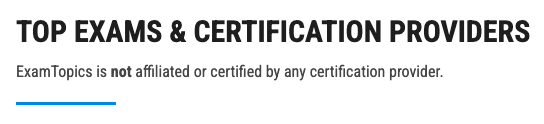
In this screenshot the company states plainly that they are not affiliated or certified by any certification provider. Reading between the lines, the message is ‘caveat emptor’ or ‘buyer beware’. They are telling you upfront that they are in the business of selling exam questions and make no guarantees about their products.

Screenshot #3: Samples of accreditation exam questions for sale

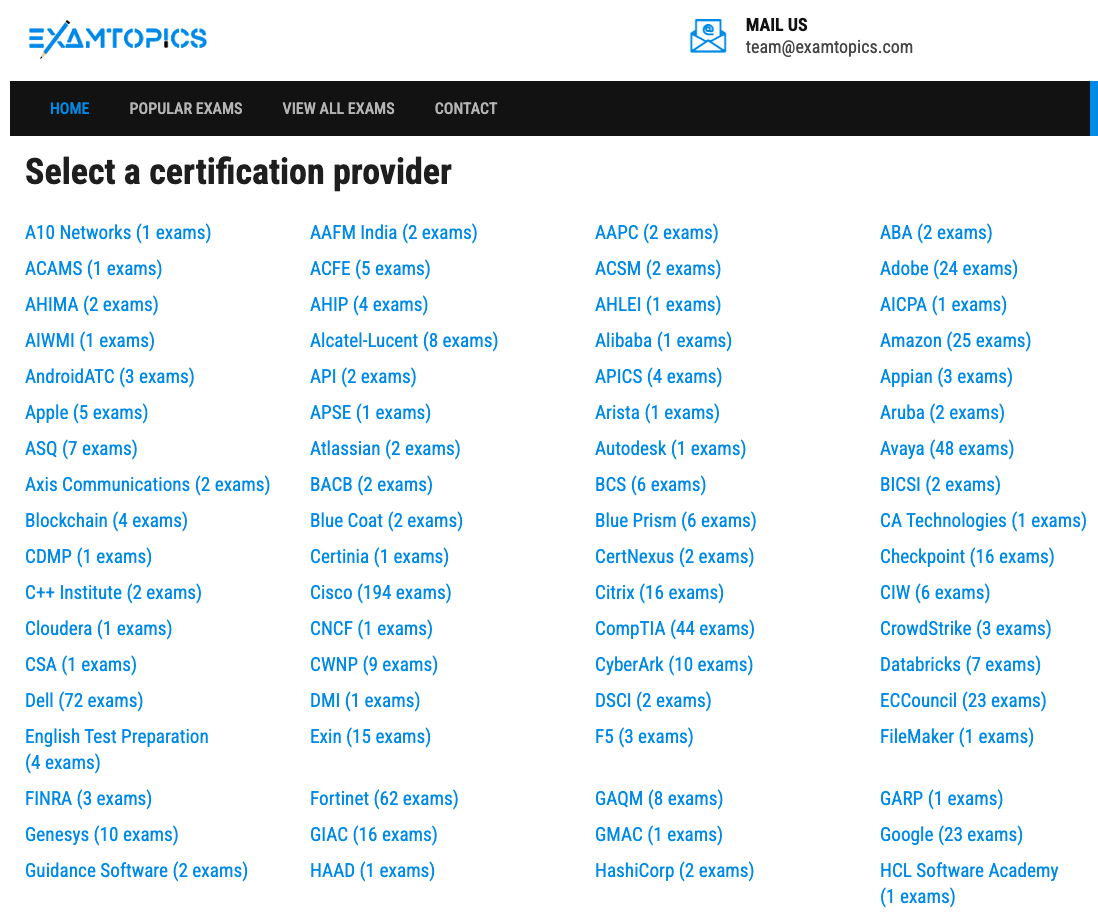
A website screenshot. White background. Black task bar with light grey text. There are lists of texts written in blue.

Look at all the options: You can buy exam questions for certifications offered by DELL, English language proficiency exams, Citrix, Adobe, and Amazon, and Google just to name a few. 

Screenshot #4: More samples of certification provider exam questions for sale.

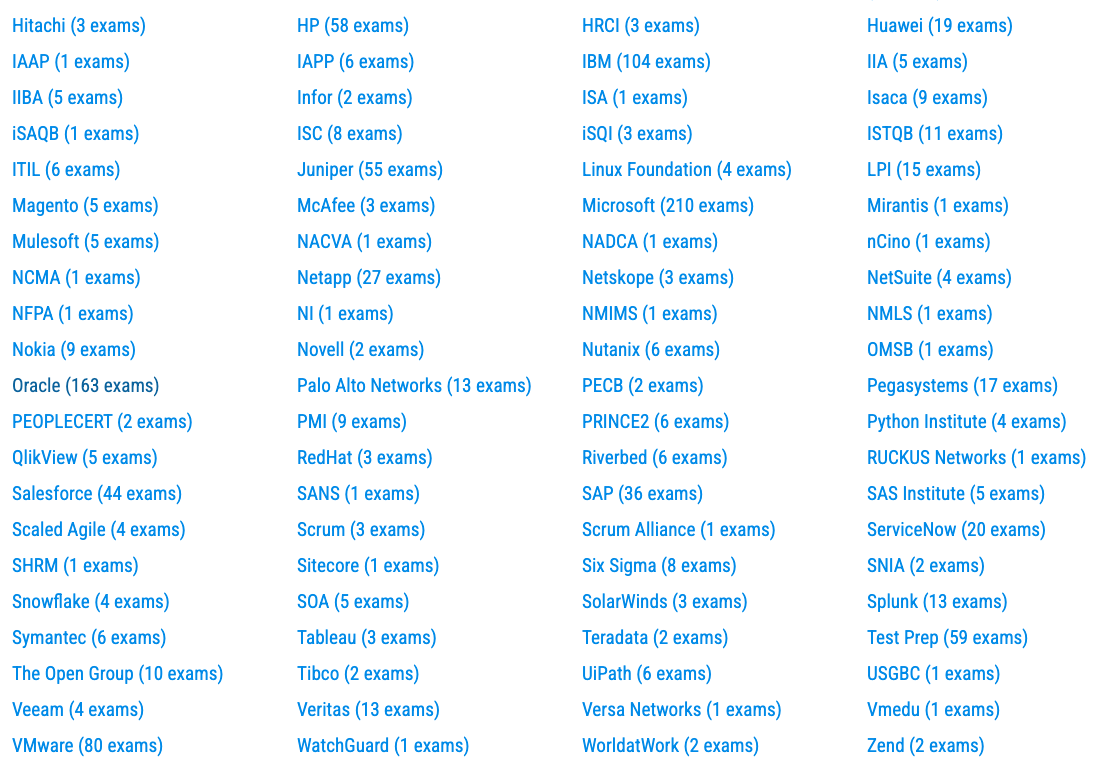
A website screenshot. White background. Black task bar with light grey text. There are lists of texts written in blue.

But wait! There’s more! You can buy exam questions for certifications offers by Oracle, IBM, SAP, and others.

Assessment Security

Sites like compromise the assessment security of certification exams that are meant to qualify individuals to do a particular job. If this term is new to you, I recommend Professor Phill Dawson’s book, Defending Assessment Security in a Digital World. For a quick (and free) overview, of Phill’s work, this slide deck from one of his presentations is worth checking out.

Businesses that buy and sell exam certification questions engage in fraudulent practices undermine trust in the certification system and create significant risks for employers.

Consequences for Employers

Hiring someone with counterfeit credentials can have dire consequences. Unqualified employees may lack the technical skills to handle complex tasks, leading to project delays, costly errors, or even security breaches. Beyond the financial impact, fraudulent certifications can erode team morale, as employees with genuine qualifications may feel undervalued when working alongside those who faked their way in.

What Employers and Hiring Managers can Do

Employers, and especially hiring managers and those working in HR, must take proactive steps to safeguard their hiring processes. Some of you may be asking if this kind of practice is actually illegal. I’m not a lawyer, but what I can say is that although contact cheating for students is illegal in countries like Australia, the UK, and Ireland, if you’re not a student, then you might get to live a proverbial grey zone. To the best of my knowledge, it is not actually illegal to buy and sell questions for professional certification exams in most countries of the world.

So, what can employers do? First, trust but verify! Verifying certifications directly with issuing organizations is one step. Many certification bodies offer easy online verification tools to confirm a candidate’s credentials. Additionally, employers should stay informed about recognized accreditation standards and avoid unverified institutions. 

Having said this, verification of credentials and certification won’t help if someone has bought exam questions online and then taken the test themselves. Their results could be ‘verifiable’ in a sense, because there’s an assumption that a person who has passed an exam had the knowledge to do so. But when someone buys their exam questions before sitting the test, it means that they have prepared for an exam and may not necessarily have internalized the knowledge or skills that should match the certification they receive from passing an exam. An exam is one measure of knowledge, but it isn’t the only one. 

Having prospective employees demonstrate their skills and respond to technical questions that could only be answered if the person has the knowledge to back up their documentation can also help. One possibility is to give an interviewee a real-world scenario that could happen at your organization. Ask them how they would go about problem-solving it. If they struggle or stumble, it could be a sign that they lack the necessary skills for the job. (It could also be a sign that they’re just nervous or that interviewing isn’t their strength. So let me also make a plug here for having an inclusive and equitable interviewing process.)

Investing in robust, inclusive, and equitable hiring practices not only protects an organization from the pitfalls of fraud but also helps to create a culture of accountability and excellence. By placing a premium on authentic certifications combined with demonstrable knowledge and skills and inclusive hiring practices, employers signal their commitment to integrity and ensure they are building a team of qualified professionals.

Bottom line: If you’re hiring someone who says they have an IT certification based on taking exams, it’s worth it to find out if they actually have the knowledge and skills to do the job. 

And this is just one example of one site. Rest assured that it is not the only one out there. Exam cheating companies like this one don’t exist in isolation. They’re in the game to make money, and lots of it. 

In an industry where skills and knowledge drive success, vigilance against certification and accreditation fraud is not optional—it is a driver of success.

Future Outlook

Fraud and corruption are alive and well education and industry. There is a growing community of sleuths, scholars, and activists who are ready to sniff out fraud and expose it and naïveté about these matters is quickly going out of fashion. 

There may have been a time when it was acceptable—or even fashionable—to clutch your pearls, proclaim moral outrage, or just refuse to accept that educational and professional fraud are more commonplace than you might have previously thought. GenAI is here to stay, and so are companies whose business is educational, accreditation, scientific, and professional fraud. These companies are profitable because they have customers willing to pay for their goods and services.

Vigilance, sleuthing, and exposing fraud are very much on trend as we move ahead into the new year. And if you’re a hiring manager, taking steps to protect the integrity of your operations is definitely part of the job in 2025 and beyond.

References and Further Reading

Carmichael, J. (2023, June 7). Understanding Fake Degrees and Credential Fraud in Higher Ed. The Evollution: A Modern Campus Illumination. https://evolllution.com/programming/credentials/understanding-fake-degrees-and-credential-fraud-in-higher-ed/

Eaton, S. E., & Carmichael, J. (2022). The Ecosystem of Commercial Academic Fraud. In. Calgary, Canada: University of Calgary. https://dx.doi.org/10.11575/PRISM/40330

Eaton, S. E., Carmichael, J., & Pethrick, H. (Eds.). (2023). Fake degrees and credential fraud in higher education. Springer. https://doi.org/10.1007/978-3-031-21796-8

Related posts

________________________

Share this post: Accreditation and Certification Fraud in IT – https://drsaraheaton.com/2024/12/27/accreditation-and-certification-fraud-in-the-it-world/

This blog has had over 3 million views thanks to readers like you. If you enjoyed this post, please “like” it or share it on social media. Thanks!

Sarah Elaine Eaton, PhD, is a Professor and Research Chair in the Werklund School of Education at the University of Calgary, Canada. Opinions are my own and do not represent those of my employer. 


Book launch: Fake Degrees and Fraudulent Credentials in Higher Education

March 7, 2023

Carleton University Innovation Hub is pleased to host this public event.

Fake Degrees and Fraudulent Credentials in Higher Education

Join editors/authors Sarah Elaine Eaton, Jamie J. Carmichael, and Helen Pethrick in the Innovation Hub on Friday March 24, 2023 for the launch of their new book Fake Degrees and Fraudulent Credentials in Higher Education. This hybrid event will feature reading from the book and continue an important conversation facing many people in the world today.

Event Date: March 24th, 11:00 am – 12:00 (Eastern Standard Time)  

Event Location: Innovation Hub, 2020 Nicol Building, Carleton University or online

Hybrid Option:  A zoom Link will be provided via email to event registrants.

For more information or to register – https://carleton.ca/innovationhub/book-launch/

Related posts

_________________________________

Share or Tweet this: Book launch: Fake Degrees and Fraudulent Credentials in Higher Education https://wp.me/pNAh3-2SD

This blog has had over 3 million views thanks to readers like you. If you enjoyed this post, please “like” it or share it on social media. Thanks!

Sarah Elaine Eaton, PhD, is a faculty member in the Werklund School of Education, and the Educational Leader in Residence, Academic Integrity, University of Calgary, Canada. Opinions are my own and do not represent those of the University of Calgary.