Research Integrity Oversight in Canada: A Postplagiarism Perspective

April 11, 2026

The Canadian Panel on Responsible Conduct of Research (PRCR) is proposing substantive changes to Canada’s research integrity framework, and the public comment window closes April 17, 2026. If you care about research ethics in this country, you have days left to weigh in.

I want to flag a few things about these proposed changes and why they matter to those of us working in postplagiarism research.

The most consequential proposal is the removal of any statute of limitations on allegations of research misconduct. As attorney Minal Caron told Retraction Watch, the existing policy is silent on this question. The proposed language would require institutions to review allegations regardless of how much time has passed since the work was published, which would be a significant shift. It’s also a long-overdue one. Complainants often delay coming forward out of fear of retaliation, and a policy that turns away allegations on procedural grounds protects no one except those who benefit from institutional inaction.

The PRCR also proposes to require institutions to hold respondents accountable even after they have left, and to accept anonymous allegations and allegations already circulating in the public domain as grounds for review. These aren’t radical ideas. They’re basic conditions for a credible oversight system.

I’ve written and spoken at length about how postplagiarism requires us to rethink accountability in an age of AI. But accountability without enforcement infrastructure is a philosophical position, not a policy. These proposed changes represent a concrete attempt to build infrastructure. They will not resolve every tension in Canadian research oversight, and the critics quoted in the article are right to flag gaps, particularly around the vagueness of institutional RCR education requirements.

One of the scholars quoted in the Retraction Watch piece is Gengyan Tang, a PhD candidate and a member of our Postplagiarism Research Lab, who studies research integrity policy. His observation that the proposed language around RCR education is too ambiguous is precise and fair. Institutions can host an ‘Academic Integrity Week’ and check a compliance box without delivering anything substantive. Policies that do not specify how education is to be delivered or evaluated leave too much room for performative compliance.

The Pruitt case, cited in the article as a catalyst for some of this reform momentum, is worth naming directly. Jonathan Pruitt was found to have fabricated and falsified data. The case exposed how the 2011 framework’s absence of relevant procedures allowed institutions to deflect rather than investigate. Requiring institutions to act regardless of elapsed time or an individual’s current affiliation is a direct response to that failure.

Postplagiarism, as a framework, asks us to think past the categories we have inherited. The academic integrity arms race that I have discuss in my research applies just as much to research misconduct oversight as it does to student cheating. Detection tools, policies, and procedures are only as good as the institutional will to apply them rigorously. These proposed changes push toward compulsion rather than discretion, which warrants close attention.

The comment period is open until April 17, 2026. If you work in research integrity, this is your chance: read the proposed revisions and submit feedback.

__________

Reposted from: Research Integrity Oversight in Canada: A Postplagiarism Perspective – https://postplagiarism.com/2026/04/11/research-integrity-oversight-in-canada-a-postplagiarism-perspective/


Neuralink’s Clinical Trials in Canada

January 11, 2025

Last month CBC’s Geoff Leo did a great article on called, ‘No consequences’, for violating human rights in privately funded research in Canada. This was a bit of an eye opener, even for me.

He writes that, “Roughly 85 per cent of clinical trials in Canada are privately funded” and that research undergoes very little scrutiny by anyone.

One of the cases Geoff wrote about involved a research study that ran from 2014-2016 involving Indigenous children in Saskatchewan, aged 12-15, who were research subjects in a study that monitored their brainwaves. Student participants were recruited with the help of a Canadian school board.

The study was led by James Hardt, who runs something called the Biocybernaut Institute, a privately run business. According to Leo, James Hardt claims that “brainwave training can make participants smarter, happier and enable them to overcome trauma. He said it can also allow them to levitate, walk on water and visit angels.”

Geoff Leo digs deep into some of the ethical issues and I recommend reading his article.

So, that was last month. This month, I happened to notice that according to Elon Musk’s Neuralink website, Musk’s product has now been approved by Health Canada to recruit research participants. There’s a bright purple banner at the top of the Neuralink home page showing a Canadian flag that says, “We’ve received approval from Health Canada to begin recruitment for our first clinical trial in Canada”.

A screenshot of the Neuralink.com home page. On the bottom right is a blurred photo of a man wearing a ball cap, who appears to be in a wheelchair and using tubes as medical assistance. There is white text on the right-hand side. At the top is a purple banner with white text and a small Canadian flag.

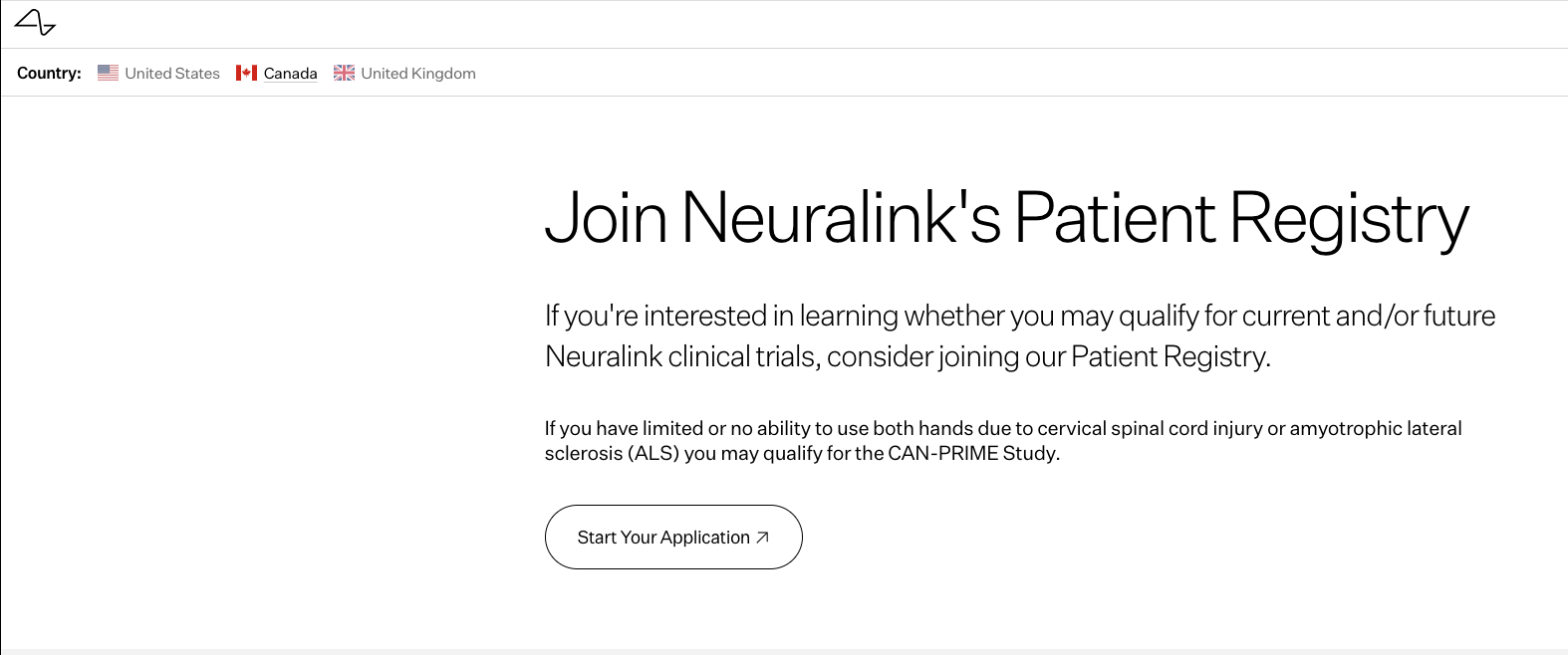
When you click on the link, you get to another page that shows the flags for the US, Canada, and the UK, where clinical trials are either underway or planned, it seems.

A screenshot of a webpage from the Neuralink web site. It has a white background with black text. In the upper left-hand corner there are three small flags, one each for the USA, Canada, and the UK.

The Canadian version is called CAN-PRIME. There’s a YouTube video promo/recruitment video for patients interested in joining, “this revolutionary journey”.

According to the website, “This study involves placing a small, cosmetically invisible implant in a part of the brain that plans movements. The device is designed to interpret a person’s neural activity, so they can operate a computer or smartphone by simply intending to move – no wires or physical movement are required.”

A screenshot from the Neuralink web page. The background is grey with black text.

So, just to connect the dots here… ten years ago in Canada there was a study involving neurotechnology that “exploited the hell out of” Indigenous kids, according to Janice Parente who leads the Human Research Standards Organization

Now we have Elon Musk’s company actively recruiting people from across Canada, the US, and the UK, for research that would involve implanting experimental technology into people’s brains without, it seems, much research ethics oversight at all.

What could possibly go wrong?

Reference

Leo, G. (2024, December 2). ‘No consequences’ for violating human rights in privately funded research in Canada, says ethics expert. https://www.cbc.ca/news/canada/saskatchewan/ethics-research-canada-privately-funded-1.7393063

________________________

Share this post: Neuralink’s Clinical Trials in Canada – https://drsaraheaton.com/2025/01/11/neuralinks-clinical-trials-in-canada/

This blog has had over 3.7 million views thanks to readers like you. If you enjoyed this post, please ‘Like’ it using the button below or share it on social media. Thanks!

Sarah Elaine Eaton, PhD, is a Professor and Research Chair in the Werklund School of Education at the University of Calgary, Canada. Opinions are my own and do not represent those of my employer.