Consequences of Teacher Cheating: A Canadian Case Study

July 3, 2026

A British Columbia arbitrator recently confirmed what the Vernon School District 22 board decided in 2024: Tasha Whitney, a continuing contract teacher at W. L. Seaton Secondary School, will not return to the classroom (Assman, 2026b). The arbitrator dismissed the union’s grievance and upheld her termination for cause. The ruling offers a case study in how academic integrity violations by educators differ from those committed by students, and why the consequences differ, too.

The facts, as reported by Assman (2026a, 2026b), are straightforward. Whitney invigilated a mandatory Grade 12 literacy assessment in June 2024. When one student, identified as CD, joked about having someone else write his exam, Whitney suggested other students who might do it. On the day of the exam, another student, AB, used CD’s login credentials to complete both his own assessment and CD’s, running out the clock on one screen with a video game while completing the other exam on a second screen. Whitney signed documents certifying that both students had written their own assessments. When a colleague noticed the irregularity, Whitney fabricated an explanation. She continued to minimize her role throughout the district investigation and the arbitration hearing that followed.

The arbitrator’s reasoning matters as much as the outcome. Had Whitney told the truth from the outset, the arbitrator indicated that termination would have been excessive; the district could have treated the incident as a serious error made under personal strain, with progressive discipline restoring her employment (Assman, 2026b). The union presented medical evidence that Whitney had experienced post-traumatic stress disorder and anxiety following a violent workplace incident in October 2023, and a psychiatric assessment acknowledged that this anxiety likely affected her decision-making. The assessment found no causal link between the diagnosis and the fraudulent conduct itself. Dishonesty, sustained over months and through a formal investigation, severed the trust her employment required.

This distinction between error and deceit connects to an argument I make with my co-author Zeenath Reza Khan in our own work on ethics in teacher training. Zeenath and I contend that teacher training programs must include explicit instruction in ethical decision-making, not compliance training alone, because teachers model integrity for the students in their care (Eaton & Khan, 2022). The arbitrator’s finding in the Whitney case reflects this same principle, holding that facilitating cheating violated Whitney’s fiduciary duty to model ethical behaviour for the youth in her charge (Assman, 2026b).

A student who cheats on an exam violates a rule. A teacher who helps a student cheat, then invigilates the fraud, signs false certification documents, and misleads colleagues and investigators, violates the basis on which the school entrusts her with that role. I have written, with Zeenath Reza Khan, that academic integrity education for pre-service teachers remains inconsistent internationally, with many programs offering little beyond a brochure or a single workshop (Eaton & Khan, 2022). The Whitney case suggests what happens when that gap is left unaddressed at the level of professional judgement, particularly when a person under stress reaches for concealment rather than disclosure.

The arbitrator’s finding leaves a narrow but clear lesson for the profession: honesty in the aftermath of a mistake changes what an institution can offer in response. Whitney’s initial decision to encourage a workaround may have originated in a lapse of judgement. Her subsequent choice to lie repeatedly, to a colleague, to school administrators, and to an independent investigator, closed the door that honesty could have left open.

References

Assman, B. (2026a, February 10). Vernon teacher fired for helping student cheat on an exam. Castanet. https://www.castanet.net/news/Vernon/598708/Vernon-teacher-fired-for-helping-student-cheat-on-an-exam

Assman, B. (2026b, June 23). Vernon teacher’s firing upheld, after facilitating exam cheating and lying to cover it up. Castanet. https://www.castanet.net/news/Vernon/621104/Vernon-teacher-s-firing-upheld-after-facilitating-exam-cheating-and-lying-to-cover-it-up

Eaton, S. E., & Khan, Z. R. (2022). Ethics in teacher training: An overview. In S. E. Eaton & Z. R. Khan (Eds.), Ethics and integrity in teacher education (pp. 1–11). Springer. https://doi.org/10.1007/978-3-031-16922-9_1

___________

Share this post – Consequences of Teacher Cheating: A Canadian Case Study https://drsaraheaton.com/2026/07/03/consequences-of-teacher-cheating-a-canadian-case-study/

Sarah Elaine Eaton, PhD, is a Professor and Research Chair in the Werklund School of Education at the University of Calgary, Canada. Opinions are my own and do not represent those of my employer.


Fake Degrees, Fraudulent Credentials and the Ecosystem of Commercial Academic Fraud

April 10, 2025

Since 2020 I’ve been working with a number of collaborators on projects related to fake degrees, diploma mills, and credential fraud. One of the people I have had the privilege of working with is FBI Special Agent (ret.), Allen Ezell, who is one of the world’s leading experts on  fake degrees and accreditation fraud. 

I’ve spent countless hours on the phone with Allen and have exchanged dozens, if not hundreds, of e-mails with him, over the years. Now in his 80s, Allen is one of the world’s finest experts on the topic. He contributed a fascinating chapter called “Yesterday, today, and tomorrow: A tour of Axact, the ‘World’s Largest Diploma Mill’” to our book, Fake Degrees and Fraudulent Credentials in Higher Education

We also learned from other contributors to the book that the companies who sell fake credentials don’t stop there. They can also provide contact cheating services (often under the guise of ‘research services’), fake admission letters, fake transcripts, fraud in standardized testing (e.g., sending impersonators to write English language proficiency tests), and much more. 

In the introduction for the book, we connect the dots to show how admissions fraud, contract cheating (e.g., term paper mills), scientific and scholarly paper mills, and fake degrees and fraudulent credentials are all connected. We synthesize the key ideas in this infographic:

Diagram titled "The Ecosystem of Commercial Academic Fraud" by Eaton & Carmichael (2022), showing four overlapping colored circles, each representing a type of academic fraud, with "Fraud" in the center where all circles overlap. The categories are: Degree Mills (red): Fake and fraudulent diplomas, transcripts, reference letters, and other academic and professional documents. Contract Cheating (orange): Outsourced student academic work including term paper mills, assignment completion services, thesis writing services, and student proxy services. Admissions Fraud (green): Impersonation and fraud services for standardized admissions testing (e.g., SATs), language proficiency testing, and unethical educational agents. Paper Mills (blue): Manufactured scholarly and scientific publications, authorship for sale. Each category overlaps in the center to show they are part of a broader ecosystem of fraud. The image includes a citation and Creative Commons license at the bottom.

It is difficult to get a handle on the exact size and scope of the industry, but based on what we know, we estimated that the industry is worth at least $21 Billion USD, and we figure that is a low estimate.

Throughout the past half-decade, we’ve developed a number of resources related to these topics. I’ve posted about them previously, but I figured it might be helpful if I gathered some of them into a single blog post. They are all freely available as open access resources.

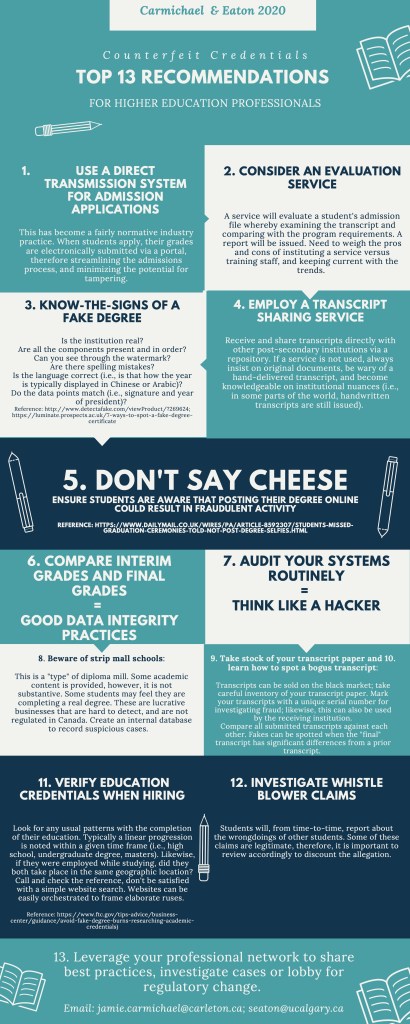
Counterfeit Credentials: 13 Recommendations for Higher Education Professionals

Infographic titled "Counterfeit Credentials: Top 13 Recommendations for Higher Education Professionals" by Carmichael & Eaton (2020). It offers guidance to help institutions detect and prevent the use of fake degrees and fraudulent documents in admissions and hiring. The recommendations are:
1.	Use a direct transmission system for admission applications – Electronic grade submissions reduce tampering.
2.	Consider an evaluation service – Evaluate transcripts against program requirements.
3.	Know the signs of a fake degree – Check for authenticity, spelling, watermarks, correct language, matching data points.
4.	Employ a transcript sharing service – Use secure repositories or verify hand-delivered transcripts.
5.	Don't say cheese – Warn students not to post degrees online due to risk of fraud.
6.	Compare interim and final grades – Ensures data integrity.
7.	Audit your systems routinely – Think like a hacker to uncover weaknesses.
8.	Beware of strip mall schools – Diploma mills that mimic real institutions; create internal databases for tracking.
9.	Take stock of your transcript paper – Use serial numbers and compare for inconsistencies.
10.	Learn how to spot a bogus transcript – Identify fakes by comparing submitted transcripts.
11.	Verify education credentials when hiring – Check for linear academic progression and verify references beyond website searches.
12.	Investigate whistleblower claims – Some student reports may be legitimate and need proper review.
13.	Leverage your professional network – Share practices, investigate cases, or lobby for change.
References and contact emails (jamie.carmichael@carleton.ca; seaton@ucalgary.ca) are included for further information.

This infographic is intended mainly for registrars, admissions staff, admissions committees and others whose work involves assessing the credentials of applicants for university and college programs. 

Scholarships Without Scruples

In this infographic, Jamie Carmichael and I share signs of scholarship scams, which is one from of educational fraud:

Infographic titled “Scholarships Without Scruples – 3 Signs of Scholarship Scams.” Credit Card Required: Don’t give out your credit card number. Legitimate scholarship applications never ask for this information. Discount in Disguise: You should not have to buy anything to receive a scholarship. Legit scholarships never require payment for goods or services. Tax Trickery: Legit scholarships are taxed differently than earned income. If proper tax documentation isn’t provided, it may not be a real scholarship. At the bottom: “Find out more” – Contact information for Sarah Elaine Eaton (University of Calgary, seaton@ucalgary.ca) and Jamie Carmichael (Carleton University, Jamie.Carmichael@Carleton.ca). Footer text: “Scholarship scams are real. Learn how to protect yourself!”

When it comes to education fraud, there are many angles to consider. There is certainly a need for more research, awareness, and advocacy on these topics, especially as GenAI can make these types of fraud easier.

Below are some related posts and further resources that I hope you find helpful.

Related posts

References and Resources

  • Carmichael, J. (2023, June 7). Understanding Fake Degrees and Credential Fraud in Higher Ed. The Evollution: A Modern Campus Illumination. https://evolllution.com/programming/credentials/understanding-fake-degrees-and-credential-fraud-in-higher-ed/
  • Carmichael, J. J. (2024). Reframing and Broadening Adversarial Stylometry for Academic Integrity. In S. E. Eaton (Ed.), Second Handbook of Academic Integrity (pp. 1467-1485). Springer Nature Switzerland. https://doi.org/10.1007/978-3-031-54144-5_148 
  • Carmichael, J., & Eaton, S. E. (2020). Counterfeit Credentials: Top 13 Recommendations for Higher Education Professionals (Infographic). University of Calgary. http://hdl.handle.net/1880/113042 
  • Clark, A. (2023). Examining the problem of fraudulent English test scores: What can Canadian higher education institutions learn? In S. E. Eaton, J. J. Carmichael, & H. Pethrick (Eds.), Fake Degrees and Fraudulent Credentials in Higher Education (pp. 187-207). Springer International Publishing. https://doi.org/10.1007/978-3-031-21796-8_9 
  • Çelik, Ö., & Razı, S. (2023). Avoiding favouritism in the recruitment practice of Turkish higher education institutions. In S. E. Eaton, J. J. Carmichael, & H. Pethrick (Eds.), Fake Degrees and Fraudulent Credentials in Higher Education (pp. 153-167). Springer International Publishing. https://doi.org/10.1007/978-3-031-21796-8_7 
  • DeCoster, B. (2023). There is no culture? A framework for addressing admissions fraud. In S. E. Eaton, J. J. Carmichael, & H. Pethrick (Eds.), Fake Degrees and Fraudulent Credentials in Higher Education (pp. 209-226). Springer International Publishing. https://doi.org/10.1007/978-3-031-21796-8_10 
  • Duklas, J. (2023). Bridging to tomorrow: A historical and technological review of credential exchange in higher education within Canada. In S. E. Eaton, J. J. Carmichael, & H. Pethrick (Eds.), Fake Degrees and Fraudulent Credentials in Higher Education (pp. 95-113). Springer International Publishing. https://doi.org/10.1007/978-3-031-21796-8_4
  • Eaton, S. E., & Carmichael, J. (2020). Scholarships without scruples (Infographic). University of Calgary: http://hdl.handle.net/1880/113044
  • Eaton, S. E., & Carmichael, J. (2022). The Ecosystem of Commercial Academic Fraud. University of Calgary. https://dx.doi.org/10.11575/PRISM/40330
  • Eaton, S. E., Carmichael, J., & Pethrick, H. (Eds.). (2023). Fake degrees and credential fraud in higher education. Springer. https://doi.org/10.1007/978-3-031-21796-8
  • Ezell, A. (2023). Yesterday, today, and tomorrow: A tour of Axact, the “World’s Largest Diploma Mill”. In S. E. Eaton, J. J. Carmichael, & H. Pethrick (Eds.), Fake Degrees and Fraudulent Credentials in Higher Education (pp. 49-94). Springer International Publishing. https://doi.org/10.1007/978-3-031-21796-8_3 
  • Hextrum, K. (2023). Fair play, fraud, or fixed? Athletic credentials in U.S. higher education. In S. E. Eaton, J. J. Carmichael, & H. Pethrick (Eds.), Fake Degrees and Fraudulent Credentials in Higher Education (pp. 115-132). Springer International Publishing. https://doi.org/10.1007/978-3-031-21796-8_5
  • Orim, S.-M., & Glendinning, I. (2023). Corruption in admissions, recruitment, qualifications and credentials: From research into quality assurance. In S. E. Eaton, J. J. Carmichael, & H. Pethrick (Eds.), Fake Degrees and Fraudulent Credentials in Higher Education (pp. 133-151). Springer International Publishing. https://doi.org/10.1007/978-3-031-21796-8_6
  • Sabbaghan, S., & Fazel, I. (2023). None of the above: Integrity concerns of standardized English proficiency tests. In S. E. Eaton, J. J. Carmichael, & H. Pethrick (Eds.), Fake Degrees and Fraudulent Credentials in Higher Education (pp. 169-185). Springer International Publishing. https://doi.org/10.1007/978-3-031-21796-8_8

–——–-

Share this post: Fake Degrees, Fraudulent Credentials and the Ecosystem of Commercial Academic Fraud – https://drsaraheaton.com/2025/04/10/fake-degrees-fraudulent-credentials-and-the-ecosystem-of-commercial-academic-fraud/

This blog has had over 3.7 million views thanks to readers like you. If you enjoyed this post, please ‘Like’ it using the button below or share it on social media. Thanks!

Sarah Elaine Eaton, PhD, is a Professor and Research Chair in the Werklund School of Education at the University of Calgary, Canada. Opinions are my own and do not represent those of my employer.