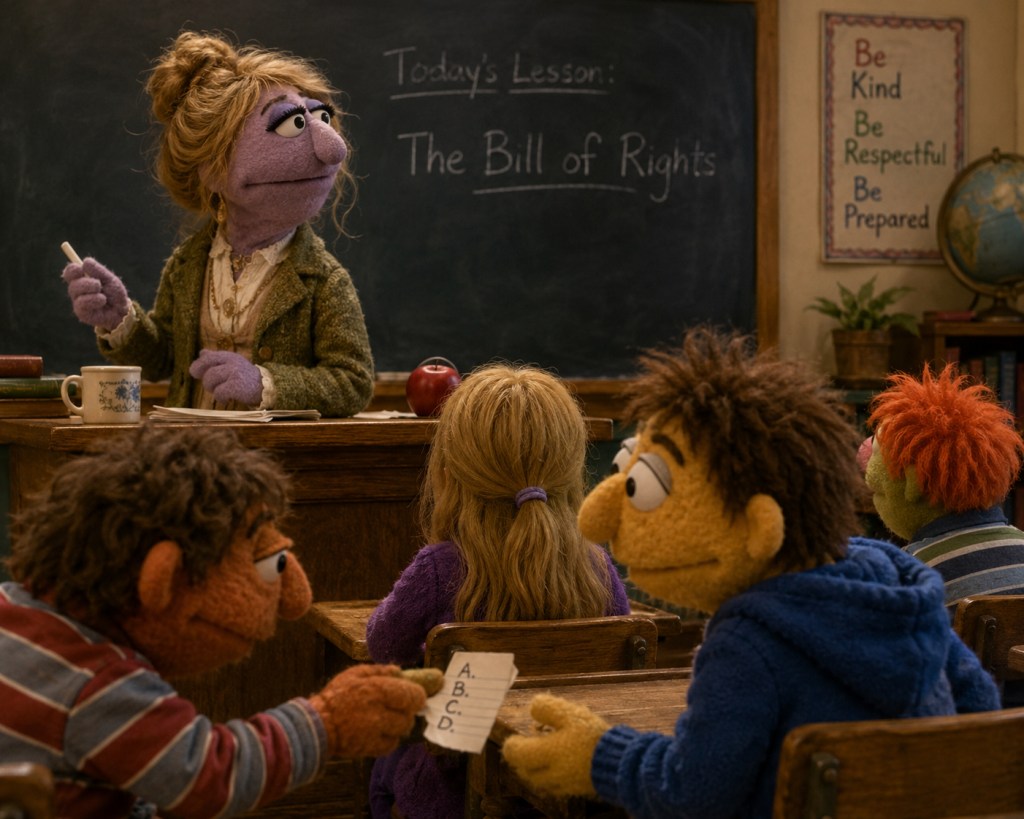
A British Columbia arbitrator recently confirmed what the Vernon School District 22 board decided in 2024: Tasha Whitney, a continuing contract teacher at W. L. Seaton Secondary School, will not return to the classroom (Assman, 2026b). The arbitrator dismissed the union’s grievance and upheld her termination for cause. The ruling offers a case study in how academic integrity violations by educators differ from those committed by students, and why the consequences differ, too.
The facts, as reported by Assman (2026a, 2026b), are straightforward. Whitney invigilated a mandatory Grade 12 literacy assessment in June 2024. When one student, identified as CD, joked about having someone else write his exam, Whitney suggested other students who might do it. On the day of the exam, another student, AB, used CD’s login credentials to complete both his own assessment and CD’s, running out the clock on one screen with a video game while completing the other exam on a second screen. Whitney signed documents certifying that both students had written their own assessments. When a colleague noticed the irregularity, Whitney fabricated an explanation. She continued to minimize her role throughout the district investigation and the arbitration hearing that followed.
The arbitrator’s reasoning matters as much as the outcome. Had Whitney told the truth from the outset, the arbitrator indicated that termination would have been excessive; the district could have treated the incident as a serious error made under personal strain, with progressive discipline restoring her employment (Assman, 2026b). The union presented medical evidence that Whitney had experienced post-traumatic stress disorder and anxiety following a violent workplace incident in October 2023, and a psychiatric assessment acknowledged that this anxiety likely affected her decision-making. The assessment found no causal link between the diagnosis and the fraudulent conduct itself. Dishonesty, sustained over months and through a formal investigation, severed the trust her employment required.
This distinction between error and deceit connects to an argument I make with my co-author Zeenath Reza Khan in our own work on ethics in teacher training. Zeenath and I contend that teacher training programs must include explicit instruction in ethical decision-making, not compliance training alone, because teachers model integrity for the students in their care (Eaton & Khan, 2022). The arbitrator’s finding in the Whitney case reflects this same principle, holding that facilitating cheating violated Whitney’s fiduciary duty to model ethical behaviour for the youth in her charge (Assman, 2026b).
A student who cheats on an exam violates a rule. A teacher who helps a student cheat, then invigilates the fraud, signs false certification documents, and misleads colleagues and investigators, violates the basis on which the school entrusts her with that role. I have written, with Zeenath Reza Khan, that academic integrity education for pre-service teachers remains inconsistent internationally, with many programs offering little beyond a brochure or a single workshop (Eaton & Khan, 2022). The Whitney case suggests what happens when that gap is left unaddressed at the level of professional judgement, particularly when a person under stress reaches for concealment rather than disclosure.
The arbitrator’s finding leaves a narrow but clear lesson for the profession: honesty in the aftermath of a mistake changes what an institution can offer in response. Whitney’s initial decision to encourage a workaround may have originated in a lapse of judgement. Her subsequent choice to lie repeatedly, to a colleague, to school administrators, and to an independent investigator, closed the door that honesty could have left open.
References
Assman, B. (2026a, February 10). Vernon teacher fired for helping student cheat on an exam. Castanet. https://www.castanet.net/news/Vernon/598708/Vernon-teacher-fired-for-helping-student-cheat-on-an-exam
Assman, B. (2026b, June 23). Vernon teacher’s firing upheld, after facilitating exam cheating and lying to cover it up. Castanet. https://www.castanet.net/news/Vernon/621104/Vernon-teacher-s-firing-upheld-after-facilitating-exam-cheating-and-lying-to-cover-it-up
Eaton, S. E., & Khan, Z. R. (2022). Ethics in teacher training: An overview. In S. E. Eaton & Z. R. Khan (Eds.), Ethics and integrity in teacher education (pp. 1–11). Springer. https://doi.org/10.1007/978-3-031-16922-9_1
___________
Share this post – Consequences of Teacher Cheating: A Canadian Case Study https://drsaraheaton.com/2026/07/03/consequences-of-teacher-cheating-a-canadian-case-study/
Sarah Elaine Eaton, PhD, is a Professor and Research Chair in the Werklund School of Education at the University of Calgary, Canada. Opinions are my own and do not represent those of my employer.


 Posted by Sarah Elaine Eaton, Ph.D.


You must be logged in to post a comment.