How to market your language or literacy program: Build trust over time

October 30, 2011

If you send prospective students a brochure or answer an e-mail, they are not very likely to register in your program. Here’s why…

Marketers tell us that we need to see an advertisement or hear a message at least seven times before we are likely to buy a product. Sales professionals say that it can take anywhere between five and 27 “touches” or contact with a prospective buyer before they are convinced to make a purchase from you.

What does that mean for language programs and literacy organizations? It means that we can not simply send out a brochure to a student and reasonable expect that suddenly he or she will want to register in our program.

The “drip theory” recommends regular, repeated contact – at least six or seven times – with a prospect to ensure that your name sticks in her mind. This does not mean sending out six or seven copies of the same brochure! There is a difference between “dripping” and “bombarding” or worse yet, “stalking”.

Each “touch” needs to be different — and still relevant. For example, connecting via e-mail, followed by sending a brochure, followed a week later by an invitation to register, followed by a couple of monthly newsletters.

The timing of each contact is also important. Bombarding someone in seven different ways in a very short period of time is more likely to turn them off than to convince them that they want to join your program. There is no one perfect formula for how often you should connect with your prospects… Once a week or a few times a week seems to be an accepted norm in the educational and non-profit sectors. There seems to be a lower tolerance for repeated contact in a short period of time with prospects in the social sectors than there is in the business sectors.

In my PhD research, I found that it can take anywhere from two to five years to get a new language program off the ground. That is the “sales cycle” for English as an Additional Language (ESL / EFL / EAL / ESOL) programs. It can also take up to two years to convert a prospective student into a current student.

In Guerrilla Marketing for NonProfits, authors Jay Conrad Levinson, Frank Adkins and Chris Forbes talk about how non-profit organizations often give up too soon. They expect to see results NOW. If they do not get an immediate response (which is highly unlikely) they give up. In fact, they say that most non-profits give up on new programs just before they hit the point of success.

If you get an e-mail address for the prospect and you can send monthly updates about what is going on in your program, you will be using yet another medium to show your prospects that you have not forgotten about them.

Ideally, you want to combine different types of contact: social media, mail, e-mail, phone calls and personal contact. This is not always easy in an international marketplace, but do try for repeated contact in a variety of ways.

If you don’t get any response after several tries, then you can change the prospect from active to inactive in your database. In any case, you are more likely to get more registrants by using the drip effect than by sending an initial brochure and nothing else.

Here are seven ways to help you market your language or literacy program consistently

1) List all of the methods you use to connect with your prospective learners (phone, e-mail, drop-in, brochures, etc.).

2) Set up a spreadsheet with each method of contact across the top.

3) Every time a prospect contacts you, ask for his or her contact information.

4) Note the date that you made contact under the appropriate column.

5) Make an effort to stay in touch with the prospective learner, at least once a week, using a different method each time.

6) If a prospective student shows a preference for a particular type of communication, use that one more often. For example, if a prospective student does not respond to e-mails, but calls or Skypes, then make a note of it. At least once, take the initiative to connect with the prospect in the way that they prefer. It’s about them, after all.

7) Track how many prospective students actually end up enrolling in your program and how long it takes. You may be surprised to find that it take  longer than you think it will, or longer than you would like it to. This does not mean that should try to accelerate that cycle. That can often backfire and turn prospects off. It is useful, however, to show you how long prospective learners may take to make a decision.

It’s not about trying to force them to make a decision faster. It is about cultivating trust and building a relationship with them so that when they are ready to make a decision, they choose your program because they feel that they know you and that you care about them. When the time comes for them to make their decision, trust will often be the factor that sways people one way or another. If you haven’t built the trust with them over time, they may never register. That takes time. In the long run, it is worth it.

___________________

This post is adapted from “Idea #17: Be a Drip ” in 101 Ways to Market Your Language Program

________________

Share or Tweet this post: How to market your language or literacy program: Build trust over time http://wp.me/pNAh3-wx

Update – January 2018 – This blog has had over 1.8 million views thanks to readers like you. If you enjoyed this post, please “like” it or share it on social media. Thanks!

Sarah Elaine Eaton is a faculty member in the Werklund School of Education, University of Calgary, Canada.


How the Military Promotes Language Learning

October 21, 2011

Dr. Sarah Eaton's blogThe U.S. Department of Defense (DOD) recently released an article about how they strive to preserve and promote language skills. The article talks about how the DOD trains thousands of employees a year in over two dozen languages. They make some interesting points such as:

Recruits often wait 2 or 3 years for assignments in a location requiring a foreign language, in order to get their skills up to snuff.

Language skills can atrophy over time. It’s a “use it or lose it” kind of thing.

The military uses a variety of means of teaching including face-to-face classes, distance education, video training, virtual classrooms and mobile learning teams.

The Defense Language Institute (DLI) has over 26 language training facilities around the world.

Last year the program provided 21,000 hours of instruction to nearly 1,300 students. That’s almost ten times what it provided in 2009, which was 2400 hours of instruction.

I find it ironic that while government ministries, school boards and universities are drastically slashing the budgets for language programs, the U.S. military has increased its language teaching programs dramatically. Wouldn’t it stand to reason that if those in charge of education invested in language training for younger students, that those students would become more employable in their early adult years?

Could it be that the military has more insight into the value of language learning than educational policy makers?

_______________________________

Share this post: How the Military Promotes Language Learning http://wp.me/pNAh3-Y8

Update – January 2018 – This blog has had over 1.8 million views thanks to readers like you. If you enjoyed this post, please “like” it or share it on social media. Thanks!

Sarah Elaine Eaton is a faculty member in the Werklund School of Education, University of Calgary, Canada.


Literacy and Language Listservs – My favorites

August 22, 2011

Do you subscribe and participate in professional listservs? Though some say listservs are outdated, I still find tremendous value in the tips, information and ideas that are exchanged. Here are the publicly available lists I subscribe to:

#1. Literacy Information and Communication System (LINCS) –  They have lists on:

  • Adult English Language Acquisition
  • Adult Literacy Professional Development
  • Assessment
  • Diversity and Literacy
  • Health and Literacy
  • Learning Disabilities
  • Math and Numeracy
  • Reading and Writing
  • Transitions to Post-secondary Education
  • Technology and Distance Learning
  • Workforce Competitiveness

Subscribe to any or all of these lists here: http://lincs.ed.gov/lincs/discussions/subscribe_all.html

#2. Foreign Language Teaching Forum (FL Teach) – I’ve been on this list for years, possibly over a decade. Definitely worth it for teachers of second, foreign or world languages.
http://www.cortland.edu/flteach/

#3. Edling list – This is more of a research list for people interested in linguistics and language teaching methodology and other research related questions. I met the listserv administrator, Dr. Francis Hult, at a conference last year and he invited me to subscribe. I enjoy it and keep up on the messages. If you’re in a scholarly or research field, check it out: https://lists.sis.utsa.edu/mailman/listinfo/edling

Tip: I always choose the “digest” option to receive messages, so my inbox doesn’t fill up.

All of these lists are free, public professional exchanges of information. They are all moderated, so there is no spam, profanity or sales pitches. (Bless the list administrators!)

If you know of other content-rich lists, feel free to offer your contribution to the list by leaving a comment.

___________

Share this post: Literacy and Language Listservs – My favorites http://wp.me/pNAh3-Ra

Update – January 2018 – This blog has had over 1.8 million views thanks to readers like you. If you enjoyed this post, please “like” it or share it on social media. Thanks!

Sarah Elaine Eaton is a faculty member in the Werklund School of Education, University of Calgary, Canada.


Marketing tip: Ask your students where they heard about you

August 20, 2011

This is a simple way of determining which method of marketing works for your language or literacy program: Ask your students how they heard about you. Do most of your students find out about you through the Internet? …word of mouth? …your brochure? … trade fairs? Once you figure out what has proven most successful, you will know where to focus more of your marketing dollars.

I suggest getting this valuable information in writing. Whether it is through an evaluation form or an exit interview where the results are recorded, get the information in concrete written form. Compare it from year to year. See if your most successful marketing strategy changes over time.

Of course, we know that word of mouth is the most powerful way to market your program. If the majority of your students come to you through word of mouth, then you are very lucky. Most language schools need to combine word of mouth with other marketing efforts.

But what other marketing efforts are successful for you? You may be surprised. You may be pouring thousands of dollars into a fancy brochure and find out that 85% of your students used the Internet to find you. If that is the case, you would want to drive more of your marketing dollars into the Internet (maybe pay for a higher ranking on a search engine or get a banner ad onto other people’s sites). Once you know what has proven successful, you can use that information to generate even more interest and registrations.
Marketing materials: tools and tips to do the job better

This post is adapted from “Idea #18” in 101 Ways to Market Your Language Program

________________

Share or Tweet this post: Marketing tip: Ask your students where they heard about you http://wp.me/pNAh3-wA

Update – January 2018 – This blog has had over 1.8 million views thanks to readers like you. If you enjoyed this post, please “like” it or share it on social media. Thanks!

Sarah Elaine Eaton is a faculty member in the Werklund School of Education, University of Calgary, Canada.


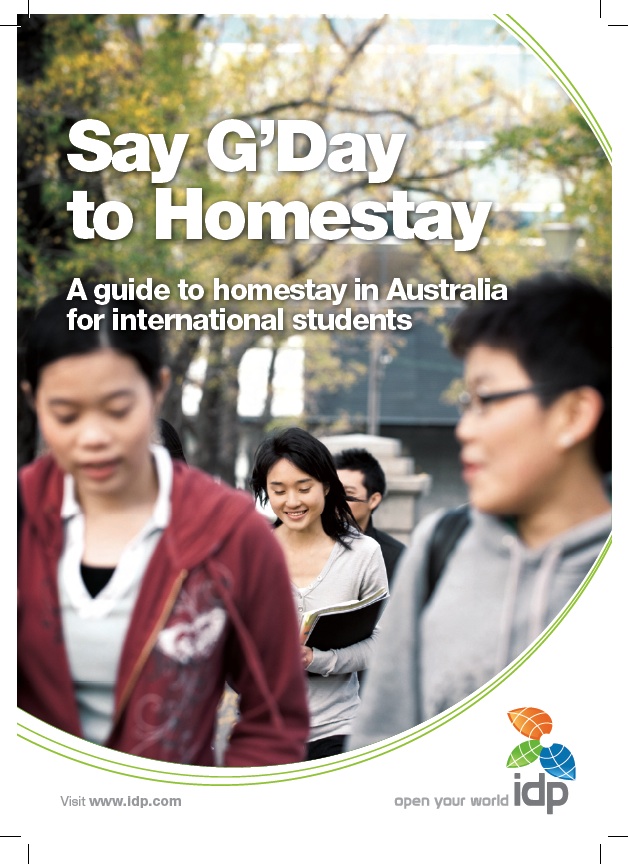
Resource: “Say G’Day to Homestay”

July 27, 2011

G'Day to HomestayIDP is an Australian organization specializing in international education services for Australia. One of those resources is a homestay guide called Say G’Day to Homestay. It is for Australia-bound international students who will be living with a local family.  This is a brilliant guide. It answers questions about everyday life in Australia that foreigners may not know such as:

  • How do I get to school?
  • What will I eat?
  • How do I dispose of household waste?

It also offers tips on laundry, lights, heating, using the telephone, home security, smoking and pets.

These are topics that locals take for granted because they seem second nature to us. The same issues confound and confuse the foreigner who may have no idea of what is expected or appropriate.

This guide is specifically for students going to Australia. If you’re not in Australia, go check it out anyway. Then ask yourself how you can provide a similar guide to your international students that will help them understand the same issues in your local area.

Here’s the link to the guide: http://www.idp.com/PDF/Say%20Gday%20to%20Homestay.pdf

Related posts:

___________________

Share this post: Resource: “Say G’Day to Homestay” http://wp.me/pNAh3-PP

Update – January 2018 – This blog has had over 1.8 million views thanks to readers like you. If you enjoyed this post, please “like” it or share it on social media. Thanks!

Sarah Elaine Eaton is a faculty member in the Werklund School of Education, University of Calgary, Canada.