Cool Apps for Language Learning

November 3, 2010

Are you teaching or learning a language? Want to do it the 21st century way though your Android, iPhone or Blackberry? There are literally dozens of apps out there to help you learn foreign languages!

Some of them are language specific, while others offer multilingual options. Here are some examples:

24/7 Tutor – Spanish, French, Italian, Russian and German

Katahira App – Japanese (Katahira)

Greek – flash cards

American Sign Language (ASL) – tutorial and reference app

Cherokee – iPhone app for this endangered indigenous language

Korean Essentials – a free app from the Apple Store by AccelaStudy

Spanish vocabulary – by Componica

Matt Silverman, in Mashable/Mobile, wrote about free apps for the Android phone, including one called Talk To Me. He writes:

“Talk To Me is an impressive app that can translate your input text or speech between over 40 different languages, and in most cases, speak the translations back to you. The interface is really dead-simple: An input for text, a drop-down list to choose your languages, and a big green button to activate the speech recognition.” Read the full article here.

Claire Bradin Siskin offers a superb overview of instructional and learning apps for languages for iPhone, Blackberry and other smart phones, including a list of places to get them.

Angel Brady at Princeton University did a great review of over 20 different apps for language learning.

Here’s an idea: Ask your students what apps they can find for their own mobile devices. Build your own links and resources for your students by engaging them in the process of figuring out what works for them, what doesn’t and why.

_________________________________

Related posts:

Share or Tweet this post: Cool Apps for Language Learning http://wp.me/pNAh3-mQ

Update – January 2018 – This blog has had over 1.8 million views thanks to readers like you. If you enjoyed this post, please “like” it or share it on social media. Thanks!

Sarah Elaine Eaton is a faculty member in the Werklund School of Education, University of Calgary, Canada.


Sample Host Family Application

October 9, 2010

Choosing host families for your international education or language program takes significant time and effort. Matching prospective students with families willing to open their hearts and home to a foreign student who is studying English as a Second Language (or any other language or subject, for that matter) requires skill, patience, background checks and a fine balance between working with the people that you have in your pool of students and families and ensuring that some basic requirements are met.

The first step in setting up your host family selection process is to develop your host family application. The application needs to include more than just the name and address of the family. You also want to ask questions about lifestyle, such us: do they allow smoking in the home?

The local police service in many communities will perform security checks for a small fee. Adult members of the household should include a police security check, as you will want to know if anyone in the household has had criminal charges brought against them, or if there have been incidents of domestic violence in the home.

The more questions you ask up front, the better chance you’ll have of selecting excellent families to host your students.

Here’s a sample host or billet family application that you can download and adapt to your own needs. Remember to include a statement about privacy if your area requires you to do so when you collect personal information.

Related posts:

____________

Share or Tweet this post: Sample Host Family Application http://wp.me/pNAh3-fv

Update – January 2018 – This blog has had over 1.8 million views thanks to readers like you. If you enjoyed this post, please “like” it or share it on social media. Thanks!

Sarah Elaine Eaton is a faculty member in the Werklund School of Education, University of Calgary, Canada.


Interview with Felix Wöhler: Leading by Example Series

October 4, 2010

This series is dedicated to highlighting the impact made by exemplary literacy and language professionals who lead by example. They share their inspirational tips and stories. In this article I’m pleased to showcase the work of Felix Wöhler, owner and manager of an English as a Second Language (ESL) school in Ontario, Canada.

What is your name, affiliation, and connection to language learning?

The school name is English Encounters (formerly Bronte Language Centre) and we have been in business since 1986.  We are fully accredited by Languages Canada for our ESL Program.

In your opinion, what’s the most important aspect of managing a language school?

The most important thing is to provide students with an enjoyable and useful language learning experience.

There are very few people who have bought a pre-existing language school. That makes you a pioneer of sorts. I think readers would be very interested to hear about your experience. What were the best and worst aspects of this experience for you?

The best part was not having to build everything from scratch.  I “inherited” an existing database of agents, students, and staff as well as an existing online and physical location.  This made the takeover relatively seamless in the sense that, in contrast to starting a school from zero, I was fully operational from day one.  On the other hand, the fact that all these aspects had already been established meant that there was a long period of adjustment – for both myself and staff, and to a lesser extent, for students – to each others’ way of doing things.

It took me a long time to truly “identify” with the school. At the beginning, it always felt like I was managing someone else’s business.  However, over the past year, I have worked closely together with my team and helped recreate and improve the school in a way I really feel I can identify with and am, in fact, very proud of.  This includes renaming the school, relocating to a brand new facility in a neighbouring city – a location we feel is far better-suited for student needs, decorating the new premises, redoing the website, getting accredited by Languages Canada, and creating new and improved programs and curricula.

What is it that you like best about owning your own language school?

The most rewarding aspect of owning my own language school is meeting students from all over the world and seeing their English improve as they enjoy their time in Canada with us.  Many of our students have become very close and it is wonderful to see how they keep in touch and refer their friends and family members.

What do you see for the future of language learning?

Language learning in the future will become increasing important as the world continues to globalize. To that end,  more and more people will need a second language, particularly English, which seems well-placed to become a global lingua franca. For language schools, the challenge is to provide language training that is both attainable and enjoyable.  At the same time, the high demand for English training means that large amounts of students can become concentrated in popular areas or language schools.  The problem with that, is the strong tendency for these students to break off into ethnic groups and revert to their 1st language in all out-of-class activities.  The strategy at English Encounters, therefore, is to provide a small, student-centred learning environment in a smaller city where the likelihood of finding many speakers of languages other than English is much lower.  This makes our school the ideal place for true immersion and language training.

Share or Tweet this post: Interview with Felix Wöhler: Leading by Example Serieshttp://wp.me/pNAh3-kg

Update – January 2018 – This blog has had over 1.8 million views thanks to readers like you. If you enjoyed this post, please “like” it or share it on social media. Thanks!

Sarah Elaine Eaton is a faculty member in the Werklund School of Education, University of Calgary, Canada.


EU Competition: How Has Learning a Language Changed Your Life?

October 1, 2010

I’m just thrilled to hear about this new competition organized by the European Union. Tongue Stories invites submission from participants in 31 European countries to share stories of how learning a language has changed their life:

Share your story with Europe

How languages changed your life, or just one day.
How knowing a foreign language made you happy,
How languages surprised you; made you laugh,
moved you, made you feel proud, or simply useful.

Send your contribution, tell us a nice story and inspire people to use different languages!

This competition echoes in spirit my free ebook “Want to Change the World? Learn Another Language” and accompanying video.

While I confess that I’m a bit sad that this competition is only in Europe, on the other hand I am absolutely thrilled to see that the EU is taking on the languages and leadership movement so proactively! Learning languages changes us and in so doing, we change the world!

__________________

Share this post: EU Competition: How Has Learning a Language Changed Your Life? https://wp.me/pNAh3-lF

Update – January 2018 – This blog has had over 1.8 million views thanks to readers like you. If you enjoyed this post, please “like” it or share it on social media. Thanks!

Sarah Elaine Eaton is a faculty member in the Werklund School of Education, University of Calgary, Canada.


Foreign Language Programs in Crisis: Programs Closing, Faculty Losing Jobs

September 30, 2010

Lately people have been sending me all sorts of news articles about enrollments dropping in second and foreign language programs in high schools and universities. Here are a few examples:

“Community, Adult Education Programs Will be Missed”, Hometownlife.com, by Susan Steinmueller, Sept. 12, 2010

“Foreign language classes unresolved” – Isureveille, by Catherine Threlkeld, September 23, 2010

Cuts hurting language classes – The NewsStar by Carlos D. Fandal, September 26, 2010

Replacing Teachers with Technology – Fox News by Meredith Orban, September 28, 2010

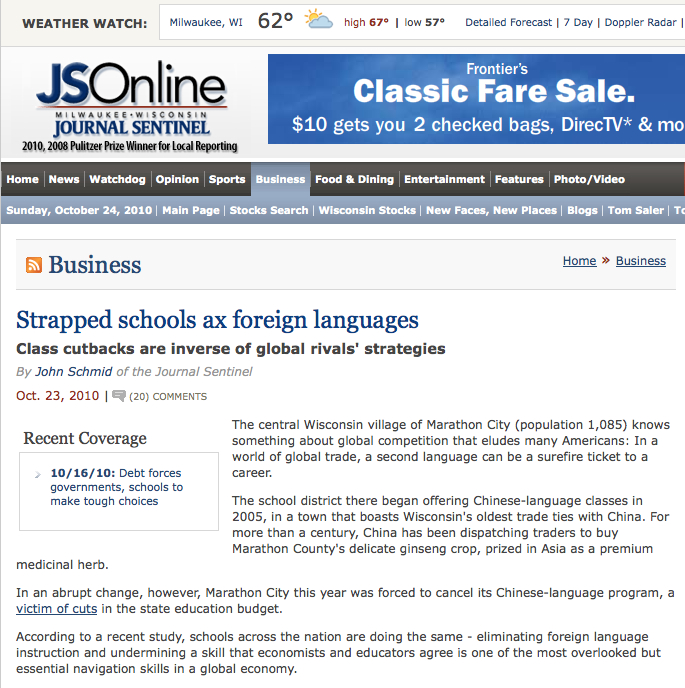
Strapped Schools Ax Foreign Language Programs – Milwaukee – Wisconsin Journal Sentinel, by John Schmid, October 23, 2010

It breaks my heart when I hear about programs that have decreasing enrollment or worse, under threat of closure due to low enrollment. From my experience of working with schools and programs over the past decade as a marketing consultant, I can honestly say that there is no “magic bullet” in a situation like this.

If you’ve been given notice that your program is about to close, managers and teachers essentially face a crisis situation. Not only is their passion about to be killed, and they know their students’ futures will be shaped in a very different way, but their livelihood may be gone, too.

What are language teachers, administrators and foreign language advocates to do?

The only answer it seems is find a way to revitalize not only our programs, but also interest in them. Parents and community stake holders need to see the value of second and foreign language learning and the benefits that students derive by studying them. There is no quick fix to this one, I’m afraid. If you manage or teach in a foreign language program, the best thing to do right now is to keep it vibrant and alive. If your program is under the threat of closure, there may still be time to implement a revitalization, public relations or marketing strategy to rebuild your program’s health so it doesn’t get shut down, or replaced by a computer program.

___________

Share or Tweet this article: Foreign Language Programs in Crisis: Programs Closing, Faculty Losing Jobs http://wp.me/pNAh3-hy

Update – January 2018 – This blog has had over 1.8 million views thanks to readers like you. If you enjoyed this post, please “like” it or share it on social media. Thanks!

Sarah Elaine Eaton is a faculty member in the Werklund School of Education, University of Calgary, Canada.