New Trends in Education: Formal, Non-formal and Informal Learning – Implications for Evaluation and Assessment

June 9, 2011

Thanks to the Ontario Literacy Coalition (OLC) for inviting me to be part of their webinar series. In case you missed the program this week on “New Trends in Education: Formal, Non-formal and Informal Learning: Implications for Evaluation and Assessment” you can watch the recording here:

Here’s the link to program, too: http://youtu.be/6iH_ikNmn9I

_____________________________________________

Share this post: New Trends in Education: Formal, Non-formal and Informal Learning – Implications for Evaluation and Assessment http://wp.me/pNAh3-JD

Update – January 2018 – This blog has had over 1.8 million views thanks to readers like you. If you enjoyed this post, please “like” it or share it on social media. Thanks!

Sarah Elaine Eaton is a faculty member in the Werklund School of Education, University of Calgary, Canada.


Pastel de Tres Leches – a la canadiense

June 8, 2011

Every semester, I like to close my language classes with a fun activity. Years ago, I used to arrange for a field trip to a local Mexican restaurant. However, times have changed and such field trips now require reams of paperwork and releases… even for adult education classes. So now we have a pot luck in class. This week, my adult education Spanish class wraps up and I decided to make my pastel de tres leches.

If you’ve never had it, then “three milk cake” or “cake soaked in 3 milks” could sound kind of disgusting, I guess. But once your taste buds have experienced the beauty that is pastel de tres leches you never forget it.

There are loads of food blogs out there and don’t worry, this blog is in no danger of becoming one of them. But every now and again, you need to do something different. Since “language” is in the title of the blog, and teaching culture is an important aspect of teaching the language, I’m taking a one-dime detour to include some Latin American culinary culture (with a Canadian twist, just because we’re so obsessed with multiculturalism here.)

This post is dedicated to my adult education Spanish students this semester and to all the language teachers around the globe who are also wrapping up the end of a semester. Many of you, no doubt, will also be making some kind of dish to share with your students. (Feel free to leave a comment and share your dish with us!)

Pastel de Tres Leches

Background and Culture

The first time I heard about pastel de tres leches, it was from an Argentinian friend who raved about it. With eyes rolling back in his head and drool dripping from his mouth as he described it, he said it was famous in Argentina.

Central American friends vehemently deny that claim and assert that it originated much further north.

I’ve worked in Venezuela, Honduras, Cuba and Mexico and personally, I’ve never seen this pastel in any of those places! I’m sure it exists, but I’m not certain who has the real claim to its origin.

Step 1 – Plan ahead

Decadence comes with a price. In this case, the price is time. Ideally, your cake will need to rest for about 24 hours to soak in the goodness of the tres leches.

Step 2 – Prepare and bake the cake

Here is the recipe I use for the cake:

1 1/2 cups (375 ml) all-purpose flour

1 Tbs (15 ml) baking powder

1 Tbs (15 ml) cinnamon

4 eggs, separated

1 1/2 cups (375 ml) sugar

1/2 cup (125 ml) milk

For the topping:

1 12-oz (335 g) can evaporated milk

1 14-oz (390 g) can sweetened condensed milk

2 cups (500 ml) milk

1 cup (250 ml) sugar

1 tsp (5 ml) vanilla extract

Sift the flour with the baking powder.  In large bowl beat the egg whites until frothy.  Add the sugar gradually, beating to form stiff peaks.  Add the yolks one at a time.  Slowly add the flour and milk.

Pour the batter into a grease and floured 13x9x2-inch (33x23x5-cm) baking pan and bake in a preheated 350F (180C) oven until edges are golden brown, about 40 to 45 minutes.  Remove from the oven and let cool on a wire rack.

For the topping, combine the three milks with the other ingredients, stirring until smooth.  Pour the topping over the cake and let sit until all the mixture is absorbed (at least 3 hours, but a full day is better).  Serves 8 to 12.

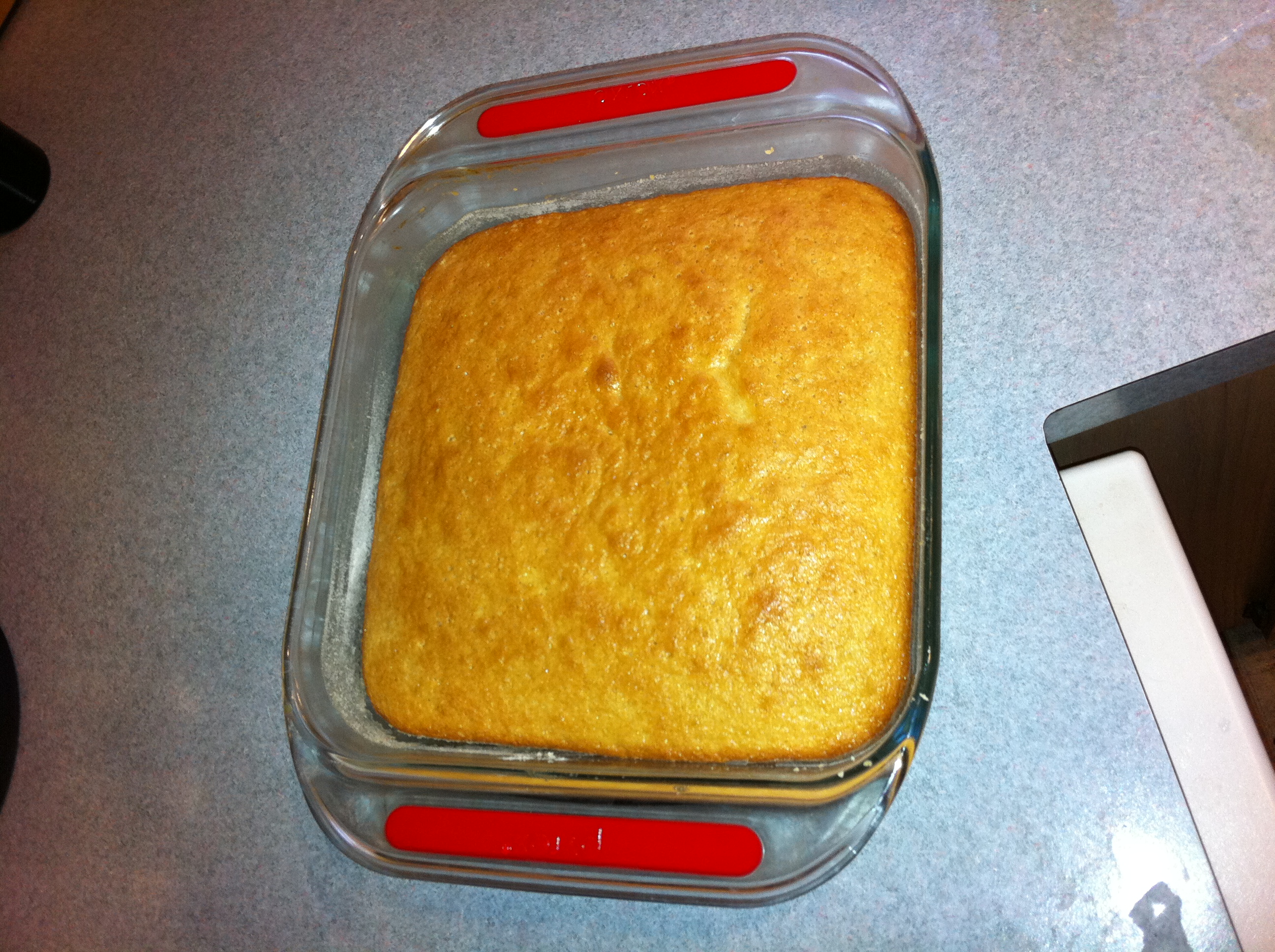
Pastel de Tres Leches

The recipe calls for a 9 x 13 pan. This is a 9 x 9 pan… and I made a smaller cake with the extra batter.

Step 3 – Add a cranberry compote to make it “a la canadiense”

I was inspired by this recipe. I adapted it this way:

Cranberry Compote

This, for me, is what makes this recipe “a la canadiense”. I remember when I was about 11 years old, growing up in Halifax one cold Saturday in November we went cranberry picking near the beach outside off town. It was one of the coldest, dampest days I ever remember. Our fingers froze. Our buckets seemed to take forever to fill. I’d filled buckets with blueberries loads of times during the summer, but picking cranberries along the beach, with icy wind whipping around you in November is a different experience entirely.

I’m sure my mother and her friends thought it would be a wonderful experience for us kids to know where cranberries came from and to experience picking them ourselves. But even the mothers decided that once was enough and we never repeated the experience.

Now, whenever I buy a cranberries, I always make a mental note to thank whoever picked them. It’s a thankless job, really.

1 bag of frozen or fresh cranberries (about half a kilo or 1 lb.)

1 – 2 tsp of cinnamon

1/2 cup water

1 to 2 cups of sugar (depending how sweet you like it)

rind of 1 orange

1 Tbsp of cornstarch, diluted in about 1/4 cup of warm water

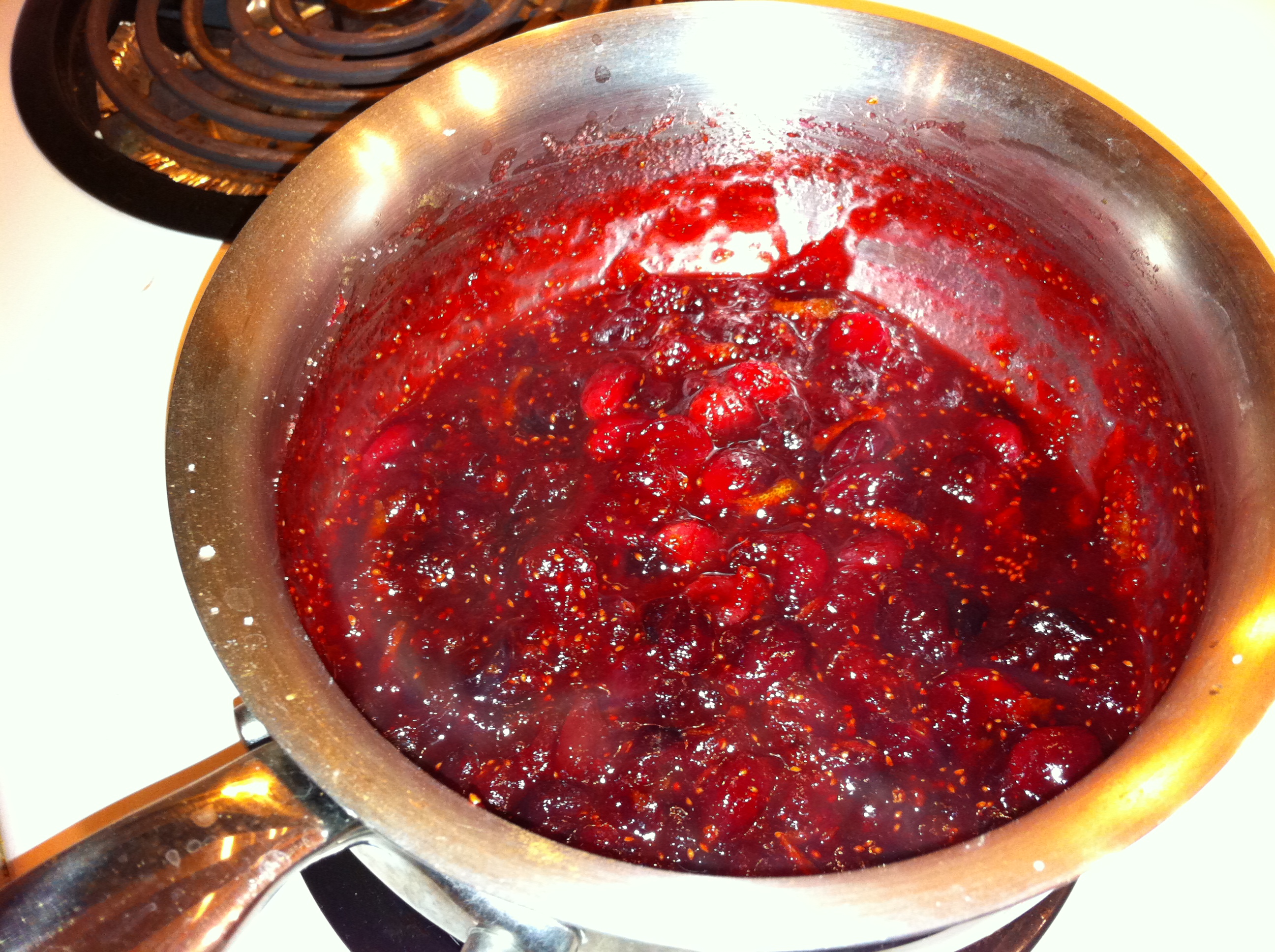
Cook the cranberries, sugar, cinnamon, water and orange rind in a saucepan until it reduces in to a nice compote. Add the cornstarch in water at the end to thicken it up a bit. This is what it looks like as you’re cooking it:

Cranberry compote

And this is the final version:

Cranberry compote - finished

Step 4 – Serve and enjoy

Serve the cake with the compote and enjoy.

Variations on this recipe include serving it with a meringue topping or whipped cream.

_______

Share this post: Pastel de Tres Leches – a la canadiense http://wp.me/pNAh3-Ji

Update – January 2018 – This blog has had over 1.8 million views thanks to readers like you. If you enjoyed this post, please “like” it or share it on social media. Thanks!

Sarah Elaine Eaton is a faculty member in the Werklund School of Education, University of Calgary, Canada.


Using Portfolios for Effective Learning

June 6, 2011

Lately the topic of asset-based or value based evaluation has come up in conversations with colleagues. People want to know how to do it and how to maintain academic rigour and standards when incorporating strength-based evaluation. Here’s a brief on how I incorporated both the philosophy and practice of asset-based evaluation into one of my courses — and how you can, too.

View this document on Scribd

Related post: Student portfolios for Language Learning: What They Are and How to Use Them

__________________

Share this post: Using Portfolios for Effective Learning http://wp.me/pNAh3-FZ

Update – January 2018 – This blog has had over 1.8 million views thanks to readers like you. If you enjoyed this post, please “like” it or share it on social media. Thanks!

Sarah Elaine Eaton is a faculty member in the Werklund School of Education, University of Calgary, Canada.


Job Opportunity: Summer Research Assistant – Specialist in Second Languages

June 2, 2011

June 15, 2011 – Update – This position has been filled. Thanks for the many responses and queries!

_________

I have a project on the go that examines questions around second language education, L2 acquisition and language learning and pedagogy. I’m looking for a part-time research assistant / associate to collaborate on this project over the summer months. Here’s what I’m looking for:

Research Assistant / Associate (Term position)

Summary statement

The Research Assistant / Associate is responsible for assisting the Principal Investigator (PI) in the collection, formatting, analysis and reporting of information on topics relating to second and other language acquisition, language pedagogy and related topics.

Major Responsibilities

  • Plans, organizes and coordinates his or her own schedule to ensure that deliverables are met by due dates.
  • Liaises with the PI for the collection, formatting, analysis and reporting of information.
  • Conducts a literature review using primarily online academic, government and other databases.
  • Data entry of bibliographic information using Endnote.
  • Maintains electronic and hard copy data files and reports.
  • Maintains up-to-date documentation of work completed.
  • Produces written materials for research reports.
  • Proofreads and edits documents generated by the PI.
Meets with the PI on a regular basis to review the work in progress.
  • Deliver work completed on a weekly basis. These deliverables will generally consist of research articles, government reports, applied research articles and professional materials that can contribute to the research report.

Education

Post-secondary degree. Candidates who are currently enrolled in a Master’s or PhD program will be given preference.

A background in second language learning or second language education is highly desirable.

Experience and Skills

  • Experience working with electronic research databases.
  • Previous research experience (e.g. conducting a literature review) is desirable.
  • High levels of personal motivation, self-management and detail-orientation. The incumbent will have the ability to take responsibility to meet deadlines and make progress with minimal supervision.
  • Strong spoken and written communication skills.
  • Rigorous research methods.

Other qualifications

  • You have access to academic research databases through the library of an accredited institution.
  • Strong existing technology skills with MS Word (or Pages), Endnote and general Internet and electronic communications.
  • You are comfortable navigating the Internet to conduct research.
  • You are able to meet face-to-face in the Calgary area on a regular basis or via Skype if you are not located in the Calgary area.
  • You have access to your own computer and the Internet.
  • Must be legally entitled to work in Canada and have a valid Social Insurance Number.

Position Details

Start date: Monday, June 13, 2011
End date: Friday, August 5, 2011

Hours: Generally flexible hours – 5 to 15 hours per week, with a minimum of 5 hours per week.

Wage: $25 / hour, to a maximum of 80 hours ($2000) during the term of the project. Wages are subject to the usual CPP and EI deductions.

Work site: You will work from your own home, on campus or anywhere the work can be completed.

To apply send a brief resume and cover letter via e-mail to:

Dr. Sarah Elaine Eaton
Eaton International Consulting Inc.
sarahelaineeaton (at) gmail.com

Applications are accepted until a suitable candidate is found.

Download a copy of this document for easy printing from:

View this document on Scribd

______________

Share this post: Job Opportunity: Summer Research Assistant – Specialist in Second Languages http://wp.me/pNAh3-HR


10 Free e-learning tools and tech programs for language and literacy learning

June 2, 2011

A few months ago I did a post sharing my favorite sites to create your own crossword puzzles. I’ve found some more free tools and tech downloads for learning and teaching second or foreign languages. Many of them might also be useful in ELL adult literacy programs.

CAPL (Culturally Authentic Pictoral Lexicon) This is a brilliant site with tons of free, culturally authentic images that teachers and students can use for educational purposes.

Eclipse – A free crossword maker in English.

Forvo – A multilingual pronunciation library, with entries in dozens of different languages.

Hell0 World – A language learning site for 15 different languages that includes games, songs and activities.

Hot Potatoes – Freeware authoring tool to create language learning activities in a variety of languages.

Lyrics training – A fun way to learn songs in foreign languages.

Memerise – A multi-lingual vocabulary-building game.

Selingua – columns – A Tetris-style game for learning French, German, Spanish or Swedish.

Sephonics – Learn the English and International Phonetic Alphabet.

Wordsteps – Helps you learn vocabulary in a new language.

__________________________

Share this post: 10 Free e-learning tools and tech programs for language and literacy learning https://wp.me/pNAh3-Hi

Update – January 2018 – This blog has had over 1.8 million views thanks to readers like you. If you enjoyed this post, please “like” it or share it on social media. Thanks!

Sarah Elaine Eaton is a faculty member in the Werklund School of Education, University of Calgary, Canada.