Myth: Only poor people lack literacy skills

July 22, 2010

A few months ago I did a short video on Literacy and Essential Skills.  Human Resources and Skills Development Canada (HRSDC) outlines 9 literacy and essential skills:

  • Reading text
  • Document use
  • Numeracy
  • Writing
  • Oral communication
  • Working with others
  • Continuous learning
  • Thinking Skills
  • Computer use

Yesterday I was reminded that a person can have high function in some areas of literacy, but not all of them. I saw an excellent, though sad, example of a young man lacking skills in basic document use.  I was at the post office, in line behind a young man who was maybe 19 or 20. Decked out in Pumas, and other high-end brand name clothing, he sported the latest in cell phones. He spent most of his time in line on the phone.

He arrived at the counter with a sheaf of papers in his hand. They had the look of some standard government forms. The conversation with the clerk went like this:

Customer: “I need to mail these.” Clearly, he was a native speaker of English.

Clerk: “OK. Do you have an envelope?”

Customer: “No. Do you sell them?”

Clerk: “Yes, we have pre-stamped envelopes.” She went to the drawer and pulled out an envelope.

Customer: “Um… What do I do with it?”

Clerk: “You have to put the papers in the envelope. You fold them. See, like this…” She showed him how to fold the papers.

He put them in the envelope and then handed it to her saying, “I don’t know what to do with it.”

She said, “You have to write your name and address up here,” she said, pointing to the upper left hand corner of the envelope. “Then you have to write the name and address of the person you’re sending it to here,” pointing to the middle of the envelope.

“Oh…OK,” he said, with his air of coolness, giving way to awkwardness, tinted by shame.

He did exactly as she told him, writing his own name and address in a single line across the top of the envelope.

He then took the papers out of the envelope and copied the addressee’s name and address in the middle of the envelope, until he ran out of space, and then he looked at her.

“Finish writing the address below where you started. Write the rest on a new line,” she said gently.

He did that and handed her the envelope again. She said, “You have to lick the flap on the back where the glue is and seal it shut.”

He did that, too and then looked at her questioningly as if to say, “Are we done, yet?”

She just smiled and told him how much it would cost. He whipped out his wallet, showing off a sheaf of bills.

Literacy isn’t about how much money you have, what kind of clothes you sport or what kind of gadgets you carry. Literacy is about having basic, yet essential skills, that allow you to do everyday things such as mail a letter.

____________________

Like this post? Share or Tweet it: Myth: Only poor people lack literacy skills http://wp.me/pNAh3-cE

Update – January 2018 – This blog has had over 1.8 million views thanks to readers like you. If you enjoyed this post, please “like” it or share it on social media. Thanks!

Sarah Elaine Eaton is a faculty member in the Werklund School of Education, University of Calgary, Canada.


Use the KISS principle in all your marketing materials

July 21, 2010

The KISS (Keep it Short and Simple) principle can – and should – be used in your marketing and promotional materials. When it comes to writing, the KISS principle may also be called a plain language approach. And it makes your marketing more powerful and effective.

Regardless of what you call it, a simple, short approach is the most effective for marketing. This applies to both the amount of content and its presentation in your marketing materials. The first step is to eliminate unnecessary words. Next, review your document to ensure that the words are short, simple and easy to understand.

Some word processing programs tell you the reading level of the documents you write. For example, in my version of MS Word, I can do this by accessing

Tools >

Spelling and Grammar >

Options >

Show readability statistics.

This shows me the grade level of the text. For most marketing documents, a grade six or seven reading level is recommended. That’s for native speakers! Remember that you are marketing to people whose first language is not the same as yours. If the reading level comes out higher than grade 7, your sentences may be too complex to sell effectively.

Avoid colloquialisms in your international marketing material. If you were an ESL student, what would you think if you read, “…homestay families will look out for students…” in a brochure? Does that mean “keep vigil over them” or simply “protect them as their own parents would”? The phrase as it is could be difficult for a non-native speaker to understand.

You could re-word the above phrase to read: “Our homestay families care for you as part of their own family.”

Review your marketing materials to ensure they follow the KISS principle. You will find that students are more interested in your program because they understand what it is about.

___________________________

This post is an excerpt from 101 Ways to Market Your Language Program It is “Idea # 10: Use the KISS principle in all your marketing materials”

___________________________

Like this post? Share or Tweet it: Use the KISS principle in all your marketing materials http://wp.me/pNAh3-75

Update – January 2018 – This blog has had over 1.8 million views thanks to readers like you. If you enjoyed this post, please “like” it or share it on social media. Thanks!

Sarah Elaine Eaton is a faculty member in the Werklund School of Education, University of Calgary, Canada.


A Review of the Literature on Second Language Learning

July 19, 2010

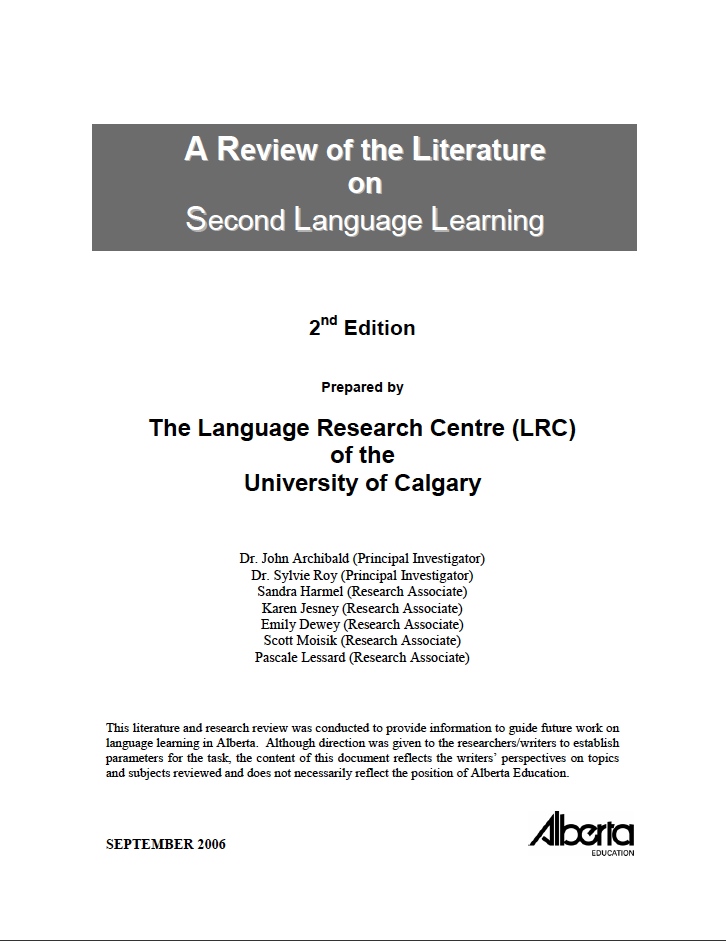
Written Dr. John Archibald,  Dr. Sylvie Roy and other researchers at from the Language Research Centre (LRC), of the University of Calgary, A Review of the Literature on Second Language Learning, 2nd ed. Published in 2006, this study examines 4 key areas:

  1. Effects of a second language on a person’s first language
  2. The role of content instruction in offering a second language
  3. Effects of second language learning on students with special needs
  4. Effects of learning and third language on students for whom English is a second language.

Some key findings of this research are:

  • Exposure to a second language can enhance non-linguistic skills such as divergent thinking, attitudes towards others and math skills.
  • Acquiring knowledge in a second language does not impede first language development.
  • Significant time investment is required to acquire full fluency.
  • Content-based language teaching (e.g. teaching math or science in a second language) can increase students’ ability to make connections between second language study and the outside world.
  • Students with special needs can learn second languages.
  • Acquiring a third language is a common occurrence around the world.
  • It helps to learn a third language if you have a strong proficiency in a first language.

________

Share this post: A Review of the Literature on Second Language Learning https://wp.me/pNAh3-bO

Update – January 2018 – This blog has had over 1.8 million views thanks to readers like you. If you enjoyed this post, please “like” it or share it on social media. Thanks!

Sarah Elaine Eaton is a faculty member in the Werklund School of Education, University of Calgary, Canada.


Teaching reading the 21st century way

July 16, 2010

In an article by the Smithsonian, author Kevin Kelly talks about reading in the digital age. He makes a good point when he says that the digital screen is the biggest thing to hit reading since Guttenberg’s invention of the printing press in 1440. He talks about how screen reading involves more than using your eyes. It includes engaging our bodies through interaction with a mouse or touch screen. He adds that portable screens (like the iPod touch, the iPad and any number of other mobile devices are becoming more and more prominent.)

Are you teaching reading in a way that makes sense in the 21st century?

Related post: How technology has changed reading in the 21st century http://wp.me/pNAh3-11P

____________

Share this post: Teaching reading the 21st century way http://wp.me/pNAh3-cb

Update – January 2018 – This blog has had over 1.8 million views thanks to readers like you. If you enjoyed this post, please “like” it or share it on social media. Thanks!

Sarah Elaine Eaton is a faculty member in the Werklund School of Education, University of Calgary, Canada.


Guerrilla Marketing for Nonprofits – Join me for an interview with the co-author

July 15, 2010

Jay Conrad Levinson. Seth Godin. These are big names in marketing and specifically in Guerrilla Marketing.

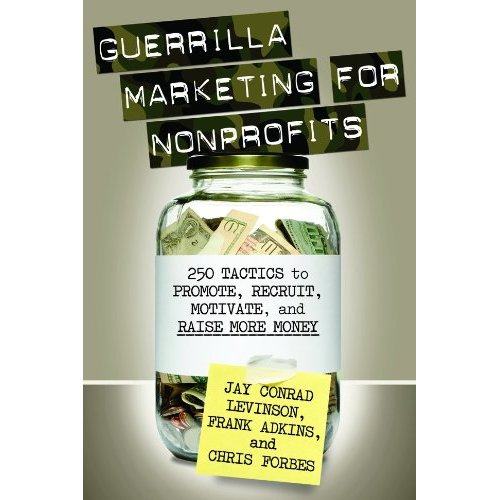
There’s a new name to add to that list: Chris Forbes. He’s just co-authored Guerrilla Marketing for Nonprofits with Jay Conrad Levinson and Frank Adkins. This book is hot off the press, having been released on July 2.

On August 5 at 10:00 a.m. Calgary time I’m going to interview Chris about his new book via webinar. This is a public webinar sponsored by Elluminate. Chris is generously donating his time and expertise with us for this special event.

There’s no cost to attend. Nothing. Just come and enjoy Chris talk about his new book and share some of his 250 tactics to promote, recruit, motivate and raise more money for nonprofit organizations.

Please join us! Click here to register. There’s a registration link in the upper right hand corner. Just click on that to reserve your seat.

Feel free to pass this invitation along to others, too.

________________

Like this post? Share or Tweet it: Guerrilla Marketing for Nonprofits Webinar http://wp.me/pNAh3-c3

Update – January 2018 – This blog has had over 1.8 million views thanks to readers like you. If you enjoyed this post, please “like” it or share it on social media. Thanks!

Sarah Elaine Eaton is a faculty member in the Werklund School of Education, University of Calgary, Canada.