The 3 C’s of 21st Century Learning and Leading: Creativity, Collaboration and Capacity-Building

April 13, 2011

What are the skills needed for 21st century leaders? I’d argue that they’re the same skills needed for 21st century students and learners. Why? Because the students and learners of today are not only the leaders of tomorrow, but also the leaders of today. Notions of leadership are changing. The component of leadership that involves wisdom gained through life experience will always rest with those who have more of that experience. But young people are pushing the boundaries of technology and social change. Here are the three skills leaders of today – and tomorrow – need.

Sarah Eaton - blog - iStock photo

Creativity

Leadership today need to be creative problem solvers. The issues that are arising challenge all that we know about the world and how to make it right. Authoritarian or cookie-cutter approaches to problem solving simply won’t work in the 21st century. Even the ability to “think outside the box” won’t be enough. Instead, learners and leaders will need to be able to say, “‘Box? There is no box.”

If you’ve seen the movie, The Matrix, you may remember a scene with the small boy who bends a spoon with nothing more than his mind. When Keanu Reeves’ character, Neo, asks him how he bent the spoon, the boy replies, “There is no spoon”. A similar idea of thinking beyond what we currently know to be possible will be a common characteristic of 21st century leaders. A creative and open mind will drive that ability.

Sarah Eaton - blog - group of children

Collaboration

Young learners and senior leaders alike need to know how to play well with others. We accomplish more when we work together. There needs to be trust, appreciation and a willingness to join forces and collaborate. Phrases such as, “Trust me… just do it my way.” or “Because I’m the boss and I say so!” just won’t cut it in this century.

In this century, everyone has the ability and capacity to be both a follower and a leader. Those who try to exert authority over others without their consent will not only be questioned, they’re likely to be shunned. Learning to appreciate others’ strengths won’t be enough… Learning how to leverage each other’s strengths will be a key to working together, creating new work, solving problems and achieving new goals.

Geographical boundaries have been almost completely transcended in the first decade of this century. In a few more decades, people won’t think twice about working with someone at a distance on a collaborative project. Those who don’t partner and collaborate effectively will be left behind. In a century driven by technology, people skills are – and will continue to be – more important than ever.

Capacity-Building

Twenty-first century leaders will have the ability to look at those around them and help them build their capacity in order to help them grown personally. That growth will add to the organizational growth. In addition to leveraging one’s current strengths, there will be a drive to explore and learn by doing.

This century, more than any other period in history is passionate about – even addicted to – creating new knowledge using technology, to inventing new and visionary projects and making things happen on a large – even global – scale. To do so, a dedication to lifelong learning not only for ourselves, but also for our colleagues, partners and team members will become the norm. Learning in a traditional classroom has already been extended to the Web, to podcasts, to television… Learning, professional development and continuous self-creation will happen almost any place, any time.

Each of us is both a learner and a leader in the 21st century. I, for one, believe in our collective potential and look forward to what we can create together.

____________________

Share this post: The 3 C’s of 21st Century Learning and Leading: Creativity, Collaboration and Capacity-Building http://wp.me/pNAh3-BT

Update – January 2018 – This blog has had over 1.8 million views thanks to readers like you. If you enjoyed this post, please “like” it or share it on social media. Thanks!

Sarah Elaine Eaton is a faculty member in the Werklund School of Education, University of Calgary, Canada.


“Let Them Build It and It Will Be Amazing”

April 8, 2011

In over 20 years in the education sector, I’ve managed and collaborated with others to develop courses and programs in a variety of ways. Each has their merits. Using the wrong approach can be disastrous.

I was recently hired by a major organization to undertake the development of a new program for them. I thought about how to go about doing this and, because I don’t know them very well, I said, “Look, there are 3 ways we can do this. Here are the options:”

Traditional Approach

Tried and true. Teacher-centered. Deliver as much solid content as possible, to as many people as possible, in the shortest amount of time. Mostly one-way (trainer-to-participant) communication.

This approach is the easiest and in some ways, the most fun (at least for the developer). I develop my goals, objectives and outcomes, build content and deliver it. If I’ve done my job right, someone else can step right in and deliver the content. In the professional training and speaking world, this is called “canned content”. You literally open up the package of materials and feed it to the participants. Or to use another analogy, the program developer is the architect, construction company and interior designer. Once you have finished the job, you invite people in.

I can churn out a job like this on a fairly tight timeline. Because of my own tendency towards perfectionism, no one gets invited to see my work before I’m happy with it. And I’ve been doing this a long time, so I know how to produce quality and do it quickly.

Interactive Approach

This approach allows for increased learner interactivity. Feed them content, and keep them engaged. Allows time at regular intervals for discussion and interaction, rather than “saving all the questions until the end”.

The Interactive Approach, although sometimes cloaked as “learner-centered”, it is really still a “teacher-centered” approach, but does allow participants to ask more questions and permits some lively discussion. The teacher or trainer is very much in control of what happens, how it happens and when it happens. And it’s expected that he or she will maintain control throughout the process.

The teacher needs to know how to keep the discussion on track, cut off those who aren’t moving in the appropriate direction or who take up too much time and generally be an authority figure who guides the process, while building in some flexibility. The program developer is the architect, construction company and may invite others to give input on the final touches, but really, what they say doesn’t change much.

Designing a course like this is much like building a traditional course, except that you build in allowances for interactivity. Over the past 10 years, most of the projects I’ve been involved with have involved this type of project. It allows the client to pay lip service to the notion of learner involvement, without any fundamental changes to how they’ve always done things.

Participatory Capacity-Building Approach

Innovative. Edgy. Highly collaborative and creative. Teacher is replaced by a facilitator who is OK relinquishing some control to participants as they drive the learning process forward.

The Participatory Capacity-Building Approach is likely to be somewhat uncomfortable for participants, since they will be challenged to try new ways of doing things (e.g. using new technologies that they’re not entirely comfortable with). Participants are challenged to be co-creators of new knowledge, as they engage in peer-to-peer-teaching-and-learning. Saying it is an “active learning process” is an understatement.

Essentially, you construct a solid frame. Then you give the learners the tools to build around it, adding to the design, rolling up their sleeves and getting in on the design and doing some of the labour. They then add the final touches. The final product is their work (likely with a few mistakes here and there). In the end, they own it… and they know it. It ends up being a place to call home because they’ve made it themselves.

From a course developer’s point of view, it is highly challenging. The frame you build needs to be rock solid. It needs to make sense to the participants. They must agree to participate, or nothing is built. You have know what tools to give them and show them how to use them (safely) in a short period of time. You must give them guidance on how to protect themselves from distractions and overcome obstacles (such as fear, anxiety and perfectionism). You have to let them know that perfection is not the goal – creation is. You have to let them fail (just a little) and allow them to get up and try again. It requires a facilitator who is comfortable being uncomfortable, who inspires creativity and doesn’t cling to control.

I’ve used this approach with my own classes and internal project staff, but less so with external clients. It’s an uncomfortable place for many organizations. I once thought this approach would be great for a certain client, but when I designed a participatory course for them, they freaked. They said, “We don’t want to build capacity! We just want the frickin’ content!”

I learned my lesson. Since then, I’ve always presented the options. Most clients don’t go for the third option… Too radical… Too uncomfortable.  That is, until recently. A new, highly forward-thinking client, has just said, “Our people do good work. Give us the tools and show us how to build it. I don’t know what we’ll create, but I know it’ll be amazing.”

A leader who believes so deeply in the potential of their people is inspiring and exhilarating to work with.

Let them collaborate (Latin for “work together”).

Let them create something new.

Provide opportunities for them to build their capacity.

Watch them build something amazing.

___________

Share this post: “Let Them Build It and It Will Be Amazing” http://wp.me/pNAh3-BM

Update – January 2018 – This blog has had over 1.8 million views thanks to readers like you. If you enjoyed this post, please “like” it or share it on social media. Thanks!

Sarah Elaine Eaton is a faculty member in the Werklund School of Education, University of Calgary, Canada.


Lifelong Language Learning: Benefits for 21st Century Global Citizens

April 1, 2011

University of CalgaryApril 2 – 9, 2001 is International Adult Learners’ Week. The Language Research Centre, in conjunction with Alberta Advanced Education and Technology and UNESCO, is hosting a panel discussion on the importance of lifelong language learning, mutilingualism and multiculturalism.

This panel brings together thought leaders from a variety of organizations in Calgary who are experts on language learning, multilingualism and multiculturalism. They will share their views on the importance of language learning in the 21st century and its relevance to us as Calgarians, Canadians and global citizens.

Expert panelists include:

  • Mr. Wayne Cao, MLA Calgary Fort (to be confirmed)
  • Dr. Mary O’Brien, Director, Language Research Centre
  • Dr. Rahat Naqvi, Associate Director, Language Research Centre
  • Dr. Jürgen Meisel, Distinguished Fellow, Language Research Centre
  • Mr. Michael Gretton, Southern Alberta Heritages Language Association (SAHLA)
  • Ms. Shaheen Murji, Mount Royal University, International Education and Past President, Alberta Teachers of English as a Second Language

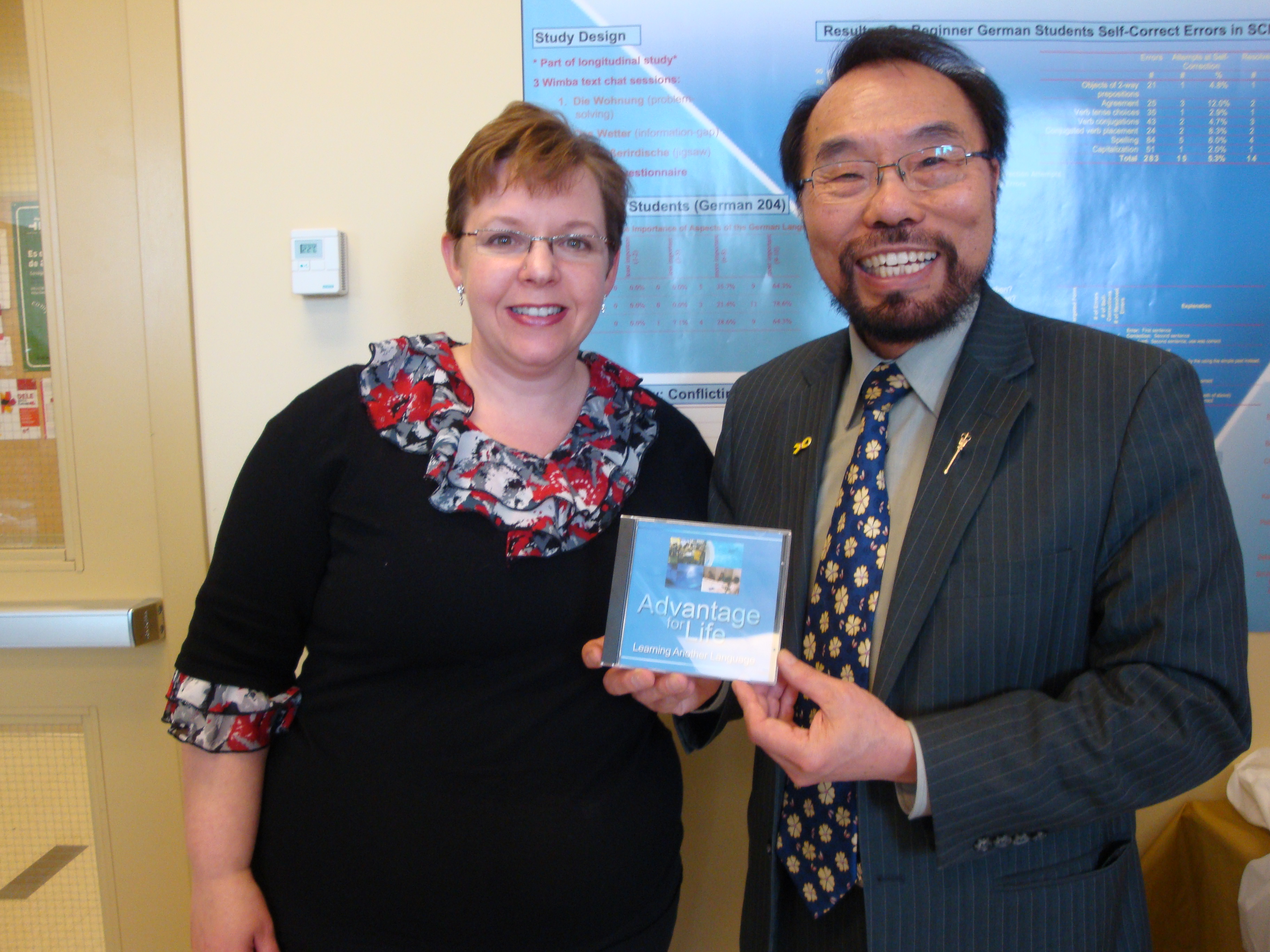
    Wayne Cao, MLA, Calgary Fort and Dr. Sarah Eaton

    Mr. Wayne Cao, MLA, Calgary Fort with me, holding the “Advantage for Life” CD produced by the Language Research Centre. This photo was taken at the IALW event.

Student Discussant: Ms. Jacqueline Warrell, PhD Candidate, Graduate Division of Educational Research

Event host: Dr. Sarah Eaton, Research Associate, Language Research Centre

The Institute for Innovation in Second Language Education (IISLE) will join us via videoconference from Edmonton.

For more information, visit these websites:

Alberta Advanced Education and Technology (AAET)
Language Research Centre

View this document on Scribd

_________________

Share this post: Lifelong Language Learning: Benefits for 21st Century Global Citizens http://wp.me/pNAh3-Bv

Update – January 2018 – This blog has had over 1.8 million views thanks to readers like you. If you enjoyed this post, please “like” it or share it on social media. Thanks!

Sarah Elaine Eaton is a faculty member in the Werklund School of Education, University of Calgary, Canada.


15 Tips To Be a Successful Expert Panelist

March 31, 2011

Over the past year I’ve been involved in a number of panel discussions as a panelist, host organizer and audience member.

Expert panelists are chosen for their experience, expertise, knowledge and wisdom on a particular topic. Audience members want to gain insight and understanding. As an expert who is invited to speak on a panel, your job is to contribute meaningful input that reflects your particular area.

Here are some “best practices” for experts to shine during a panel discussion:

1. Find out the topic or questions ahead of time – and prepare your answers.

Ask the panel organizer for the questions or topic ahead of time so you can prepare your answers. Don’t go into a panel discussion cold. This is an opportunity to have your voice hard and share your knowledge and wisdom. Taking the time to prepare answers will help you be more articulate in front of a live audience.

2. Avoid saying “As so-and-so just said…”

I once listened to a discussion where one “expert panelist” was so frazzled that another presenter had “stolen all the things” she was going to say, that she just kept saying “As Bob has already said…” and then went on to repeat his findings. There’s nothing that makes a panelist sound less informed!  Instead of saying, “As so-and-so just said…” try these openers:

  • “Building on the example given by s0-and-so, I’d like to add an example from my own experience…”
  • “It seems that so-and-so and I are on the same wave length. I echo what you’re saying and I can add to it with some evidence based on my own research…”
  • “Great point, so-and-so. Your insights echo findings from my own work. Your point reminds me of a study (or an example… or a “how to” tip…)

3. Showcase your unique expertise – without showing off

You’ve been invited to speak because you are a thought leader with “deep knowledge” in a particular area. Rather than offering generalizations, take this as an opportunity to showcase your unique knowledge. Come prepared with examples from your own research and experience. Give specific, rather than general answers, sharing details and evidence based on your own work.

It’s OK to be passionate, but no one likes a know-it-all. Being an expert doesn’t mean that you have all the answers or that your way of seeing things is the only “right” way. Find a balance.

4. Use a “head, hands, heart” approach to prepare answers (and back-up answers)

For every question, prepare 3 possible answers, each of which focuses on one of these areas:

A response from the head – Provide research-based evidence, empirical data or statistics.

A response from the heart – Prepare an answer that includes a personal example, a success story or a response meant to reach the emotions of the audience by motivating them or inspiring them.

A “hands-on” response – Provide practical “how to” information or give examples of how using a particular approach has been successful in a certain context.

Vary the types of answers that you give. If four out of the last five panel members have given heartfelt answers, change it up a bit by offering practical “how to” information. This helps to keep the audience emotionally and cognitively engaged.

Having different types of answers prepared for each question also helps you to avoid a situation where your mind goes blank because the presenter before you said everything you were going to say!

5. Be provocative

Giving answers that are sure to spark debate and further conversation is not a bad thing on a panel discussion. It can keep the session lively and engaging.

Before you make a controversial claim though, be sure to back up what you are saying with some solid evidence. Provide research, statistics and examples to strengthen your position in the debate.

6. Remain professional at all times

You may be part of a panel with someone you loathe or whose views are diametrically opposed to yours. Keep your cool at all times! This will help you shine as a professional. Here are some phrases to help:

  • “I understand where you’re coming from, but I see it differently. The reason why is…”
  • “You can absolutely do it the way that So-and-so is suggesting. Another way to approach this is…”
  • “I must respectfully disagree…”
  • “You know I respect you as a professional and you’ve given a lot to this field over the years. We haven’t always seen eye-to-eye and that helps keep us both on our toes. Here’s how I see this topic…”

7. Learn about your fellow panelists

Who else is on the panel? You may know the others on the panel, and you may not. Check out their backgrounds, experience, education, credentials and previous work they’ve done. Find out what matters to them. This will help you engage actively in a discussion, rather than just give your own point of view.

8. Acknowledge others’ expertise

Let your fellow panelists know that you’ve taken the time to learn about them and their work. Find a way to show appreciation for their contribution to the field. Here are some examples:

  • “Jane, I read your article on this topic that was published in ABCDEFG magazine two months ago. I just wanted to say how insightful I found it.”
  • “By the way, did you know that Joe won the ABCDEFG award for his work in this field last month?”
  • “Don, I was reading your blog last week. I thought your article on this topic was very thoughtful and poignant.”

9. Find out how long you have to give your answers

Panel discussions rarely have enough time to go in-depth on the topics. Ask your host how long you have to answer each question. Prepare answers that will fit within the time frame. Practice your answers aloud and time yourself.

Ask if there will be a time keeper to assist you. A time keeper seated near the panelists can use different colored cards to help panelists manage their time. For example:

  • A green card when there’s 1 minute left
  • A yellow card when there are 30 seconds left
  • A red card – You’re done. Stop speaking.

Avoid running on or taking up too much time. Honour the other panelists by leaving enough time for them to answer, too.

10. Ask about the room logistics and set up

Will you be seated at a table? In arm chairs? I was once part of a panel where there was no stage for the panelists, so in order to ensure we could be viewed from the back of the room, we sat on high bar stools! For me, since I’m 5’1″, it meant that one of my pet peeves was showcased in front a room of 150 people – my feet dangled from the chair. I delicately positioned myself so my feet tucked behind one of the legs of the stool so they weren’t floating in mid-air.

Find out if you’ll be using a mic and if so, will it be hand-held or a lapel mic? Knowing these details before hand will help you to prepare for the event.

11. Ask how you should dress

Is the event business, business casual or casual? Traditionally, darker colours are seen as being more business-like or serious.  If it is, think of yourself in context of the entire panel. You may want to avoid bold patterns or colours that may visually clash with other presenters (unless it’s an aspect of cultural attire that you’re accustomed to, or expected to wear).

The issue of dress is more important is the panel is being video-taped or photographed, so you may want to ask the organizers about whether you’ll be on camera.

12. Arrive early

Ask your host when you are expected to arrive. Even if you’re told “Oh, a few minutes before will be fine,” plan to arrive at least 30 minutes prior to the start of the event. Find a good parking spot, greet the organizers and other panel members, find out where to hang your jacket, survey the room and the set up, go to the bathroom and take a few minutes to relax before you’re in front of the audience.

13. Plan to stay late

Chances are, there will be the opportunity to connect with other panelists or engage in one-to-one conversations with audience members who were particularly interested in something you said. Budget at least an hour for networking after the event eventually closes. If there are media at the event, this will also be the time they’ll want to conduct interviews. If you have to leave right away, you could miss a media opportunity.

14. Remember to thank others

Acknowledging the contributions of your fellow panel members, thanking the audience for being there, recognizing funders and showing appreciation for the organizers are all appropriate things to do at the end of a panel discussion.

Again, avoid repeating what others have said. If someone else has already thanked the other experts, add something different such as, “I echo that sentiment. As well, I’d like to thank the volunteers (or set-up crew, or administrative staff, etc…)”

15. Have fun!

Above all else, have fun and enjoy yourself! This is a great opportunity to connect with others in the field and showcase your knowledge. Enjoy your time in the spotlight!

_____________

Share this post: 15 Tips to be a Successful Expert Panelist http://wp.me/pNAh3-Bi

Update – January 2018 – This blog has had over 1.8 million views thanks to readers like you. If you enjoyed this post, please “like” it or share it on social media. Thanks!

Sarah Elaine Eaton is a faculty member in the Werklund School of Education, University of Calgary, Canada.


Breathtaking Impact of Volunteers’ Contribution to Non-formal and Informal Literacy Education in Alberta

March 28, 2011

At the National Metropolis 2011 conference this year in Vancouver, I was part of a panel of experts presenting on Family Literacy and the New Canadian. My paper focused on the research I’ve done on Formal, Non-Formal and Informal Learning: The Case of Literacy, Essential Skills and Language Learning in Canada. I’ll post the entire paper shortly, but for now, I wanted to highlight one bit from it that generated some significant discussion.

My point was that when informal and non-formal learning for literacy and language learning are tracked and recorded, we can better see the impact. The example I gave was that in 2009, Alberta Advanced Education and Training, produced Living Literacy: A Literacy Framework for Alberta’s Next Generation Economy. The 19-page report talks about why literacy matters and outlines priority actions for 2009-2013.

Buried on page 12 of the 19-page report is a gem of information that deserves to be highlighted and explored, which is what I did at my presentation in Vancouver. It states that in Alberta,

“In 2008, 2,000 adults were matched with a volunteer tutor who assisted them with basic reading, writing and/or math. On average, these learners received 39 hours of tutoring. “

So what does this mean?

It means that volunteers collectively spent 78,000 hours assisting adults with literacy in non-formal and informal learning contexts.

78,000 hours. In one year. In one province.

Let’s put this into perspective.

According to the Government of Alberta, the average student will receive 950 to 1000 hours of instruction per year. Let’s look at that number of 1000 hours for a minute.

A student in school gets 1000 hours per year of instruction.

That means, collectively in Alberta, volunteers contributed the equivalent of 78 years of school, in the form of non-formal and informal education, helping other adults to improve their literacy skills.

That’s over three-quarters of a century in the equivalent of school years.

Doesn’t that just take your breath away?

Often when people think of adult non-formal and informal education, they think of developing countries, where formal education is harder to access than in developed nations. But the impact of non-formal and informal education in nations like Canada is significant. The problem is that we don’t track it. At least, not very often. And not very systematically.

What would we discover if every Canadian province, every US state and every developed country tracked the contributions made to language learning and literacy in the way that the Alberta government did in 2008? We’d be blown away by the results.

There’s a big push in the non-profit and education world to capture learner stories. I completely agree with that. But it’s not the whole picture. There’s a saying in evaluation: No numbers without stories; no stories without numbers.

The equivalent of 78 years of schooling, contributed completely by volunteers in one year alone is staggering.

One call to action in my presentation in Vancouver is that we must make a concerted effort to track the number of hours contributed by our volunteers – particularly those working in rural and remote areas – in order to understand the impact of volunteer literacy tutoring programs.

Stay tuned for the whole paper. It’ll be posted on line in a few days.

Related posts:

Formal, non-formal and informal learning: The case of literacy and language learning in Canada

Formal, non-formal and informal education: What Are the Differences?

Formal, Non-formal and Informal Learning: A podcast

Formal, Non-formal and Informal Learning (Infographic) https://wp.me/pNAh3-266

_____________

Share this post: Breathtaking Impact of Volunteers’ Contribution to Non-formal and Informal Literacy Education in Alberta http://wp.me/pNAh3-AK

Update – January 2018 – This blog has had over 1.8 million views thanks to readers like you. If you enjoyed this post, please “like” it or share it on social media. Thanks!

Sarah Elaine Eaton is a faculty member in the Werklund School of Education, University of Calgary, Canada.