Using Skype in Language and Literacy Programs

May 7, 2010

Skype is a free program. You set up a “Skype account” and download the program. Then, you add contacts, much like you would do in your e-mail program. Only you don’t e-mail using Skype. You talk or have a video call.

You and the other party, or parties, all need to have Skype installed on your computers. There are no tricks and no gimmicks. Think of it sort of like Hotmail or Gmail, but for voice and video calls.

Skype allows you to:

  • Voice and video calls to anyone else on Skype
  • Conference calls with three or more people
  • Instant messaging, file transfer and screen sharing

Why do I love Skype? Well, first of all, the basic service is free as long as you’re talking computer-to-computer. They also have really, really inexpensive plans were you can be on your computer and call to a regular land-line.

Here are some examples of how I use Skype:

Personally: Our family is spread out all over the place. We use Skype to talk long-distance, for free. The most amazing thing we do is with my Dad and step-Mom. They live in a remote area in Northern Ontario. Last year, my brother and his wife had a baby girl. Every Sunday night, everyone gets on Skype for a visit. My Dad gets to see his little grand daughter every single week and can watch her growing up. It’s connects our family in deeply meaningful way.

We like Skype so much in our house that we got Skype-enabled handsets that look and act just like a regular phone. We also use Skype now for computer-to-phone calling in our house and we really like it.

Professionally: I have used Skype for long-distance business. Last year, I had a consulting client in Sweden. Instead of doing phone coaching, we had our meetings via video call on Skype. It was much better than the phone, as we got to see one another and doing business was much easier (and less expensive).

Here’s another example of how I’ve used Skype in my work. Last week I was scheduled to give a webinar to a group in Tennessee. They called me at the last minute to say that the e-learning platform I’d been planning on using wouldn’t work for them. I asked if they used Skype. They said yes. We quickly exchanged user names and logged on. I gave the webinar using the screen sharing feature to go through the slides I’d prepared. At the end, they were super-happy with the presentation.

How can you use Skype in a language or literacy program:

Connect with your students: If students have Skype accounts, you can connect with them before they arrive, taking the time to connect with them and answer questions. From a relationship marketing point of view, this creates a super opportunity to create a personal bond with your students.

1-to-1 tutoring: I was giving a workshop on marketing to a group of literacy coordinators yesterday. One coordinator who works in a rural area commented that she has a hard time matching tutors with learners sometimes, as they are supposed to meet in public places, but it just isn’t convenient given the rural area in which they live. She’s obliged to match tutors and learners of the same gender, but said she had more female tutors and male learners, so it created a problem. I asked if her learners had technology literacy. She said that many of them did. I suggested that she introduce them to Skype to tutors and learners could be matched and each of them would work from their own homes.

Give information sessions and presentations: Skype has a screen-sharing feature that is brilliant for giving presentations. You can show PowerPoint slides and go through an entire presentation, just like I did with my clients last week. This is super for pre-arrival orientations, information sessions and other presentations you might give to prospective learners.

Skype is an amazing tool to help you connect with family, colleagues and learners.

Check out my research article on this topic:

Eaton, S. E. (2010). How to Use Skype in the ESL/EFL Classroom. The Internet TESL Journal, XVI(11). Retrieved from http://iteslj.org/Techniques/Eaton-UsingSkype.html

_________________________

Share this post: Using Skype in Language and Literacy Programs https://wp.me/pNAh3-4k

Update – January 2018 – This blog has had over 1.8 million views thanks to readers like you. If you enjoyed this post, please “like” it or share it on social media. Thanks!

Sarah Elaine Eaton is a faculty member in the Werklund School of Education, University of Calgary, Canada.


Want to change the world? Learn a language (Part 2 of 2)

May 5, 2010

A quick video on how leaders who learned other languages changed the world in deeply transformative ways. This video captures the essence of what I mean when I talk about leadership and language learning.

Click here to see: Want to change the world? Learn a language (Part 1 of 2)

________________________________

Share this post: Want to change the world? Learn a language (Part 2 of 2)  https://wp.me/pNAh3-4b

Update – January 2018 – This blog has had over 1.8 million views thanks to readers like you. If you enjoyed this post, please “like” it or share it on social media. Thanks!

Sarah Elaine Eaton is a faculty member in the Werklund School of Education, University of Calgary, Canada.


How to make a Facebook fan page

May 4, 2010

About a month ago I did a post entitled Language Schools and Facebook: Just do it. In it I recommended that language schools create a Facebook page. Since then, I’ve had people writing to me, saying that I should have done a post about how to make a FB page. Ask and ye shall receive.

You’ll need to have Facebook account to start. Once you have that, you can create a page for your organization.

Here are 5 easy steps to creating a Facebook page for your own school, business or organization:

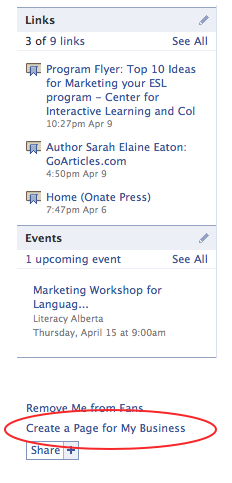
Create a page for my businessGo to another public Facebook “fan page”.  If you don’t have a favorite page, I invite you to stop by my page: http://www.facebook.com/EatonInternationalConsulting

Click on: “Create a page for my business”. You’ll find this on the far left bottom of a Facebook page. I’ve included a screen grab from my own page and circled it in red so you’ll know what to look for.

Create your page. Remember to include an appropriate graphic such as your logo.

Add some content. If you go to my page you’ll see that I have this blog linked to my Facebook page. My Facebook page is automatically updated every time I post something new on my blog. You may not be ready for automated content yet, but be sure to add a few links, an introductory note or other info about your organization.

Invite people to become fans or “like” your page. Use your list of Facebook friends as a start and let others “like” your page, too. It used to be that people had to “become a fan”. The new term is simply to “like” a page.

Here’s a bonus for you: Once you get 25 people who like your page (a.k.a. “fans”) you can request a vanity URL. This takes your long, complicated web address and turns it into something easy to remember, like mine. Once you have your 25 fans, just enter the key words “vanity URL” into the Facebook help pages, and you’ll be pointed to easy-to-follow directions on getting a nice, easy URL for your page.

_________________

Like this post? Tweet or send this URL on to others: How to Make a Facebook Fan Page http://wp.me/pNAh3-3V


Other people who have mentioned or forwarded this post:

http://topsy.com/trackback?utm_source=pingback&utm_campaign=L1&url=https://drsaraheaton.wordpress.com/2010/05/04/how-to-make-a-facebook-fan-page/

Update – January 2018 – This blog has had over 1.8 million views thanks to readers like you. If you enjoyed this post, please “like” it or share it on social media. Thanks!

Sarah Elaine Eaton is a faculty member in the Werklund School of Education, University of Calgary, Canada.


“Literacy and Empowerment: A contribution to the debate”

May 3, 2010

UNESCO has recently released “Literacy and Empowement: A contribution to the debate: Background study commissioned in the framework of the United Nations Literacy Decade”. Written by Nelly P. Stromquist, University of Maryland, this 13-page report delves into these topics:

  • Defining the concept of empowerment
  • Literacy and empowerment: The research evidence
  • Taking empowerment seriously

Stromquist shares key insights such as, “Learning is always a situated practice, within a specific cultural, institutional, and historical context. Learning is developmental in nature as students learn in different ways and at different times in their academic and ordinary lives.” (p. 7) and “there is an urgent need to reconceptualize adult literacy, all the way from program design to instructional approaches, from objectives to criteria for successful impact, from instructor/facilitator training to provision of graduated reading materials”.

This report is concise, easy-to-read and provocative. Here’s the direct download link: unesdoc.unesco.org/images/0018/001876/187698e.pdf

_____________

Share this post: “Literacy and Empowerment: A contribution to the debate” https://wp.me/pNAh3-3T

Update – January 2018 – This blog has had over 1.8 million views thanks to readers like you. If you enjoyed this post, please “like” it or share it on social media. Thanks!

Sarah Elaine Eaton is a faculty member in the Werklund School of Education, University of Calgary, Canada.


Leadership Book Recommendation: Good to Great

April 29, 2010

One of my goals for 2010 is to read one leadership book per month. I’ve been able to meet that goal and of the books I’ve read so far, the work of one author stands out. Jim Collins’ Good to Great: Why Some Companies Make the Leap and Others Don’t (2001) is an insightful read into why “good is the enemy of great” (p. 1). He shares insights such as:

  • “When you have disciplined people, you don’t need hierarchy. When you have disciplined thought, you don’t need bureaucracy.” (p. 13)
  • “There’s a huge difference between having the opportunity to have your say, and the opportunity to be heard.” (p. 74)
  • “The essence of profound insight is simplicity.” (p. 91)
  • “You can’t manufacture passion or motivate people to feel passionate. You can only discover what ignites your passion and the passions of those around you.” (p. 109)
  • “It is impossible to have a great life unless it is a meaningful life.”

After studying businesses, Collins did a short companion book called, Why Business Thinking is Not the Answer: Good to Great and the Social Sectors: A Monograph to Accompany Good to Great (2005). This is a thought-provoking little gem that helps us wrap our brains around the struggle that education and non-profit organizations face to be more like businesses. Collins makes a compelling argument that they shouldn’t try. He challenges us to think in new ways when he claims, that “most businesses are mediocre. Why would we want to import the practices of mediocrity into the social sectors?” (p. 1)

He talks about “organizational greatness”, as opposed to business as being something to aspire to. He urges us to consider that, “A great organization is one that delivers superior performance and makes a distinctive impact over a long period of time”. It’s easy to see how that could apply either to a business or a social sector organization.

Collins goes on to say that he suspects, “we will find more true leadership in the social sectors than the business sector” (p. 12). That’s quite a claim from a former faculty member of the Standford University Graduate School of Business.

Good to Great and the companion monograph, Good to Great and the Social Sectors are thought-provoking and insightful books on organizations and leadership. Well researched. Well written. Worth the read.