Alberta’s Proposed “Student First Act”: Analysis from an Academic Integrity Perspective

November 15, 2021

Last week the Hon. Adrianna LaGrange, Minister of Education in Alberta, published a commentary in the Edmonton Journal about a proposed new legislation she intended to bring forward called the “Student First Act”.

In this blog post I offer my perspective on this editorial through the lens of someone who studies educational integrity, including misconduct. I have pointed out my qualifications to comment on matters related academic misconduct in a previous blog post, so I won’t repeat them here. Suffice to say that I have some expertise related to academic integrity. Those familiar with my work will know that I advocate for a multi-stakeholder approach to academic integrity in which students, educators, and administrators are all held accountable for their behaviours. Academic integrity is about more than student conduct and examining educator and administrator misconduct remains an understudied area, but an important one.

In my analysis of LaGrange’s commentary (which was effectively an announcement about the new proposed legislation), I will examine both the positive and negative aspects of this announcement.

Lack of Transparency

LaGrange opened by stating that, “Fourteen years ago, as a newly elected school board trustee in Red Deer, I began hearing concerns about the lack of transparency in teacher disciplinary process. Now, as Alberta’s minister of education, I hear these same concerns from students and parents across the province.”

It’s a good thing that Minister LaGrange heard these concerns. There shouldn’t be any surprise with regards to misconduct occurring. Misconduct happens in almost every profession and teaching is no exception. Here LaGrange is signalling that she first became aware that there was a “lack of transparency in teacher disciplinary process”.

“Lack of transparency” is a trigger phrase. It is almost a guarantee that readers and members of the public will become offended when they hear about “lack of transparency”, especially from a government. As I have written about in my book, misconduct among educators is usually addressed by human resources. There are strict laws in Canada, including in Alberta, about what a human resources manager or department is legally permitted to disclose regarding an employee misconduct. I am not a labour relations lawyer, but I am confident saying that this “lack of transparency” is a function of existing labour laws, not a flaw in government policy.

Every large organization in Alberta and in Canada has policies and procedures in place to address employee misconduct. There are thresholds in place so that if a misconduct crosses over from an internal disciplinary matter to a criminal one, that these must be reported to police for investigation.

There is an assumption in the LaGrange editorial that school boards lack processes to investigate employee misconduct or that the existing processes are flawed. I suspect that if she dug a little deeper she would find that the existing policies and procedures conform to the labour laws already in place.

Praise… but…

LaGrange goes on to say, “While the overwhelming majority of teachers in the province are dedicated and caring professionals, we know that cases of inappropriate or even dangerous conduct do happen — and sometimes those cases involve a student.”

It’s good to see that the Minister of Education is acknowledging that “the majority of teachers in the province are dedicated and caring professionals”. This is a truism and there’s nothing really new here. In her book, Cheating: Ethics in Everyday Life, author Deborah Rhode guides us to think about cheating and other misconduct behaviours as a bell curve. At one end you have a small minority of people who rarely or never commit misconduct. At the other end, you have another small percentage of people who do bad stuff repeatedly and often. In the middle, there’s about 80% or so who are basically good most of the time, but can be influenced by circumstances on occasion.

One concerning aspect of LaGrange’s statement is that she seems to be focusing on the moral character of the teachers, rather than their behaviour. As someone who studies misconduct, I can say that in Canada, we treat misconduct cases as bad behaviour, not as a moral failing. This is an important distinction because these are drastically different philosophical positions. Bad behaviour can be corrected, but moral failings? That’s an entirely different matter. I am guessing that political scientists might agree that it would be a fool’s errand for any politician to comment on the moral failings of others…

“An extremely concerning case…”

LaGrange goes on to explain that in 2019 an “extremely concerning case” crossed her desk. Wow, that’s got to be bad, right? I mean… an extremely concerning case. We’d better pay attention here, folks.

Let’s unpack that though… A few paragraphs previously, LaGrange commented that she’s been hearing about misconduct cases for fourteen years. It took 14 years for an “extremely concerning case” to cross her desk? As someone who studies misconduct, I am genuinely surprised by this. For those of us who deal with misconduct on a regular basis as part of our jobs, it probably a matter of weeks or months — not years — before we come face to face with an egregious or complicated case. That’s like saying the Minister of Justice didn’t hear about a horrible criminal case until after a decade of being on the job. Really? How remarkably lucky for the minister that she has been in an educational leadership role and has not encountered an extremely concerning case for 14 years.

Of course, we do not know what the details of the case were and nor should we. What we do need to know is that if the case was so concerning that it crossed over into criminal behaviour, it should have been reported to the police. When the minister described that the teacher was “found guilty of inappropriately touching five young students and only a two-year suspension was recommended”. This makes me wonder if the case was reported to the police? Minister LaGrange does not comment on this in her article, but it really is a question worth asking.

Minister LaGrange that she found the recommended penalty for the teacher, “unacceptable” and that she “overturned the recommendation and handed down a lifetime teaching ban”.

Bravo for taking a stand, but the question remains, why was this case not reported to the police? There is no mention that law enforcement was involved. Surely the minister could have insisted that a case of alleged sexual violence against not one but five students be referred to the police immediately?

A Review of the Discipline Process for Educators

LaGrange goes on to say that this incident triggered “a review of the discipline processes for educators”. Periodic reviews of misconduct policies are a good thing. My colleagues and I have recommended such reviews for universities and colleges, for example. If regular reviews of misconduct policies are not already part of the educational policy governance process, then they should be. A review should not be a one-time effort, but a regular part of policy work.

LaGrange states, “cases are dealt with away from the public’s view”. Well, that’s pretty typical in an employee misconduct case, in part due to labour and privacy laws. It would be very unusual for any employer Canada to investigate and address employee misconduct cases in the public view. Employee misconduct cases are dealt with internally in almost every organization, unless the matter is criminal. If a case is criminal it might be prosecuted in court with case-related information being a matter of public record. I reiterate – why are allegations of sexual violence against students not reported to police?

LaGrange also goes on to say that cases “often take years to be settled after a complaint is made”. The timelines for addressing misconduct cases can — and should — be laid out in policy. This is easily fixed through a policy revision that outlines the number of business days permitted to address a case.

In large educational organizations, it is pretty typical for in-house counsel (i.e., the lawyers) to get involved to ensure that procedures are followed and to offer advice. One of the aspects of policy that lawyers provide guidance on is how much time to allow to ensure that a case can be dealt with fairly and in a timely manner.

The Current Legislation

Minister LaGrange states, “current legislation prohibits the government and myself from informing the public”. That’s because when it comes to employee misconduct there are laws in place to protect people’s privacy. This goes back to misconduct being a matter of bad behaviour not a moral failing. I know of no employer anywhere in Canada – including educational institutions – who engage in the practice of publicly naming and shaming every employee (or student) under review for or found responsible of misconduct.

Status of teaching certificates

LaGrange states, “Alberta’s current legislation is lagging behind. British Columbia, Ontario and Saskatchewan all have public registries where parents can easily check the status of their child’s teacher’s certificate”. Well, that’s also an easy fix. But let’s be clear that a public registry of valid teaching certificates should not be conflated with a registry of individuals who have or have not committed misconduct. Teaching certificates can lapse due to illness or any other reason. Besides, every school board in Alberta will ensure its teachers have a valid teaching certificate. Again, this is the job of the HR department.

Others have already commented on the misinformation in LaGrange’s commentary about the need for teachers to undergo police checks, so I’ll refrain from further analysis on that point. Suffice to say that, this point was poorly presented in the editorial.

LaGrange concludes by saying that she will be introducing the “Students First Act” in the legislature next week. I am curious to know what the proposed legislation will say and I’ll be watching carefully. Some key points to keep in mind are:

  • What are some easy ways to update current policies (e.g., the time allowed to address a misconduct case) without having to enact legislation? In other words, what’s the low hanging fruit here? What are some ways to tighten up existing policies and procedures quickly while still ensuring they are fair and comprehensive?
  • How do we keep the focus on identifying and correcting poor behaviour, as opposed to handing down moral judgement?
  • How do we ensure that addressing employee misconduct is not confused with a witch hunt designed to name and shame individuals?
  • And perhaps most importantly… how do we ensure that egregious instances of teacher misconduct that cross into criminal behaviour are reported to the police so the Minister herself does not have to serve as judge and jury in such cases?

We all agree that we want to “keep our students safe, parents informed and teachers accountable”, as LaGrange says. It’s how we do it that matters.

Related posts:

_________________________________________

Share or Tweet this: Alberta’s Proposed “Student First Act”: Analysis from an Academic Integrity Perspective – https://drsaraheaton.wordpress.com/2021/11/15/albertas-proposed-student-first-act-analysis-from-an-academic-integrity-perspective/

This blog has had over 2 million views thanks to readers like you. If you enjoyed this post, please “like” it or share it on social media. Thanks!

Sarah Elaine Eaton, PhD, is a faculty member in the Werklund School of Education, and the Educational Leader in Residence, Academic Integrity, University of Calgary, Canada. Opinions are my own and do not represent those of the University of Calgary.


Blogs as Public Scholarship: An Academic Integrity Example

June 30, 2021

It’s that time of year again… performance reporting for academic staff at our university happens every two years, with reports due on June 30. There was an official communication that came out a few months back saying we would not have to submit our reports in the usual way, using the online portal system. (Thank God for that… Even with the new system we got a couple of years ago, it still takes hours and hours to fill to enter one’s activities. It’s maddening). But we still had to do a report.

In my case, I had to do two, because over the past two years I have spent half of my time in my home faculty, the Werklund School of Education, and the other half of my time as the inaugural Educational Leader in Residence, Academic Integrity, at the Taylor Institute for Teaching and Learning.

Earlier this year, the University of Calgary signed the San Francisco Declaration on Research Assessment (DORA), which I was pretty excited about. It is part of an overall commitment to assess and value research and scholarly activity in a variety of ways, beyond the traditional peer-reviewed journal articles. Indeed, much of my work I share through public scholarship, including blog posts. Now, as long as I can show some impact from that work, it can be considered as part of my scholarship. That was not always the case.

I am not going to rattle off a whole bunch of numbers about how much I did of this or that (though let me tell you, I was exhausted after reading my own report). Instead, I’m going to focus on one blog post that a senior leader and mentor said in a personal communication “arguably may have been your most important public impact that you have made”. It was the blog post I did on April 3, 2021: Analysis of plagiarism in the draft Alberta K-6 curriculum.

Let’s look at the impact of this one blog post:

Total views: 36,000+

This single blog post resulted in more than 36,000 views (see Figure 1).

Figure 1.

Viewer statistics (n = 36,147) for “Analysis of Plagiarism in the Draft Alberta K-6 Curriculum. (Screenshot date: June 30, 2021)

That’s pretty good for a blog post — at least for me. I mean, I’m a professor who researches ethics and integrity. It’s not like my blog shows off the latest fashion or offers delicious recipes. This post was was — let’s be honest – as close to viral as I’m probably ever going to get.

Media attention

This analysis of plagiarism in the draft AB curriculum caught the attention of the media worldwide, with more than 60 news outlets globally reporting on it. (See details here: https://docs.google.com/document/d/1GuyeKP26wnpFT3i0FD2ztoQOoitKbwHv6OdRVUkGLZE/edit?usp=sharing)

You can see my CTV news interview about it here: https://calgary.ctvnews.ca/examples-of-plagiarism-found-throughout-draft-curriculum-1.5378232

Political action

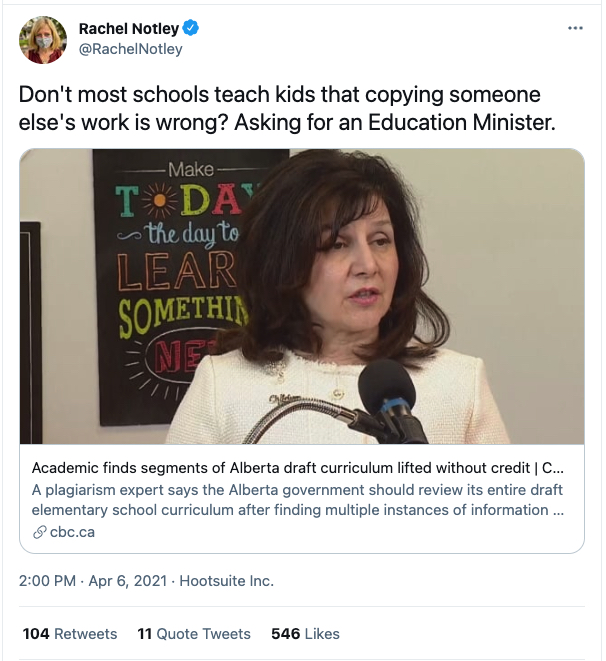
In addition, this work caught the attention of elected officials in Alberta, who shared news of the plagiarism in the draft curriculum on their social media platforms, such as this Tweet from the Hon. Rachel Notley, Leader of the Opposition. (see Figure 1).

Figure 1

Tweet from Rachel Notley, April 6, 2021.

In case you missed it, I was the “academic” quoted in the media article that the leader of opposition Tweeted out.

On April 6, 2021, the Hon. Rachel Notley, leader of the opposition, questioned the Minister of Education, the Hon. Adriana LaGrange, about the plagiarism in the draft curriculum during the official question period in the Alberta provincial legislature, as documented in the official legislative Hansard.

Although dozens and dozens of teachers and other members of the public commented on social media about the plagiarized passages in the draft curriculum, it is fair to say that my analysis of the plagiarism had an impact on all of that. It is not an impact that is easily quantified, but it is reasonable to conclude that the analysis helped to inform a broader public dialogue about the (deeply flawed) draft curriculum, plagiarism, and the need to pay attention to ethics and integrity in K-12 education.

Collaboration Resulting from the Work

This work led to a collaboration with Carla Peck, Angela Grace and others, supported by our respective Deans of Education, called the Alberta Curriculum Analysis project. Through this project, we are documenting numerous analyses of the draft curriculum, from a variety of contributors with different academic and disciplinary backgrounds. This project has become an important public artefact and act of scholarly advocacy to help hold our government accountable, as well as to inform the public.

Completely non-academic (and a little cheeky) impact

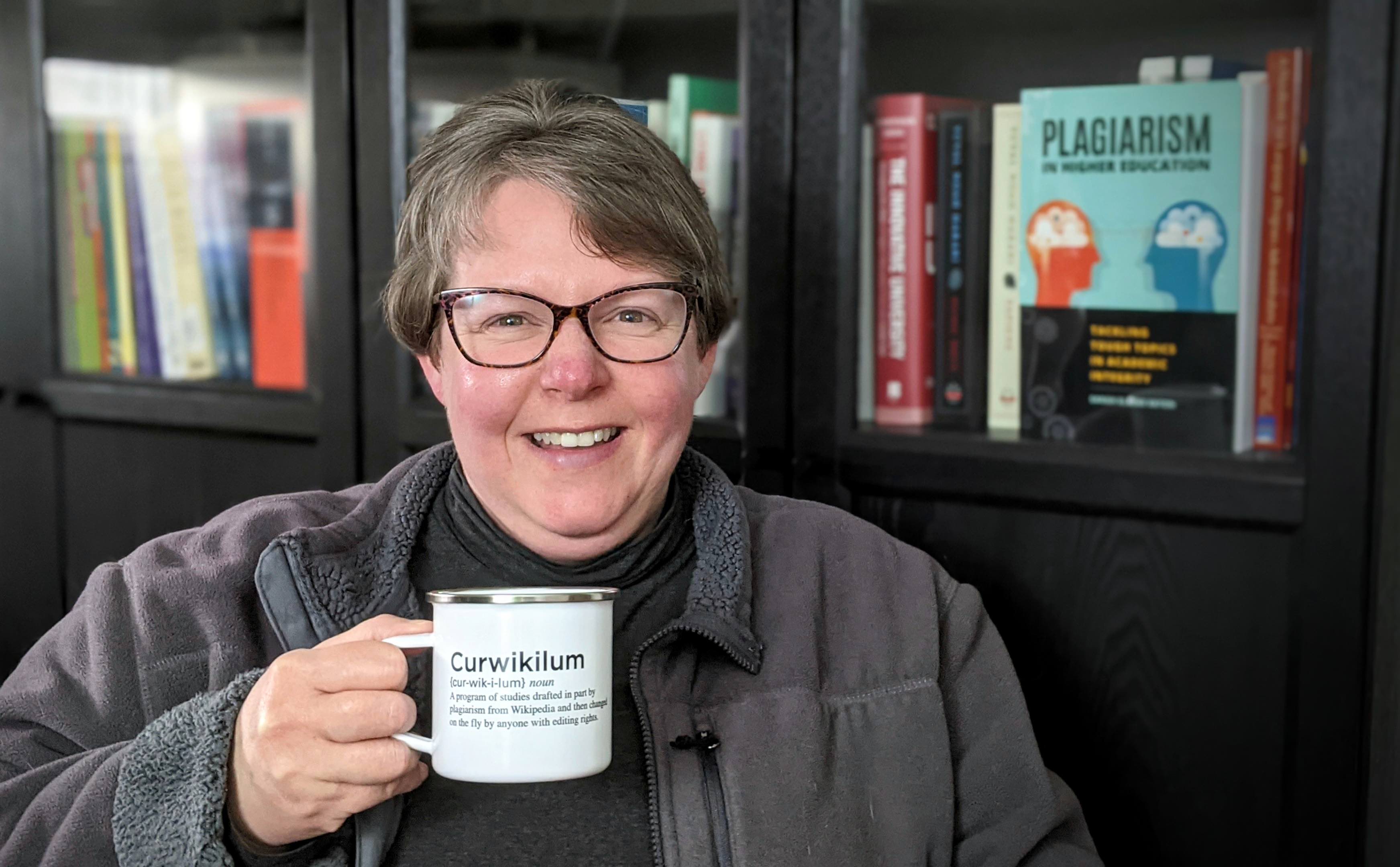
There’s a small business in Edmonton, Canada, called Fehr Play Creative that creates all kinds of custom and novelty products. Not long after I did my analysis of plagiarism in the draft curriculum, they came out with their “Curwikilum” novelty mug. A senior leader at the university bought me one as a gift and it quickly became my favourite, as you can see in this photo:

Figure 2.

Curwikilum mug produced by Fehr Play Creative in Edmonton, AB.

I didn’t ask the good folks at Fehr Play Creative to make this mug. It was entirely their idea. They did a play on words with “curriculum” and “Wikipedia”, coming up with “Curiwikilum” and defined it as: “(noun) A program of study drafted in part by plagiarism from Wikipedia and then changed on the fly by anyone with editing rights”.

It’s the perfect social commentary about what was happening with the draft curriculum… Passages lifted straight from Wikipedia and then slightly altered on the official government website in real time. This “on the fly editing” not only happened with plagiarized passages, but also other passages that members of the public and experts flagged as incorrect or objectionable.

One mug literally said it all. And in terms of impact, what can I say? I mean, man alive – Merch! How many academics can say their work has resulted (directly or indirectly) in novelty merchandise?! I honestly don’t think I’ve seen any kind of mug prior to this that talked about plagiarism. I mean — come on!! This is the area I research — and someone made a frikkin’ novelty mug about it! How utterly cool is that?! It’ll probably never happen again for the rest of my career, so I enjoyed the moment while it lasted.

Was any of this published in a peer-reviewed journal? Nope.

Was any of it reviewed by a peer in any way before I published it? Nope.

Did peers review it afterwards (voluntarily) and offer their comments on it in public forums such as Facebook and Twitter? You bet they did. (And they were very nice about it, I might add.)

Can I prove “cause and effect” with any of this?

Nope – and nor do I want to. Public scholarship isn’t about taking individual credit for work as a sole author and saying, “Hey funders (or whoever), see this causal link between my work and this great discovery?!” I don’t know of anyone who engages in public scholarship who would do that because the very idea is ludicrous.

It is imperative to push back on the notion that “impact” must equate to “cause and effect”. It doesn’t. In some cases the very idea is so reductionist it is nonsensical.

It’s not about “if A (i.e., my research) then B (i.e., some great result)”. Public scholarship is about contributing to a broad public discourse in an informed way through scientific and scholarly inquiry. It is one contribution to a great big important conversation over which few individuals (if any) have direct control, but together, we can collectively make a difference. If I can make a difference with my work that puts the focus of education squarely on ethics and integrity, then it’s all worth it.

This is the kind of scholarship I am interested in now: the kind that makes a difference. Of course, I know I still have to do the peer-reviewed journal articles. That’s part of the job. But more and more I am realizing that peer-reviewed journal articles are, ironically, the kind of work that has the least impact.

So my advice to my fellow academic integrity and ethics scholars — and academics in general — is this: Do what you need to do because your job requires it, but keep doing your public advocacy work, your blog posts, and your public scholarship because it can – and does – make a difference.

____

Share or Tweet this: Blogs as Public Scholarship: An Academic Integrity Example – https://drsaraheaton.wordpress.com/2021/06/30/blogs-as-public-scholarship-an-academic-integrity-example/

This blog has had over 2 million views thanks to readers like you. If you enjoyed this post, please “like” it or share it on social media. Thanks!

Sarah Elaine Eaton, PhD, is a faculty member in the Werklund School of Education, and the Educational Leader in Residence, Academic Integrity, University of Calgary, Canada.

Opinions are my own and do not represent those of the University of Calgary or anyone else.

Follow me on Twitter.


Analysis of Plagiarism in the Draft Alberta K-6 Curriculum

April 3, 2021

Since the draft of Alberta’s new K-6 curriculum was released by Adrianna LaGrange last week it has been under scrutiny. One of the concerns is plagiarism. Teachers have been posting examples of alleged plagiarism on social media and sending them to me directly for analysis. To be honest, my inbox exploded last week and I can hardly keep up. I lost track of all the messages I received via e-mail and social media, but I estimate that at least 100 examples have been sent to me, some of which are duplicates. In this post, I offer my analysis of a few of these examples.

In the interest of full transparency, I am not, nor have I ever been, a teacher in the K-12 system. My teaching career has been in higher education. I earned a PhD in educational leadership and my research expertise is on academic misconduct including plagiarism and contract cheating. My peer-reviewed scholarly papers include this one in which I analyze definitions of plagiarism. I serve as the Editor-in-Chief of one of the most respected journals in the field, the International Journal for Educational Integrity, published by BMC Springer Nature. I also serve on a multi-country working group for educational policy focused on academic integrity, through the European Network for Academic Integrity. My latest book, released just last month, focuses specifically on plagiarism. And I am one of two Canadians to hold a seat on the 40-person global Committee on Publication Ethics (COPE) Council. In other words, I am more than qualified to undertake an analysis of alleged plagiarism.

Definition of Plagiarism

As I have pointed out here and here, there are no absolute definitions of plagiarism. There is general consensus that plagiarism happens when someone uses the words or ideas of another without attribution. This can include copy-and-paste plagiarism (i.e., direct plagiarism), as well as the practice of re-arranging or swapping out words from the original text with synonyms (i.e., indirect plagiarism). Similarly, if an original text is paraphrased without attribution, that is also often considered plagiarism (i.e., also called indirect plagiarism).

Detecting and Declaring Plagiarism

There is no single way to detect plagiarism or declare definitively that it has occurred. There are text-matching software products (e.g., Turnitin) that can find exact matches between two texts quickly. Human detection can also be highly effective, particularly when the individual investigating the case(s) is qualified and experienced, as in my case. In my analysis, I have conducted a manual analysis of individual examples, unaided by any software.

Purpose of this Review

My goal with this review is (1) to determine if there is plagiarism in the Draft Alberta K-6 Curriculum from my perspective as an expert researcher on this topic; (2) to provide a base of evidence for further dialogue among Alberta citizens, including educators and policy makers; and (3) to offer recommendations and next steps.

My goal is not to critique the content of the draft curriculum. Others, such as Dr. Carla Peck, have already done an excellent job of that. In my inquiry, I focus specifically on the issue of plagiarism.

In the sections that follow, I offer my analysis of some examples from the Draft Alberta K-6 Curriculum. These examples are not exhaustive, and nor are they meant to be. My inbox has been filling up with examples teachers have sent to me over the past week. I simply do not have time to analyze all of these examples for plagiarism that have been sent to me from the draft AB Curriculum; there are too many. I have randomly selected some and analyze them in depth.

I conducted my analysis April 1 – 3, 2021. It is possible that some of the draft text may have changed during that time. It is easy to change digital text online. Some websites, such as Wikipedia, track every change that is made to text. In other cases, it can be difficult to track how digital text was changed on some websites unless captures of previous versions were taken using tools such as the Wayback Machine Internet Archive. Screen shots can help capture how a text looks on a website at a given moment in time, so I have included screen shots in my analysis, along with a date and timestamp to further validate the work.

I have verified and carefully reviewed each one. Below I offer specific and detailed analysis of individual cases.

Example #1: Draft Physical Education and Wellness Kindergarten to Grade 6 Curriculum

The first example is from the draft physical education curriculum. The specific passages in question, come from the text of the draft Grade 2 curriculum:

“Adventurous play can

  • promote independence and problem solving
  • provide direct experience of cause and effect
  • develop children’s coordination and bodily control
  • boost self confidence and emotional resilience
  • reduce stress
  • satisfy curiosity and a need for challenge” (p. 1-2)

Screenshot 01: Draft Alberta Curriculum for Physical Education, Grade Two. https://curriculum.learnalberta.ca/curriculum/en/c/pde2 . Screen shot taken April 3, 2021 at 08:05.

Screenshot 01: Draft Alberta Curriculum for Physical Education, Grade Two. https://curriculum.learnalberta.ca/curriculum/en/c/pde2 . Screen shot taken April 3, 2021 at 08:05.

Screenshot 01: Draft Alberta Curriculum for Physical Education, Grade Two. https://curriculum.learnalberta.ca/curriculum/en/c/pde2 . Screen shot taken April 3, 2021 at 08:05.

Likely source text: North Vancouver Recreation Centre

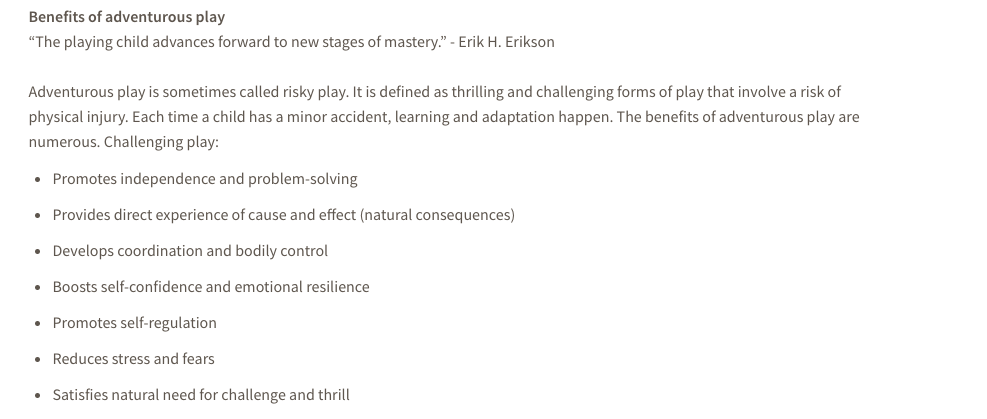
The text of the draft curriculum bears a striking resemblance to this text from the North Vancouver Recreation Centre:

“Adventurous play is sometimes called risky play. It is defined as thrilling and challenging forms of play that involve a risk of physical injury. Each time a child has a minor accident, learning and adaptation happen. The benefits of adventurous play are numerous. Challenging play:

  • Promotes independence and problem-solving
  • Provides direct experience of cause and effect (natural consequences)
  • Develops coordination and bodily control
  • Boosts self-confidence and emotional resilience
  • Promotes self-regulation
  • Reduces stress and fears
  • Satisfies natural need for challenge and thrill”

Screenshot 02: North Vancouver Recreation Centre. https://www.nvrc.ca/notices-events-blog/active-living-blog/importance-adventurous-play. Screenshot taken April 3, 2021 at 08:11

Screenshot 02: North Vancouver Recreation Centre. https://www.nvrc.ca/notices-events-blog/active-living-blog/importance-adventurous-play. Screenshot taken April 3, 2021 at 08:11

Analysis: The two texts are remarkably similar. Although some words have been changed, the substance of the content is largely the same. Also, the items in the list are in pretty much the same order in both cases.

Conclusion: This content should have been attributed to the North Vancouver Recreation Centre. Without attribution, this would be classified as plagiarism.

Example #2: Draft Social Studies Kindergarten to Grade 6 Curriculum

Educators have e-mailed me with numerous concerns about plagiarism in the draft social studies curriculum. In this example, the text in question comes from the Grade 6 draft curriculum:

“The religious affiliation of most Albertans is Christian, and the largest denominations are Roman Catholic, United, Anglican, Lutheran, and Baptist churches.”

Canada and Alberta’s latest census data on Albertan and Canadian religious diversity” (p. 33).

Screenshot 03: Draft Alberta Curriculum for Social Studies, Grade Six. https://curriculum.learnalberta.ca/curriculum/en/c/sss4 . Screen shot taken April 3, 2021 at 08:38

Screenshot 03: Draft Alberta Curriculum for Social Studies, Grade Six. https://curriculum.learnalberta.ca/curriculum/en/c/sss4 . Screen shot taken April 3, 2021 at 08:38

The text of the draft curriculum is very similar to text that appears on the Wikipedia page for the Demographics of Alberta:

“Over 60 percent of Albertans identify as Christian, while almost 32 percent of residents identify with no religion. The largest denominations are the Roman CatholicUnitedAnglicanLutheran, and Baptist Churches.”

04 - Screen Shot 2021-04-03 at 8.26.32 AM

Screenshot 04: Wikipedia page, “Demographics of Alberta”. https://en.wikipedia.org/wiki/Demographics_of_Alberta . Screenshot taken April 3, 2021 at 08:26

Analysis: The similarities between the two texts is obvious. What was not immediately obvious was whether the Wikipedia text had been changed recently to make it look as if plagiarism had occurred after the draft had been released. I took a look at the revision history of this Wikipedia page (which is openly available to everyone on the Internet).

Screenshot 05: Revision history for Wikipedia page “Demographics of Alberta”. Screenshot taken April 3, 2021 at 08:27

Screenshot 05: Revision history for Wikipedia page “Demographics of Alberta”. Screenshot taken April 3, 2021 at 08:27

It does not appear to me as though the page was maliciously modified after the draft curriculum was released. (Note: In this blog post from 2012, I state openly that I do not consider Wikipedia to be reliable source material for academic work. This would include curriculum development.)

Conclusion: Although this is a short passage, its similarity to the Wikipedia page is close enough that attribution should be provided. In cases such as Wikipedia, attribution should include a “retrieved from” date to indicate when the source material was consulted. Without attribution, this could be classified as plagiarism.

Example #3: Draft Social Studies Kindergarten to Grade 6 Curriculum

In this example, the text in question comes from the Grade 6 draft curriculum, under the knowledge section:

“A popular theory, proposed as a way of drawing a distinction between two different societies, the United States and Canada: It suggests that there is a difference between the Canadian mosaic, where ethnic groups have maintained their distinctiveness while functioning as part of the whole, and an American melting pot, where peoples of diverse origins have allegedly fused to make a new people.” (p. 32)

Screenshot 06: Draft Alberta Curriculum for Social Studies, Grade Six. https://curriculum.learnalberta.ca/curriculum/en/c/sss4. Screenshot taken April 3 at 09:03

Screenshot 06: Draft Alberta Curriculum for Social Studies, Grade Six. https://curriculum.learnalberta.ca/curriculum/en/c/sss4. Screenshot taken April 3 at 09:03

Original text: The text above is an exact duplication of text published in a 1976 article authored by Howard Palmer, published in the International Journal.

Screenshot 07: Palmer, H. (1976). International Journal. https://search.proquest.com/docview/1290345770?pq-origsite=gscholar&fromopenview=true&imgSeq=1# Screenshot taken April 3, 2021 at 09:08

Screenshot 07: Palmer, H. (1976). International Journal. https://search.proquest.com/docview/1290345770?pq-origsite=gscholar&fromopenview=true&imgSeq=1# Screenshot taken April 3, 2021 at 09:08

Conclusion: The original author’s words have been duplicated without attribution. This is an obvious case of word-for-word plagiarism.

Discussion

I have identified several different sources in my brief analysis. This indicates that content has been lifted or borrowed from multiple original sources, not just one or two. Others have commented that additional source material might have come from CoreKnowledge and specifically, the Core Knowledge Sequence.

The approach of taking bits and pieces of others’ content and stitching it together into an allegedly new document is called patchwriting, a term used extensively by plagiarism scholars such as Rebecca Moore Howard and Diane Pecorari. Patchwriting happens when writers lack the skills or confidence to paraphrase effectively and is widely regarded as an indication that the writer needs support.

This draft curriculum is a patchwork of material pulled from different sources. Plagiarism happens when source material is not attributed. A basic tenet of academic and research integrity is to give credit where it is due. In this draft curriculum, there is little to no indication of acknowledgement of those whose ideas and words contributed to its development. It appears as though the draft of Alberta’s new K-6 curriculum is rife with plagiarism.

Critics will no doubt jump on the fact that I have analyzed only three examples in this article. Although that is true, I began this post by saying that Alberta teachers have e-mailed me dozens and dozens of passages from the new curriculum that they believe have been plagiarized from a variety of sources. It actually isn’t my job to detect plagiarism in the new curriculum; it is up to the Alberta government to do that. I have provided enough examples here to show that further investigation is warranted, as is further discussion. There is much more to analyze than I had the time to do in a few days. It was important to me to get this post published so as to inform an evidence-based dialogue.

Recommendations and Solutions

The solution for plagiarism is easy: Cite the original source material. Here are three easy steps to fix the plagiarism in the draft of Alberta’s new K-6 curriculum:

Step 1: Identify content replicated or paraphrased from other sources. This will require a line-by-line review of the entire draft curriculum.

Step 2: Document where the original source material came from. Keep detailed notes of who wrote the content, as well as when and where it was published.

Step 3: Cite and reference all the sources consulted in the development of the curriculum. (If you need a refresher on the difference between citing and referencing, I explain it in this post.)  In the References below I have provided details of the original sources I consulted to conduct my analysis for this blog post. I have used APA formatting, but any format would be fine. The key is to publicly show what source material was consulted and give credit to the original authors. Give credit where it is due. In many cases, plagiarism is entirely preventable.

The draft of Alberta’s new K-6 curriculum for English Language Arts and Literature states that:

“Ethical use of information includes

  • asking permission to use, share, or store information
  • acknowledging the ownership of information used to inform writing (citing)” (p. 42 and p. 63)

These are skills that the Alberta government wants children in Grades 4 (p. 42) and Grade 5 (p. and p. 63) to learn. Surely if we are asking children in grades 4 and 5 to demonstrate the skills of ethical use of information, we should expect the same of the adults who develop the curriculum.

Acknowledgements: I wish to acknowledge all those who sent me examples of problematic passages in the new draft curriculum via e-mail or social media. Some of you wish to remain anonymous, so I conclude with a general note of thanks to everyone who has contributed to this inquiry. I am sorry I do not have time to analyze all of your examples, but I appreciate you sending them to me.

Follow up: New of the plagiarism in the Draft K-12 curriculum has now been shared by more than 60 media outlets worldwide.

References:

Demographics of Alberta. (n.d.). In Wikipedia.  Retrieved April 3, 2021. https://en.wikipedia.org/wiki/Demographics_of_Alberta

North Vancouver Recreation Centre. (2018). Importance of Adventurous Play. https://www.nvrc.ca/notices-events-blog/active-living-blog/importance-adventurous-play

Palmer, H. (1976). Mosaic versus melting pot?: immigration and ethnicity in Canada and the United States. International Journal, 31(3), 488. Retrieved from https://search.proquest.com/docview/1290345770?pq-origsite=gscholar&fromopenview=true&imgSeq=1#

_____

Share or Tweet this: Analysis of Plagiarism in the Draft Alberta K-6 Curriculum – https://drsaraheaton.wordpress.com/2021/04/03/analysis-of-plagiarism-in-the-draft-alberta-k-6-curriculum/

This blog has had over 2 million views thanks to readers like you. If you enjoyed this post, please “like” it or share it on social media. Thanks!

Sarah Elaine Eaton, PhD, is a faculty member in the Werklund School of Education, and the Educational Leader in Residence, Academic Integrity, University of Calgary, Canada.

Opinions are my own and do not represent those of the University of Calgary or anyone else.

Follow me on Twitter.


Why Superboards Could Signal the Dismemberment of Alberta’s Higher Education System

January 23, 2021

A recent CBC News article by Janet French highlights the Alberta government’s plan to establish superboards to oversee higher education in the province. It is imperative for Albertans to understand the possible implication that superboards might have on our post-secondary system.

French’s article worth a read. And pay attention to every word.

Similar to California?

Someone asked me recently whether there were other examples of this type of superboard governance that we could refer to get a concrete idea of what it might mean for Alberta. My response at the time was that to the best of my knowledge there were no such similar systems in the Commonwealth.

Canadian higher education shares much in common with its Commonwealth cousins, as it is based largely on the British system of education. It is a long history lesson, but suffice to say that the American higher education system differs from ours in some fundamental ways. Although the Canadian and American systems started out in a similar vein, the American Revolution caused some fundamental shifts that led to a bifurcation of the educational trajectories of both countries. The resulting Constitution of the United States, enacted after the revolution, provides for a far more open and entrepreneurial approach to education.

This is one reason that there are literally thousands of private universities and colleges in the United States that operate with much less oversight or quality assurance than Canadian universities and colleges. Overall, the quality of higher education across Canada is generally more consistent and steady and we do not have the drastic differences in institutional reputation that affect our neighbours to the south. This is also due, in part, to differences in how higher education is governed in both countries. Although Canadian and American universities share much in common in some ways, in other ways, they differ dramatically. One of those ways is governance.

MRU political science professor and political commentator, Duane Bratt sparked a lively conversation about this topic on his Twitter feed. One of the comments that came up is that a unified university system seems to work for the University of California (UC), so maybe it could work here. The UC system includes ten universities such as UC Berkeley, UC San Diego, etc. (As an aside, the University of Calgary’s own president, Ed McCauley, worked at UC Santa Barbara before returning to the University of Calgary in 2011, so he is no doubt well versed on the UC system.)

A system similar to the UC system could be one possible outcome if one or more superboards for post-secondary education in Alberta were to be implemented. However, I would point out that although the University of California has an excellent reputation in many respects, it exists as one institution within a larger state context.

The state of California has some of the most flexible (lax?) laws around the operation of educational entities. Retired FBI Agent, Allen Ezell and his colleague John Bear, write extensively about this in their book, Degree Mills. To paraphrase some of their key ideas, just about anyone can open a business in the state of California and call it a school. This has led to a proliferation of private entities offering so-called educational programs of questionable quality, or in some cases, outright fraudulent credentials. Although the University of California may be a reputable school, it is situated in a state where, without exaggeration, literally hundreds of other alleged universities and colleges dole out parchments with little to no credibility behind them. In my opinion, the larger higher education system that exists in the state of California is not one to which Alberta ought to aspire.

Lack of clarity regarding a possible superboard

In his remarks to the General Faculties Council (GFC) on December 10, 2020 President McCauley commented that the University of Calgary has been advocating for “the continuance of bicameral University governance and autonomy” (p. 2). The minutes of the GFC meeting are a matter of public record and can be found here.

These remarks at GFC, as well as commentary made by our executive leaders since then should not be taken lightly. They signal that our university president, along with other university presidents in Alberta, are concerned about the possibility of the dismantling of the bi-cameral governance model that currently exists at our institutions (i.e., at the University of Calgary, this means the Board of Governors and General Faculties Council) if a superboard to oversee universities is established. This website provides a brief overview of the University of Calgary’s governance and leadership.

It is not clear at the moment how an Alberta superboard for post-secondary governance might be structured or what powers they might have. It is also not clear if there would be one board for universities and another for colleges or if each system would be overseen by its own superboard. Right now there are more questions than answers. What is clear is that the possibility of establishment of one or more superboards to oversee higher education in Alberta poses the greatest potential for change to post-secondary governance that the province has seen in more than half a century – or perhaps ever.

A governance perspective: The potential dismemberment of Alberta’s higher education system

At this point, no one knows for certain what the superboards for higher education might mean. At the risk of sounding alarmist, if superboards are established, the possibility of the bicameral governance structure being dismantled is a real possibility. In turn, this could lead to a radical restructuring of Alberta’s post-secondary institutions.

I believe this is something we must pay close attention to. Funding cuts are one thing. The possibility of the dismemberment of our university governance structure is something else entirely. I use the word “dismemberment” here intentionally – and quite literally. To dismember is to sever the limbs from the body. The Board of Governors and the General Faculties Council are our university’s governing bodies. If the university does not have its own governing bodies, it would very likely lose its autonomy and its ability to function in the way it has for decades. This could be the case of every post-secondary institution in Alberta. Without bi-cameral governance, every single one of Alberta’s universities could be crippled in terms of their ability to make decisions for themselves.

When people hear that I study ethics and integrity in higher education, they often think that I study matters related to student conduct. Although that is true, it is not the entire story. The word “integrity” comes from the Latin, integritas, meaning to integrate or to make whole. A breach of integrity means that something that was previously whole has been compromised. In my opinion, the establishment of a superboard to govern higher education in our province could represent a direct threat to the integrity of our university system.

These superboards have not yet been formed, but now is very much the time for advocates of higher education to pay attention and become educated. At the very least I recommend spending some time on the Alberta 2030 Initiative website to find out more about some of what is planned for post-secondary education in Alberta.

I encourage you to learn as much as you can about how and why bi-cameral governance is a hallmark of Canadian higher education and how the autonomy it provides to individual institutions promotes ethical governance and decision-making in a variety of ways. Governance work is not values-free and nor is it agnostic. As Jenny Ozga so eloquently points out in her book, governance and policy work can be a form of advocacy. The very values that the University of Calgary – and other post-secondary institutions in Alberta – hold are lived out not only in the decisions that we make, but through the structures and systems in place that allow us to make those decisions in the first place.

_____

Share or Tweet this: Why Superboards Could Signal the Dismemberment of Alberta’s Higher Education System https://drsaraheaton.wordpress.com/2021/01/23/why-superboards-could-signal-the-dismemberment-of-albertas-higher-education-system/

This blog has had over 2 million views thanks to readers like you. If you enjoyed this post, please “like” it or share it on social media. Thanks!

Sarah Elaine Eaton, PhD, is a faculty member in the Werklund School of Education, and the Educational Leader in Residence, Academic Integrity, University of Calgary, Canada.

Opinions are my own and do not represent those of the University of Calgary or anyone else.


Workshop: Exploring Racism and Academic Integrity through a Circle Process

October 16, 2020

ATESL 2020I’m excited to partner with colleagues from Norquest College and the Alberta Council on Academic Integrity to present this workshop at the Alberta Teachers’ of English as a Second Language (ATESL) 2020 E- Conference: Seeds of Possibility: Curiosity, Drive, and Innovation.

Workshop Description

In this session participants will explore and experience the Circle of Courage and circle process by engaging in a dialogue on anti-racism and racism related to academic misconduct.

The Circle of Courage (Brendtro, Brokenleg, & Van Bockern, 2005) is a model of resilience and positive development based on Indigenous values of Belonging, Mastery, Independence and Generosity. Applied together with a circle process, this way of approaching the relational space in classrooms helps create the conditions for students and instructors to engage more authentically and openly in difficult complex topics. As a holistic approach to discussion this a way to spur conversation about the dynamic faced by English as additional language learners.

Keywords: Academic integrity; Restorative Justice; Restorative Practices; Circle Process; Racism

Reference:

Brendtro, L., Brokenleg, M., & Bockern, V. (2005). The circle of courage and positive psychology. Reclaiming Children and Youth, 14(3). 130-136.

Workshop Materials

You can download our workshop materials for free from here: http://hdl.handle.net/1880/112689

Presenter bios

Sheryl Boisvert, B.Ed, CPA, CGA is currently a full-time instructor at NorQuest College. Though she has performed a variety of roles since 2001, Sheryl has found being an instructor to be the most fulfilling.  She has always believed that students gain a better understanding of the material they learn when they can go beyond textbook theory and put concepts into practice.

Nazanin Teymouri, MBA, is as an instructor at NorQuest College in the Faculty of Business, Environment, and Technology. Currently her time at the college is split between teaching and co-leading research initiatives on academic integrity. With a background in communication and business, her focus is on analysis, cultural understanding, and collaboration aimed at bettering the learning environment.

Jamie Ahksistowaki Medicine Crane is Blackfoot from Kainai and Piikani, an activist, advocate, educator, and multi-disciplinary artist. Shes very passionate in education and is currently working with NorQuest College as a curriculum developer- in regards to Indigenous education, history and perspectives, building faculty capacity, supporting curriculum development and Indigenization strategy.

Sarah Elaine Eaton, PhD, is an Associate Professor at the Werklund School of Education, University of Calgary. She is a long-standing member of ATESL. Her research focuses on academic integrity.

_________________________________________

Share or Tweet this: Exploring Racism and Academic Integrity through a Circle Process – https://drsaraheaton.wordpress.com/2020/10/16/exploring-racism-and-academic-integrity-through-a-circle-process/

This blog has had over 2 million views thanks to readers like you. If you enjoyed this post, please “like” it or share it on social media. Thanks!

Sarah Elaine Eaton, PhD, is a faculty member in the Werklund School of Education, and the Educational Leader in Residence, Academic Integrity, University of Calgary, Canada. Opinions are my own and do not represent those of the University of Calgary.