Webinar: Contract Cheating and Cryptocurrency with Dr. Joel Reardon

November 12, 2020
man creating a presentation on laptop

Photo by Canva Studio on Pexels.com

Join Dr. Joel Reardon for insights into the role cryptocurrency plays in the outsourcing of academic work, also known as contract cheating, which is s serious breach of academic integrity. Learn what cryptocurrency is, how it works and how it can be used to purchase assignments, theses and other academic work.

Presenter: Dr. Joel Reardon, Assistant Professor, Department of Computer Science, University of Calgary.  Check out Dr. Reardon’s faculty profile.

Learning Objectives

By the end of this session participants will be able to:

  • Describe what cryptocurrency is.
  • Understand how cryptocurrency functions.
  • Understand the connection between cryptocurrency and contract cheating.

This session is part of the webinar series, “Academic Integrity: Urgent and Emerging Topics”, hosted by the Taylor Institute for Teaching and Learning. The series is convened by Dr. Sarah Elaine Eaton, Educational Leader in Residence, Academic Integrity.

Webinar date: Friday, 11 December, 2020

Time: 10:00 a.m. to 11:30 a.m. Mountain Time. Please convert to your own local time zone.

Registration Info

Register here. (Hint: Look for Course #TI0747-004 near the bottom of the page).

Deadline to register: 9 December 2020.

The session will be recorded and a link to the recording will be shared with registered participants. Even if you cannot make the webinar in live format, please register in order to receive the link to the recorded version.

______

Share or Tweet this: Webinar: Contract Cheating and Cryptocurrency with Dr. Joel Reardon

https://drsaraheaton.wordpress.com/2020/09/25/webinar-contract-cheating-and-cryptocurrency/

This blog has had over 2 million views thanks to readers like you. If you enjoyed this post, please “like” it or share it on social media. Thanks!

Sarah Elaine Eaton, PhD, is a faculty member in the Werklund School of Education, and the Educational Leader in Residence, Academic Integrity, University of Calgary, Canada. Opinions are my own and do not represent those of the University of Calgary.


Public talk: “The Latest Research on Big Tech and the Cheating Industry” – November 5, 2020

November 1, 2020

CPL logo

I’m excited to be working with the Knowledge Engagement Team at the Calgary Public Library to give a talk next week on contract cheating and term paper mills.

Description

Explore the world of essay-mills, homework completion services, academic-file sharing sites and other contract cheating companies. Ads on social media are often framed as “help”, implying and promoting academic misconduct. Learn how the industry works, how they trick students into buying from them, and the consequences that can ensue.

Date: Thursday, November 5, 2020

Time: 19:00 – 20:00 (Mountain Time)

Where: Online

Register here.

Audience: This is a general interest talk is intended for the public. Everyone is welcome.

Registration is required. The link to attend will be sent to registered participants.

This talk will not be recorded, but if you can’t make it feel free to connect with me about doing a presentation for your group.

______

Share or Tweet this: Public talk: “The Latest Research on Big Tech and the Cheating Industry” – https://drsaraheaton.wordpress.com/2020/11/01/public-talk-the-latest-research-on-big-tech-and-the-cheating-industry-november-5-2020/

This blog has had over 2 million views thanks to readers like you. If you enjoyed this post, please “like” it or share it on social media. Thanks!

Sarah Elaine Eaton, PhD, is a faculty member in the Werklund School of Education, and the Educational Leader in Residence, Academic Integrity, University of Calgary, Canada. Opinions are my own and do not represent those of the University of Calgary.


New Report: Contract Academic Work and Contract Cheating: Policy Brief

October 19, 2020

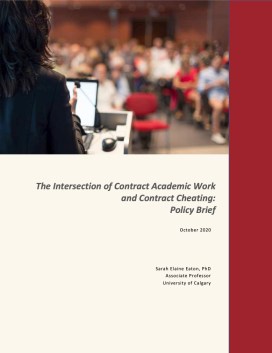
Cover - Contract academic work contract cheatingThe week of October 18-23, 2020 marks Fair Employment Week, hosted by the Canadian Association of University Teachers (CAUT). In many countries, it also marks Integrity Week, built around the International Day of Action Against Contract Cheating. These weeks have coincided for the past several years. A few years ago, I began to study the intersection of contract academic work and contract cheating (e.g., essay mills, term paper mills, etc.)

This report offers a preliminary discussion of the intersection between precarious academic employment and the commercial contract cheating industry. I have written it with the Canadian context in mind, though it may be relevant in other jurisdiction as well. The entire report is available for free download here.

Abstract

Purpose: The goal of this report is to provide substance for an evidence-informed discussion about the intersection of precarious academic employment and the contract cheating industry.

Methods: This is a qualitative report informed by the extant literature. It synthesizes available source material relating to academic staff who also supply services (e.g., essay writing, assignment completion, etc.) to the commercial contract cheating industry.

Results: A summary and synthesis are provided of issues relating to precariously employed academic staff and the contract cheating industry. A key outcome of this work is to highlight how the commercial cheating industry preys on underemployed academic staff. Predatory practices of the contract cheating industry are highlighted including false promises of high pay and meaningful work. Consequences such as disciplinary action and dismissal of academic staff who moonlight as suppliers to the industry are discussed, along with possible counter-measures to raise awareness and protect academic staff.

Implications: This guide is intended to provide guidance on methods used by the commercial contract cheating industry to exploit contract academic staff. Recommendations are provided on how to build awareness about the issue and also consider protections for the precariously employed.

Additional materials: 1 table; 46 references

Document type: Report, 26 pages

Keywords: academic integrity, higher education, academic labour, contingent faculty, precarious employment, cheating economy, sessional, adjunct, faculty

________

Share or Tweet this: New Report: Contract Academic Work and Contract Cheating: Policy Brief https://drsaraheaton.wordpress.com/2020/10/19/contract-academic-work-and-contract-cheating-policy-brief/

This blog has had over 2 million views thanks to readers like you. If you enjoyed this post, please “like” it or share it on social media. Thanks!

Sarah Elaine Eaton, PhD, is an Associate Professor the Werklund School of Education, and the Educational Leader in Residence, Academic Integrity, University of Calgary, Canada. Opinions are my own and do not represent those of the University of Calgary.


A Systems Approach to Address Contract Cheating

September 24, 2020

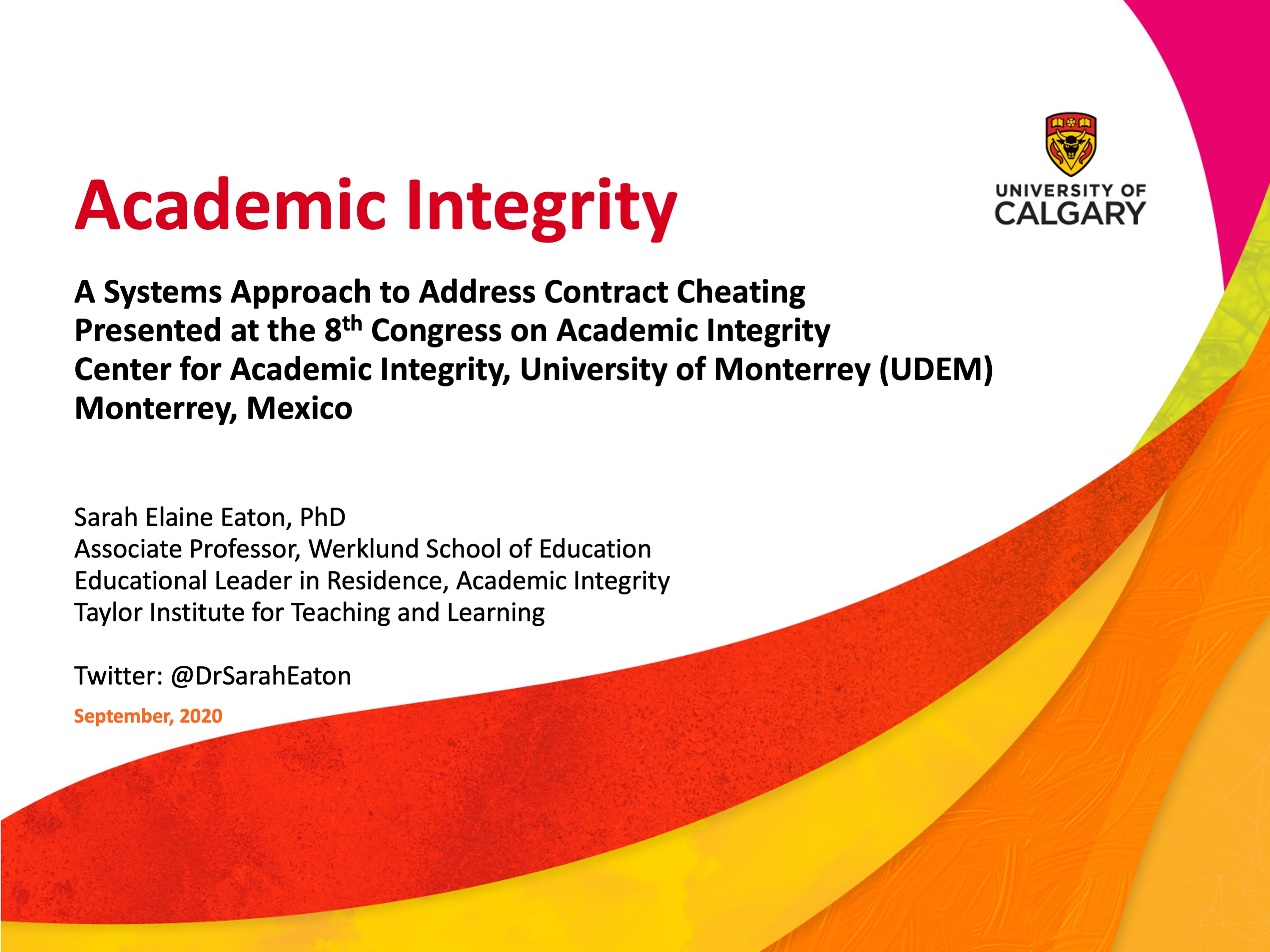
I’m delighted to be giving a presentation today at the the 8th Congress on Academic Integrity organized by the Center for Academic Integrity, University of Monterrey (UDEM), Monterrey, Mexico.

Slide1

Abstract

In this presentation I examine how a systems approach is needed to address contract cheating in its various forms. Using the 4M framework, I demonstrate the role of the individual (micro), the department (meso), the learning organization (macro) and stakeholders beyond the institution (mega).

In this session, I share insights from my forthcoming book, Plagiarism in Higher Education: Tackling Tough Topics in Academic Integrity to be published by ABC Clio/Libraries Unlimited in 2021.

Keywords: academic integrity, academic misconduct, contract cheating, 4M Framework, SoTL

You can find a complete English-language slide deck and the script for the talk archived online here: http://hdl.handle.net/1880/112560

Integridad Académica: Un enfoque de sistemas para enfrentar la compraventa de trabajo académico1
8.° Congreso de Integridad Académica

En esta presentación Eaton examina cómo y por qué se requiere de un enfoque de sistemas para abordar la compraventa de trabajo académico.

Utilizando el marco de referencia de las 4M, Eaton muestra el rol de la persona (micro), el departamento (meso), la institución y la comunidad (mega).

Palabras clave: integridad académica, mala conducta académica, marco de referencia de las 4M, Investigación en Docencia y Aprendizaje (IDA / SoTL)

Se encuentra las diapositivas y todo el contenido de esta presentación aquí:  http://hdl.handle.net/1880/112565

_________________________________

Share or Tweet this:

Academic Integrity: A Systems Approach to Address Contract Cheating 8th Congress on Academic Integrity https://drsaraheaton.wordpress.com/2020/09/24/a-systems-approach-to-address-contract-cheating/(opens in a new tab)

This blog has had over 2 million views thanks to readers like you. If you enjoyed this post, please “like” it or share it on social media. Thanks!

Sarah Elaine Eaton, PhD, is a faculty member in the Werklund School of Education, and the Educational Leader in Residence, Academic Integrity, University of Calgary, Canada. Opinions are my own and do not represent those of the University of Calgary.


¿Cómo se dice “contract cheating”? Exploring Academic Integrity Terminology in Spanish-speaking contexts

September 15, 2020

All Posts

by: Sarah Elaine Eaton and Beatriz Moya Figueroa

Abstract

In this brief report we explore linguistic differences in how contract cheating has been explained and translated into Spanish.

Keywords: academic integrity, academic misconduct, terminology, contract cheating

Palabras clave: integridad académica, mala conducta académica, terminología

Overview

Academic integrity is a concern across the world. Contract cheating, which is the outsourcing of academic work to third parties is a growing problem. We know that contract cheating happens in a multitude of languages, including Spanish (Eaton & Dressler, 2019). In order to address a problem, we must first have a common language to talk about it. The term “contract cheating” was coined by Clarke and Lancaster (2006), as a more updated way and comprehensive term to address academic outsourcing in text-based as well as non-text-based disciples. “Contract cheating” is now preferred over “essay mill” or “term paper mills”, though all of these terms remain in use in various contexts.

In this brief report we explore linguistic differences in how contract cheating has been explained and translated into Spanish.

ENAI Glossary: A Starting Point

We acknowledge and applaud the work done by the European Network for Academic Integrity (ENAI) (n.d.) to produce a multilingual glossary of terms relating to academic integrity. The glossary is available in ten languages; but currently, Spanish is not one of them. We consulted the glossary in the closest language, Portuguese, (see Taúginienė et al., 2019) and found contract cheating referenced as, “fraude no contrato” (p. 23), explained as, “Forma de má conduta que existe quando uma pessoa utiliza uma entidade terceira para a assistir a produzir trabalho, independentemente de envolver um pagamento ou favor” (p. 23).

Although the accompanying explanation describes contract cheating well, to translate “fraude no contrato” (Portuguese) into Spanish would result in “el fraude de contrato”, the meaning of which could be misconstrued as contractual fraud in a legal sense, rather than an academic one. For this reason, we contend that “el fraude de contrato” is not an appropriate translation of the English term, “contract cheating”.

In Search of a Spanish Translation

Having eliminated that possibility, we continued our inquiry, but we found no standardized translation of the term. Instead, we encountered a variety of phrases used in the literature. Some examples of translations we found include:

  • realización por parte de un tercero de trabajos escritos” (Gómez Córdoba & Pinto Bustamante, 2017, p. 170)

Gómez Córdoba & Pinto Bustamante (2017) self-identified in their paper as being in Columbia.

  • “comprar ensayos finales (u otros ensayos) en agencias específicas o de otros estudiantes” (Denisova-Schmidt, 2016, p. 6)

Denisova-Schmidt (2016) self-identified as working in Switzerland.

  • La “compraventa de trabajos académicos” (Comas, Sureda, Casero, & Morey, 2011, p. 209)

These researchers self-identified as being in Spain.

  • La “compra de textos” (Armesto, 2016, p. 6)

A review of the front matter of the publication in which Armesto’s article was published showed she works in Mexico.

We found the term used by Comas et al. (2011), “compraventa de trabajos académicos” to be the closest translation to the English phrase contract cheating if one is speaking about the commercial industry, including aspects of both buying and selling. However, we acknowledge that the term “compraventa de trabajos académicos” excludes those who complete academic work on behalf of others who do not receive payment (e.g. family members, partners, friends, etc.).

To convey the idea that a third party who is not part of the commercial cheating industry is completing work on behalf of a student, the phrase used by Gómez Córdoba & Pinto Bustamante (2017), “realización por parte de un tercero de trabajos escritos” might be more accurate. However, we point out that this phrase specifically addresses text-based disciplines and excludes fields where the academic work produced does not necessarily include prose writing, including computer code.

We do not claim that our search was exhaustive. We have highlighted particular examples from the extant literature to illustrate the inconsistency in how contract cheating is discussed in scholarship written in the Spanish language.

Conclusion: Call to Action

In order to effectively address a problem, we must first be able to name it; to talk about it in ways that others will understand. Only then can we, as community of educators, advocates, and scholars, be as unified in our actions against the problem as we are in the way we talk about it. Therefore, we conclude with a call to action to our colleagues across the Spanish-speaking world to produce a Spanish-language glossary for academic integrity that includes a precise phrase to convey contract cheating that can be used with confidence as a common term.

References

Armesto, G. (2016). El plagio académico: ¿Qué es y cómo distinguirlo? Revista de integridad académica, 1(1), 5-7.

Clarke, R., & Lancaster, T. (2006). Eliminating the successor to plagiarism: Identifying the usage of contract cheating sites. Paper presented at the Second International Plagiarism Conference, The Sage Gateshead, Tyne & Wear, United Kingdom.

Comas, R., Sureda, J., Casero, A., & Morey, M. (2011). La integridad académica entre el alumnado universitario español. Estudios Pedagógicos, 37(1), 2007-2225.

Denisova-Schmidt, E. (2016). El desafío global de la integridad académica. International Higher Education (Spanish edition), 87, 5-7. Retrieved from http://ceppe.uc.cl/images/stories/recursos/ihe/Numeros/87/art_03.pdf

Eaton, S. E., & Dressler, R. (2019). Multilingual essay mills: Implications for second language teaching and learning. Notos, 14(2), 4-14. Retrieved from http://hdl.handle.net/1880/110695

European Network for Academic Integrity (ENAI). (n.d.). Glossary. Retrieved from http://www.academicintegrity.eu/wp/glossary/

Gómez Córdoba, A., & Pinto Bustamante, B. (2017). La integridad académica: el dilema de la formación médica / Academic integrity: The dilemma of medical education. Revista Educación y Desarrollo Social, 11(2). doi:org/10/18359/reds.3248

Taúginienė, L, Gaižaúskaitė, I, Glendinning, I, Kravjar, J, Ojsteršek, M, Ribeiro, L, Odiņeca, T, Marino, F, Cosentino, M, Sivasubramaniam, S. Glossary for Academic Integrity (Portuguese). ENAI Report 3G [online]. Tradução de: Malaquias, A, Fachada, B, Ribeiro, L. 2019. http://www.academicintegrity.eu/wp/wp-content/uploads/2019/09/Glossary_PT.pdf

__________________________

Note: This post is a re-print of our short paper. Here is how to cite this content:

Eaton, S. E., & Moya Figueroa, B. (2020). ¿Cómo se dice “contract cheating”?: Exploring academic integrity terminology in Spanish-speaking contexts. University of Calgary. http://hdl.handle.net/1880/112526

_________________________________

Share or Tweet this: ¿Cómo se dice “contract cheating”? Exploring Academic Integrity Terminology in Spanish-speaking contexts https://drsaraheaton.wordpress.com/2020/09/15/como-se-dice-contract-cheating-exploring-academic-integrity-terminology-in-spanish-speaking-contexts/

This blog has had over 2 million views thanks to readers like you. If you enjoyed this post, please “like” it or share it on social media. Thanks!

Sarah Elaine Eaton, PhD, is a faculty member in the Werklund School of Education, and the Educational Leader in Residence, Academic Integrity, University of Calgary, Canada. Opinions are my own and do not represent those of the University of Calgary.