New Role: Academic Director, Equity, Diversity, and Inclusion (EDI), Education, and Academic Integrity

August 9, 2023

On July 1, 2023 I started a new role at the University of Calgary as the Academic Director, Equity, Diversity, and Inclusion (EDI), Education, and Academic Integrity. I have the privilege of working with Dr. Malinda Smith, Vice-Provost, EDI, and an entire team of academic and professional staff whose primary focus is on equity, diversity, inclusion, and accessibility.

In this role, I will:

  • Continue to build awareness of equity, diversity, inclusion, and accessibility as they relate to academic ethics across the university.
  • Advise and contribute to the development of resources and supports on academic ethics needed for leaders, academic staff, managers, support staff, students and other university stakeholders.
  • Develop local, regional, and national partnerships that connect initiatives related to academic ethics as they pertain to equity, diversity, inclusion, and accessibility.
  • Facilitate campus conversations related to academic ethics through existing networks, committees, and other informal and formal groups.
  • Develop action-oriented recommendations related to academic ethics from the perspective of equity, diversity, inclusion, and accessibility.
  • Focus on equity-deserving groups that include, but are not limited to, international students, visiting students, post-doctoral fellows, and early career researchers. 

For a few years now, my research and advocacy work as included a more intense focus on social justice, advocacy, and equity. Here is some work I’ve done in the past few years that led to this role that might be helpful if you’re looking for resources on this topic:

The forthcoming Handbook of Academic Integrity (2nd ed.) has a brand new section on Equity, Diversity, and Inclusion in Academic Integrity. Dr. Ceceilia Parnther serves as the Section Editor. Bringing this topic to light in the handbook will help to centre important conversations about discrimination and advocacy for student success and the student experience.

I am excited to take on this work and look forward to the ways in which we can make progress on these important matters.

_________________________________

Share this post: New role: Academic Director, Equity, Diversity, and Inclusion (EDI), Education, and Academic Integrity – https://drsaraheaton.wordpress.com/2023/08/09/new-role-academic-director-equity-diversity-and-inclusion-edi-education-and-academic-integrity/

This blog has had over 3 million views thanks to readers like you. If you enjoyed this post, please “like” it or share it on social media. Thanks! Sarah Elaine Eaton, PhD, is a faculty member in the Werklund School of Education, and the Educational Leader in Residence, Academic Integrity, University of Calgary, Canada. Opinions are my own and do not represent those of the University of Calgary.


A Comprehensive Academic Integrity (CAI) Framework: An Overview

April 14, 2023

This post is a reprint of a self-archived document available here: https://prism.ucalgary.ca/handle/1880/116060

Background

As I write this, the Handbook of Academic Integrity (2nd ed.) is well underway. All the chapters have been submitted and are at various stages of review, revision, and production. Page proofs should start going out to contributing authors this month. This has been a massive project: 150+ authors, 109 chapters, 9 section editors, and me herding all the cool cats who have made it happen.

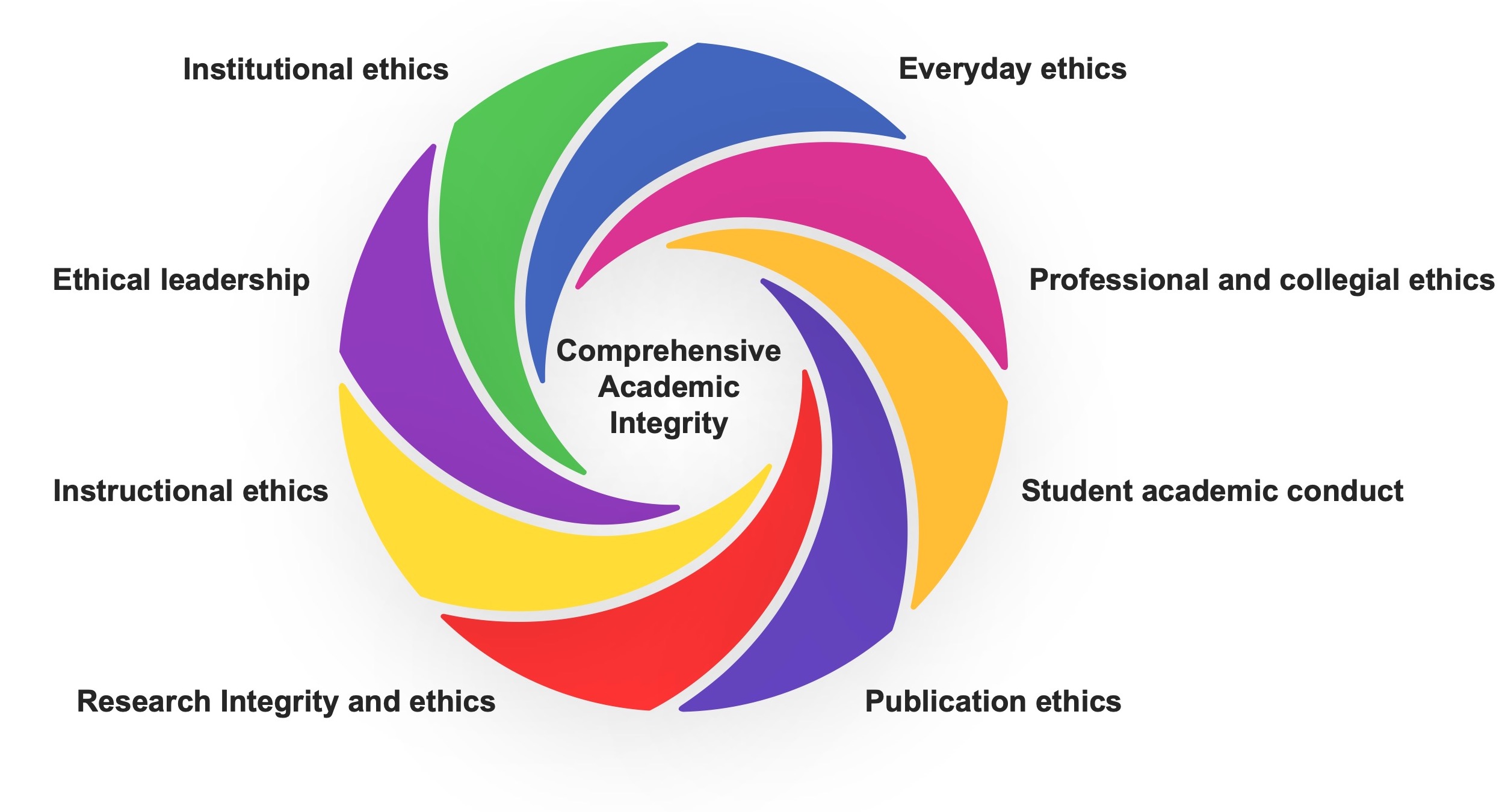
After all the chapters had been submitted, I realized that we had something new and fresh with this edition. We have pushed the boundaries beyond persistently historical ideas about academic integrity only as a matter of student conduct. So, I wrote an introduction for the handbook that synthesizes some its through lines. The common threads of this updated edition are summed up in this Comprehensive Academic Integrity (CAI) framework.

I wrote this intro in two epic writing sessions, fuelled by gallons of coffee, Vegemite on toast, and a pizza that a friend had delivered to my house because he felt sorry for me eating Vegemite on toasted bread crusts. (I am not kidding.) Anyway, first, I drafted the chapter in full. Then I asked a couple of other section editors and contributors to the handbook to provide me with an open peer review of the draft. In the chapter I acknowledge them by name and I re-iterate my gratitude to them here. Thanks are due to Guy Curtis, Brenda M. Stoesz, Rahul Kumar, Beatriz Moya, and Bibek Dahal for their feedback that helped me to improve the chapter. In the second writing session, I incorporated just about all of their suggestions and completely re-vamped the visual image to the one you see below. The CAI Framework is a high-level synthesis of all the chapters in the handbook and as such, every single author who has contributed to the handbook (as well as those they have cited in their respective chapters) all deserve credit.

According to the publisher’s rules around self-archiving and pre-prints, I am not allowed to share the entire chapter with you ahead of publication. But I can share a summary of it, so I’m doing that here. I’ve also self-archived a copy of this overview (minus the background commentary about Vegemite and pizza) in our university’s digital repository. On the off-chance you want to cite the “official” version of the summary, I have included instructions below. You’ll have to wait for the Handbook to be published to read the full chapter, but in the meantime, I hope this overview is useful.

How to cite this overview

Eaton, S.E. (2023). A Comprehensive Academic Integrity (CAI) Framework: An Overview. Calgary, Canada: University of Calgary. https://prism.ucalgary.ca/handle/1880/116060

Overview

For years scholars and other experts have called for a more holistic approach to academic integrity (e.g., Bertram Gallant, 2008; Boud & Bearman, 2022; Bretag et al, 2014; Carrol & Duggan, 2005; Löfström et al., 2015; Morris & Carrol, 2016; Turner & Beemsterboer, 2003). The CAI framework synthesizes ideas that have been repeated for decades in various iterations.

The central argument behind a wholistic framework is that academic integrity must encompass, but extend beyond, notions of student conduct, and should be considered a foundation of all aspects of education. In this framework, I do not propose a new definition of academic integrity in part, because several useful definitions already exist (see Bretag, 2016; ICAI, 2021; Tauginienė et al., 2018). Instead, this framework can be used with existing definitions.

The Comprehensive Academic Integrity (CAI) framework includes eight (8) essential elements that includes, and extends beyond traditional notions of academic integrity merely as a student responsibility:

  • everyday ethics
  • institutional ethics
  • ethical leadership
  • professional and collegial ethics
  • instructional ethics
  • student academic conduct
  • research integrity and ethics
  • publication ethics

Figure 1. Comprehensive Academic Integrity (CAI) Framework

A circle with eight colourful swirls (one each in green, blue, pink, dark yellow, darker purple, red, bright yellow, medium purple, and green). There is black text associated with each swirl. This image is a graphic representation of the Comprehensive Academic Integrity (CAI) framework.

Keywords

academic integrity, student conduct, student affairs, research ethics, research integrity, publication ethics, instructional ethics, pedagogy, everyday ethics, experiential learning, definition, ethical decision-making, morals, values, virtues, leadership, equity, diversity, inclusion, accessibility, justice, decolonization, Indigenization

Postscript

Appreciation to Kieran Forde at the University of British Columbia for his most awesome interpretation of the graphic as a “colourful swirly donut”. Who doesn’t love donuts?! Thanks, Kieran!

References

Bertram Gallant, T. (2008). Academic integrity in the twenty-first century: A teaching and learning imperative. Wiley.

Boud, D., & Bearman, M. (2022). The assessment challenge of social and collaborative learning in higher education. Educational philosophy and theory, 1-10. https://doi.org/10.1080/00131857.2022.2114346   

Bretag, T. (2016). Educational integrity in Australia. In T. A. Bretag (Ed.), Handbook of Academic Integrity (pp. 1-13). Springer Singapore. https://doi.org/10.1007/978-981-287-079-7_2-1 

Bretag, T., Mahmud, S., Wallace, M., Walker, R., McGowan, U., East, J., Green, M., Partridge, L., & James, C. (2014). ‘Teach us how to do it properly!’ An Australian academic integrity student survey. Studies in higher education, 39(7), 1150-1169. https://doi.org/10.1080/03075079.2013.777406

Carroll, J., & Duggan, F. (2005, December 2-5). Institutional change to deter student plagiarism:  What seems essential to a holistic approach? 2nd Asia-Pacific Educational Integrity Conference, University of Newcastle, Callaghan, Australia.

Eaton, S. E. (forthcoming). Comprehensive academic integrity (CAI): An ethical framework for educational contexts. In S. E. Eaton (Ed.), Handbook of Academic Integrity (2nd ed.). Springer. 

International Center for Academic Integrity (ICAI). (2021). The fundamental values of academic integrity (3rd ed.). https://academicintegrity.org/resources/fundamental-values

Löfström, E., Trotman, T., Furnari, M., & Shephard, K. (2015). Who teaches academic integrity and how do they teach it? Higher Education, 69(3), 435-448. https://doi.org/10.1007/s10734-014-9784-3

Morris, E. J., & Carroll, J. (2016). Developing a sustainable holistic institutional approach: Dealing with realities “on the ground” when implementing an academic integrity policy. In T. Bretag (Ed.), Handbook of Academic Integrity (pp. 449-462). Springer Singapore. https://doi.org/10.1007/978-981-287-098-8_23

Tauginienė, L, Gaižauskaitė, I, Glendinning, I, Kravjar, J, Ojsteršek, M, Ribeiro, L, Odiņeca, T, Marino, F, Cosentino, M, Sivasubramaniam, S, Foltýnek, T. Glossary for Academic Integrity. ENAI Report 3G [online]: revised version, October 2018. https://www.academicintegrity.eu/wp/wp-content/uploads/2023/02/EN-Glossary_revised_final_24.02.23.pdf

Turner, S. P., & Beemsterboer, P. L. (2003). Enhancing academic integrity: Formulating effective honor codes. Journal of Dental Education, 67(10), 1122-1129. https://doi.org/10.1002/j.0022-0337.2003.67.10.tb03705.x

_________________________________

Share this post: A Comprehensive Academic Integrity (CAI) Framework: An Overview – https://drsaraheaton.wordpress.com/2023/04/14/a-comprehensive-academic-integrity-cai-framework-an-overview/

This blog has had over 3 million views thanks to readers like you. If you enjoyed this post, please “like” it or share it on
social media. Thanks!

Sarah Elaine Eaton, PhD, is a faculty member in the Werklund School of Education, and the Educational Leader in Residence, Academic Integrity, University of Calgary, Canada. Opinions are my own and do not represent those of the University of Calgary.


Indigenous Academic Integrity: A Post in Honour of the National Day for Truth and Reconciliation

September 30, 2021

21-TAY-Orange-Shirt-DayToday marks the first National Day for Truth and Reconciliation in Canada. The purpose of the day is to honour Survivors of residential schools and those who died in them.

Keeta Gladue Headshot (web size)A few days ago Keeta Gladue, Indigenous Student Advisor and Team Lead at the Writing Symbols Lodge at the University of Calgary reached out to me and asked me to consider writing a blog post today about Indigenous ways of citing and referencing. Keeta led the Indigenous Academic Integrity project, which has not only benefitted our university, but has been shared further at other institutions across the country including Ryerson University (Ontario) and Red River College (Manitoba), among others. Keeta has also presented this project nationally and internationally. Check out the recorded version of one of her presentations on this project here.

Keeta is not alone in her efforts to bring awareness to the ways in which academic integrity is embedded in Indigenous ways of knowing, being, teaching, and learning. Iehnhotonkwas B.J. Maracle from the University of Toronto developed “Seven Grandfathers in Academic Integrity”, a fantastic resource that is publicly available as a .pdf.

The impact of residential schools on Indigenous children, in terms ethical and moral violations, not to mention outright abuse and crime, could fill volumes. When Keeta asked me to think about a blog specifically about Indigenous citing and referencing, that resonated with me. This post is not intended to trivialize, diminish, or dismiss the importance of broader conversations about residential schools, decolonization, or reconciliation. Instead, it is intended to honour the Indigenous scholars, educators, and knowledge keepers I have learned from, directly and indirectly, with respect to my work as an academic integrity scholar and advocate, including Keeta Gladue, Yvonne Poitras Pratt, Gabrielle Lindstrom, among others. It is also intended to generate broader conversations about the need to question systems of oppression that get labelled as “integrity” when do little or nothing to promote integrity at all.

Truth

Before we get to reconciliation, we start with truth. Here are some truths about citing and referencing:

  1. Citing and referencing styles are established, by and large, by organizations (e.g., APA, MLA) that profit from the sale of manuals and guidebooks that prescribe conventions for how citing and referencing should be done in a particular discipline.
  2. The organizations that set up citing and referencing systems are generally academic in nature, and their boards of directors are often populated by white scholars, many of whom are male. Indigenous scholars (as well as Black and other scholars of colour) are rarely, if ever, elected or appointed to the boards that govern these organizations.
  3. Citing and referencing manuals universally ignore or diminish the value of Indigenous knowledge by failing to provide adequate guidance about how to cite and reference Indigenous knowledge. (See this article by Lorisia MacLeod for a discussion of how citing oral knowledge as personal communication is simply not enough.)
  4. Too often, when students fail to follow the conventions of a particular citing and referencing style, they are punished or reported for plagiarism. Research has shown over, and over, and over again that many cases of student plagiarism are not intentional or deceitful, but instead they are due to a lack of skills and knowledge.
  5. The minutiae of citing and referencing standards are weaponized against students (and everyone else who uses them, for that matter). Those who know how to wield the finer details of citing and referencing are lauded as erudite scholars. Those who do not are mocked, dismissed, or accused of misconduct. (Honestly, who gives a flying leap about sentence case versus title case capitalization? Can we do away with these nonsensical details, once and for all, please?!)

These are just a few of the truths about citing and referencing that we need to confront. As an academic integrity scholar and advocate, part of my job involves not only upholding the rules, but questioning the systems that created them. The deeper I dive into this world, the more I realize that much of what gets labelled as “academic integrity” actually has little to do with ethics, and more to do with behaviour control, oppression, and even corporate profit. There’s a lot of work we need to do to put the integrity back into “academic integrity”.

Reconciliation

Once we have told the truth, we can start to work on reconciliation. Here are a few things we can think about as we move along the path to reconciliation:

  1. Learn from (and cite) Indigenous authors and knowledge keepers. As part of my own journey towards reconciliation, I am making a point to educate myself about Indigenous ways of knowing, being, teaching, and learning. I have a lot to learn, and the journey is worthwhile. In addition to learning, I make an effort to give attribution to those from whom I have learned.
  2. Educate ourselves about how to give attribution to Indigenous Elders and Knowledge Keepers. A great place to start is by reading Elements of Indigenous Style by Gregory Younging. From there, check out MacLeod’s Templates for Citing Indigenous Elders and Knowledge Keepers.
  3. Stop weaponizing citation and referencing. These systems should be used to give attribution to the creators and keepers of knowledge, not to punish people for failing to comply with rules. Focus on giving attribution as a way to honour and show respect, not as a means to inflict punishment. Giving attribution to others should be a joy, not an afterthought, a drudgery, or a cause for punishment or anxiety.
  4. Re-consider citing and referencing systems in general. These systems embody colonialism in education and scholarship, focusing on rule compliance, rather than actual learning. It is time to have deep and provocative conversations about the ways citing and referencing systems propagate colonialism, oppression, and elitism in education and publishing. Elsewhere I have called for a universal citation system that is easy and free to use and that is accepted by educational institutions and publishers.
  5. Take an educative and supportive approach, rather than punitive to academic integrity. The “Gotcha!” approach doesn’t help students learn.
  6. Think about attribution in relational ways. As I have discussed in my book on plagiarism, my own PhD supervisor taught me to think about the people who write books and articles, situating myself in relation to their work and words. He taught me to pay attention to who was writing as much as what they were writing.

There are many conversations we need to have about decolonizing education. Recognizing the harms inflicted by colonial education systems is essential. Oppressive systems have become a pervasive hallmark of education. We need to recognize the ways in which vestiges of colonialism permeate all aspects of our educational systems, including academic integrity, citing, and referencing. As part of our work to decolonize education, let’s not forget about how to decolonize our approaches to academic and research integrity (and misconduct). It’s time to ditch the “crime and punishment” approach to misconduct and instead focus on relational, reconciliatory, and restorative approaches to building integrity with one another and the systems in which we live and work.

References and further reading from Indigenous authors

Gladue, K. (2021). Indigenous Academic Integrity. Retrieved from https://taylorinstitute.ucalgary.ca/resources/indigenous-academic-integrity

MacLeod, L. (2021). More than personal communication: Templates For citing Indigenous Elders and Knowledge Keepers. KULA, 5(1), 1-5. https://doi.org/10.18357/kula.135

Poitras Pratt, Y., & Gladue, K. (forthcoming). Re-defining academic integrity: Embracing Indigenous truths. In S. E. Eaton & J. Christensen Hughes (Eds.), Academic integrity in Canada: An enduring and essential challenge: Springer.

Lindstrom, G. (forthcoming). Accountability, relationality and Indigenous epistemology: Advancing an Indigenous perspective on academic integrity. In S. E. Eaton & J. Christensen Hughes (Eds.), Academic integrity in Canada: An enduring and essential challenge: Springer.

Younging, G. (2018). Elements of Indigenous style: A guide for writing by and about Indigenous Peoples. Edmonton, AB: Brush Education Inc.

References and further reading from non-Indigenous authors

Eaton, S. E. (2021). Plagiarism in higher education: Tackling tough topics in academic integrity. Santa Barbara, CA: Libraries Unlimited.

Howard, R. M. (2001). Forget about policing plagiarism. Just teach. The Chronicle of Higher Education, B24. Retrieved from http://chronicle.com/article/Forget-About-Policing/2792

McGowan, U. (2005). Academic integrity: An awareness and development issue for students. Journal of University Teaching and Learning Practice, 2(3a), 48-57. Retrieved from http://jutlp.uow.edu.au/2005_v02_i03a/pdf/mcgowan_005.pdf

Schwabl, K., Rossiter, M. J., & Abbott, M. L. (2013). University students’ and instructors’ paraphrasing and citation knowledge and practices. Alberta Journal of Educational Research, 59(3). Retrieved from https://journalhosting.ucalgary.ca/index.php/ajer/article/view/55730

______________________

Share or Tweet this: Indigenous Academic Integrity: A Post in Honour of the National Day for Truth and Reconciliation – https://drsaraheaton.wordpress.com/2021/09/30/indigenous-academic-integrity-a-post-in-honour-of-the-national-day-for-truth-and-reconciliation/

This blog has had over 2 million views thanks to readers like you. If you enjoyed this post, please “like” it or share it on social media. Thanks!

Sarah Elaine Eaton, PhD, is a faculty member in the Werklund School of Education, and the Educational Leader in Residence, Academic Integrity, University of Calgary, Canada.

Opinions are my own and do not represent those of the University of Calgary or anyone else.