Promise only what you can deliver

November 8, 2010

There are no two ways about it: education is a competitive business. A huge component of a learning organization’s reputation is its credibility. As non-profit organizations and schools jump on the marketing bandwagon, there is a temptation to promise more than you can actually deliver. There is no faster way to lose a good reputation than by disappointing your learners, or their parents, depending on who is footing the bill for their education.

Promising fluency in three weeks or guaranteeing students a certain score on internationally recognized tests are bad ways to market your program. Why? Because you’re lying to them. And lying does little to build trust or an excellent long-term reputation.

A more effective way is to show students what they will be learning and the benefits they will receive. You can do this by including a syllabus in your promotional package and on your web site. Be honest about the kinds of activities and excursions you take them on. Don’t promise them they will go whitewater rafting and horseback riding unless you actually plan to take them. (By the way, it is a good idea to check with your insurance policy before endorsing high-risk activities for your students.)

Many language schools do promise only what they can deliver, only to work with the occasional agent or representative who inflates the promises while they are promoting the school abroad. While many agents are legitimate, there are those who are not. It is worth your while to review all literature your agents plan to send out on your behalf, even if that means hiring a translator. Your credibility is on the line, and it is your responsibility to ensure that prospects are getting a true picture of your school before they sign up.

Another way to boost your credibility is to outline on your web page exactly what students can expect from your program. That way, it is clear and you will show that you are being accountable to your students and to your own sense of credibility.

____________

This post has been adapted from “Idea # 14: Promise only what you can deliver” from 101 Ways to Market Your Language Program.

Tweet or share this: Promise only what you can deliver http://wp.me/pNAh3-7j

Update – January 2018 – This blog has had over 1.8 million views thanks to readers like you. If you enjoyed this post, please “like” it or share it on social media. Thanks!

Sarah Elaine Eaton is a faculty member in the Werklund School of Education, University of Calgary, Canada.


Are Language Textbooks a Scam for Students?

November 4, 2010

It used to be that university students taking language courses would buy a textbook and a workbook for a university course. The prices were high, but they could buy used copies. A student who wanted to sell his or her book later would be careful to do the workbook in pencil so it could be erased later.

Nowadays, textbooks companies have gone all high tech. They’re encouraging teachers to do away with “old fashioned paper workbooks” in favor of an online version. The teacher needs a course code. The students need a book code. Only the magical combination of both codes will allow students access to their high tech web student activity manual.

The scam? All of these codes have expiry dates. Students who bought a second-hand book have no access to the online activity manual, unless they cough up about $100 for their own personal book code. $100 for a code? Seriously? I have students who simply can not afford this and as a result, there is no way for them to access their homework activities.

To boot, the textbook takes a communicative approach, which is super for in class, but offers little in the way of activities to assign for homework. The homework is supposed to come from the web-based activity manual.

Not all students – even college age students – like the online versions. Anything but a high speed internet connection is insufficient to use the fancy web-based versions. Students complain about difficulties setting up their online accounts and some give up even before they get to do their first activity. Their frustration levels escalate.

The textbook rep comes in to do a demo. Everything works perfectly in his presentation and students are encouraged to try again.

Here it is the end of the semester and I still have students who haven’t done any online activities. When I ask them why, they sheepishly say they find the web versions cumbersome. Either that, or they simply can’t afford the $100 for a book code. A search for old, used workbooks has ensued so they can have paper versions to work from.

I’ve been giving them activities and materials I’ve developed myself over the years. These used to be “extra practice”, but for the students who have no other way to reinforce what we do in class, they have become their only option.

Some students are very tech-savvy, very into mobile learning. Some still like paper-and-pen activities. Others may like technology, but be cash poor. Our job as educators should be to make it easy for them to learn, not more cumbersome.

At least when we bought paper versions of books and workbooks, they were ours to keep for as long as we wanted, not until the textbook publisher decided that they expired and cut off our access to them. At best, they became outdated, but they didn’t disappear into thin air. I’m a huge fan of technology, but not when it becomes a barrier to my students’ learning.

________________________________

Share this post: Are Language Textbooks a Scam for Students? https://wp.me/pNAh3-n8

Update – January 2018 – This blog has had over 1.8 million views thanks to readers like you. If you enjoyed this post, please “like” it or share it on social media. Thanks!

Sarah Elaine Eaton is a faculty member in the Werklund School of Education, University of Calgary, Canada.


Sample Host Family Application

October 9, 2010

Choosing host families for your international education or language program takes significant time and effort. Matching prospective students with families willing to open their hearts and home to a foreign student who is studying English as a Second Language (or any other language or subject, for that matter) requires skill, patience, background checks and a fine balance between working with the people that you have in your pool of students and families and ensuring that some basic requirements are met.

The first step in setting up your host family selection process is to develop your host family application. The application needs to include more than just the name and address of the family. You also want to ask questions about lifestyle, such us: do they allow smoking in the home?

The local police service in many communities will perform security checks for a small fee. Adult members of the household should include a police security check, as you will want to know if anyone in the household has had criminal charges brought against them, or if there have been incidents of domestic violence in the home.

The more questions you ask up front, the better chance you’ll have of selecting excellent families to host your students.

Here’s a sample host or billet family application that you can download and adapt to your own needs. Remember to include a statement about privacy if your area requires you to do so when you collect personal information.

Related posts:

____________

Share or Tweet this post: Sample Host Family Application http://wp.me/pNAh3-fv

Update – January 2018 – This blog has had over 1.8 million views thanks to readers like you. If you enjoyed this post, please “like” it or share it on social media. Thanks!

Sarah Elaine Eaton is a faculty member in the Werklund School of Education, University of Calgary, Canada.


Foreign Language Programs in Crisis: Programs Closing, Faculty Losing Jobs

September 30, 2010

Lately people have been sending me all sorts of news articles about enrollments dropping in second and foreign language programs in high schools and universities. Here are a few examples:

“Community, Adult Education Programs Will be Missed”, Hometownlife.com, by Susan Steinmueller, Sept. 12, 2010

“Foreign language classes unresolved” – Isureveille, by Catherine Threlkeld, September 23, 2010

Cuts hurting language classes – The NewsStar by Carlos D. Fandal, September 26, 2010

Replacing Teachers with Technology – Fox News by Meredith Orban, September 28, 2010

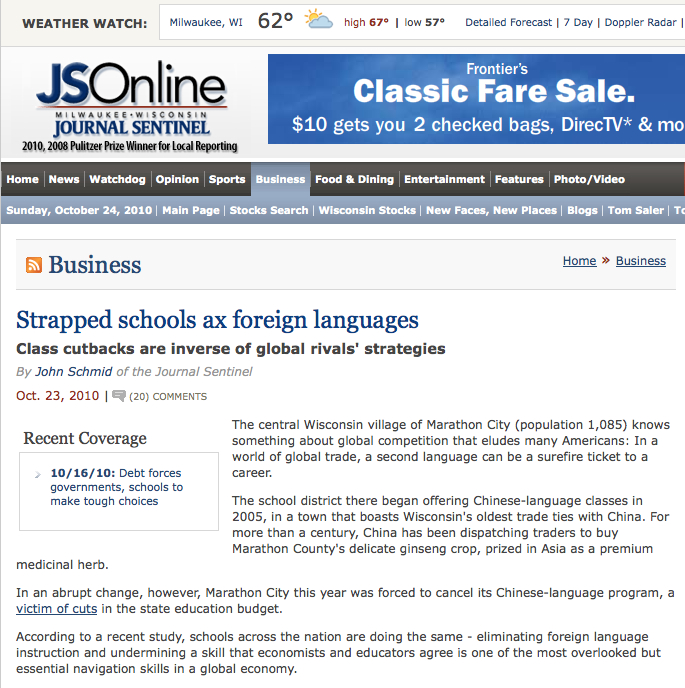
Strapped Schools Ax Foreign Language Programs – Milwaukee – Wisconsin Journal Sentinel, by John Schmid, October 23, 2010

It breaks my heart when I hear about programs that have decreasing enrollment or worse, under threat of closure due to low enrollment. From my experience of working with schools and programs over the past decade as a marketing consultant, I can honestly say that there is no “magic bullet” in a situation like this.

If you’ve been given notice that your program is about to close, managers and teachers essentially face a crisis situation. Not only is their passion about to be killed, and they know their students’ futures will be shaped in a very different way, but their livelihood may be gone, too.

What are language teachers, administrators and foreign language advocates to do?

The only answer it seems is find a way to revitalize not only our programs, but also interest in them. Parents and community stake holders need to see the value of second and foreign language learning and the benefits that students derive by studying them. There is no quick fix to this one, I’m afraid. If you manage or teach in a foreign language program, the best thing to do right now is to keep it vibrant and alive. If your program is under the threat of closure, there may still be time to implement a revitalization, public relations or marketing strategy to rebuild your program’s health so it doesn’t get shut down, or replaced by a computer program.

___________

Share or Tweet this article: Foreign Language Programs in Crisis: Programs Closing, Faculty Losing Jobs http://wp.me/pNAh3-hy

Update – January 2018 – This blog has had over 1.8 million views thanks to readers like you. If you enjoyed this post, please “like” it or share it on social media. Thanks!

Sarah Elaine Eaton is a faculty member in the Werklund School of Education, University of Calgary, Canada.


In their own words – Boost ESL enrollments with multilingual marketing materials

September 20, 2010

Imagine this: Your daughter wants to go away and study a foreign language… maybe Chinese or French or some other language that you don’t speak. She tells you that she has found two possible schools and wants you to have a look at their web sites. She sends the links to you at the office. During your coffee break, you check out the first school’s site. All the information is written in English. You find out about the school, the teachers who work there, the homestay accommodations available and the program she will be taking.

You move on to the second site. All the same information is there (you think?) but it is written only in the language your daughter wants to learn. You surf around, look at the pictures and try to get back to the home page again.

After you’ve looked at both sites, where do you want to send your daughter?

The fact of the matter is that both schools may have excellent programs, but if students (and their parents) can read about it in their own language, you will build an unspoken relationship of trust with them. It’s both perception and perspective. You trust what you know.

For ESL programs that recruit international students, translating your web site (or at least major points of it) into the languages of your major markets gives you an advantage over your monolingual counterparts.

______________

This post has been adapted from “Idea # 16: Sell yourself in as many languages as possible — translate your marketing materials into the languages of countries you want to target” from 101 Ways to Market Your Language Program.

Tweet or share this: In their own words – Boost ESL enrollments with multilingual marketing materials http://wp.me/pNAh3-7r

Update – January 2018 – This blog has had over 1.8 million views thanks to readers like you. If you enjoyed this post, please “like” it or share it on social media. Thanks!

Sarah Elaine Eaton is a faculty member in the Werklund School of Education, University of Calgary, Canada.