
Sample Forms: Language School Application and Photo Release

February 9, 2011

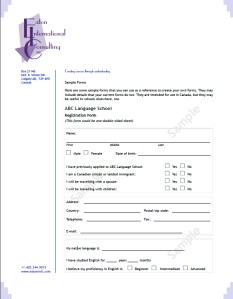
I’m often asked by clients how to build a registration form for a new school or program. The two most requested forms are:

  • A sample registration form for a language school.
  • A photo release form for marketing materials.

I’ve developed sample forms that you can download for free.

I’ve designed them to give you an idea of what you’ll want to include on your own forms. Feel free to modify or customize them for your own language school or literacy program.

_________

Related posts:

Share this post: Sample Forms: Language School Application and Photo Release http://wp.me/pNAh3-vB

Update – January 2018 – This blog has had over 1.8 million views thanks to readers like you. If you enjoyed this post, please “like” it or share it on social media. Thanks!

Sarah Elaine Eaton is a faculty member in the Werklund School of Education, University of Calgary, Canada.

Free Resources Every Language Program Administrator Needs to Know About

January 30, 2011

Language program administration and management is not new in terms of the work we do, but it is starting to emerge as a “profession”. Training programs have popped up here and there that focus specifically on how to train language program directors to do their job better

Here are some free resources you’ll want to know about if you manage or direct a language program. Don’t worry if they are language-specific. There’s some good stuff in these manuals and papers that every LPA (language program administrator) can benefit from.

If you know of more free resources, let me know and I’ll add them to the list.

_________________________

Share this post: Free Resources Every Language Program Administrator Needs to Know About http://wp.me/pNAh3-sW

Update – January 2018 – This blog has had over 1.8 million views thanks to readers like you. If you enjoyed this post, please “like” it or share it on social media. Thanks!

Sarah Elaine Eaton is a faculty member in the Werklund School of Education, University of Calgary, Canada.


How Literacy Programs Can use Webinars to Benefit Learners, Staff & Volunteers

January 28, 2011

The word webinar is being used today to refer to all kinds of online training and virtual presentations.

More and more literacy organizations are adding a component of e-learning to their programs. It’s the 21st century way to learn!

Webinars are relatively easy to put on. Some of the language is a bit different from face-to-face environments, so it’s helpful to know that instructors, facilitators and teachers are mostly referred to as “presenters” in the webinar environment. Learners and clients are generally called “participants”.

Both presenters and participants need some technology and computer literacy in order to take part in a webinar. Current teachers and facilitators may require some training before moving into an e-learning environment. Your participants may benefit from an orientation prior to the content to familiarize them with how webinars work.

Assuming that both parties have the technology literacy to move forward, here are some ideas on how you can make the most of webinar technology in your organization.

For Participants

Online group classes

Bring participants together in an e-learning class not only to teach them new content and skills, but also to learn how to work together in an online environment. You can build two of the Essential Skills at once: Computer Use and Working with Others.

Online tutoring

Do you have learners in rural and remote areas? Or single parents who find it hard to get a sitter? Online tutoring provides a way for otherwise isolated learners to connect with tutors from the comfort and convenience of their own home. This is a super way to reach out to people who might otherwise not engage with learning.

Information sessions

If you offer information sessions about your programs in a live setting (your office space, a public library or elsewhere), you can adapt your content and host virtual information sessions. Information sessions are for prospective students and have a slight marketing component. A word of caution though… don’t try to “sell” in a webinar. Instead, demonstrate your expertise and what makes you unique.

Orientation sessions

When you bring new learners into your physical space, do you give them an orientation on  what to expect and how things work there? Photos, maps, and other materials can also be used in an online environment to give a virtual orientation. Though I’m a big fan of doing live webinars, this is one that you could record and use over again.

Follow-up workshops

Webinars are a great way to keep relationships going once the opportunity for face-to-face interaction has passed. A value-added webinar one month after the course ends is a super way to stay connected. For example, if you have a work placement component in any of your programs, you can incorporate virtual sessions after work hours. Learners can share stories about their work experience and learn from one another. In cases where participants already know one another, the online interaction is usually fun and very dynamic.

For staff and volunteers

Volunteer information sessions

Do you like the idea of having virtual teachers or tutors? Then set the stage by offering online information sessions for prospective teachers and volunteers about your organization. Review the programs that you offer, the opportunities you and the benefits of working with your organization. This is a great time to have current staff members and volunteer tutors chime in with what they love about working with you!

Volunteer training

Do you train your staff in intensive sessions that jam in loads of information? You can break it up into a series of online training workshops. The material is easier to absorb if you divide it into “chunks”. If you have ongoing workshops, your volunteers get ongoing training, which keeps building their skills. As an organization, ongoing training for them means you give offering them something back for their time and expertise.

Staff development workshops

Do your staff currently get all their professional development at an annual conference? I love conferences because of the chance to connect with old friends. But wouldn’t it be great to offer ongoing training and development for your staff throughout the year? The cool thing about this is that you don’t have to organize all the sessions yourself. Check out the Centre for Interactive Learning and Collaboration (CILC). They specialize in  offering online PD for educators. They have literally hundreds of programs to choose from, ranging from free to expensive.

For the community

A Virtual Open House

Share what you do with the community, your stakeholders and donors through a virtual open house. Include photos of your facilities and your staff. A video that uses digital storytelling to celebrate the success of your learners makes it even more dynamic.

These are just a few ideas for literacy and language programs to use webinars in their organizations. I’m a big fan of using this technology in the non-profit and educational sectors. It offers a lot of value for everyone – staff, volunteers, learners and students, as well as community stake holders. How many non-profits still lag behind when it comes to their own technology literacy? Implementing the use of webinars positions your organization as a leader in terms of technology. You lead by example, showing others how virtual and online learning is an important part of 21st century of education and professional capacity building.

___________________

Share or Tweet this post: How Literacy Programs Can use Webinars to Benefit Learners, Staff & Volunteers http://wp.me/pNAh3-sE

Update – January 2018 – This blog has had over 1.8 million views thanks to readers like you. If you enjoyed this post, please “like” it or share it on social media. Thanks!

Sarah Elaine Eaton is a faculty member in the Werklund School of Education, University of Calgary, Canada.


Be positive in all your marketing materials – avoid negative words

January 24, 2011

There’s a theory that says if you project negativity, you will get negativity in return. So if you fill your marketing materials with rules and regulations about what students must not do and what the program will not provide, chances are you will not attract very many students.

Review your marketing materials looking for negative words – “no”, “not”, “never”, “can’t”, “won’t”, “shouldn’t”, “don’t”, etc. Then, change the sentences to give them a positive spin. For example, “Classes are no larger than 15 students” can be changed to, “Your class will have a maximum of 15 students.”

Another classic example: “Don’t hesitate to contact us” can be changed to a positive statement, starting with a strong action verb: “Contact us today to reserve your place in our course!”

Precisely because our schools often have strict policies and procedures, we find ourselves mentioning what can’t be done and what is not allowed. We need to remember that marketing materials are not the same as application and registration forms, policies, procedures or waivers. It’s important that every document serve its purpose. Marketing materials are meant to generate interest and make students want to take part in your courses. Tell your students what you will provide, what they will experience and what they can expect. Focus on a having a positive, simple, upbeat tone, filled with action verbs.

Fill your marketing material with positive, energetic words and you are likely to generate positive feelings in your prospects. That could lead to an energetic, “Yes, sign me up!”

_______________________________

This post is adapted from “Idea # 12: Be positive in all your marketing materials – avoid negative words” in 101 Ways to Market Your Language Program

_______________________________

Share or Tweet this post: Be positive in all your marketing materials – avoid negative words http://wp.me/pNAh3-7c

Update – January 2018 – This blog has had over 1.8 million views thanks to readers like you. If you enjoyed this post, please “like” it or share it on social media. Thanks!

Sarah Elaine Eaton is a faculty member in the Werklund School of Education, University of Calgary, Canada.


Do You Have What it Takes to Save Your Language Program?

January 22, 2011

Over the past several months, I’ve heard a lot about language programs closing or being cut. This is troubling not only because I’m a strong believer in second and additional language education, but also because it means that highly trained and committed professionals are losing their jobs.

So what does it take to save a language program that’s at risk of closure?

Time

If your program is scheduled to be cut at the end of the semester or even within the next two years, the best thing you can do is buy yourself some time. You will need it to build your campaign and garner support.

A campaign to save your language program

This is a bit tricky. You don’t want to be so zealous that you turn people against you. Your campaign needs to be well-crafted and thought out thoroughly. You’ll need the help of other people. Develop the plan together and monitor it as you go. Include things like letters of support from parents, alumni, local politicians or other champions.

Support

No matter how much you may love your program, you won’t be able to save it alone. You may find support in unexpected places and no support from people whom you think should back you. Surround yourself with like-minded people. Leave behind the whiners or those who are too burnt out to care. Build those relationships. Ask their opinions and advice. Include them in your activities.

Energy

Above all else, you will need unrelenting energy and a “can-do” attitude.  You’ll need to stay positive (but not nauseatingly so) as you lead the charge.

A focus on the future

This isn’t just about closing your program today. This is also about the effect it will have on an entire generation of students and possibly even the generation after that. You’re working for them. You’re doing this so that they continue to gain all the benefits of studying a second language that you know will make them more intellectually and culturally robust.

There is a ripple effect that happens when second language programs are cut from schools and universities. It’s worth the fight.

____________________

Share this post: Do You Have What it Takes to Save Your Language Program? http://wp.me/pNAh3-hB

Update – January 2018 – This blog has had over 1.8 million views thanks to readers like you. If you enjoyed this post, please “like” it or share it on social media. Thanks!

Sarah Elaine Eaton is a faculty member in the Werklund School of Education, University of Calgary, Canada.