US Teacher loses her job, then her court appeal, due to Facebook

October 12, 2011

In 2009 someone sent an anonymous e-mail to the school district in Barrow County, Georgia, USA complaining about the Facebook page of teacher Ashley Payne. The teacher’s Facebook page showed her drinking while on a trip to Europe. One news report states that out of more than 700 photos, approximately 10 showed alcohol.

Other news reports state that Payne did not allow her students to be her friends on Facebook and that in none of the photos does she appear intoxicated.

Long story short, Payne was offered a choice by the principal of the school where she worked: resign or he would refer her case to the Professional Standards Commission and she would possibly lose her teaching license.

In a panic, she resigned and later tried to appeal the situation through the Georgia court system, with the help of her attorney, Richard Storrs. They lost.

  • Does your school or organization have a social media policy for its employees?
  • Do you what restrictions or limitations (if any) your employer has around employee behaviour on social media?
  • How much stock can an employer put into “evidence” found on social media?

These are some of the questions I’ve been working through with a new client. I’d be interested to hear your thoughts.

___________

Share this post: US Teacher loses her job, then her court appeal, due to Facebook http://wp.me/pNAh3-X1

Update – January 2018 – This blog has had over 1.8 million views thanks to readers like you. If you enjoyed this post, please “like” it or share it on social media. Thanks!

Sarah Elaine Eaton is a faculty member in the Werklund School of Education, University of Calgary, Canada.


The Best Time of Day to Tweet, When to Post to Facebook and other Social Media Insights

September 25, 2011

KISS Metrics has done some serious research into social media. Their stats are for the U.S., but they make those of us in Canada and other parts of the world think about when we tweet, too. KISS metrics notes that nearly 50% of the US population lives in the Eastern Time Zone. If you add in those who live in the Central time zone, you get to 80% of the population.

So what? For maximum effectiveness, post to Twitter and other social media when people in the Eastern and Central Time Zones are likely to be on line.

Top Facts about Twitter

If you want to be re-Tweeted, the best time to Tweet is 5:00 p.m. Eastern Time. That’s 3:00 p.m. for those of us living in Calgary and other parts of Alberta. Figure that out in your local time zone by converting the time at TimeandDate.com.

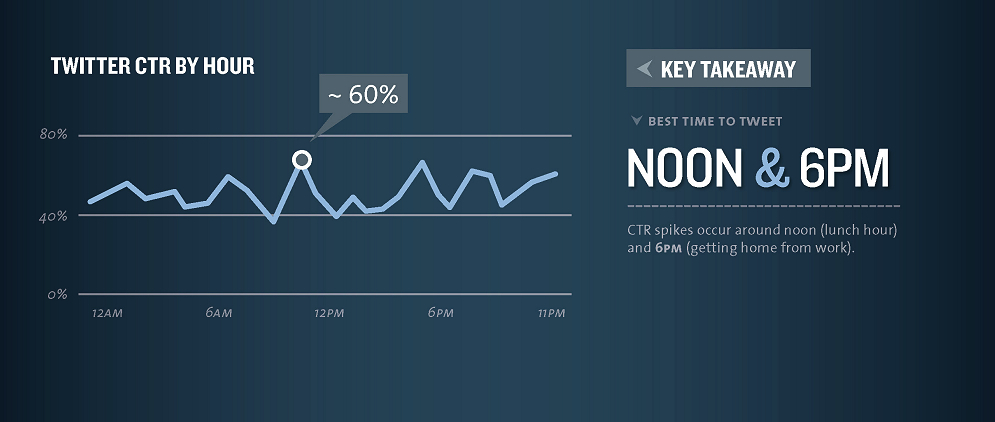
If your purpose isn’t to be re-Tweeted, but rather to have followers click on your links, the statistics change a bit. The report says that the highest click through rate (CTR) is noon and 6:00 p.m., Eastern time.

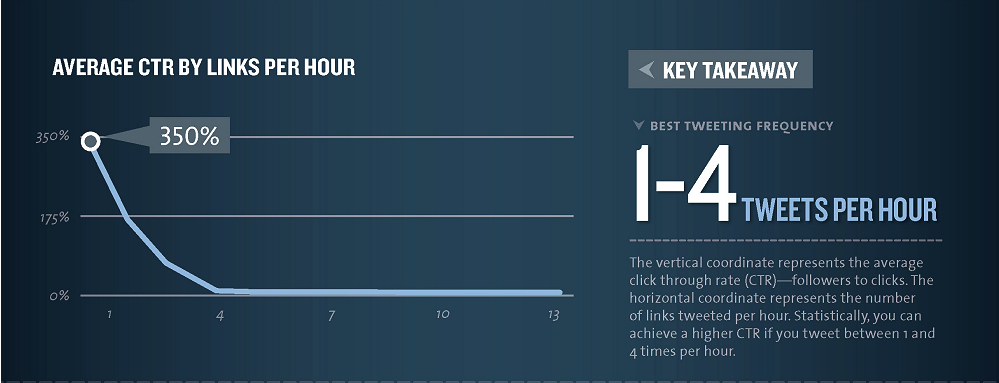
How often should you Tweet if you want people to click through to your links? Survey says… 1 to 4 times per hour. The click through rate (CTR) is apparently highest for those who Tweet their links every 15 to 60 minutes. If you tweet links more than 4 times per hour, your followers are likely to become numbed to your barage of Tweets. Personally, I never Tweet with links that much. I guess I need to start Tweeting more!

KISS Metrics2

People are most likely to click on your links mid-week and on the weekends. That is when the click through rate (CTR) is highest.

Top Facts about Facebook

The best day to share on Facebook is Saturday. That’s when the most sharing is done. This offers good food for thought for companies, schools and non-profits who only share on Facebook during the work week. Maybe it is worth using a tool such as Hootsuite to schedule your FB updates so you are sharing when employees are off the clock.

And if you’re wondering when on Saturday (or any day) to post things that are most likely to be shared, the best time of day to post on Facebook is at noon.

If you have a Facebook page, the KISS metrics show that one post every day will help you build the most “likes”.

Check out the full post by KISS Metrics.

So, what’s the moral of the story? Use social media regularly and consistently, but don’t jam it down anyone’s throat. Share information when others are likely to share your links. Pay attention to when people are on line and post at times when your links and “shareables” are likely to be seen.

_______________

Share this post: The Best Time of Day to Tweet, When to Post to Facebook and other Social Media Insights http://wp.me/pNAh3-TN

Update – January 2018 – This blog has had over 1.8 million views thanks to readers like you. If you enjoyed this post, please “like” it or share it on social media. Thanks!

Sarah Elaine Eaton is a faculty member in the Werklund School of Education, University of Calgary, Canada.


6 Things You Probably Didn’t know About Social Media and the WWW

September 23, 2011

Did you know…?

In 1978 authors Roxanne Hiltz and Murray Toroff envisioned a future in which computer-mediated communication (CMC) would have a major effect on people’s every day lives. Their book,”The Network Nation”, is published by MIT Press in Cambridge, MA. It has been updated and revised since its original printing and is now considered a classic book in the field of CMC.

In 1992 the World Wide Web was officially launched to the public. (Can you believe that the Web is only 20 years old?!)

In 1997 SixDegrees was established as the first social networking site that most resembles the sites we use today, but users were skeptical and reluctant to interact with strangers. The company was sold in 2000 and today many people believe that the original company was too ahead of its time.

LinkedIn was created in 2002 and publicly launched in 2003 (before Facebook!)

In 2004 Facebook was launched.

Two years later, in 2006, Twitter was launched.

______________

Share this post: 6 Things You Probably Didn’t know About Social Media and the WWW http://wp.me/pNAh3-Qi

Update – January 2018 – This blog has had over 1.8 million views thanks to readers like you. If you enjoyed this post, please “like” it or share it on social media. Thanks!

Sarah Elaine Eaton is a faculty member in the Werklund School of Education, University of Calgary, Canada.


Social media: A catalyst for revolt and revolution

September 22, 2011

Protesters shout anti-government slogans during a protest in Suez, Egypt., AP

In January of this year, Egyptian activist turned to Facebook to increase awareness and invite participation in public protests held in the streets of major cities there. People from around the world watched with both horror and curiosity and the events in Egypt unfolded. It was the first time (as far as I know) that social media had been used on such a large scale to promote political and social protests. But it was not the last.

Here is just one example of a news article about how Egyptian activists used Facebook to inform, educate and invite support. Social media has become a force for social change… And not just in Egypt.

Over 3600 Air Canada flight attendants are reportedly participating in a Facebook page (limited to Air Canada employees) to vent their anger at the company, as well as union leaders who are representing them in current negotiations.  That’s over half of all the flight attendants who work for the company, who are spread out across the country. Sixty percent (60%) of the company’s pilots have joined a private website, limited only to pilots, to dialogue on related issues. (Check out the news story here).

Management and the union at Air Canada are in the middle of talks to negotiate a new contract. It is reported that a six-page letter written by Susan Welscheid, Air Canada’s senior vice-president of customer service, sparked a wave of rage among the company’s workers, causing them to join the Facebook group and vent their frustrations.

The employees voted last month on a new contract. Eighty eight per cent (88%) of unionized flight attendants members who cast ballots rejected the contract, one that had been endorsed by their  negotiating team. By way of a comparison, less than 60% of Canadians voted in the 2008 federal election. Canadians tend to be a bit of an apathetic lot when it comes to voting in anything, really. Getting 88% of a Canadian group out to vote on something is startling in and of itself, really.

Union leaders and management say they are floored by the Facebook outburst, saying that it is making negotiations difficult.

So what do the cases in Egypt and Canada have in common? We can see some commonalities, as both groups

  • chose Facebook pages as their medium
  • united people who are spread out across a nation
  • gave voice to a group who felt that those who were supposed to represent and protect them were not fulfilling their responsibilities
  • created a space for people to express anger and talk about what actions to take
  • sparked interest by the media by the very fact that they used (and continue to use) social media as a catalyst for change, driven by the people themselves

The use of social media as a social force to rally ordinary citizens joined by a common cause, ready and willing to fight for something they believe in — seems to be a growing phenomenon. My guess is that we’ll continue to see social media used by people for causes, concerns and as a catalyst for change.

_______

Share this post: Social media: A catalyst for revolt and revolution http://wp.me/pNAh3-Te

Update – January 2018 – This blog has had over 1.8 million views thanks to readers like you. If you enjoyed this post, please “like” it or share it on social media. Thanks!

Sarah Elaine Eaton is a faculty member in the Werklund School of Education, University of Calgary, Canada.


Teachers’ competition for Social Media use in Formal Language Learning Contexts

September 7, 2011

How cool is this? Teachers’ competition for Social Media use in Formal Language Learning Contexts is a competition that aims to find the best practices of using social media for language learning in formal learning contexts (e.g. schools and universities.) The aim of this competition is to “identify and award language teaching initiatives with social networking technologies that take place in classroom settings in Europe.”

Stage one of the competition: The Top 10 entries have been selected for their best practices. Check them out.

Stage two of the competition: By mid-november the top practice (subject to a second round of selection among the ten best) will be announced.

I can’t wait to see who the final winners are!

_______________________

Share this post: Teachers’ competition for Social Media use in Formal Language Learning Contexts http://wp.me/pNAh3-RS

Update – January 2018 – This blog has had over 1.8 million views thanks to readers like you. If you enjoyed this post, please “like” it or share it on social media. Thanks!

Sarah Elaine Eaton is a faculty member in the Werklund School of Education, University of Calgary, Canada.