Pastel de Tres Leches – a la canadiense

June 8, 2011

Every semester, I like to close my language classes with a fun activity. Years ago, I used to arrange for a field trip to a local Mexican restaurant. However, times have changed and such field trips now require reams of paperwork and releases… even for adult education classes. So now we have a pot luck in class. This week, my adult education Spanish class wraps up and I decided to make my pastel de tres leches.

If you’ve never had it, then “three milk cake” or “cake soaked in 3 milks” could sound kind of disgusting, I guess. But once your taste buds have experienced the beauty that is pastel de tres leches you never forget it.

There are loads of food blogs out there and don’t worry, this blog is in no danger of becoming one of them. But every now and again, you need to do something different. Since “language” is in the title of the blog, and teaching culture is an important aspect of teaching the language, I’m taking a one-dime detour to include some Latin American culinary culture (with a Canadian twist, just because we’re so obsessed with multiculturalism here.)

This post is dedicated to my adult education Spanish students this semester and to all the language teachers around the globe who are also wrapping up the end of a semester. Many of you, no doubt, will also be making some kind of dish to share with your students. (Feel free to leave a comment and share your dish with us!)

Pastel de Tres Leches

Background and Culture

The first time I heard about pastel de tres leches, it was from an Argentinian friend who raved about it. With eyes rolling back in his head and drool dripping from his mouth as he described it, he said it was famous in Argentina.

Central American friends vehemently deny that claim and assert that it originated much further north.

I’ve worked in Venezuela, Honduras, Cuba and Mexico and personally, I’ve never seen this pastel in any of those places! I’m sure it exists, but I’m not certain who has the real claim to its origin.

Step 1 – Plan ahead

Decadence comes with a price. In this case, the price is time. Ideally, your cake will need to rest for about 24 hours to soak in the goodness of the tres leches.

Step 2 – Prepare and bake the cake

Here is the recipe I use for the cake:

1 1/2 cups (375 ml) all-purpose flour

1 Tbs (15 ml) baking powder

1 Tbs (15 ml) cinnamon

4 eggs, separated

1 1/2 cups (375 ml) sugar

1/2 cup (125 ml) milk

For the topping:

1 12-oz (335 g) can evaporated milk

1 14-oz (390 g) can sweetened condensed milk

2 cups (500 ml) milk

1 cup (250 ml) sugar

1 tsp (5 ml) vanilla extract

Sift the flour with the baking powder.  In large bowl beat the egg whites until frothy.  Add the sugar gradually, beating to form stiff peaks.  Add the yolks one at a time.  Slowly add the flour and milk.

Pour the batter into a grease and floured 13x9x2-inch (33x23x5-cm) baking pan and bake in a preheated 350F (180C) oven until edges are golden brown, about 40 to 45 minutes.  Remove from the oven and let cool on a wire rack.

For the topping, combine the three milks with the other ingredients, stirring until smooth.  Pour the topping over the cake and let sit until all the mixture is absorbed (at least 3 hours, but a full day is better).  Serves 8 to 12.
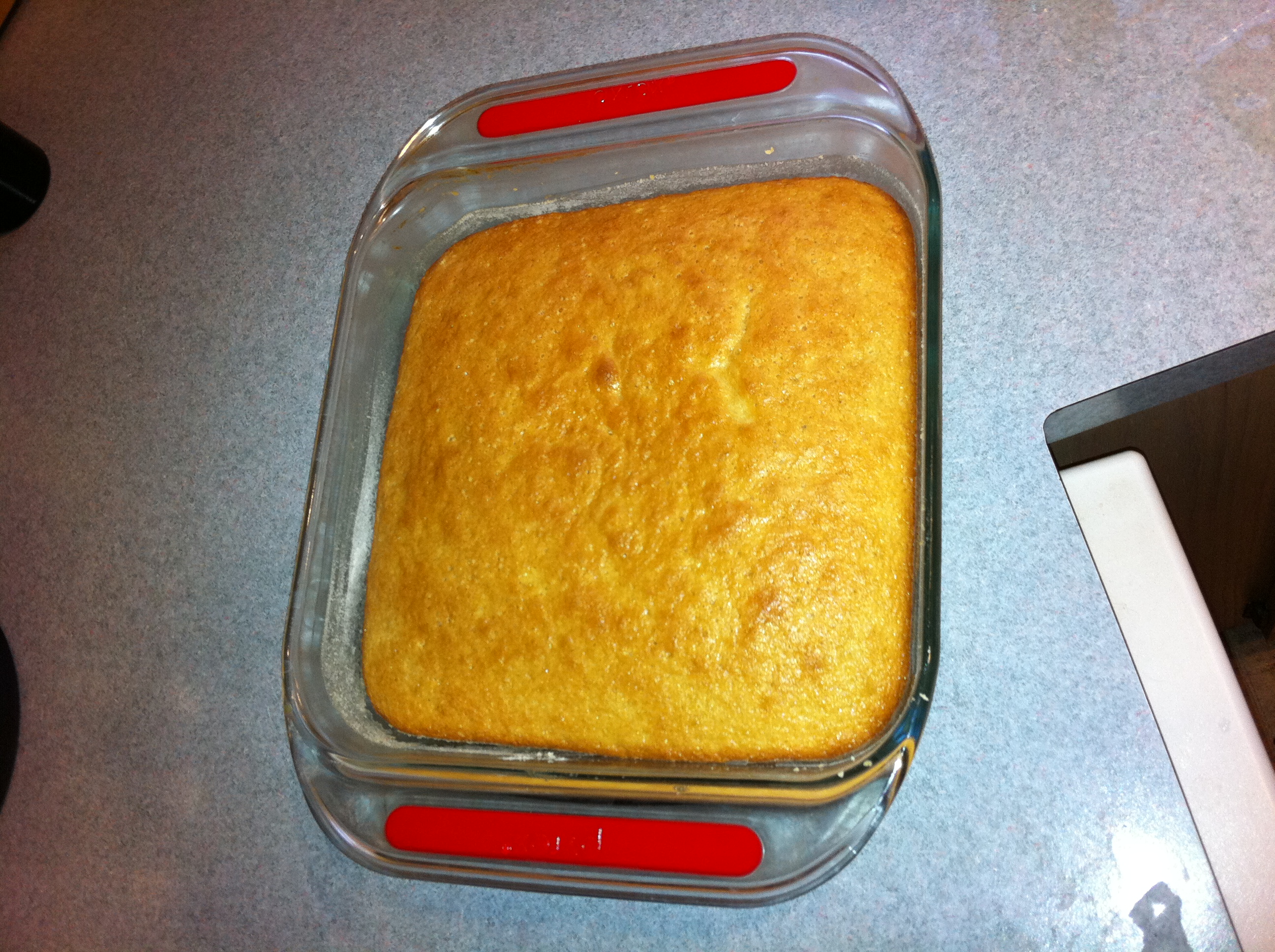
Pastel de Tres Leches

The recipe calls for a 9 x 13 pan. This is a 9 x 9 pan… and I made a smaller cake with the extra batter.

Step 3 – Add a cranberry compote to make it “a la canadiense”

I was inspired by this recipe. I adapted it this way:

Cranberry Compote

This, for me, is what makes this recipe “a la canadiense”. I remember when I was about 11 years old, growing up in Halifax one cold Saturday in November we went cranberry picking near the beach outside off town. It was one of the coldest, dampest days I ever remember. Our fingers froze. Our buckets seemed to take forever to fill. I’d filled buckets with blueberries loads of times during the summer, but picking cranberries along the beach, with icy wind whipping around you in November is a different experience entirely.

I’m sure my mother and her friends thought it would be a wonderful experience for us kids to know where cranberries came from and to experience picking them ourselves. But even the mothers decided that once was enough and we never repeated the experience.

Now, whenever I buy a cranberries, I always make a mental note to thank whoever picked them. It’s a thankless job, really.

1 bag of frozen or fresh cranberries (about half a kilo or 1 lb.)

1 – 2 tsp of cinnamon

1/2 cup water

1 to 2 cups of sugar (depending how sweet you like it)

rind of 1 orange

1 Tbsp of cornstarch, diluted in about 1/4 cup of warm water

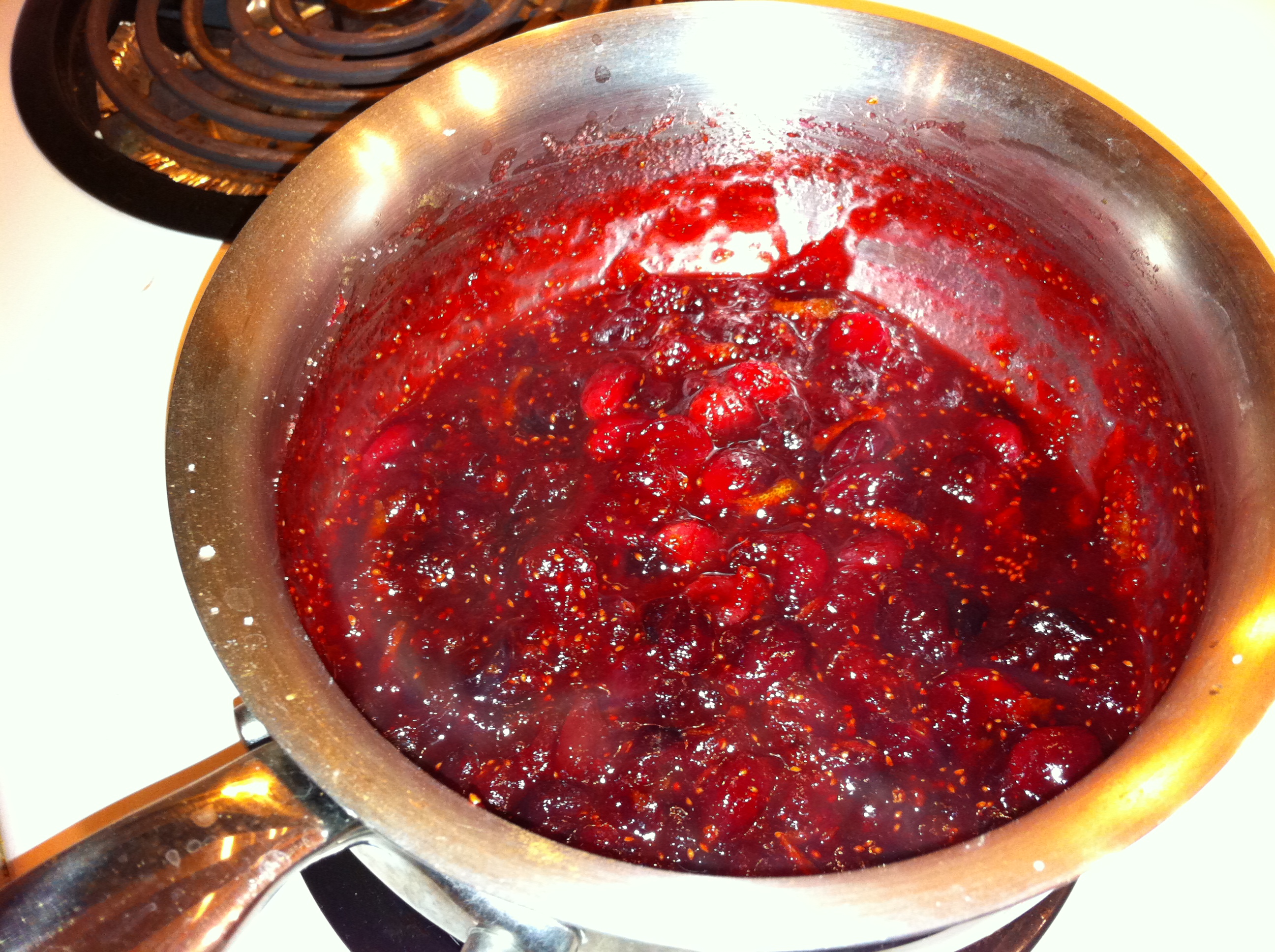
Cook the cranberries, sugar, cinnamon, water and orange rind in a saucepan until it reduces in to a nice compote. Add the cornstarch in water at the end to thicken it up a bit. This is what it looks like as you’re cooking it:

Cranberry compote

And this is the final version:

Cranberry compote - finished

Step 4 – Serve and enjoy

Serve the cake with the compote and enjoy.

Variations on this recipe include serving it with a meringue topping or whipped cream.

_______

Share this post: Pastel de Tres Leches – a la canadiense http://wp.me/pNAh3-Ji

Update – January 2018 – This blog has had over 1.8 million views thanks to readers like you. If you enjoyed this post, please “like” it or share it on social media. Thanks!

Sarah Elaine Eaton is a faculty member in the Werklund School of Education, University of Calgary, Canada.


Social Media for Language Programs – Free conference

April 22, 2011

Yup, you read that right. My friend, Evan Rubin, and his colleagues at San Diego State University’s Language Acquisition Resource Centre (LARC) are busy planning the 2011 Social Media Workshop. They invited me to present at the 2010 Social Media conference where I gave a session on Using Skype in the Second and Foreign Language Classroom. I also attended a number of other sessions and their quality was outstanding.

This year, Evan has put together a stellar line-up that includes 5 full days of sessions, August 8-12, 2011. There will be everything from keynotes and presentations to hands-on practice and exchanges of ideas. We’ll be looking at performance-based assessment, e-portfolios, blogging and a whole host of other social media for language education.

The best part? It’s free, all of it! People in San Diego can attend the live sessions and the rest of us can join in via webinar from all around the globe.

This is a fantastic way to get yourself revved up for the new school year, get energized, share and learn. Go. Register now. Tell Evan I sent you. (It’s not like I get a commission or anything… It’s free after all.)

_________

Share this post: Social Media for Language Programs – Free conference http://wp.me/pNAh3-Dc


Teaching Spanish to Adults: Sharing Insights

March 11, 2011

Adult learners (iStock photo) - Literacy, Languages and Leadership blog by Sarah EatonI’ve been teaching since 1994. I’ve taught mostly post-secondary students and adult classes. Over the past few years, I’ve been trying to incorporate Stephen Lieb’s Principles on Adult Learning into my teaching practice.

In my adult education classes for Spanish, I now focus on three things: keeping it relevant, useful and actionable.

Here’s what I’ve been doing:

In every class, there are phrases they will actually use, but may not show up in the formal curriculum.

For example, Spanish phrases for expressions such as:

Speak slower, please.

I don’t remember.

How do you say…?

I’m lost.

De-emphasizing outdated aspects of the curriculum

While I absolutely honour and respect the curriculum I use, when I put myself in the place of a learner, I just don’t see the relevance of learning classroom vocabulary for items such as chalk (la tiza) and student desks (el pupitre). Who uses chalk any more, anyway? There’s not a piece to be found in the school where I’m teaching right now.

I spend very little time on this type of vocabulary. My idea is that if they can’t realistically use the vocabulary in normal conversations about life, work, family and other grown up topics, I don’t spend a lot of time on it.

Use examples of key words that they will realistically see when they travel.

Instead of la tiza, I’ll give them an example of la salida (exit), which is a word they are likely to see all over the place, over and over again when they travel.

Engage them in the learning

I encourage them to draw on their own experiences travelling to come up with words they feel they need to know and are relevant and useful for them. This helps to make the class more learner-centered and gives them a chance to have some input.

Challenge them to be resourceful

In my beginner class this semester, I divided them into pairs. I gave each pair a different situation that they could potentially encounter while travelleing. One pair were told that they were lost in a major Latin American city. Another pair had their wallets and passports stolen. Another two got a stomach bug and needed to go to the pharmacy for some medicine. You get the idea.

I said, “You have twenty minutes. Use whatever resources you have… Your textbooks. Your glossaries. Your dictionaries. Whatever you have. Come up with 5 new key vocabulary words, one key question and a new phrase that you would realistically use in this situation.”

One person pulled out his iPhone and immediately downloaded an app. Others saw what he did and followed suit. They learned that Google translate and apps, while helpful, are imperfect tools. They worked together. They asked me questions. I didn’t help. This was their time to be resourceful.

After 20 minutes, I drew lines down the white board to divide the board into columns. I told them that it was their turn to teach each other. Each pair were given a marker and asked to write their new key words, phrases and question(s) on the board. Because each pair had a different situation, they had all found different vocabulary and phrases.

Then we went through each pair’s column. They explained their new words, phrases and questions, and when they would use them.

Of course, because they were beginners, every pair had made grammatical mistakes. I corrected the most obvious mistakes for them and changed a word or two here and there. But in every case, they were able to convey the main ideas and ask for help.

As each pair presented their findings, the others madly wrote down the new vocabulary. These were useful, relevant words and phrases that they might actually use.

In a single class we had generated more vocabulary, gone through more grammar and talked about more culture than we could possibly have done by learning lists of vocabulary that might not come up in a conversation or travels for most people.

The best part? When they came back to class the following week, they remembered much of what they’d discovered.

As a I teacher, my takeaways from this were:

  1. The language we teach adult learners must have some relevance for them.
  2. Challenging adult learners to be resourceful, self-directed learners produces real results.
  3. Teach less (don’t throw information at them), guide more (let them discover and keep them on track).
  4. Focusing on communication and collaboration keeps them engaged.
  5. Let them help each other by putting them in the teaching role from time to time.

____________________

Share this post: Teaching Spanish to Adults: Sharing Insights http://wp.me/pNAh3-zX

Update – January 2018 – This blog has had over 1.8 million views thanks to readers like you. If you enjoyed this post, please “like” it or share it on social media. Thanks!

Sarah Elaine Eaton is a faculty member in the Werklund School of Education, University of Calgary, Canada.


The shocking thing my student said

December 16, 2010

At the end of our last Spanish class for the semester, a few of the students stayed behind to chat and visit for a few minutes. They were an excellent group and had interacted well throughout the semester. Many of them thanked me for a good class, which I always appreciate.

One student, Sam, we’ll call him, said something I’ve never heard before and it shocked me in a way that few comments from a student have in 16 years of teaching.

“You’re the first instructor at university to learn my name,” he said. “I really appreciate that.”

I reeled in disbelief.

“What year are you in?” I asked.

“Third year,” he replied. “I’m on schedule to graduate next year.”

“What’s your major?” I probed further.

“Sciences. This is the only class I’ve ever had that has fewer than 100 people in it. None of the other profs learn our names. I suppose they can’t with that many students.”

I nodded in agreement. My classes have grown in size since I started teaching and with 35 students this year, it took me longer than usual to learn everyone’s name.

He went on to say, “I want to be a science teacher, but not here. I want to work in a place where I can get to know my students. This place is a factory.”

Not wanting to enter a discussion on the state of post-secondary institutions today, I simply remarked that I thought he had many qualities that would make him a good teacher.

He’s got good, solid grades and comes to class on a regular basis. He’s interested and engaged, polite and congenial. He’s got a decent work ethic and works well with other students in class. His classmates like him and he gets along with just about everyone. He’s not a super-duper genius, and nor is he a complete trouble maker. That’s part of the trouble, I suppose. Not being at the far end of either side of the scale, he gets lost in the crowd.

How sad… this student pays thousands of dollars a year in tuition for higher education and even as he approaches graduation, almost no one knows his name. As educators, we make a powerful connection with our students when we learn their names (or at least try).

____________

Share this post: The shocking thing my student said http://wp.me/pNAh3-pu

Update – January 2018 – This blog has had over 1.8 million views thanks to readers like you. If you enjoyed this post, please “like” it or share it on social media. Thanks!

Sarah Elaine Eaton is a faculty member in the Werklund School of Education, University of Calgary, Canada.


Spanish, French, German and ASL: Most Popular Languages Taught in US

December 8, 2010

Dan Berrett’s article, “Getting Their Babel On” (Inside Higher Ed, Dec. 8, 2010) shares the results of a study conducted by the Modern Language Association (MLA) in terms of university students in the US studying foreign languages. Here are the highlights:

  • The rate at which students took foreign language courses in 2009 remained constant, compared to three years prior.
  • The number of enrollments in language courses grew from 1.57 million in 2006 to 1.68 million in 2009, or 6.6 percent. However, the total number of enrollments in undergraduate courses as a whole also increased. In simple terms this means that language courses account for 8.6 of every 100 course enrollments in post-secondary institutions. That number has remained the same since 2006.
  • Of every 100 undergraduate degrees earned, 1.16 of them are in foreign languages.
  • 70 % of undergrad degrees in foreign languages are earned by women.
  • The most popular languages to study (aside from English, which is not considered a “foreign” language in the US) are Spanish, French, German, and American Sign Language, in that order.
  • American universities teach a total of 232 different languages.
  • Arabic boasted the highest increases in enrollments last year, with a 46% increase over the three previous years.
  • Graduate program enrollments in languages have dropped by 6.7 percent since 2006.

__________________

Share this post: Spanish, French, German and ASL: Most Popular Languages Taught in US https://wp.me/pNAh3-pe

Update – January 2018 – This blog has had over 1.8 million views thanks to readers like you. If you enjoyed this post, please “like” it or share it on social media. Thanks!

Sarah Elaine Eaton is a faculty member in the Werklund School of Education, University of Calgary, Canada.