How to develop your Knowledge Mobilization Plan

March 8, 2017

This week in one of my courses, I’m working with doctoral students to help them understand and figure out how to develop a Knowledge Mobilization Plan (KMP) for their research projects. The KMP is a required element of their project this term.

Here are some resources I shared to help them understand what KMPs are and how to build one:

https://research.usask.ca/documents/Knowledge_Mobilization.pdf

http://www.oise.utoronto.ca/research/UserFiles/File/Amanda%20Cooper%20Building%20KM%20Plans%20UT%20Final%20Post%20Version.pdf

https://www.edu.uwo.ca/research/documents/Thinking_About_Knowledge_Mobilization_Plans.pdf

http://www.sshrc-crsh.gc.ca/funding-financement/policies-politiques/knowledge_mobilisation-mobilisation_des_connaissances-eng.aspx

http://www.slideshare.net/sreibling/how-to-write-a-knowledge-mobilization-plan

https://www.mta.ca/uploadedFiles/Community/Research_and_creative/Research_Office/Mount_Allison_Connects/Institute_events/Building%20a%20Knowledge%20Mobilization%20Strategy.pdf

I also shared my approach to knowledge mobilization for my own research. I use a multi-dimensional approach that includes four different audiences:

  1. Academic – Academic (peer-reviewed) articles, academic conferences
  2. Professional – Professional journal articles (edited); Professional reports; professional conferences (e.g. teachers’ conventions); professional development workshops
  3. Social media – My blog Twitter (@DrSarahEaton); LinkedIn; Research Gate & Academia.edu. (Note: Those last two are are like LinkedIn, but directed towards those working in research).
  4.  Community – This can include public presentations or workshops. The key is to tailor these to a broad general audience.

I am to get my work out to as many different audiences as possible and to create a digital footprint for the work, so that if someone comes across it years down the road and they are interested long after I have moved on to new projects, they can still find out about the project.

I also look for ways to link the “products” or “outputs” of my projects. For example, I just led a project on signature pedagogies for e-learning in Higher education. I had the report archived on the University’s digital repository, so the citation looks like this:

Eaton, S. E., Brown, B., Schroeder, M., Lock, J. & Jacobsen, M. (2017). Signature pedagogies for e-learning in higher education and beyond. Calgary: University of Calgary. Retrieved from http://hdl.handle.net/1880/51848

I then blogged about the report on this blog: Signature pedagogies for e-learning in higher education and beyond http://wp.me/pNAh3-1MP

I then Tweeted about the report, which then got Re-tweeted:

Brown RT.jpg

I also posted or submitted a copy of the report at:

  • Research Gate:
  • Academia.edu
  • LinkedIn.
  • ERIC (When there is a full report available).

Basically, I try to get the word out in any many ways as possible.

All this, by the way, took less than two hours to do. I have had these accounts set up for some years now and this has been a fairly consistent process for me when I want to mobilize knowledge about a project.

Here is an infographic I created to help you visualize how you might develop your own KMP. Not all the elements I talked about in this post fit onto the infographic, so don’t think of the visual as exhaustive:KMP.jpg

____________________________________________________

Share this post: How to develop your Knowledge Mobilization Plan https://wp.me/pNAh3-1N2

This blog has had over 1.8 million views thanks to readers like you. If you enjoyed this post, please “like” it or share it on social media. Thanks!

Sarah Elaine Eaton is a faculty member in the Werklund School of Education, University of Calgary, Canada.


EDER 708.01 Collaboratory of Practice II: Post-Secondary Leadership

February 15, 2017

U of C logo - 2015I usually post copies of my course outlines here on the blog, both for current students and for future ones. I realized that I forgot to post this earlier, so I am adding it now. This winter I have the pleasure to work with an awesome cohort of students specializing in post-secondary leadership. Here’s what the course is about:

Course Description:

Collaboratories of Practice represent a fusion of two important developments in contemporary research: communities of practice and collaboratories.  A collaboratory is a new-networked organizational form involving structured experiences of authentic, real-world practice that serve as sources of active inquiry and professional learning.  Using a studio or “collaborative laboratory” learning design, this course facilitates the application of knowledge in real world settings and to investigate and learn from inquiry in the field.

The goal of this second collaboratory is to promote critical inquiry that addresses high-leverage problems of practice related to teaching, learning, and leading in order that service and collaboration among colleagues and the professional communities can be enhanced.  It will provide students the opportunity to critically apply theoretical and technical knowledge, to develop and refine professional skills, and to integrate theoretical, research, and practical knowledge through a focus on data collection and analysis.

Learner Outcomes:

By the conclusion of this course each learner will:

  1. evaluate and select a research methodology to address the research questions.
  1. determine a setting, sample and data sources applicable to the research problem and purpose.
  2. develop methods of data collection and data analysis to address the research problem and purpose within the ethical requirements of the Research Ethics Board.
  3. write a draft Research Methods and Methodology section for an EdD Research Proposal.

Throughout this course each learner will:

  1. contribute to an online scholarly community;
  2. provide constructive feedback on colleagues’ work in collaboratory (studio) groups and incorporate feedback into one’s own work; and
  3. develop and enhance scholarly writing skills through ongoing cycles of feedback from peers, the instructor and the supervisor.

Here’s a copy of the course outline: eder_708-01_l01_eaton_w2017-final-approved

____________________________________________________

Share this post: Course outline EDER 708 – CoLaboratory of Practice https://goo.gl/m5DH99

This blog has had over 1.6 million views thanks to readers like you. If you enjoyed this post, please “like” it or share it on social media. Thanks!

Sarah Elaine Eaton is a faculty member in the Werklund School of Education, University of Calgary, Canada.


Focus Groups: Training Manual for Research Assistants

February 13, 2017

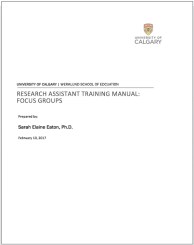
ra-training-manual-cover-001As the research project on academic integrity and plagiarism gets underway, I prepared a training manual for the research assistants I am working with.
This manual is an open source document and I am making it freely available as a .pdf for other scholars and research assistants.

Here is the link to the manual: ra-training-manual-focus-groups-2017-02-10

Here is the complete citation for the manual:

Eaton, S. E. (2017). Research assistant training manual: Focus groups. Calgary: University of Calgary. Retrieved from http://hdl.handle.net/1880/51811

The research team is grateful to the Office of Teaching and Learning, Werklund School of Education, University of Calgary, who awarded funding for this project under the Scholarship of Teaching and Learning Grant, 2016-2017.

I have to give a special shoutout of appreciation to Yvonne Kjorlien, Research Facilitator, Werklund School of Education, and Benedict “Kojo” Otoo, Research Assistant, for their review of drafts of this manual and feedback for improvement.

____________________________________________________

Share this post: Focus groups: Training Manual for Research Assistants http://wp.me/pNAh3-1Me

This blog has had over 1.6 million views thanks to readers like you. If you enjoyed this post, please “like” it or share it on social media. Thanks!

Sarah Elaine Eaton is a faculty member in the Werklund School of Education, University of Calgary, Canada.


New research project: Student learning in synchronous online classes

January 23, 2017
Image courtesy of patrisyu at FreeDigitalPhotos.net

Image courtesy of patrisyu at FreeDigitalPhotos.net

Are you involved with online learner as a student or an educator? Have you ever wondered how effective those real-time synchronous (webinar) sessions are for students?

A couple of colleagues and I were wondering the same thing, so we set up a research project to study it.

The primary research question guiding this inquiry is:

  1. How do online synchronous sessions support student learning in professional graduate programs engaging in research active opportunities for scholarship of the profession?

Secondary research questions include:

  1. To what extent do online synchronous sessions impact student learning in researching authentic problems of practice through distance delivery courses?
  2. How do the online synchronous sessions align with the learning outcomes for research design courses?
  3. What signature pedagogies make for successful learning during online synchronous sessions?

Check out our full research brief here:

Eaton, S. E., Brown, B., & Schroeder, M. (2017). Student learning in synchronous online classes: Research project brief. Retrieved from http://hdl.handle.net/1880/51792 doi:10.13140/RG.2.2.29667.55844

We are grateful to the Office of Teaching and Learning, Werklund School of Education, University of Calgary, who awarded funding for this project under the Scholarship of Teaching and Learning Grant, 2016-2017.

____________________________________________________

Update – January 2018 – This blog has had over 1.8 million views thanks to readers like you. If you enjoyed this post, please “like” it or share it on social media. Thanks!

Sarah Elaine Eaton is a faculty member in the Werklund School of Education, University of Calgary, Canada.


Article: Comparative Analysis of Institutional Policy Definitions of Plagiarism: A Pan-Canadian University Study

January 18, 2017

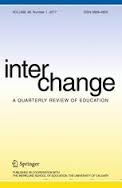
interchange I’m pleased to share the news with you about my latest article, published in Interchange. The title is: “Comparative Analysis of Institutional Policy Definitions of Plagiarism: A Pan-Canadian University Study”.

Here is a link to the online version of the article: http://rdcu.be/oCx2

Funding for this study was provided by  the University of Calgary Werklund School of Education Scholarship of Teaching and Learning Grant.

Here are some other posts related to this research project:

____________________________________________________

Share this post: Comparative Analysis of Institutional Policy Definitions of Plagiarism: A Pan-Canadian University Study https://wp.me/pNAh3-1LD

This blog has had over 1.8 million views thanks to readers like you. If you enjoyed this post, please “like” it or share it on social media. Thanks!

Sarah Elaine Eaton is a faculty member in the Werklund School of Education, University of Calgary, Canada.