Indigenous Research Methodologies: Resources and Readings

July 7, 2017

Let me start by stating the obvious. I am not an Indigenous person and as such, my understandings of Indigenous ways of knowing and understanding the world are limited. Having said that, I find myself working with students who want to conduct research about Indigenous issues. When that happens, I counsel my students to consider using Indigenous research methodologies to shape and inform their projects, as opposed to relying only on sources that have been so-far accepted as being “the norm” in Western educational research context.

Here is a list of some resources students have shared with me. In turn, I share them here. I do not claim that this is a complete or exhaustive list, but rather it is a starting point.

It is important for me to add that I also counsel students to work with one or more members of the Indigenous communities they wish to study to receive authentic guidance on their projects.

I owe a debt of gratitude to Dr. Aubrey Hanson, my colleague in the Werklund School of Education, who offered advice and feedback on this post.

Resources

  • Absolon, K. E. (2012). Kaandossiwin: how we come to know. Halifax, NS: Fernwood Publishers.
  • Ball, J. &  Janyst, P. (2008).  Enacting Research Ethics in Partnerships with Indigenous Communities in Canada: ‘Do it in a Good Way’. Journal of Empirical Research on Human Research Ethics: An International Journal 3(2), 33-51.
  • Brown, L., & Strega, S. (Eds.). (2005). Research As resistance: Critical, Indigenous and anti-oppressive approaches. Toronto: Canadian Scholars.
  • Cadwallader, N., Quigley, C., Yazzie-Mintz, T. (2011). Enacting decolonized methodologies: The doing of research in educational communities. Qualitative Inquiry (18)1, 3-15
  • Castellano, M.B. (2004). “Ethics of Aboriginal Research.” Journal of Aboriginal Health, 1(1), 98-114. Retrieved from http://www.naho.ca/jah/english/jah01_01/journal_p98-114.pdf
  • Chilisa, B. (2012). Indigenous reserach methodologies. Los Angeles: Sage.
  • Kovach, M. (2010). Conversational method in Indigenous research. First Peoples Child and Family Review,5(1), 40-48.
  • Kovach, M. (2010). Indigenous methodologies: characteristics, conversations and contexts. Toronto: University of Toronto Press.
  • Lambert, L. (2014). Research for indigenous survival: Indigenous research methodologies in the behavioral sciences. Brantford, ON: Salish Kootenai College Press.
  • Lavallé, L. (Producer). (2016). Reconciling Ethical Research with Métis, Inuit, and First Nations People (video). Retrieved from https://youtu.be/D5qh7MY4el0
  • Ledoux, J. (2006). Integrating Aboriginal perspectives into curricula: A literature review. The Canadian Journal of Native Studies, 26(2), 265-288.
  • Lincoln, Y. S., Tuhiwai Smith, L., & Denzin, N. K. (Eds.). (2008). Handbook of critical and indigenous methodologies. Los Angeles: Sage.
  • Mertens, D. M., Cram, F., & Chilisa, B. (Eds.). (2013). Indigenous pathways into social research: Voices of a new generation. Walnut Creek, CA: Left Coast Press.
  • Michell, H. (2009). Gathering berries in northern contexts: A Woodlands Cree metaphor for community-based research.  Pimatisiwin: A Journal of Aboriginal and Indigenous Community Health, 7(1): 65-73.
  • Mihesuah, D. A., & Wilson, A. C. (Eds.). (2004). Indigenizing the academy: Transforming scholarship and empowering communities. Lincoln: University of Nebraska Press. Retrieved from https://muse.jhu.edu/chapter/334026
  • Schnarch, Brian. (2009). “Ownership, Control, Access, and Possession (OCAP) or Self-Determination Applied to Research, A Critical Analysis of
    Contemporary First Nations Research and Some Options for First Nations Communities.” Journal of Aboriginal Health, 14.16. NAHO Conference Our People Our Health.
  • Tuhiwai Smith, L. (2012). Decolonizing methodologies: Research and indigenous peoples. New York: Zed Books Ltd.
  • Wotherspoon, T. (2006). Teachers’ ’work in Aboriginal communities. Comparative and International Education Society, 50(4), 672-694.
  • Wallace, & Rick. (2011). Power, practice and a critical pedagogy for non-Indigenous allies. The Canadian Journal of Native Studies, 31(2).
  • Walter, M., & Andersen, C. (2013). Indigenous Statistics: a quantitative research methodology. Walnut Creek, CA: Left Coast Press.
  • Wilson, S. (2001). What is Indigenous reserach methodology. Canadian Journal of Native Education, 25(2), 175-179.
  • Wilson, S. (2008). Research is ceremony- Indigenous research methods. Halifax: Fernward Press.

____________________________________________________

Share this post: Indigenous Research Methodologies: Resources and Readings http://wp.me/pNAh3-1Ve

This blog has had over 1.8 million views thanks to readers like you. If you enjoyed this post, please “like” it or share it on social media. Thanks!

Sarah Elaine Eaton is a faculty member in the Werklund School of Education, University of Calgary, Canada.


Making evidence informed decisions about formative written feedback for ELLs

July 6, 2017

iStock-woman at laptopI have been working on a research project with a former student, Lorelei Anselmo, about providing effective formative effective feedback for English Language Learners.

Here’s a piece featured on the Werklund School of Education’s “Research@Werklund” site:

Providing post-secondary ELLs with high quality feedback

Formative assessment provides students with feedback that focuses on growth, rather than a grade. Effective formative feedback can help students demonstrate that learning has taken place, and that the learners have used the suggestions to improve their work. Students who can reflect and act on feedback are more likely to be successful in their academic tasks – however, students of all ages must be taught how to use and apply feedback for it to be impactful.

In a study on international post-secondary English language learners (ELLs), Dr. Sarah Elaine Eaton and Lorelei Anselmo, a Werklund MEd graduate, interviewed and surveyed 19 learners on their experiences with formative feedback, both in their home countries, and in Canada. The researchers examined what it means to deliver high quality feedback to students about their writing, and how these students perceive and experience receiving feedback. Read more…

____________________________________________________

Share this post: Making evidence informed decisions about formative written feedback for ELLs http://wp.me/pNAh3-1V1

This blog has had over 1.8 million views thanks to readers like you. If you enjoyed this post, please “like” it or share it on social media. Thanks!

Sarah Elaine Eaton is a faculty member in the Werklund School of Education, University of Calgary, Canada.


Summer course – Research Methodology in Education

June 19, 2017

I am pleased to be teaching Research Methodology in Education this summer for our Master of Education students. This is an online course offered from July 4 to August 16, 2017.

Course description

This first course in educational research methodologies provides the background necessary to make intelligent decisions around the kinds of research questions that might be asked and the sort(s) of insights and answers particular methods can provide.

Learner outcomes

Throughout the course of study students will be able to:

  • Identify viable and interesting research questions, both in their own potential research endeavours and in the work of published academics
  • Identify, compare and critique a variety of educational research methodologies based on their primary assumptions and methods
  • Evaluate the relevance of educational research methodologies with special consideration being given to stated research questions and the knowledge being sought
  • Differentiate between the central tenets of qualitative and quantitative data collection and analysis strategies with special consideration being given to the strengths, weaknesses and relevance of each in education
  • Assess the validity of a variety of research methods, both qualitative and quantitative, commonly used in education
  • Examine and interrogate the relationships between research questions, research methods and interpretation of findings in educational studies
  • Demonstrate a critical understanding of ethical issues in educational research, particularly with regard to the use of human participants
  • Formulate and evaluate their own preliminary research questions in response to both their research interests and professional context
  • Understand how action research applies to educational settings and contexts

Required readings

Creswell, J. W. (2014).  Research design: Qualitative, quantitative, and mixed methods approaches (4th ed).  Thousand Oaks, CA: SAGE Publications, Inc.

Hendricks, C. (2016). Improving schools through Action Research: A reflective practice approach (4th ed.), Upper Saddle River, NJ: Pearson Education.

Here’s a copy of the course outline: EDER_603.21_Su2017_Eaton_approved

This marks the tenth time I have taught this course online. I love working with students to help them gain a strong foundation in research methodology. I can’t wait to get started with this year’s group!

____________________________________________________

Share this post: Summer course – Research Methodology in Education http://wp.me/pNAh3-1UJ

This blog has had over 1.8 million views thanks to readers like you. If you enjoyed this post, please “like” it or share it on social media. Thanks!

Sarah Elaine Eaton is a faculty member in the Werklund School of Education, University of Calgary, Canada.


Writing Educational Research (EDER 603.23)

May 11, 2017

U of C logo - 2015I am feeling energized! This spring, I get to teach one of my all-time favourite courses: Writing Educational Research (EDER 603.23). I’ll be working with Master of Education (M.Ed.) students to help them craft a term paper into a manuscript for publication.
Why do I love this course? Because it generates results! Some of the students who take this course really do end up getting their work published in peer-reviewed journals, conference proceedings, books and professional publications. Here are some real-life examples of students who have taken this course with me and have published their work:

There are additional students who have written to me to tell me they have manuscripts in progress. I really love to see authentic, real-world outcomes from student learning and these are some fabulous examples.

Course description

Here is the official description of the course:

This course will focus on examining and developing the skills associated with crafting an academic report and discussion on research data. Topics include genres and purposes of academic writing, as well as venues for presentation and publication. An academic paper is more than a compilation of relevant literature, attending information and a conclusion.

An acceptable paper, whether intended for an academic or a professional audience, and whether a report of findings or a theoretical-philosophical argument, takes a clearly defined idea, situates it in the current literature, and supports it with a well-structured discussion. The principal intentions of this course are to introduce students to the various structures of academic and professional papers and to provide support in their efforts to craft, present and potentially publish their written work.

A traditional approach to writing educational research involves first learning about writing, then learning to write. Learners first study sample texts, analyzing them and then dissecting them, examining their structure, argument and style. The next step often involves producing an original piece of writing that mimics the style, tone and structure of the sample text. The final step is to integrate elements of the student’s own voice and style with elements of the texts they have previously studied. The rationale behind this approach is that the student must first learn what counts as excellent writing by learning about writing. Only then are they prepared to write themselves.

This course takes a non-traditional approach to learning to write about research for scholarly or professional purposes. Students will focus on writing, offering feedback to peers, revising, and incorporating feedback.

Students take on three key roles during this course:

  1. Writer – Crafting an original work intended for sharing in a public forum.
  2. Reviewer – Developing your skills offering substantive and supportive feedback to peers to help them improve their writing so that they, too, are successful in sharing their work in a public forum.
  3. Reviser – Learning to consider and incorporate peer feedback thoughtfully. As scholars and professionals, we recognize that our work is stronger when we incorporate revisions from trusted colleagues whose intention is to help us succeed.

Check out a copy of the course outline here:

EDER_603.23_L09_Eaton_SP2017 – approved

____________________________________________________

Share this post: Writing Educational Research (EDER 603.23)

This blog has had over 1.8 million views thanks to readers like you. If you enjoyed this post, please “like” it or share it on social media. Thanks!

Sarah Elaine Eaton is a faculty member in the Werklund School of Education, University of Calgary, Canada.


Journal of Educational Thought – Celebrating 50 Years

April 18, 2017

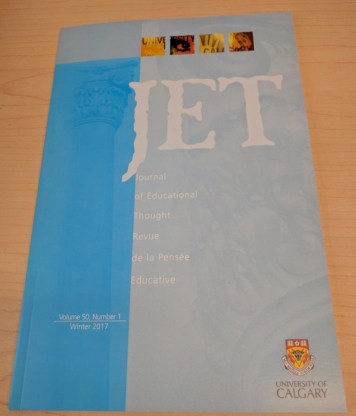
When I first started in my role as an Assistant PrJET 50(1)ofessor in the Werklund School of Education, one of my former professors, Dr. Ian Winchester, approached me about being a book review editor for the Journal of Educational Thought. I accepted immediately. I set to work acquiring titles and recruiting people to write book reviews for the journal.

It has been a fabulous experience so far, as I’ve had the opportunity to meet other scholars, re-connect with former students, and mentor a couple of current students, too.

Today, the editorial assistant, the fabulous Aber Abulhassn, stopped by my office with a copy of the latest issue of the journal. This issue is special for a few reasons. Firstly, I’m named as the Book Review Editor (a position previously vacant). I am thrilled about that. Secondly, I actually have a book review published in this issue, wish is lovely in a “meta” kind of way. Finally — and this is what’s most inspiring — this is volume 50, issue 1 of the journal. That’s right, this journal has been around for half a century.

Dr. Winchester’s opening editorial is “Fifty Years of the Journal of Educational Thought“. In it, he traces the history of the journal, with its origins starting at the University of Calgary. He discusses how the landscape for journals has changed and the how “this is not any easy time for journals” (p. 3), but closing on a high note by inviting readers to “raise a glass to the first fifty years” (p. 3).

I feel honoured to be part of a publication with half a century of tradition and quality. I recognize that I share a special path of those who have come before me, contributing to a long-standing publication in the field of academia.

Related article:

Werklund School’s Journal of Educational Thought turns 50 – https://wcm.ucalgary.ca/utoday/issue/2017-12-07/werklund-schools-journal-educational-thought-turns-50

____________________________________________________

Share this post: Journal of Educational Thought – Celebrating 50 Years http://wp.me/pNAh3-1RM

This blog has had over 1.8 million views thanks to readers like you. If you enjoyed this post, please “like” it or share it on social media. Thanks!

Sarah Elaine Eaton is a faculty member in the Werklund School of Education, University of Calgary, Canada.