Modern Languages Experience Week helps students build confidence

November 12, 2011

In a small corner of Wales this week 200 students have been taking part in a commendable initiative designed to boost their interest and confidence in using foreign languages. The Modern Languages Experience Week is a joint initiative between Cardiff University’s School of European Studies and eleven local schools. The project brings students to the university for activities around language learning designed to increase their curiosity, practice their skills and increase their cultural awareness.

The Health Canal reports on the benefits of the initiative to the students sense of self-confidence and overall attitude.

This is a brilliant initiative, not only to increase students’ curiosity and awareness, but also to generate positive links between the school system and the post-secondary system, where the students are the ones benefitting.

___________

Share this post: Modern Languages Experience Week helps students build confidence http://wp.me/pNAh3-11g

Update – January 2018 – This blog has had over 1.8 million views thanks to readers like you. If you enjoyed this post, please “like” it or share it on social media. Thanks!

Sarah Elaine Eaton is a faculty member in the Werklund School of Education, University of Calgary, Canada.


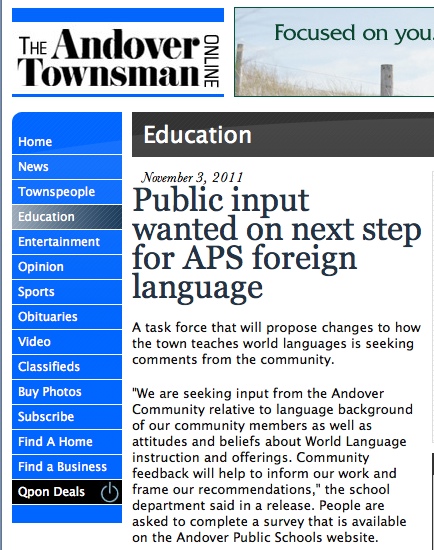
U.S. School district asks for public input on world language program

November 6, 2011

Andover public schools seek public inputThe Andover Public School board in Massachusetts, U.S.A. has established a World Language Task Force, reports the Andover Townsman. The purpose of the task force is to seek input from the community on what languages they would like to see taught in their schools and why. The task force is comprised of teachers, parents, community members, and administrators. The purpose of the task force is to:

Study the K-12 programming model and trends in world language teaching and learning.

Develop goals and strategies for a K-12 World Language program for inclusion in the Andover Public Schools Strategic Plan.

Produce recommendations relative to which one language will be taught on the elementary school level, which two languages will be taught on the middle school level, and which languages will be taught at Andover High School.

The task force is soliciting input from the public through a public online survey developed by the school board. The survey asks respondents to rank the importance of such factors as cultural competence, writing and testing skills in a first language and preparing students for global society. It also asks for input on what languages the board should offer, including popular languages such as Spanish and Chinese, as well as less popular languages such as Hmong, Khmer and Creolo Haitian.

I believe that this is a commendable initiative for a variety of reasons:

  1. Generating dialogue between school boards and the community promotes a culture of open communication. It gives a voice to parents, grandparents and even students about that is important to them. It gives a voice to the community.
  2. In addition to giving a voice to the community, it also seeks to uncover what is important to the community, digging deeper into the values, beliefs and opinions of those who live in the local area. Then, it would assume, the task force would consider these values as part of its criteria when it comes to making its decisions.
  3. It downplays the traditional authoritarian nature of school boards. Instead of propagating the ideas that “school boards know best”, it levels the playing field (at least in terms of the optics) and sends the message that “We’re here to serve you, not dictate to you.” This is a strategy that the Calgary Board of Education would have done well to employ when it arbitrarily decided to cut French programs without engaging the community in any dialogue about it.
  4. It generates community involvement and interest in language programs at the local schools. At a time when cutbacks to language programs, particularly in the United States, are mercilessly targeting world language programs, initiatives such as this will draw importance to language programs. After people have contributed to the discussion and have had some say into the decision-making process they are emotionally and psychologically invested in the outcome and are more likely to support foreign and world language programs in general.

One comment posted on the Andover news article pointed out that the survey is an imperfect tool, since respondents can answer as many times as they like, potentially skewing the results. This is relatively easy to overcome, depending on which survey tool is used. Nevertheless, the concept is brilliant. Opening up discussions about education and in particular, language learning, to the public and ultimately involving the community in the decision making process is innovative, respectful of the community and downright brilliant.

________________

Share this post: U.S. School district asks for public input on world language program http://wp.me/pNAh3-ZV

Update – January 2018 – This blog has had over 1.8 million views thanks to readers like you. If you enjoyed this post, please “like” it or share it on social media. Thanks!

Sarah Elaine Eaton is a faculty member in the Werklund School of Education, University of Calgary, Canada.


How the Military Promotes Language Learning

October 21, 2011

Dr. Sarah Eaton's blogThe U.S. Department of Defense (DOD) recently released an article about how they strive to preserve and promote language skills. The article talks about how the DOD trains thousands of employees a year in over two dozen languages. They make some interesting points such as:

Recruits often wait 2 or 3 years for assignments in a location requiring a foreign language, in order to get their skills up to snuff.

Language skills can atrophy over time. It’s a “use it or lose it” kind of thing.

The military uses a variety of means of teaching including face-to-face classes, distance education, video training, virtual classrooms and mobile learning teams.

The Defense Language Institute (DLI) has over 26 language training facilities around the world.

Last year the program provided 21,000 hours of instruction to nearly 1,300 students. That’s almost ten times what it provided in 2009, which was 2400 hours of instruction.

I find it ironic that while government ministries, school boards and universities are drastically slashing the budgets for language programs, the U.S. military has increased its language teaching programs dramatically. Wouldn’t it stand to reason that if those in charge of education invested in language training for younger students, that those students would become more employable in their early adult years?

Could it be that the military has more insight into the value of language learning than educational policy makers?

_______________________________

Share this post: How the Military Promotes Language Learning http://wp.me/pNAh3-Y8

Update – January 2018 – This blog has had over 1.8 million views thanks to readers like you. If you enjoyed this post, please “like” it or share it on social media. Thanks!

Sarah Elaine Eaton is a faculty member in the Werklund School of Education, University of Calgary, Canada.


Google Translate with Conversation Mode

October 17, 2011

I am not a fan of online translation.

Or rather, I was not a fan of online translation.

For years I’ve been vehemently vocal about the pitfalls of leaving language translation up to a mechanical device.

I’ve just seen something that is making me reconsider. This is quite possibly the coolest thing I’ve seen in a while. Computer-based translation has come a long way in the past 15 years or so.

Check it out and let me know what you think.

___________

Share this post: Google Translate with Conversation Mode http://wp.me/pNAh3-Xv

Update – January 2018 – This blog has had over 1.8 million views thanks to readers like you. If you enjoyed this post, please “like” it or share it on social media. Thanks!

Sarah Elaine Eaton is a faculty member in the Werklund School of Education, University of Calgary, Canada.


The new “F” word in language departments: Foreign.

October 5, 2011

A recent article in Inside Higher Ed offers insights into the political correctness of how we talk about language programs. If you’re like me, you started your career by taking or teaching “foreign languages” or “modern languages”. These terms are now, apparently, passé. These terms have been thrown out, replaced by designations such as “world languages”.

The article reports that “many educators also do not like the way “foreign” suggests a division of the world into the United States and everyone else” or that ” the word ‘foreign’ could imply different in a negative sense”, arguing that Spanish, in particular, is no longer a language foreign to the United States, but rather an officially un-recognized second language of that country.

What about the term “foreign word”? Does that now get replaced by “international word”? Or “world word”? (Try saying that one ten times fast in front of your class.)

Similarly, English as a Second Language (ESL), English as a Foreign Language (EFL) have also fallen out of favor, being replaced by English as an Additional Language (EAL) and English as and International Language (EIL).

Personally (and I accept the risks of ticking off some colleagues as a I say this), I wonder about all these name changes. If we keep changing perfectly respectable words and phrases in order to be politically correct, then are we not at the mercy of fear mongering and negativity, anyway?

I’m not talking here about heinous and derogatory racial or religious verbal aberrations that belong in the toilet bowl. I am talking about professional nomenclature, used by trained and credentialed teachers, researchers, professors, students and government agencies.

If we keep changing professional terms are we not lowering them to the same status as derogatory slang that refers to race, religion or sexual preference? Those terms are intended to ridicule, insult, defile and debase others. Those terms should most definitely be dropped from professional (and even personal) vernacular, in favour of more respectful and less emotionally-charged terminology.

But as far as I know, professional nomenclature was never intended to be emotionally charged. Its purpose, as with all scientific and professional nomenclature, is intended to be objective and even clinical. It is designed to stand the test of time, be searchable in research works throughout the ages and signify the tradition and pride of a the profession.

How often do we see other disciplines fretting about what they call themselves? Physics, for example. One could argue that the word is archaic, dated and hard to spell. It is! Yet physicists around a proud and vigilant bunch who revel in the ancient Greek tradition from which it hails.

Should the word “Physics” be dropped because it’s hard to spell? (I hear my physicist friends snorting in disgust at the very thought of such a ludicrous proposition.)

Or Mathematics. Though it is sometimes shortened to “Maths” or “Math”, we really haven’t seen great changes to name of the discipline in centuries.

Moving away from the hard sciences, “Philosophy” retains its name and its tradition, as well, as does “Fine Arts”, or even “Education” (which I’m surprised hasn’t been banished in favour of “Learning”… but give it time.)

I agree that words are important and wording is highly important. But I do wonder what happens to our sense of identity and pride as language teaching professionals if, every decade or so, we change the name of our discipline to suit what is politically correct at the time?

I’m not saying that “World Languages” is wrong and “Foreign Languages” is right. I am suggesting that we, as professionals, settle on what to call our discipline and stick with it for a century or two.

We lament about cuts to funding and the marginalization of our programs within the institutions in which we work. At the same time, I suspect that colleagues in other disciplines quietly snicker at us. While we bicker and fret about what to call ourselves, they methodically and strategically move forward, claiming funding and research dollars, unapologetically going by the same name they’ve had for centuries.

___________

Share this post: The new “F” word in language departments: Foreign. http://wp.me/pNAh3-Wi

Update – January 2018 – This blog has had over 1.8 million views thanks to readers like you. If you enjoyed this post, please “like” it or share it on social media. Thanks!

Sarah Elaine Eaton is a faculty member in the Werklund School of Education, University of Calgary, Canada.