Supporting struggling pre-service teachers: A guide for mentor teachers

January 9, 2020

Cover

In 2017 I joined a project led my my colleague, Dr. Amy Burns, in the Werklund School of Education at the University of Calgary. 

The project was called “Pre-service teachers at risk: Intervention strategies for and by teachers“. It was funded by the Alberta Advisory Committee for Educational Studies (AACES).

The primary question our research addressed was: (RQ1) What strategies do in-service teachers employ to support struggling pre-service teachers in field education?

A secondary question addressed was: (RQ2) How can postsecondary institutions better facilitate placements where a pre-service teacher is struggling before the field placement begins, given the legislative restrictions that exist with regard to privacy?

The research is complete now and as a result, we have developed an entirely open access educational resource to help both pre-service teachers (e.g. teacher trainees) and the mentor teachers they work with. Here are the key themes we identified through our research:

  1. Don’t Do This Job in Isolation: Seek Support
  2. Guide and Model What You Want to See
  3. Provide Immediate and Frequent Feedback
  4. Communicate: Early, Often, Directly, Honestly, and Clearly
  5. Remember the Big Picture
  6. Set Clear and High Expectations
  7. Support Engagement in Self-Reflection
  8. Reflect on the Preservice Teacher’s Difficulties
  9. Recognize Early Warning Signs and Don’t Ignore Them
  10. Identify the Preservice Teacher’s Current Skill Level
  11. Create Goals


Download a full copy of the resource free of charge here:

Burns, A., Eaton, S. E., Gereluk, D., Mueller, K., & Craig, H. L. (2019). Supporting Struggling Pre-Service Teachers: A Guide for Mentor Teachers. Retrieved from Calgary, AB: http://hdl.handle.net/1880/111439

______________________________________________________

Share or Tweet this: Supporting struggling pre-service teachers: A guide for mentor teachers – https://wp.me/pNAh3-2pq

This blog has had over 2 million views thanks to readers like you. If you enjoyed this post, please “like” it or share it on social media. Thanks!

Sarah Elaine Eaton is a faculty member in the Werklund School of Education, and the Educational Leader in Residence, Academic Integrity, University of Calgary, Canada. Opinions are my own and do not represent those of the University of Calgary.


Canadian Directory of Graduate Supervisors specializing in Academic Integrity

October 24, 2019

The idea for this directory came to me after talking with a number of graduate students who are undertaking research related to academic integrity under the supervision of generous professors who have agreed to be their advisors, but have little to no expertise in this field.

I developed this directory to provide opportunities for graduate students (and their supervisors) to be better supported in developing sound research projects on topics related to academic integrity.

The goal of this work is to provide an accessible directory of faculty members who are qualified and interested in supporting graduate students through as academic supervisors, graduate committee members, and examiners. Those who are currently supervising students whose research relates to plagiarism, academic misconduct policy, contract cheating or other topics related to academic integrity may find this directory useful when considering who might serve as a committee member or examiner for a graduate student.

Because the field of academic integrity is still developing in Canada and scholars are still forming their networks of collaboration and practice, I have purposely limited this directory to faculty members who have current affiliations to accredited Canadian universities. There are a number of other inclusion criteria, which you can see in the directory itself.

This is an informal directory and those whose names appear in it have agreed to having their contact information shared. It is formatted as a shareable Google doc, which I have embedded here.

The embedded doc should automatically update as I update the directory. It is my intention to grow the directory over time, as the field of academic integrity research further develops in Canada.

Related posts:

______________________________________________________

Share or Tweet this: Canadian Directory of Graduate Supervisors specializing in Academic Integrity https://wp.me/pNAh3-2pe

This blog has had over 2 million views thanks to readers like you. If you enjoyed this post, please “like” it or share it on social media. Thanks!

Sarah Elaine Eaton is a faculty member in the Werklund School of Education, and the Educational Leader in Residence, Academic Integrity, University of Calgary, Canada. Opinions are my own and do not represent those of the University of Calgary.


University of Calgary activities planned for 2019 International Day of Action Against Contract Cheating

October 16, 2019

This year, the Univeristy of Calgary has activities planned for students, faculty, staff, teaching assistants and other members of the university community. We have activities being led by students all over campus including:

  • Student’s Union, Mac Hall – Lunch time awareness event and game.
  • Taylor Family Digital Library – Interactive prize wheel game.
  • Health Research Innovation Centre (HRIC) Atrium – Foothills Campus – Interactive prize wheel game.
  • Roaming Whiteboards – Social media campaign – Students Union representatives.


I will document the student-focused initiatives in another post after the Day of Action.

We have also launched the University of Calgary’s own social media campaign called #UHaveIntegrity. Here’s a photo of our shiny new laptop stickers that we’ll be giving out starting tomorrow:

#Uhaveintegrity sticker on Mac small

In this post, I highlight two workshops, designed specifically to help academic staff and teaching assistants better understand what contract cheating is and how to address it.

Workshop #1: Contract Cheating: What professors and teaching assistants need to know

Wednesday, October 16, 2019 – 10:30 a.m. – 11:30 a.m.

How do you know if your students are buying their academic work from the Internet? How prevalent is this practice, anyway? How do you talk to your students about the issue of contract cheating? Get answers to these questions and more in this interactive workshop. Find out the latest research about academic outsourcing and get resources to help.

Participants will:

Gain insights into how the contract cheating industry really works

Learn what the latest research says

Learn practical ways to detect contract cheating and how to talk to students about it.

Facilitator: Sarah Elaine Eaton, PhD. is the Educational Leader in Residence, Academic Integrity, at the University of Calgary. Her research focuses on academic integrity, misconduct and contract cheating.

Register here.

Workshop #2: Pay-to-Pass: Knowledge as a commodity

Wednesday, October 16, 2019 – 12:00 p.m. – 1:00 p.m.

With the aid of social media, companies offering study ‘help’ and better grades have proliferated the post-secondary sector at an alarming rate.  Students are deliberately or inadvertently breaching academic integrity regulations in the search of an easier solution to improve academic performance. This interactive workshop examines how some of these companies have created the ease and (sometimes) anonymity of online uploads and downloads.

Participants will:

Learn the scope of the pay-to-pass phenomenon

Share and discuss their experiences with pay-to-pass companies

Brainstorm solutions to this rising crisis.

Facilitators: Ebba Kurz,  PhD., Associate Dean, Undergraduate Health and Science Education and Director, O’Brien Centre for the Bachelor of Health Sciences Program, Cumming School of Medicine

Nancy Chibry, Associate Dean, Undergraduate Programs and Student Affairs, Faculty of Science

These workshops are free of charge and open to all members of the campus community.

Register here.

______________________________________________________

Share or Tweet this: University of Calgary activities planned for 2019 International Day of Action Against Contract Cheating #defeatthecheat #excelwithintegrity #uhaveintegrity

This blog has had over 2 million views thanks to readers like you. If you enjoyed this post, please “like” it or share it on social media. Thanks!

Sarah Elaine Eaton is a faculty member in the Werklund School of Education, and the Educational Leader in Residence, Academic Integrity, University of Calgary, Canada. Opinions are my own and do not represent those of the University of Calgary.


MEd Certificate in Academic Integrity

October 2, 2019

MEd Cert - Academic IntegrityThis program is situated as one component of a course-based Master of Education (MEd) Interdisciplinary. Students will undertake a 4-course topic in Academic Integrity to earn a Master’s level certificate qualification.
Program Overview: The Academic Integrity four-course topic fosters an understanding of theories of knowledge, knowledge sharing, attribution, as situated within an educational leadership context. Students will engage in research-intensive courses to understand how academic integrity is understood from the perspectives of theory and professional practice. Students will apply their knowledge in the exploration, critique and design of institutional, teaching, learning and assessment practices as they relate to academic integrity. This 4-course topic serves to develop professional autonomy and capacity at both K-12 and post-secondary contexts.

Program Goals:

  • Develop research-informed understanding of academic integrity, situated within current problems, as well as emerging trends in the field.
  • Develop and extend concepts relating to ethical decision-making, policy, academic misconduct case management.
  • Develop and extend methodological and theoretical competence in the field of academic integrity.

Format: Fully online

Program dates: July 2020 to April 2021

Applications open: November 1, 2019  Applications close: March 15, 2020

For more information about the Master of Education (MEd) Interdisciplinary: http://werklund.ucalgary.ca/gpe/

______________________________________________________

Share or Tweet this: MEd Certificate in Academic Integrity

This blog has had over 2 million views thanks to readers like you. If you enjoyed this post, please “like” it or share it on social media. Thanks!

Sarah Elaine Eaton is a faculty member in the Werklund School of Education, and the Educational Leader in Residence, Academic Integrity, University of Calgary, Canada. Opinions are my own and do not represent those of the University of Calgary.


Academic Integrity: Resource for Teaching Assistants

September 16, 2019
Academic Integrity resource for teaching assistants

Academic Integrity resource for teaching assistants

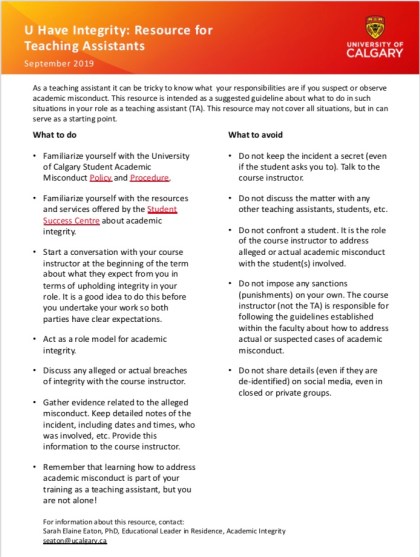
As a Teaching Assistant (TA) it can be tricky to know what your responsibilities are if you suspect or observe academic misconduct. This resource is intended to help both TAs and course instructors about the roles and responsibilities teaching assistants play in upholding academic integrity at the University of Calgary.

Teaching assistants are responsible for acting with integrity, maintaining the privacy of all parties involved and reporting any suspected or actual cases of academic misconduct to the course instructor. TAs are not responsible for confronting student(s) who may be allegedly responsible for academic misconduct and nor are they responsible for imposing sanctions (discipline). It is the responsibility of the course instructor to follow the guidelines established by their faculty for responding to allegations of academic misconduct.

Open communication between course instructors and teaching assistants is key. Establishing expectations early in the term, before issues might arise can be very helpful for teaching assistants.

It is important for teaching assistants to know they are not alone when it comes to upholding academic integrity.

This one-page tip sheet is intended as a suggested guideline to help teaching assistants figure out what to do if they encounter or suspect a breach of academic integrity. This handout is not exhaustive and it may not cover all situations. This resource was developed specifically for teaching assistants at the University of Calgary and may not apply to TAs at other institutions.

Here is a link to this free and downloadable .pdf resource: U Have Integrity: Resource for Teaching Assistants.

Here is the text of the .pdf for anyone wanting a quick read:

As a teaching assistant it can be tricky to know what your responsibilities are if you suspect or observe academic misconduct. This resource is intended as a suggested guideline about what to do in such situations in your role as a teaching assistant (TA). This resource may not cover all situations, but in can serve as a starting point. 

What to do 

  • Familiarize yourself with the University of Calgary Student Academic Misconduct Policy and Procedure. 
  • Familiarize yourself with the resources and services offered by the Student Success Centre about academic integrity. 
  • Start a conversation with your course instructor at the beginning of the term about what they expect from you in terms of upholding integrity in your role. It is a good idea to do this before you undertake your work so both parties have clear expectations. 
  • Act as a role model for academic integrity. 
  • Discuss any alleged or actual breaches of integrity with the course instructor. 
  • Gather evidence related to the alleged misconduct. Keep detailed notes of the incident, including dates and times, who was involved, etc. Provide this information to the course instructor. 
  • Remember that learning how to address academic misconduct is part of your training as a teaching assistant, but you are not alone! 

What to avoid 

  • Do not keep the incident a secret (even if the student asks you to). Talk to the course instructor. 
  • Do not discuss the matter with any other teaching assistants, students, etc. 
  • Do not confront a student. It is the role of the course instructor to address alleged or actual academic misconduct with the student(s) involved. 
  • Do not impose any sanctions (punishments) on your own. The course instructor (not the TA) is responsible for following the guidelines established within the faculty about how to address actual or suspected cases of academic misconduct. 
  • Do not share details (even if they are de-identified) on social media, even in closed or private groups.

Related posts:

______________________________________________________

Share or Tweet this: Academic Integrity: Resource for Teaching Assistants https://wp.me/pNAh3-2oQ

This blog has had over 2 million views thanks to readers like you. If you enjoyed this post, please “like” it or share it on social media. Thanks!

Sarah Elaine Eaton is a faculty member in the Werklund School of Education, and the Educational Leader in Residence, Academic Integrity, University of Calgary, Canada. Opinions are my own and do not represent those of the University of Calgary.