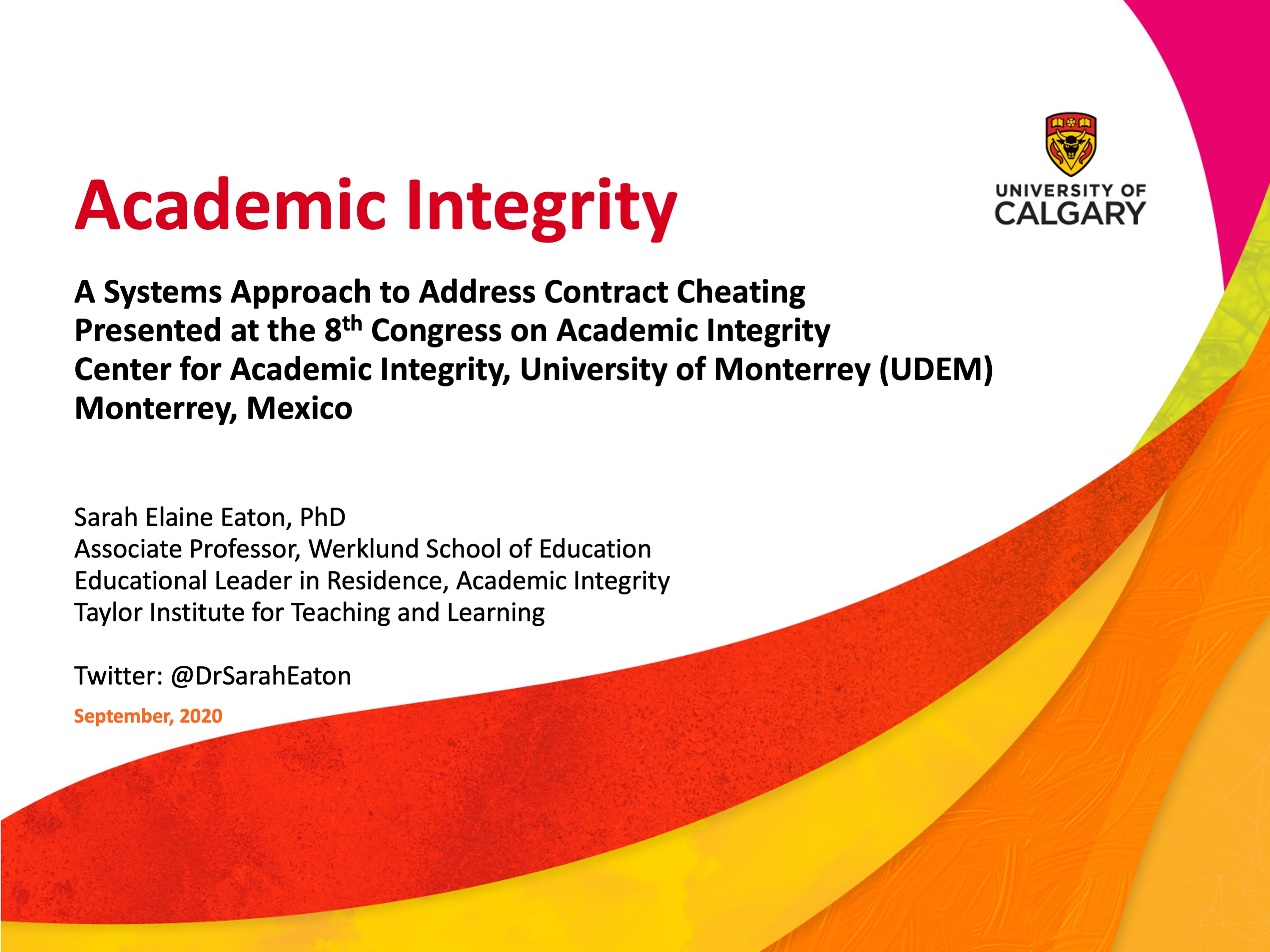
A Systems Approach to Address Contract Cheating

September 24, 2020

I’m delighted to be giving a presentation today at the the 8th Congress on Academic Integrity organized by the Center for Academic Integrity, University of Monterrey (UDEM), Monterrey, Mexico.

Slide1

Abstract

In this presentation I examine how a systems approach is needed to address contract cheating in its various forms. Using the 4M framework, I demonstrate the role of the individual (micro), the department (meso), the learning organization (macro) and stakeholders beyond the institution (mega).

In this session, I share insights from my forthcoming book, Plagiarism in Higher Education: Tackling Tough Topics in Academic Integrity to be published by ABC Clio/Libraries Unlimited in 2021.

Keywords: academic integrity, academic misconduct, contract cheating, 4M Framework, SoTL

You can find a complete English-language slide deck and the script for the talk archived online here: http://hdl.handle.net/1880/112560

Integridad Académica: Un enfoque de sistemas para enfrentar la compraventa de trabajo académico1
8.° Congreso de Integridad Académica

En esta presentación Eaton examina cómo y por qué se requiere de un enfoque de sistemas para abordar la compraventa de trabajo académico.

Utilizando el marco de referencia de las 4M, Eaton muestra el rol de la persona (micro), el departamento (meso), la institución y la comunidad (mega).

Palabras clave: integridad académica, mala conducta académica, marco de referencia de las 4M, Investigación en Docencia y Aprendizaje (IDA / SoTL)

Se encuentra las diapositivas y todo el contenido de esta presentación aquí:  http://hdl.handle.net/1880/112565

_________________________________

Share or Tweet this:

Academic Integrity: A Systems Approach to Address Contract Cheating 8th Congress on Academic Integrity https://drsaraheaton.wordpress.com/2020/09/24/a-systems-approach-to-address-contract-cheating/(opens in a new tab)

This blog has had over 2 million views thanks to readers like you. If you enjoyed this post, please “like” it or share it on social media. Thanks!

Sarah Elaine Eaton, PhD, is a faculty member in the Werklund School of Education, and the Educational Leader in Residence, Academic Integrity, University of Calgary, Canada. Opinions are my own and do not represent those of the University of Calgary.


¿Cómo se dice “contract cheating”? Exploring Academic Integrity Terminology in Spanish-speaking contexts

September 15, 2020

All Posts

by: Sarah Elaine Eaton and Beatriz Moya Figueroa

Abstract

In this brief report we explore linguistic differences in how contract cheating has been explained and translated into Spanish.

Keywords: academic integrity, academic misconduct, terminology, contract cheating

Palabras clave: integridad académica, mala conducta académica, terminología

Overview

Academic integrity is a concern across the world. Contract cheating, which is the outsourcing of academic work to third parties is a growing problem. We know that contract cheating happens in a multitude of languages, including Spanish (Eaton & Dressler, 2019). In order to address a problem, we must first have a common language to talk about it. The term “contract cheating” was coined by Clarke and Lancaster (2006), as a more updated way and comprehensive term to address academic outsourcing in text-based as well as non-text-based disciples. “Contract cheating” is now preferred over “essay mill” or “term paper mills”, though all of these terms remain in use in various contexts.

In this brief report we explore linguistic differences in how contract cheating has been explained and translated into Spanish.

ENAI Glossary: A Starting Point

We acknowledge and applaud the work done by the European Network for Academic Integrity (ENAI) (n.d.) to produce a multilingual glossary of terms relating to academic integrity. The glossary is available in ten languages; but currently, Spanish is not one of them. We consulted the glossary in the closest language, Portuguese, (see Taúginienė et al., 2019) and found contract cheating referenced as, “fraude no contrato” (p. 23), explained as, “Forma de má conduta que existe quando uma pessoa utiliza uma entidade terceira para a assistir a produzir trabalho, independentemente de envolver um pagamento ou favor” (p. 23).

Although the accompanying explanation describes contract cheating well, to translate “fraude no contrato” (Portuguese) into Spanish would result in “el fraude de contrato”, the meaning of which could be misconstrued as contractual fraud in a legal sense, rather than an academic one. For this reason, we contend that “el fraude de contrato” is not an appropriate translation of the English term, “contract cheating”.

In Search of a Spanish Translation

Having eliminated that possibility, we continued our inquiry, but we found no standardized translation of the term. Instead, we encountered a variety of phrases used in the literature. Some examples of translations we found include:

  • realización por parte de un tercero de trabajos escritos” (Gómez Córdoba & Pinto Bustamante, 2017, p. 170)

Gómez Córdoba & Pinto Bustamante (2017) self-identified in their paper as being in Columbia.

  • “comprar ensayos finales (u otros ensayos) en agencias específicas o de otros estudiantes” (Denisova-Schmidt, 2016, p. 6)

Denisova-Schmidt (2016) self-identified as working in Switzerland.

  • La “compraventa de trabajos académicos” (Comas, Sureda, Casero, & Morey, 2011, p. 209)

These researchers self-identified as being in Spain.

  • La “compra de textos” (Armesto, 2016, p. 6)

A review of the front matter of the publication in which Armesto’s article was published showed she works in Mexico.

We found the term used by Comas et al. (2011), “compraventa de trabajos académicos” to be the closest translation to the English phrase contract cheating if one is speaking about the commercial industry, including aspects of both buying and selling. However, we acknowledge that the term “compraventa de trabajos académicos” excludes those who complete academic work on behalf of others who do not receive payment (e.g. family members, partners, friends, etc.).

To convey the idea that a third party who is not part of the commercial cheating industry is completing work on behalf of a student, the phrase used by Gómez Córdoba & Pinto Bustamante (2017), “realización por parte de un tercero de trabajos escritos” might be more accurate. However, we point out that this phrase specifically addresses text-based disciplines and excludes fields where the academic work produced does not necessarily include prose writing, including computer code.

We do not claim that our search was exhaustive. We have highlighted particular examples from the extant literature to illustrate the inconsistency in how contract cheating is discussed in scholarship written in the Spanish language.

Conclusion: Call to Action

In order to effectively address a problem, we must first be able to name it; to talk about it in ways that others will understand. Only then can we, as community of educators, advocates, and scholars, be as unified in our actions against the problem as we are in the way we talk about it. Therefore, we conclude with a call to action to our colleagues across the Spanish-speaking world to produce a Spanish-language glossary for academic integrity that includes a precise phrase to convey contract cheating that can be used with confidence as a common term.

References

Armesto, G. (2016). El plagio académico: ¿Qué es y cómo distinguirlo? Revista de integridad académica, 1(1), 5-7.

Clarke, R., & Lancaster, T. (2006). Eliminating the successor to plagiarism: Identifying the usage of contract cheating sites. Paper presented at the Second International Plagiarism Conference, The Sage Gateshead, Tyne & Wear, United Kingdom.

Comas, R., Sureda, J., Casero, A., & Morey, M. (2011). La integridad académica entre el alumnado universitario español. Estudios Pedagógicos, 37(1), 2007-2225.

Denisova-Schmidt, E. (2016). El desafío global de la integridad académica. International Higher Education (Spanish edition), 87, 5-7. Retrieved from http://ceppe.uc.cl/images/stories/recursos/ihe/Numeros/87/art_03.pdf

Eaton, S. E., & Dressler, R. (2019). Multilingual essay mills: Implications for second language teaching and learning. Notos, 14(2), 4-14. Retrieved from http://hdl.handle.net/1880/110695

European Network for Academic Integrity (ENAI). (n.d.). Glossary. Retrieved from http://www.academicintegrity.eu/wp/glossary/

Gómez Córdoba, A., & Pinto Bustamante, B. (2017). La integridad académica: el dilema de la formación médica / Academic integrity: The dilemma of medical education. Revista Educación y Desarrollo Social, 11(2). doi:org/10/18359/reds.3248

Taúginienė, L, Gaižaúskaitė, I, Glendinning, I, Kravjar, J, Ojsteršek, M, Ribeiro, L, Odiņeca, T, Marino, F, Cosentino, M, Sivasubramaniam, S. Glossary for Academic Integrity (Portuguese). ENAI Report 3G [online]. Tradução de: Malaquias, A, Fachada, B, Ribeiro, L. 2019. http://www.academicintegrity.eu/wp/wp-content/uploads/2019/09/Glossary_PT.pdf

__________________________

Note: This post is a re-print of our short paper. Here is how to cite this content:

Eaton, S. E., & Moya Figueroa, B. (2020). ¿Cómo se dice “contract cheating”?: Exploring academic integrity terminology in Spanish-speaking contexts. University of Calgary. http://hdl.handle.net/1880/112526

_________________________________

Share or Tweet this: ¿Cómo se dice “contract cheating”? Exploring Academic Integrity Terminology in Spanish-speaking contexts https://drsaraheaton.wordpress.com/2020/09/15/como-se-dice-contract-cheating-exploring-academic-integrity-terminology-in-spanish-speaking-contexts/

This blog has had over 2 million views thanks to readers like you. If you enjoyed this post, please “like” it or share it on social media. Thanks!

Sarah Elaine Eaton, PhD, is a faculty member in the Werklund School of Education, and the Educational Leader in Residence, Academic Integrity, University of Calgary, Canada. Opinions are my own and do not represent those of the University of Calgary.


CFP: Degrees of Deceit – Impact of Counterfeit Credentials and Admissions Fraud

September 9, 2020

CFP

Call for chapter proposals

Editors: Sarah Elaine Eaton (University of Calgary, Canada) and Jamie Carmichael (Carleton University, Canada)

Fraudulent credentials have existed since the days of hand-scribed parchments. However, in recent years, scandals such as Operation Varsity Blues in 2019 and 2020 in the United States have drawn renewed attention to the topic of fake credentials, university admissions fraud, and diploma mills. The issue of fraudulent credentials is a global one, and there are no academic disciplines or professions that are immune to the problem.

The Internet has made it even easier for individuals to obtain fraudulent credentials online in a matter of minutes. The platform economy that underpins this nefarious activity churns out both the good and the ugly. However, it is predicted that the ugly will diminish as technical tools become more accessible and easier to manipulate. Therefore, it can be challenging for college admissions staff to spot fake credentials given the changing landscape, particularly during admissions season, when workloads surge and demands to meet deadlines to process admissions applications are unrelenting.

The purpose of this book is to analyze the issue of fraudulent credentials and their impact on higher education admissions, as well as in professional and industry contexts. This volume offers a scholarly examination and discussion of the issues. Evidence-based submissions are also welcomed by higher education professionals and practitioners. We welcome a variety of contributions from case studies to preferred practices, historical inquiries, empirical studies, literature reviews, and conceptual papers. Chapters will include substantive references to credible sources.

Topics:

  • History of credential fraud: Chapters delve into this history of credential fraud, during ancient times, as well as modern times.
  • Admissions fraud in higher education: Chapters focus on issues particular to admissions fraud in higher education, including admissions test fraud and other fraudulent activities related to admissions fraud, including: transcripts, reference letters, and previous educational credentials.
  • Credential forgery: Chapters on this topic explore forged credentials (i.e., fake diplomas, degrees, and transcripts) from legitimate and reputable educational institutions.
  • Diploma mills: Chapters on this topic investigate low-quality for-profit colleges and universities, as well as business selling credentials from institutions that do not actually exist.
  • Impact on industry and the professions: Chapters on this topic address the impact of credential fraud in professional contexts and industry.
  • Introduction of technology to circumvent credential fraud: Chapters on this topic examine how technology can be employed to thwart the risk of credential fraud. This topic can span the spectrum of data protection, and the use of technologies like blockchain, to computer vision, which has the potential to detect “fake” documents or outliers.

 Contributor guidelines:

If you are interested in submitting a book chapter, send a 500-word proposal in Word format by November 1, 2020.

Chapter proposals should clearly indicate:

  • Proposed title
  • Purpose statement
  • Methodology or submission type (i.e., empirical research, historical inquiry, literature review, etc.)
  • Overview of topic(s) to be addressed
  • Originality and significance of the work
  • Reference list (APA 7th edition) (Minimum of 3 references)
  • Full contributor information (name, institution, e-mail, phone, address, ORCid) and brief bio (~50 words)

Proposals will be reviewed for suitability using the following criteria:

  • Substance and quality of the proposal, including the proposed source material (i.e., references)
  • English language proficiency
  • Clarity and feasibility
  • Alignment with the proposed chapter topics
  • Note that chapters with excessive self-citations will not be favourably received.

Decisions on chapter proposals will be made by February 1, 2021.

Full chapters are to be 5000-8000 words, including abstract and references (APA, 7th ed.). Chapter drafts will undergo rigorous peer review. Deadline for full chapters is June 1, 2021.

Submit your proposal in Word format to:

  • seaton (at) ucalgary.ca
  • Jamie.carmichael (at) carleton.ca

About the editors

Sarah Elaine EatonSarah Elaine Eaton, PhD, is an Associate Professor of Education at the University of Calgary, Canada, where she also serves as the inaugural Educational Leader in Residence, Academic Integrity. Eaton’s research focuses on academic ethics in higher education. Her work can be found in the British Educational Research Journal, Journal of Academic Ethics, the Journal of Educational Thought and Interchange, among other places. She is the co-Editor-in-Chief of the International Journal for Educational Integrity (Springer Nature) and co-founder and co-editor of Canadian Perspectives on Academic Integrity. In 2020 she received the Research and Scholarship award from the Canadian Society for the Study of Higher Education (CSSHE) for her contributions to research on academic integrity in Canadian higher education.

Her previous books include: Women Negotiating Life in the Academy (Eaton & Burns, Eds., Springer, 2020); Academic Integrity in Canada (Eaton & Christensen Hughes, Eds, Springer, 2021) and Plagiarism in Higher Education: Tackling Tough Topics in Academic Integrity (ABC Clio / Libraries Unlimited, 2021).

Jamie Carmichael, Carleton University, Ottawa, CanadaJamie Carmichael is the Associate Registrar of Scheduling and Systems at Carleton University. She is accountable for the construction of the university timetable, scheduling and administration of formally scheduled examinations, the operation of two examination centres for students with disabilities, a university-wide space management system, implementation and maintenance of core student administrative systems (from the audit to CRM), and production of the graduate and undergraduate calendars. Since 2009, she has received eight service excellence nominations for her work that range from information technology projects (i.e., timetabling data collection utility tool to secure exam upload system), team acknowledgement to innovation.

Carmichael is completing her Masters in Applied Science candidate in Technology Information Management (Engineering) and her research area is contract cheating and machine learning. She has presented or co-presented her work at the International Society for Professional Innovation Management (ISPIM) conference (2019) and the International Center for Academic Integrity annual conference (2020).

_________________________________

Share or Tweet this: CFP: Degrees of Deceit – Impact of Counterfeit Credentials and Admissions Fraud – https://drsaraheaton.wordpress.com/2020/09/09/cfp-degrees-of-deceit-impact-of-counterfeit-credentials-and-admissions-fraud/

This blog has had over 2 million views thanks to readers like you. If you enjoyed this post, please “like” it or share it on social media. Thanks!

Sarah Elaine Eaton, PhD, is a faculty member in the Werklund School of Education, and the Educational Leader in Residence, Academic Integrity, University of Calgary, Canada. Opinions are my own and do not represent those of the University of Calgary.

This blog has had over 2 million views thanks to readers like you. If you enjoyed this post, please “like” it or share it on social media. Thanks!

Sarah Elaine Eaton, PhD, is a faculty member in the Werklund School of Education, and the Educational Leader in Residence, Academic Integrity, University of Calgary, Canada. Opinions are my own and do not represent those of the University of Calgary.


Scholarships Without Scruples: 3 Signs of Bogus Scholarships and Scams

September 4, 2020

In 2019 Operation Varsity Blues shed light on organized admissions fraud in the United States. Although that scandal focused on the American context, the problem of counterfeit credentials, fake degrees, and other kinds of academic fraud is a global issue.

My colleague, Jamie Carmichael, from Carleton University (Ottawa, Canada), and I have begun some systematic inquiry into these topics. Among them, the issue of scholarship scams has come up repeatedly. We wanted to share some telltale signs of bogus scholarships we have found as part of our work.

Signs of a Scholarship Scam

#1 Credit card required

Legitimate scholarships do not require students, parents, or anyone else to submit credit card information as part of an application. If an application requires you to include this information, it might not be a legitimate scholarship at all.

#2 Discount in disguise

We have found an increasing number of so-called scholarships offered by businesses that are merely a discount for their services. In order to receive the alleged scholarship, students must purchase products or services (e.g., editing of academic work) in order to be eligible for the funds (a.k.a. discount).

Legitimate scholarships do not require students to pay for goods or services in order to receive the funding.

#3 Tax Trickery

In many countries, including Canada, legitimate scholarships and bursaries fall under different tax regulations than earned income. Canadian citizens and permanent residents can find out more on the Canada Revenue Agency website. If the organization awarding the so-called scholarship cannot or will not issue you tax documentation that follows federal taxation requirements, it is likely not a scholarship at all.

Scholarships without scruples: 3 signs of scholarship scams

We are finding increasing evidence of aggressive marketing from organizations promoting various kinds of scholarship scams. This includes sending direct e-mails to students, professors, and university administrators proclaiming how their “opportunity” (i.e., scam) benefits students.

If you are unsure about whether a funding offering might be legitimate or not, consult with an academic advisor at your school.

If you are a faculty member or administrator, ensure that you have checked the credibility of any organization asking you to promote alleged scholarships on their behalf.

The old adage applies: If something seems too good to be true, it probably is.

Want to learn more about admissions fraud, fake degrees, fraudulent credentials and scholarship scams? Join Jamie Carmichael and me for our upcoming webinar, “Degrees of Deceit” scheduled for 11 September 2020.

Related posts:

_________________________________

Share or Tweet this: Scholarships Without Scruples: 3 Signs of Bogus Scholarships and Scams – https://drsaraheaton.wordpress.com/2020/09/04/scholarships-without-scruples-3-signs-of-bogus-scholarships-and-scams/

This blog has had over 2 million views thanks to readers like you. If you enjoyed this post, please “like” it or share it on social media. Thanks!

Sarah Elaine Eaton, PhD, is a faculty member in the Werklund School of Education, and the Educational Leader in Residence, Academic Integrity, University of Calgary, Canada. Opinions are my own and do not represent those of the University of Calgary.

This blog has had over 2 million views thanks to readers like you. If you enjoyed this post, please “like” it or share it on social media. Thanks!

Sarah Elaine Eaton, PhD, is a faculty member in the Werklund School of Education, and the Educational Leader in Residence, Academic Integrity, University of Calgary, Canada. Opinions are my own and do not represent those of the University of Calgary.


Understanding Academic Integrity from a Teaching and Learning Perspective: Engaging with the 4M Framework

August 27, 2020

This post situates academic integrity within the scholarship of teaching and learning (SoTL) discourse. The 4M framework frames integrity through a four interrelated organizational lenses: (a) micro (individual); (b) meso (departmental); (c) macro (institutional); and (d) mega (community).

Keywords: academic integrity, scholarship of teaching and learning (SoTL), pedagogy, 4M framework, systems theory.

Introduction

Using a framework to understand complex issues, such as those relating to academic integrity, can be helpful while avoiding being overly reductionist. For a long time scholars and educators haven calling for more pro-active and pedagogical approaches to academic integrity (Eaton et al., 2017; Howard, 2002; Morris, 2016). One scholar has even called academic integrity a “teaching and learning imperative” (Bertram Gallant, 2008). In addition, the position that academic integrity is solely a student responsibility is now considered outdated, as advocates call for multi-stakeholder approaches that engage various members of the learning community including students, educators, and administrators, in different but interconnected ways (Eaton et al., 2017; Morris, 2016).

To help us understand how all these different stakeholders play a role, a systems approach to academic integrity can be helpful (Bertram Gallant, 2016; Bertram Gallant & Kalichman, 2011; Drinan & Bertram Gallant, 2008).

Systems thinking is not new; it has been around for more than half a century, if not longer (Bronfenbrenner, 1976; 1981; von Bertalanffy, 1968).

The 4M Framework

Systems theory helped to inform the conceptualization of the 4M Framework, which was developed within the Scholarship of Teaching and Learning (SoTL) community to help educators understand teaching and learning inquiry (Friberg 2016; Kalu et al., 2018; Kenny et al., 2016; Poole & Simmons, 2013; Simmons, 2016; Williams et al., 2013). The framework consists of four nested levels: micro, meso, macro, and mega.

The 4M Framework: Micro, Meso, Macro, and Mega Levels

The 4M Framework: Micro, Meso, Macro, and Mega Levels

The Micro Level: Individual

Individual students and educators are at the heart of the 4M framework. Each person’s conceptual understanding of academic integrity, as well as practical skills such as paraphrasing, citing, and referencing, develop at an individual level. But this learning does not happen in isolation. It is impacted by other individuals within the system, as well as the system itself.

Individual educators also operate at the micro level when they are preparing course content, lessons and activities. Research has shown over and over again that students are more likely to care about academic integrity when educators show that it matter to them, too (Bertram Gallant, 2018; McCabe et al., 2012; Eaton et al., 2017). It is at this level that educators can have a direct and lasting impact on teaching students how to engage in ethical decision making and also how to build practical skills such as paraphrasing, citing and referencing.

The Meso Level: Departmental

At this level, academic departments and support units, such as the library or the student affairs office, provide resources and learning opportunities that allow academic integrity to be operationalized. At this level support for academic integrity can be hands-on and pro-active in the form of workshops, tutorials, and practical resources.

The Macro Level: Learning Organization

The learning organization (e.g., college or school) is responsible for setting the institutional direction and culture for academic integrity. This includes having clearly articulated policies and procedures that can be applied fairly and equitably across the institution. Leaders at this level can also act as champions who set the tone for the entire school (McCabe et al, 2012).

The Mega Level: Community

This level includes stakeholders who are connected with the school, but who may not be involved on a day-to-day basis. This includes government bodies, alumni, parents and others who can be engaged to as partners in promoting academic integrity and ethical conduct in a variety of ways.

It is important to engage with colleagues from other institutions to form networks of professional practice (Kenny et al., 2016). This helps us to expand our understanding, push our boundaries and learn with and from one another. When we engage with colleagues outside of our institutions, we are engaging at the mega level. This is essential for those working in academic integrity contexts, where there might be only a handful of individuals directly engaged with this work on a day-to-day basis. Ongoing engagement with a network of like-minded professionals is key to continuing our professional learning in a sustained and sustainable way.

Conclusions

The 4M lens helps us to understand who the various stakeholders are and how they can play a role in upholding and enacting academic integrity in our learning communities. Creating a culture of integrity cannot happen if only certain individuals are engaged (McCabe et al., 2012). Instead, creating a culture of integrity requires intentional and sustained effort across a variety of different stakeholder groups within the institution.

Discussion Questions

  • Who are some of the stakeholders actively engaged in promoting academic integrity at your school?
  • How are you engaging stakeholders at every level of your school to uphold and enact academic integrity?
  • How are you creating a culture of integrity at your school?

References

Bertram Gallant, T. (2008). Academic integrity in the twenty-first century: A teaching and learning imperative. Hoboken, NJ: Wiley.

Bertram Gallant, T. (2016). Systems approach to going forward: Introduction. In T. Bretag (Ed.), Handbook of Academic Integrity (pp. 975-977). Singapore: Springer Singapore.

Bertram Gallant, T., & Kalichman, M. (2011). Academic ethics: A systems approach to understanding misconduct and empowering change in the academy. In T. Bertram Gallant (Ed.), Creating the ethical academy: A systems approach to understanding misconduct and empowering change in higher education (pp. 27-44). New York: Routledge.

Boyer, E. L. (1990). Scholarship reconsidered: Priorities of the professoriate. New York: The Carnegie Foundation for the Advancement of Teaching.

Bronfenbrenner, U. (1976). The Experimental Ecology of Education. Paper presented at the American Educational Research Association (AERA), San Francisco, CA

Bronfenbrenner, U. (1981). The ecology of human development: Experiments by nature and design. Cambridge: Cambridge: Harvard University Press.

Drinan, P. M., & Bertram Gallant, T. (2008). Plagiarism and academic integrity systems. Journal of Library Administration, 47(3-4), 125-140. doi:10.1080/01930820802186472

Eaton, S. E., Guglielmin, M., & Otoo, B. (2017). Plagiarism: Moving from punitive to pro-active approaches. In A. P. Preciado Babb, L. Yeworiew, & S. Sabbaghan (Eds.), Selected Proceedings of the IDEAS Conference 2017: Leading Educational Change Conference (pp. 28-36). Calgary, Canada: Werklund School of Education, University of Calgary. https://prism.ucalgary.ca/handle/1880/52096

Friberg, J. C. (2016). Might the 4M Framework Support SoTL Advocacy? (July 11). Retrieved from https://illinoisstateuniversitysotl.wordpress.com/2016/07/11/might-the-4m-framework-support-sotl-advocacy/

Howard, R. M. (2002). Don’t Police Plagiarism: Just TEACH! The Education Digest, 67(5), 46-49.

Kenny, N., Watson, G. P. L., & Desmarais, S. (2016). Building sustained action: Supporting an institutional practice of SoTL at the University of Guelph. New Directions for Teaching and Learning, 2016(146), 87-94. doi:10.1002/tl.20191

Kalu, F., Dyjur, P., Berenson, C., Grant, K. A., Jeffs, C., Kenny, N., & Mueller, R. (2018). Seven voices, seven developers, seven one things that guide our practice. To Improve the Academy, 37(1), 111-127. doi:10.1002/tia2.20066

McCabe, D. L., Butterfield, K. D., & Treviño, L. K. (2012). Cheating in college: Why students do it and what educators can do about it. Baltimore, MD: Johns Hopkins University Press.

Morris, E. J. (2016). Academic Integrity: A Teaching and Learning Approach. In T. Bretag (Ed.), Handbook of Academic Integrity (pp. 1037-1053). Singapore: Springer Singapore.

Poole, G., & Simmons, N. (2013). Contributions of the scholarship of teaching and learning to quality enhancement in Canada. In R. Land & G. Gordon (Eds.), Enhancing quality in higher education international perspectives (pp. 278-298). London: London: Routledge.

Simmons, N. (2016). Synthesizing SoTL institutional initiatives toward national impact. New Directions for Teaching and Learning, 2016(146), 95-102. doi:10.1002/tl.20192

von Bertalanffy, L. (1968). General system theory: Foundations, development, applications. New York: George Braziller.

Williams, A. L., Verwoord, R., Beery, T. A., Dalton, H., McKinnon, J., Strickland, K., . . . Poole, G. (2013). The Power of social networks: A model for weaving the scholarship of teaching and learning into institutional culture. Teaching & Learning Inquiry: The ISSOTL Journal, 1(2), 49-62. doi:10.2979/teachlearninqu.1.2.4

_____________________

To cite this post in your own work, refer to the original report archived online:

Eaton, S. E. (2020). Understanding Academic Integrity from a Teaching and Learning Perspective: Engaging with the 4M Framework. Calgary: University of Calgary. http://hdl.handle.net/1880/112435

For a deeper dive into this topic, read more in:

Eaton, S. E. (2021). Plagiarism in higher education: Tackling tough topics in academic integrity. Santa Barbara, CA: Libraries Unlimited.

_________________________________

Share or Tweet this: Understanding Academic Integrity from a Teaching and Learning Perspective: Engaging with the 4M Framework https://drsaraheaton.wordpress.com/2020/08/27/understanding-academic-integrity-from-a-teaching-and-learning-perspective/

This blog has had over 2 million views thanks to readers like you. If you enjoyed this post, please “like” it or share it on social media. Thanks!

Sarah Elaine Eaton, PhD, is a faculty member in the Werklund School of Education, and the Educational Leader in Residence, Academic Integrity, University of Calgary, Canada. Opinions are my own and do not represent those of the University of Calgary.