New article: Academic integrity during COVID-19

July 13, 2020

ISEA 48(1)

I am excited to share my latest article, “Academic Integrity During COVID-19: Reflections From the University of Calgary”, published in International Studies in Educational Administration (ISEA).

Abstract:
In this paper I document and reflect on our institutional response to the coronavirus crisis from an academic integrity perspective. I contemplate how the rapid transition to remote learning impacted academic misconduct, including how assessment of student learning played a role. I explore the proliferation of commercial file-sharing and contract cheating companies during the pandemic, situating Canada within broader global contexts. Finally, I consider how to address concerns around academic integrity as remote and online delivery continue into the fall 2020 semester and beyond.

Keywords: academic integrity, COVID-19, emergency conditions, higher education, contract cheating, file-sharing

This article is part of a special series of papers focusing on educational responses to the pandemic. ISEA is published by the Commonwealth Council for Educational Administration and Management (CCEAM). According to the journal’s website: “The journal is one of the oldest journals in the educational leadership field” CCEAM retains the copyright, and has granted permission for me (and all authors in this issue) to make their work publicly and widely available on the Internet. Thus, with full permissions, I am happy to share a full copy of the article free of charge in .pdf format: Eaton ISEA 2020 48(1).

Special thanks to Dr. David Gurr, Editor-in-Chief, and his team who managed to turn around these submissions in record time. It is a privilege to be included in this first issue.

Here’s the full reference:

Eaton, S. E. (2020). Academic Integrity During COVID-19: Reflections From the University of Calgary. International Studies in Educational Administration, 48(1), 80-85.

_________________________________

Share or Tweet this: New article: Academic integrity during COVID-19 https://wp.me/pNAh3-2wz

This blog has had over 2 million views thanks to readers like you. If you enjoyed this post, please “like” it or share it on social media. Thanks!

Sarah Elaine Eaton, PhD, is a faculty member in the Werklund School of Education, and the Educational Leader in Residence, Academic Integrity, University of Calgary, Canada. Opinions are my own and do not represent those of the University of Calgary.


Race-based data in student conduct: A call to action – Report now available

June 8, 2020

Cover - Race-based data in student conductIt is essential to take a strong stand against systemic racism and discrimination. This includes a commitment to identify and address racism and discrimination in matters relating to academic and non-academic student misconduct. In this report I synthesize existing resources and issue a call to action to collect more race-based data relating to student conduct for the purposes of identifying and addressing systemic injustices perpetuated by existing higher education reporting, policies and procedures.

Abstract

Purpose: This report highlights ways in which race-based data can be used to combat systemic racism in matters relating to academic and non-academic and student misconduct.

Methods: Information synthesis of available information relating to race-based data and student conduct.

Results: A summary and synthesis of how and why race-based data can be used to identify and combat discrimination of students with regards to academic and non-academic misconduct.

Implications: Through this report, an argument is made for more attention to fair and equitable treatment of students in matters relating to academic and non-academic misconduct regardless of race, colour, language or country of origin.

Additional materials: 21 references.

Document type: Report

Keywords: equity, diversity, inclusion, racism, discrimination, student conduct, student affairs, academic integrity, race-based data

This report is available free of charge as an open access resource. Download your complete copy of this report here: http://hdl.handle.net/1880/112157

Related posts:

_________________________________________

Share or Tweet this: Race-based data in student conduct: A call to action – Report now available  https://wp.me/pNAh3-2uD

This blog has had over 2 million views thanks to readers like you. If you enjoyed this post, please “like” it or share it on social media. Thanks!

Sarah Elaine Eaton, PhD, is a faculty member in the Werklund School of Education, and the Educational Leader in Residence, Academic Integrity, University of Calgary, Canada. Opinions are my own and do not represent those of the University of Calgary.


Academic Integrity: Combating Systemic Racism – A Free Resource for Everyone

June 5, 2020

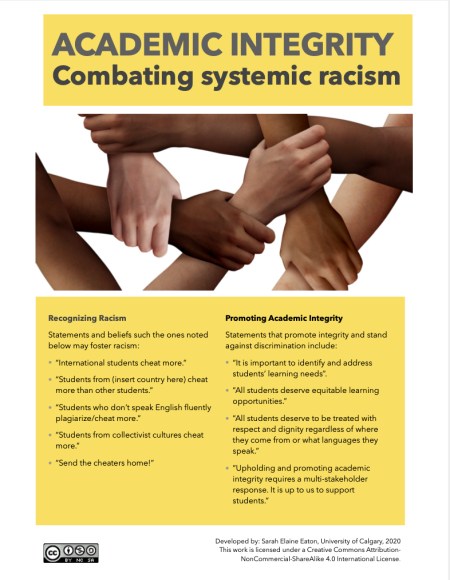
Yesterday the Alberta Council on Academic Integrity (for which I serve as a Steering Committee member) released its formal Statement Against Racism. I was sad, but not suprised that we started getting pushback almost immediately about the statement.  As a result, I have developed this one-page resource to help educate others about how racism is pervasive in discussions about academic misconduct:

Academic Integrity- Combating Systemic Racisim (.jpg)

I am aware that resources do not solve problems. I intend for this resource to be a tool that can help start meaningful conversations about how racism manifests in our beliefs and responses to academic integrity.

Here is a free, downloadable .pdf of this resource. It has a Creative Commons license, so feel free to share it.

Possible uses for this resource:

Poster

  • Discussion tool for staff, educators and administrators
  • Digital resource for sharing
  • Other uses that advocate anti-discrimination and anti-racism in student conduct.

Remember: Academic integrity cannot co-exist with injustice. If discrimination and racism enter into the conversation, we aren’t talking about academic integrity anymore. Academic integrity is based around a set of six fundamental values, as articulated by the International Center for Academic Integrity:

  1. Courage
  2. Fairness
  3. Honesty
  4. Respect
  5. Responsibility
  6. Trust

Inherent in all of this is an underlying respect for persons and human rights. Injustice is antithetical to academic integrity.

I look forward to moving this conversation forward in the coming days, months and years.

Related posts:

_________________________________________

Share or Tweet this: Academic Integrity: Combating Systemic Racism – A Free Resource for Everyone https://wp.me/pNAh3-2uu

This blog has had over 2 million views thanks to readers like you. If you enjoyed this post, please “like” it or share it on social media. Thanks!

Sarah Elaine Eaton, PhD, is a faculty member in the Werklund School of Education, and the Educational Leader in Residence, Academic Integrity, University of Calgary, Canada. Opinions are my own and do not represent those of the University of Calgary.


How to Deal with Contract Cheating: A Collection of Resources

June 1, 2020

Last updated: 20 October 2021

I have been getting a lot more requests lately about how to determine if a student has outsourced their academic work. I am noticing a need for more practical hands-on tools, particularly for educators who work at institutions that do not have an academic integrity office or staff with roles dedicated to academic misconduct investigations.

Resources for educators and administrators

Here are some of my favourite free, open-access resources to help educators and administrators:

  1. Substantiating contract cheating for symbol-dense, logical responses in any discipline, particularly mathematics A guide for investigators (from TEQSA, Australia)  https://www.teqsa.gov.au/sites/default/files/substantiating-contract-cheating-for-symbol-dense-logical-responses.pdf?v=1634700092
  2. Contract cheating detection for markers: checklist (from the UK-based LSEAIN Contract Cheating Working Group) https://rise.articulate.com/share/dPC3F7wAQgeKahu71aUg0vBKfEUg8vsj#/
  3. Bretag, T., & Harper, R. (n.d.). Impossible to prove? Substantiating contract cheating. Retrieved from https://cheatingandassessment.edu.au/wp-content/uploads/2018/07/EDUCATOR-RESOURCE-Substantiating-contract-cheating.pdf
  4. Deakin University: CRADLE. (2018). How to detect contract cheating. Retrieved from https://www.deakin.edu.au/__data/assets/pdf_file/0007/1853881/01-cradle-detect-contract-cheating.pdf
  5. Eaton, S. E. (2020). 15 Strategies to Detect Contract Cheating. Retrieved from http://hdl.handle.net/1880/112660
  6. Eaton, S. E. (2019). U Have Integrity: Educator Resource – How to Lead a Discovery Interview About Contract Cheating. Retrieved from http://hdl.handle.net/1880/111077
  7. Ellis, C. (2015). Know the signs of contract cheating (Fact sheet). Retrieved from http://www.apfei.edu.au/wp-content/uploads/2016/08/Contract-Cheating-Factsheet-UNSW-2015.pdf
  8. Sambell, K., Brown, S., & Race, P. (n.d.). ENhance QUICK GUIDE: Combatting Contract Cheating. Retrieved from https://staff.napier.ac.uk/services/dlte/Documents/14%20Combatting%20Contract%20Cheating.pdf
  9. UC San Diego. (n.d.). Detecting Contract Cheating in Narrative Assessments. Retrieved from https://academicintegrity.ucsd.edu/_files/Detecting%20Contract%20Cheating.pdf
  10. University of California – San Diego. (n.d.). Excellence with Integrity: Combating Contract Cheating. Retrieved from https://humber.ca/staff/sites/default/files/sub-attachments/Combating%20Contract%20Cheating.pdf
  11. University of New South Wales. (n.d.). Have you contact cheated? Retrieved from https://www.arc.unsw.edu.au/uploads/Yellow%20poster_v2.pdf

Resources for Institutions

  1. International Center for Academic Integrity. (2016). Institutional toolkit to combat contract cheating. Retrieved from http://integrity.fiu.edu/pdfs/Contract%20Cheating.pdf

Resources for Quality Assurance Agencies

  1. International Network for Quality Assurance Agencies in Higher Education (INQAAHE). (2020). Toolkit to support quality assurance agencies to address academic integrity and contract cheating. Retrieved from https://www.teqsa.gov.au/latest-news/publications/toolkit-support-quality-assurance-agencies-address-academic-integrity

I hope you find these helpful. It is important to have practical tools to be able to identify if a third party has completed work on the student’s behalf. I will update this post with more tool as I find them, review them and then assess their quality and utility, as I have done with all of the resources included in this post.

Related posts:

_________________________________________

Share or Tweet this: How to Deal with Contract Cheating: A Collection of Resources – https://wp.me/pNAh3-2u5

This blog has had over 2 million views thanks to readers like you. If you enjoyed this post, please “like” it or share it on social media. Thanks!

Sarah Elaine Eaton, PhD, is a faculty member in the Werklund School of Education, and the Educational Leader in Residence, Academic Integrity, University of Calgary, Canada. Opinions are my own and do not represent those of the University of Calgary.


Let’s Talk About the Other Pandemic: Academic Cheating

May 17, 2020

Since the shift to remote emergency teaching and learning as a result of the COVID-19 crisis, there has been story after story in the news about students violating academic integrity.

It’s time we talked about it. Let’s talk about the associate head of school at a New York city upper west side private schools who allegedly tampered with high school admissions tests by (allegedly) providing unsolicited answers to students to help improve their scores.

Let’s talk about how the “unidentified party” who posted fake answers to the Advance Placement (AP) test on Reddit and other social media to lure cheaters taking. It has been reported that the body who administers the test, the US College Admissions board, would not comment on how a “ring of students who were developing plans to cheat” were identified. But someone planted fake answers on social media for students to find. Then that “someone” used those fake answers to identify alleged cheaters.

Let’s talk about the other incidents of individual college professors allegedly posting fake answers to assignments on social media in order to identify students who cheat. Let’s be clear, if this is really happening and it is not some mutated urban myth in which educators are evil masterminds, these would be pretty clear cases of entrapment.

Let’s talk about the professors who allegedly post messages directed to their own students on social media outlining how they’re tracking students’ every move, from their social media posts to their IP addresses during exams. If this is really  happening, then that would be awful. I mean, it would be surveillance to levels that even Orwell didn’t dream up. It might even be considered intimidation, or harassment, or even bullying of students.

Let’s talk about how none of this actually helps students, who are also living through this pandemic along with the rest of us. Let’s talk about how students are reporting they are so stressed out by the conditions under which they are learning and taking exams, that they are throwing up, due to anxiety related to the crisis conditions in which they too, are living. Yes, students. They are trying to complete their academic work in the middle of a global crisis.

I acknowledge there are many caring and dedicated educators who are working hard to support students’ learning, but the increasing number of examples of unethical behaviour among instructors and administrators during the Coronavirus pandemic is not only worrisome, it is downright disturbing. Those educators and administrators who believe that entrapment or other unethical behaviour is “fighting fire with fire” when it comes to academic conduct have forgotten this basic lesson: Two wrongs don’t make it right.

If we are going to ask students to uphold academic integrity, then for the sake of all that is holy, teachers, administrators and learning organizations must lead by example. Educators and administrators who focus on cheating, rather than learning, may not have students’ best interests at heart.

It’s time to start talking about instructional integrity, administrative integrity, and institutional integrity.

A symptom of the academic cheating pandemic is not that students are cheating more, it is that we, those who are responsible for supporting their learning and development, are letting them down. We must keep the focus on helping students to learn. We need to work with our students, not against them.

In the game of “Gotcha!” no one wins.

Related posts:

_________________________________________

Share or Tweet this: Let’s Talk About the Other Pandemic: Academic Cheating – https://wp.me/pNAh3-2t2

This blog has had over 2 million views thanks to readers like you. If you enjoyed this post, please “like” it or share it on social media. Thanks!

Sarah Elaine Eaton, PhD, is a faculty member in the Werklund School of Education, and the Educational Leader in Residence, Academic Integrity, University of Calgary, Canada. Opinions are my own and do not represent those of the University of Calgary.