“Let Them Build It and It Will Be Amazing”

April 8, 2011

In over 20 years in the education sector, I’ve managed and collaborated with others to develop courses and programs in a variety of ways. Each has their merits. Using the wrong approach can be disastrous.

I was recently hired by a major organization to undertake the development of a new program for them. I thought about how to go about doing this and, because I don’t know them very well, I said, “Look, there are 3 ways we can do this. Here are the options:”

Traditional Approach

Tried and true. Teacher-centered. Deliver as much solid content as possible, to as many people as possible, in the shortest amount of time. Mostly one-way (trainer-to-participant) communication.

This approach is the easiest and in some ways, the most fun (at least for the developer). I develop my goals, objectives and outcomes, build content and deliver it. If I’ve done my job right, someone else can step right in and deliver the content. In the professional training and speaking world, this is called “canned content”. You literally open up the package of materials and feed it to the participants. Or to use another analogy, the program developer is the architect, construction company and interior designer. Once you have finished the job, you invite people in.

I can churn out a job like this on a fairly tight timeline. Because of my own tendency towards perfectionism, no one gets invited to see my work before I’m happy with it. And I’ve been doing this a long time, so I know how to produce quality and do it quickly.

Interactive Approach

This approach allows for increased learner interactivity. Feed them content, and keep them engaged. Allows time at regular intervals for discussion and interaction, rather than “saving all the questions until the end”.

The Interactive Approach, although sometimes cloaked as “learner-centered”, it is really still a “teacher-centered” approach, but does allow participants to ask more questions and permits some lively discussion. The teacher or trainer is very much in control of what happens, how it happens and when it happens. And it’s expected that he or she will maintain control throughout the process.

The teacher needs to know how to keep the discussion on track, cut off those who aren’t moving in the appropriate direction or who take up too much time and generally be an authority figure who guides the process, while building in some flexibility. The program developer is the architect, construction company and may invite others to give input on the final touches, but really, what they say doesn’t change much.

Designing a course like this is much like building a traditional course, except that you build in allowances for interactivity. Over the past 10 years, most of the projects I’ve been involved with have involved this type of project. It allows the client to pay lip service to the notion of learner involvement, without any fundamental changes to how they’ve always done things.

Participatory Capacity-Building Approach

Innovative. Edgy. Highly collaborative and creative. Teacher is replaced by a facilitator who is OK relinquishing some control to participants as they drive the learning process forward.

The Participatory Capacity-Building Approach is likely to be somewhat uncomfortable for participants, since they will be challenged to try new ways of doing things (e.g. using new technologies that they’re not entirely comfortable with). Participants are challenged to be co-creators of new knowledge, as they engage in peer-to-peer-teaching-and-learning. Saying it is an “active learning process” is an understatement.

Essentially, you construct a solid frame. Then you give the learners the tools to build around it, adding to the design, rolling up their sleeves and getting in on the design and doing some of the labour. They then add the final touches. The final product is their work (likely with a few mistakes here and there). In the end, they own it… and they know it. It ends up being a place to call home because they’ve made it themselves.

From a course developer’s point of view, it is highly challenging. The frame you build needs to be rock solid. It needs to make sense to the participants. They must agree to participate, or nothing is built. You have know what tools to give them and show them how to use them (safely) in a short period of time. You must give them guidance on how to protect themselves from distractions and overcome obstacles (such as fear, anxiety and perfectionism). You have to let them know that perfection is not the goal – creation is. You have to let them fail (just a little) and allow them to get up and try again. It requires a facilitator who is comfortable being uncomfortable, who inspires creativity and doesn’t cling to control.

I’ve used this approach with my own classes and internal project staff, but less so with external clients. It’s an uncomfortable place for many organizations. I once thought this approach would be great for a certain client, but when I designed a participatory course for them, they freaked. They said, “We don’t want to build capacity! We just want the frickin’ content!”

I learned my lesson. Since then, I’ve always presented the options. Most clients don’t go for the third option… Too radical… Too uncomfortable.  That is, until recently. A new, highly forward-thinking client, has just said, “Our people do good work. Give us the tools and show us how to build it. I don’t know what we’ll create, but I know it’ll be amazing.”

A leader who believes so deeply in the potential of their people is inspiring and exhilarating to work with.

Let them collaborate (Latin for “work together”).

Let them create something new.

Provide opportunities for them to build their capacity.

Watch them build something amazing.

___________

Share this post: “Let Them Build It and It Will Be Amazing” http://wp.me/pNAh3-BM

Update – January 2018 – This blog has had over 1.8 million views thanks to readers like you. If you enjoyed this post, please “like” it or share it on social media. Thanks!

Sarah Elaine Eaton is a faculty member in the Werklund School of Education, University of Calgary, Canada.


Lifelong Language Learning: Benefits for 21st Century Global Citizens

April 1, 2011

University of CalgaryApril 2 – 9, 2001 is International Adult Learners’ Week. The Language Research Centre, in conjunction with Alberta Advanced Education and Technology and UNESCO, is hosting a panel discussion on the importance of lifelong language learning, mutilingualism and multiculturalism.

This panel brings together thought leaders from a variety of organizations in Calgary who are experts on language learning, multilingualism and multiculturalism. They will share their views on the importance of language learning in the 21st century and its relevance to us as Calgarians, Canadians and global citizens.

Expert panelists include:

  • Mr. Wayne Cao, MLA Calgary Fort (to be confirmed)
  • Dr. Mary O’Brien, Director, Language Research Centre
  • Dr. Rahat Naqvi, Associate Director, Language Research Centre
  • Dr. Jürgen Meisel, Distinguished Fellow, Language Research Centre
  • Mr. Michael Gretton, Southern Alberta Heritages Language Association (SAHLA)
  • Ms. Shaheen Murji, Mount Royal University, International Education and Past President, Alberta Teachers of English as a Second Language

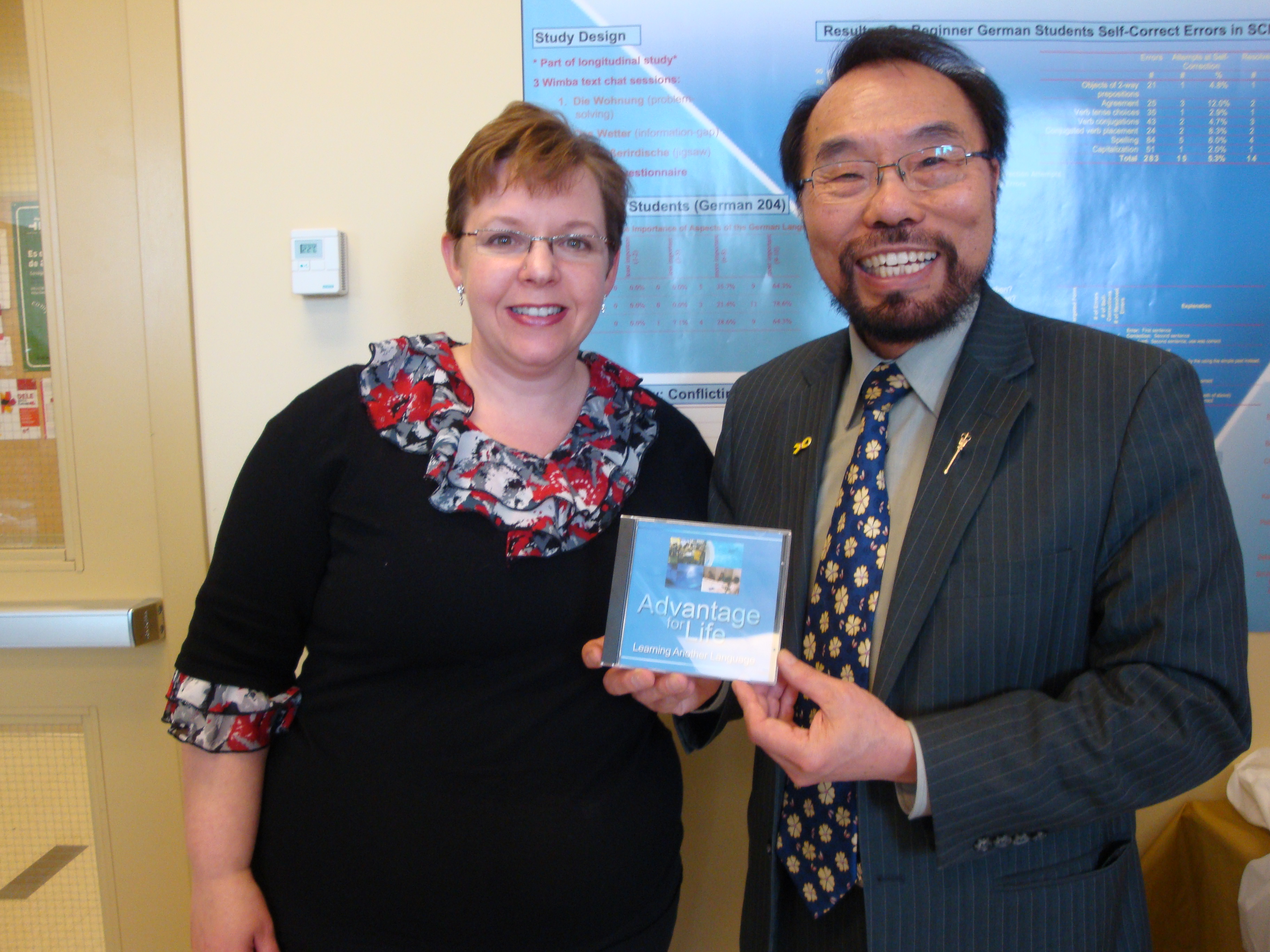
    Wayne Cao, MLA, Calgary Fort and Dr. Sarah Eaton

    Mr. Wayne Cao, MLA, Calgary Fort with me, holding the “Advantage for Life” CD produced by the Language Research Centre. This photo was taken at the IALW event.

Student Discussant: Ms. Jacqueline Warrell, PhD Candidate, Graduate Division of Educational Research

Event host: Dr. Sarah Eaton, Research Associate, Language Research Centre

The Institute for Innovation in Second Language Education (IISLE) will join us via videoconference from Edmonton.

For more information, visit these websites:

Alberta Advanced Education and Technology (AAET)
Language Research Centre

View this document on Scribd

_________________

Share this post: Lifelong Language Learning: Benefits for 21st Century Global Citizens http://wp.me/pNAh3-Bv

Update – January 2018 – This blog has had over 1.8 million views thanks to readers like you. If you enjoyed this post, please “like” it or share it on social media. Thanks!

Sarah Elaine Eaton is a faculty member in the Werklund School of Education, University of Calgary, Canada.


Breathtaking Impact of Volunteers’ Contribution to Non-formal and Informal Literacy Education in Alberta

March 28, 2011

At the National Metropolis 2011 conference this year in Vancouver, I was part of a panel of experts presenting on Family Literacy and the New Canadian. My paper focused on the research I’ve done on Formal, Non-Formal and Informal Learning: The Case of Literacy, Essential Skills and Language Learning in Canada. I’ll post the entire paper shortly, but for now, I wanted to highlight one bit from it that generated some significant discussion.

My point was that when informal and non-formal learning for literacy and language learning are tracked and recorded, we can better see the impact. The example I gave was that in 2009, Alberta Advanced Education and Training, produced Living Literacy: A Literacy Framework for Alberta’s Next Generation Economy. The 19-page report talks about why literacy matters and outlines priority actions for 2009-2013.

Buried on page 12 of the 19-page report is a gem of information that deserves to be highlighted and explored, which is what I did at my presentation in Vancouver. It states that in Alberta,

“In 2008, 2,000 adults were matched with a volunteer tutor who assisted them with basic reading, writing and/or math. On average, these learners received 39 hours of tutoring. “

So what does this mean?

It means that volunteers collectively spent 78,000 hours assisting adults with literacy in non-formal and informal learning contexts.

78,000 hours. In one year. In one province.

Let’s put this into perspective.

According to the Government of Alberta, the average student will receive 950 to 1000 hours of instruction per year. Let’s look at that number of 1000 hours for a minute.

A student in school gets 1000 hours per year of instruction.

That means, collectively in Alberta, volunteers contributed the equivalent of 78 years of school, in the form of non-formal and informal education, helping other adults to improve their literacy skills.

That’s over three-quarters of a century in the equivalent of school years.

Doesn’t that just take your breath away?

Often when people think of adult non-formal and informal education, they think of developing countries, where formal education is harder to access than in developed nations. But the impact of non-formal and informal education in nations like Canada is significant. The problem is that we don’t track it. At least, not very often. And not very systematically.

What would we discover if every Canadian province, every US state and every developed country tracked the contributions made to language learning and literacy in the way that the Alberta government did in 2008? We’d be blown away by the results.

There’s a big push in the non-profit and education world to capture learner stories. I completely agree with that. But it’s not the whole picture. There’s a saying in evaluation: No numbers without stories; no stories without numbers.

The equivalent of 78 years of schooling, contributed completely by volunteers in one year alone is staggering.

One call to action in my presentation in Vancouver is that we must make a concerted effort to track the number of hours contributed by our volunteers – particularly those working in rural and remote areas – in order to understand the impact of volunteer literacy tutoring programs.

Stay tuned for the whole paper. It’ll be posted on line in a few days.

Related posts:

Formal, non-formal and informal learning: The case of literacy and language learning in Canada

Formal, non-formal and informal education: What Are the Differences?

Formal, Non-formal and Informal Learning: A podcast

Formal, Non-formal and Informal Learning (Infographic) https://wp.me/pNAh3-266

_____________

Share this post: Breathtaking Impact of Volunteers’ Contribution to Non-formal and Informal Literacy Education in Alberta http://wp.me/pNAh3-AK

Update – January 2018 – This blog has had over 1.8 million views thanks to readers like you. If you enjoyed this post, please “like” it or share it on social media. Thanks!

Sarah Elaine Eaton is a faculty member in the Werklund School of Education, University of Calgary, Canada.


5 Tips to Keep Up with Technology

March 20, 2011

Although my formal education isn’t in ed tech, I’ve been involved with projects involving both synchronous and asynchronous technology since the turn of the millennium. I’ve come to love technology, but it wasn’t always that way. Even now, I find myself overwhelmed at times with the number of resources that seem to grow by the second. There are amazing, free resources available for teachers. How do you sort through them all? Make sense of them all? Figure out what to use? Here are some tips I’ve found helpful:

File for Later

When something comes into my e-mail box that looks interesting, but I just don’t have time to tend to it right away, I put it in a file in my e-mail called “Cool stuff to explore”.

Quick Scan of New Resources

I go to my e-mail file of “Cool Stuff to Explore” when I have 5 or 10 minute chunks. I’ve found that you can usually decide pretty quickly if a resource is worth more in-depth exploration later. I will often go through the sites in my e-mail folder when I’m on hold on the phone, when I’m waiting for a webinar to start or I have a few minutes when I can’t do work that requires me to concentrate deeply for a long period of time.

Use Online Bookmarks

I use Diigo to archive the resources I think are worth paying more attention to. I add tags to help me remember what topics the site refers to. Then I organize the pages into topics or lists. When I come across a web page that I think is good quality, I add it to my online bookmarks. I love, love, love using online bookmarks to help me organize resources I want to share or explore later. There’s even a “read later” option that allows you to bookmark something you want to spend more time on later.

In-depth Assessment

If a resource or new technology looks interesting, spend some time assessing it. Ask yourself:

  • Can I use this in my own teaching practice?
  • Is this technology permitted or authorized by my school division or institution? (No matter how cool or useful a tool is, if your jurisdiction doesn’t allow it, then it may not be worth spending significant time learning it.)
  • Would it be easy for my students to use?
  • What is the cost, if any?
  • Is it safe, secure and appropriate for my students?

Share, Collaborate and Have Conversations – Online and Offline

When you find something wonderful, share it. Ask others if they know about it – ask around at work, ask on Twitter, ask in online professional groups. Get tips on how to use it. Find out what others are doing.

Play Favorites – Really, it’s OK!

It’s easy to get overwhelmed quickly. There are too many wonderful resources out there to become an expert at them all. Pick a few that appeal to you and that are truly useful and relevant to your teaching practice. Learn those ones and leave the others in categories of “Might Explore Later” or  “Cool, but not really relevant to me right now”. Even people who are full-time technology teachers can’t possibly know every single technology that is available. When you choose a few favorites, you’ll get excited about them. Your students will sense your enthusiasm and they’ll be motivated by it.

Give Yourself Permission to Play, Explore and When you Need to, Step Back

One of the biggest barriers to learning new technology is anxiety. Remember that you don’t have to be perfect and know everything. Allow your curiosity to lead you and take a playful approach. If you get overwhelmed, take a break and step back. Come back to it later.

By taking a break when you find yourself getting frustrated or overwhelmed, you’ll be able to avoid burnout and return to it later with fresh eyes and renewed energy. Give yourself permission to set boundaries that will ultimately empower you to do your best in the long run.

_____________________

Share this post: 5 Tips to Keep Up with Technology https://wp.me/pNAh3-Au

Update – January 2018 – This blog has had over 1.8 million views thanks to readers like you. If you enjoyed this post, please “like” it or share it on social media. Thanks!

Sarah Elaine Eaton is a faculty member in the Werklund School of Education, University of Calgary, Canada.


Notos Journal: Call for Submissions

March 17, 2011

Do you have research, expertise or classroom best practices on language learning and intercultural education to share? Does your work have a focus on Alberta? If yes, listen up!

Recently I was invited to take on the position of Guest Editor for Notos, the official journal of the Second Languages and Intercultural Council (SLIC) of the Alberta Teachers’ Association (ATA).

Notos is a peer reviewed scholarly journal that links the academy with the classroom. The contents include an eclectic range of conventional articles, reviews and creative writing.

The Journal invites manuscripts for its upcoming issue. Of particular interest are submissions that:

  • highlight the issues of culture and second languages in Alberta;
  • enhance the knowledge, skills and understanding of teachers in the areas of second languages and culture;
  • discuss existing practices, programs and resources;
  • showcase research being done in Alberta on second languages, language pedagogy, innovation in second languages and intercultural education; and
  • offer advice and expertise to both in-service and pre-service language teachers in the province of Alberta.

Submissions should be between 2500 and 10,000 words. In keeping with the mandate of the Council, articles appear in several languages (preferrably those languages taught in Alberta schools). All submissions are reviewed by the Editorial board, who reserve the right to select those submissions they feel are the most appropriate for the journal.

Deadline for Winter 2011 submissions is April 15, 2011.

Direct queries and manuscripts to:
Sarah Elaine Eaton, PhD, Guest Editor, Notos
University of Calgary, Language Research Centre
seaton (at) ucalgary.ca

Please help me share this call for submissions with language professionals all over Alberta. Forward this post, tweet it or download a .pdf copy of the call for submissions from Scribd and share it around!

Thanks!

View this document on Scribd

_______________
Share this post: Notos Journal: Call for Submissions http://wp.me/pNAh3-Am